Articulate Storyline Interactive · Branching · SCORM/xAPI

01
Ethics & Compliance in Financial Services

An interactive Storyline course for financial services learners built with a cautionary yellow theme, featuring icon-triggered popups, icon-driven navigation, and visited button states covering confidentiality and data privacy, regulatory reporting standards, and conflicts of interest. High-contrast text and background pairings throughout follow universal design principles, keeping content legible for everyone, especially low-vision learners.

ComplianceRegulatoryFinancial ServicesIcon-Triggered PopupsInteractive Design
Ethics and Compliance in Financial Services course start page with a split-screen layout, dark grey left panel showing the course title, gold Start Course button, and a teal top bar reading Company Logo Placeholder, right panel featuring a professional woman in a matching yellow blazer and trouser suit standing in a bright office by large windows, gold geometric corner accents, and a teal bottom bar reading Confidentiality Note PlaceholderStart Page — course title, Start Course button, and professional imagery
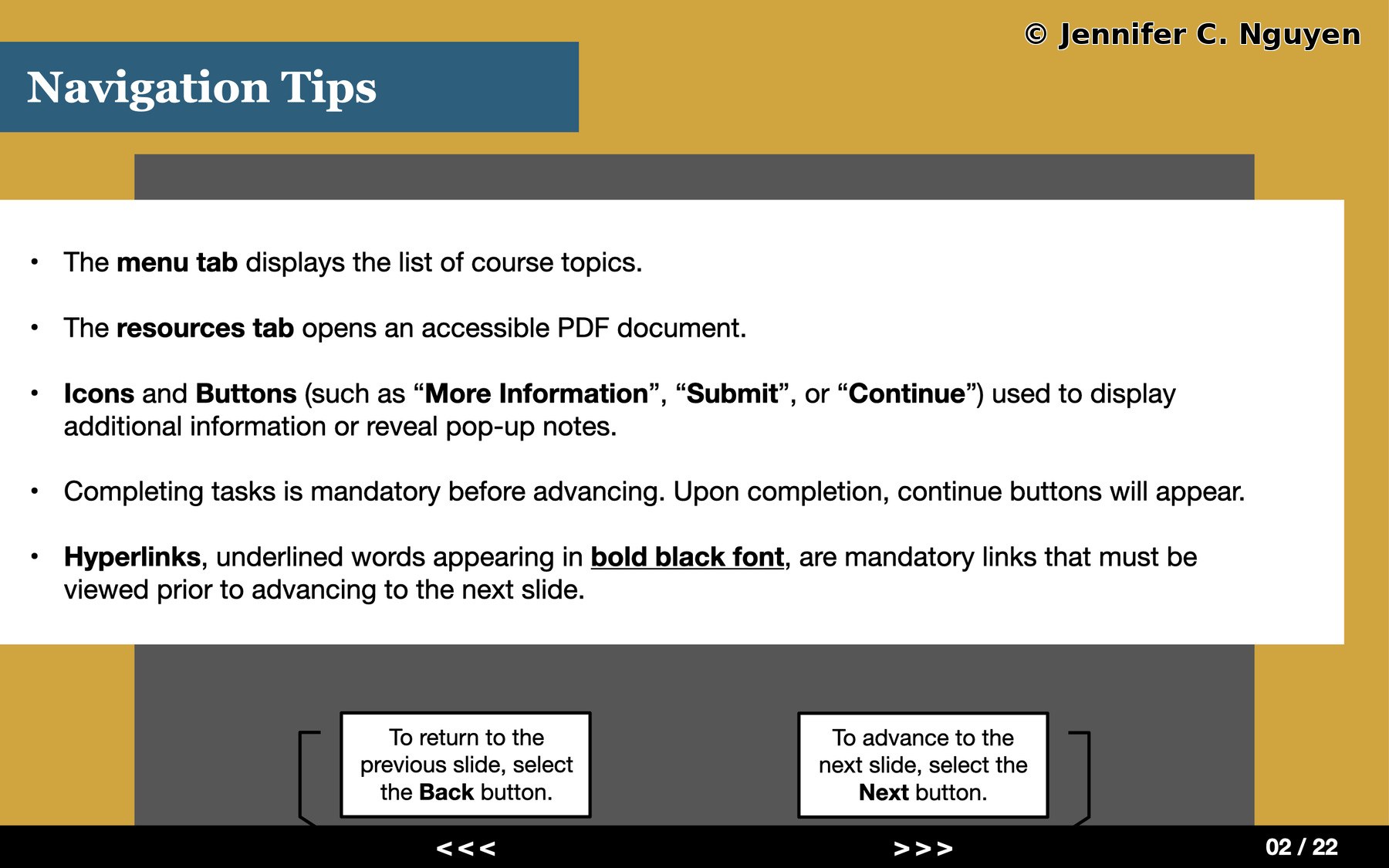
Navigation Tips slide with a gold background, teal header bar, and white content panel listing five navigation instructions covering the menu tab, resources tab, icons and buttons, mandatory task completion, and hyperlinks, two bracketed callout boxes explaining the Back and Next buttons, black footer bar with back and next arrows and a slide counter reading 02 of 22Navigation Tips — learner guide for icons, buttons, tabs, and hyperlinks
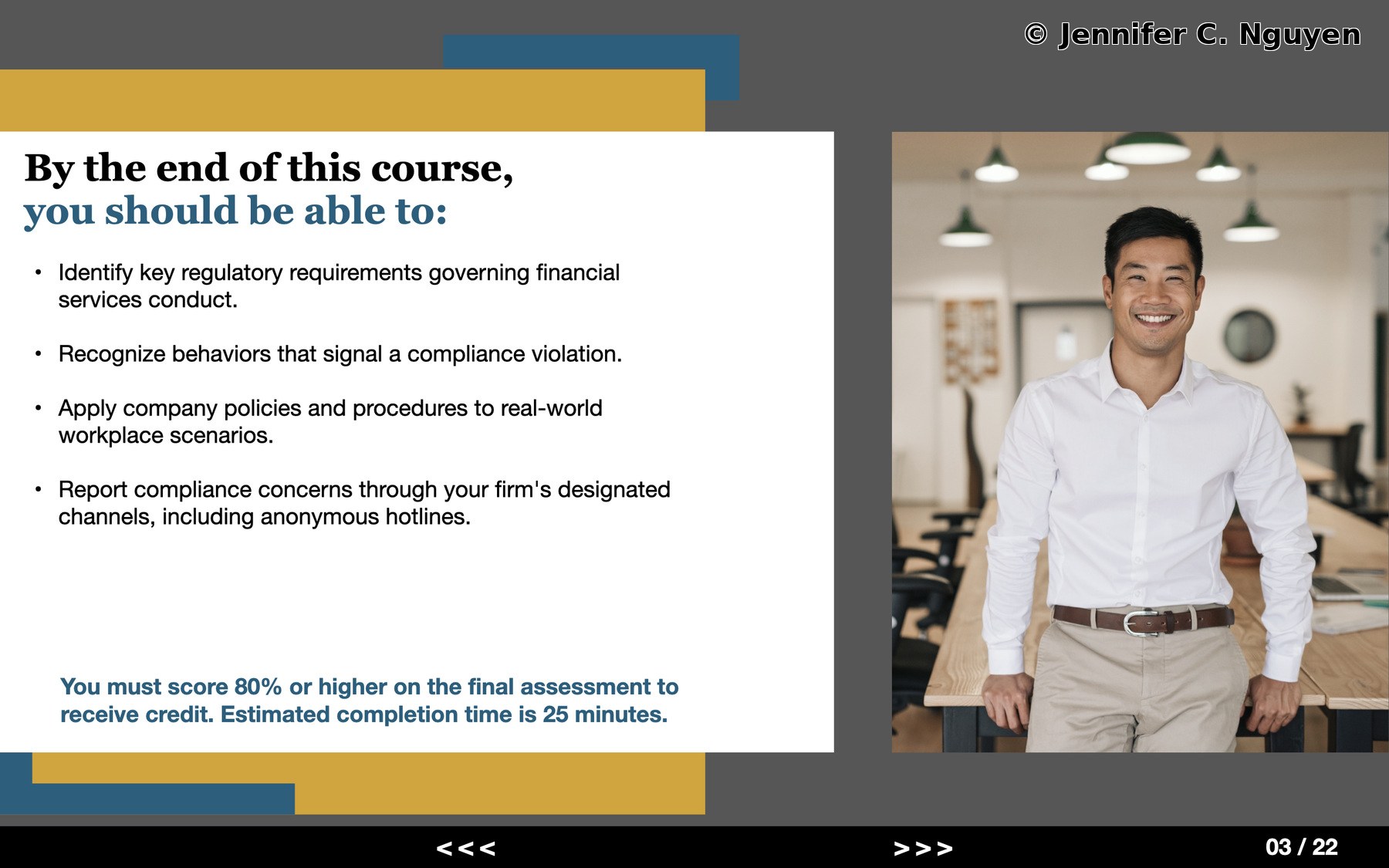
Course objectives slide with a grey background, layered gold and teal geometric accents, white content panel on the left with a two-tone bold title, four learning objectives, and a bold teal note stating an 80 percent passing score and 25 minute estimated completion time, photograph of a smiling man in a white shirt in an office on the right, black footer bar with a slide counter reading 03 of 22Course Objectives — four learning objectives for regulatory compliance
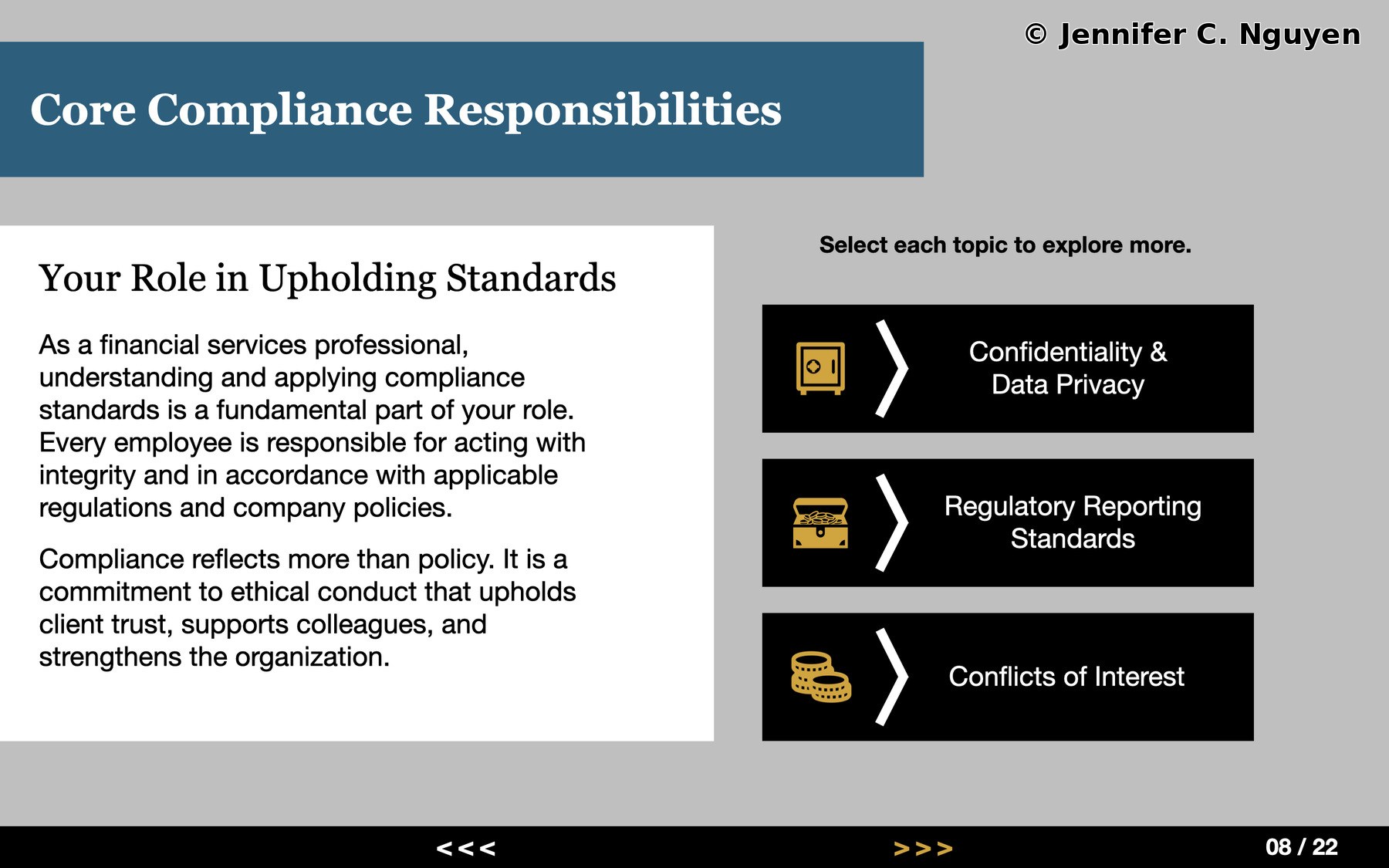
Interactivity slide with a light grey background and teal header bar reading Core Compliance Responsibilities, white left panel with a subtitle and two paragraphs of body text, instruction reading Select each topic to explore more, three clickable black bars on the right with gold icons and white chevrons for Confidentiality and Data Privacy, Regulatory Reporting Standards, and Conflicts of Interest, black footer bar with a gold hover-state next arrow and a slide counter reading 08 of 22Core Compliance Responsibilities — interactive topic selection with three clickable buttons
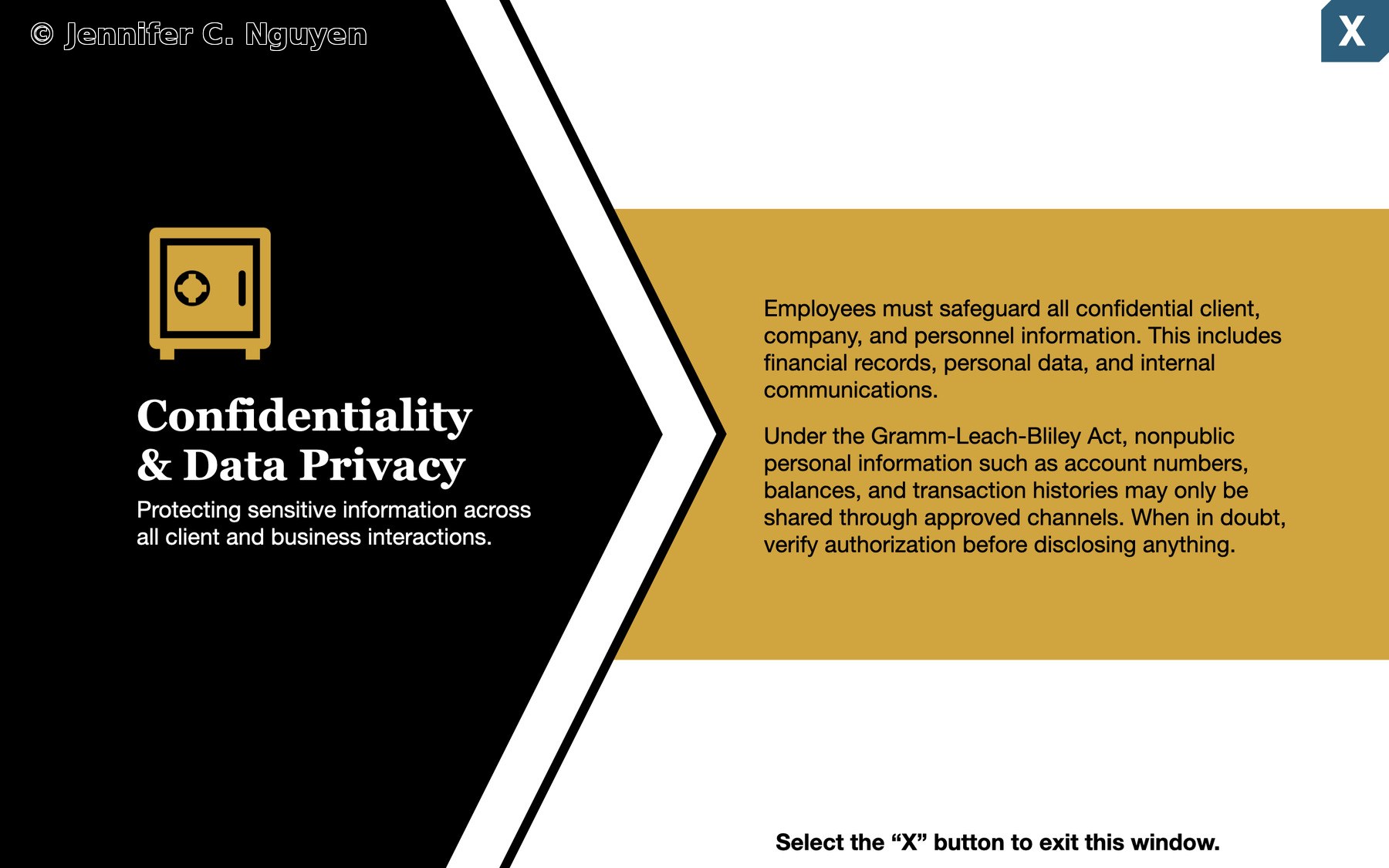
Branching reveal slide for the Confidentiality and Data Privacy topic, black left panel with a gold safe icon, bold white title, and subtitle description, diagonal white arrow divider leading to a gold content panel on the right with two paragraphs citing the Gramm-Leach-Bliley Act and nonpublic personal information handling, teal X close button in the top right corner, bold black instruction at the bottom reading Select the X button to exit this windowConfidentiality and Data Privacy — branching reveal with content panel
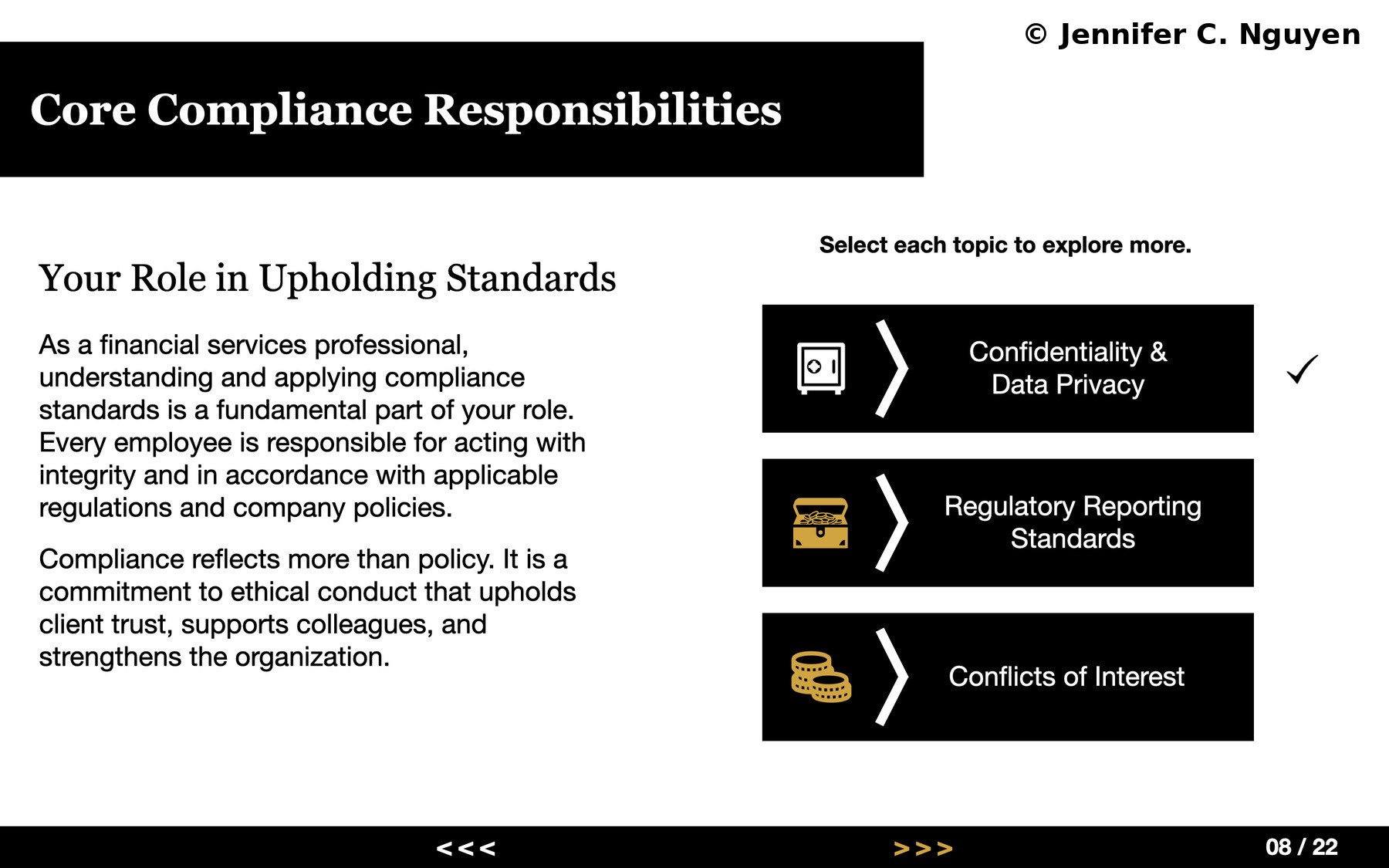
After-branching slide with a black header bar reading Core Compliance Responsibilities on a white background, left content panel with two paragraphs, three black bars on the right where the first Confidentiality and Data Privacy bar shows a black checkmark in its visited state while Regulatory Reporting Standards and Conflicts of Interest remain unvisited, black footer bar with a gold hover-state next arrow and a slide counter reading 08 of 22After Branching — checkmark and visited state shown after completing Confidentiality and Data Privacy
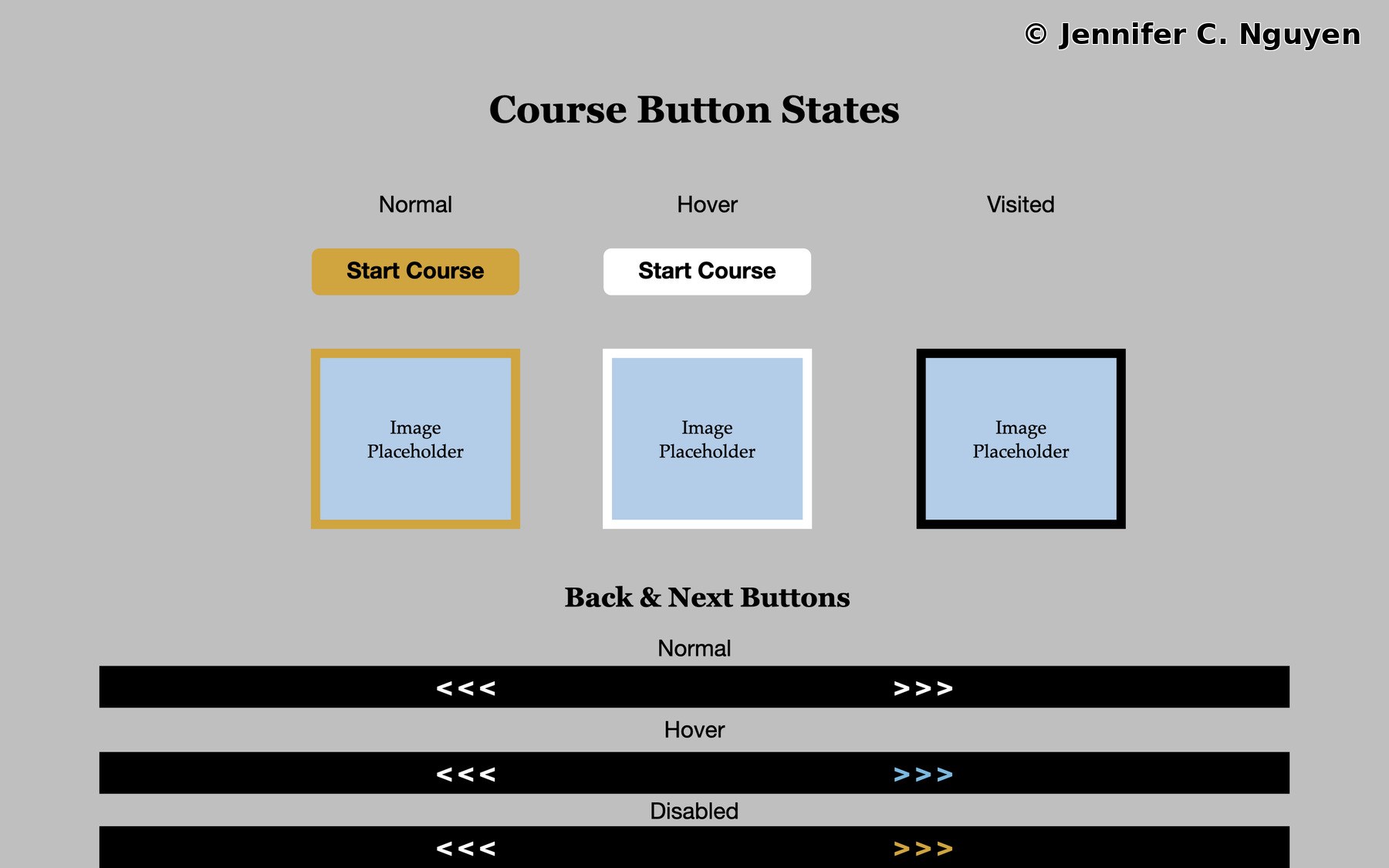
Course button states design reference on grey background showing Start Course button in normal gold and hover white states, image placeholder buttons with gold normal border, white hover border, and black visited border showing Normal Hover and Visited states, plus back and next navigation buttons in normal, hover with teal arrows, and disabled with gold arrows statesCourse Button States — Normal, Hover, and Visited states for Start and navigation buttons
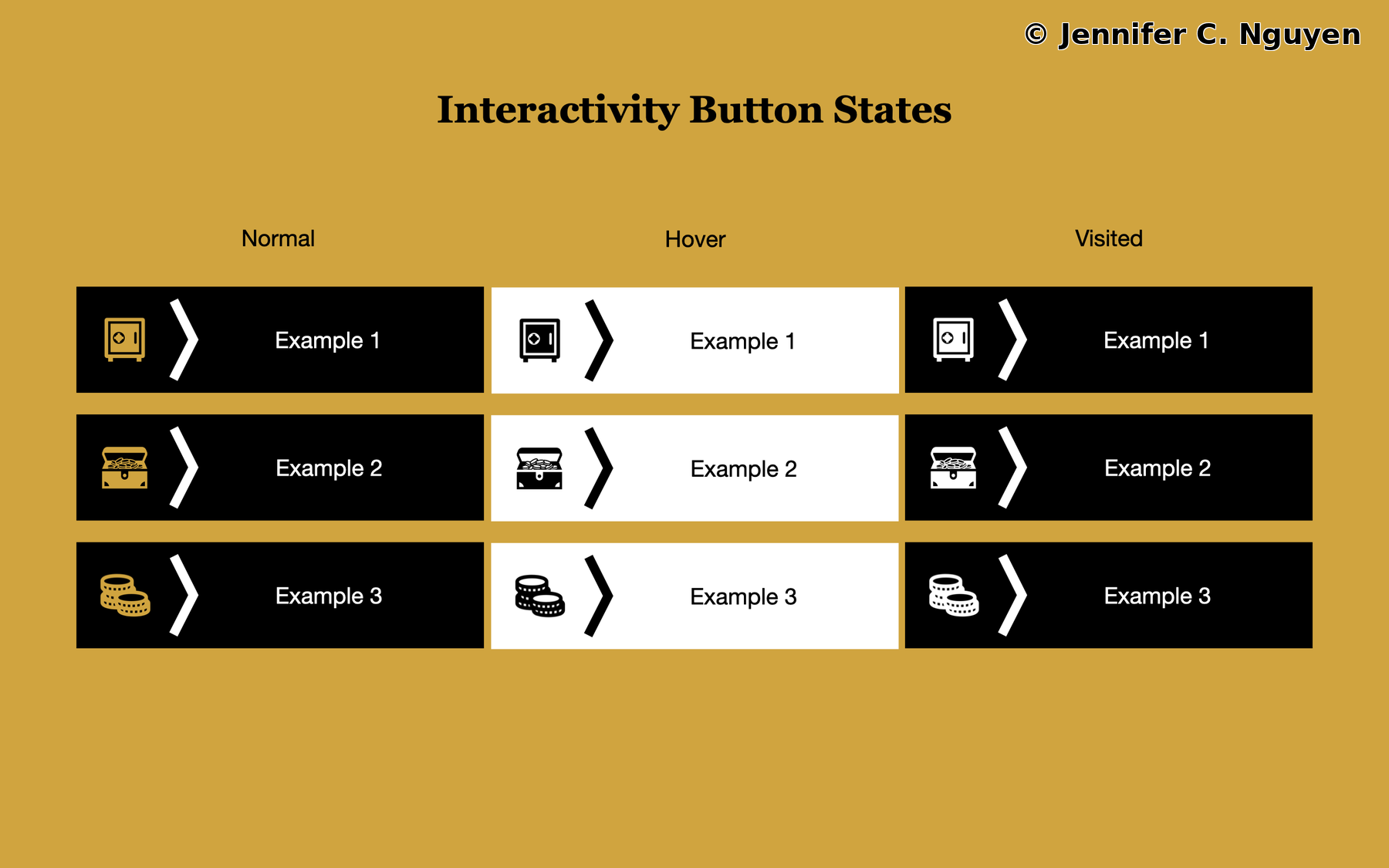
Interactivity Button States design reference on a gold background showing three example rows in Normal, Hover, and Visited states, Normal and Visited both use a black background but the icon shifts from gold in Normal to white in Visited, Hover uses a white background with black icons and text, safe, treasure chest, and coins icons paired with chevron arrows and example labels throughoutInteractivity Button States — Normal, Hover, and Visited states for icon navigation buttons

02
Medicare Parts C and D General Compliance Training
This fully redesigned Storyline course for healthcare compliance learners was built from the ground up using a minimalist teal theme to convey calm and trustworthiness. Disorganized source material was restructured into a visually intentional learning experience featuring a creative compass navigation design, icon-driven interactivity, real photography, and scenario-based knowledge checks.

MedicareHealthcare ComplianceCMSScenario-BasedRedesign
Medicare Parts C and D General Compliance Training start page with a split-screen layout, left panel showing a stethoscope and keyboard with a teal overlay, right panel with a left-aligned course title in black serif font, teal General Compliance Training subtitle, short teal accent bar above the title, teal Start button in the bottom right corner, Company Logo Placeholder text in the top right corner, and Confidentiality Placeholder text at the bottomStart Page — Medicare Parts C and D General Compliance Training
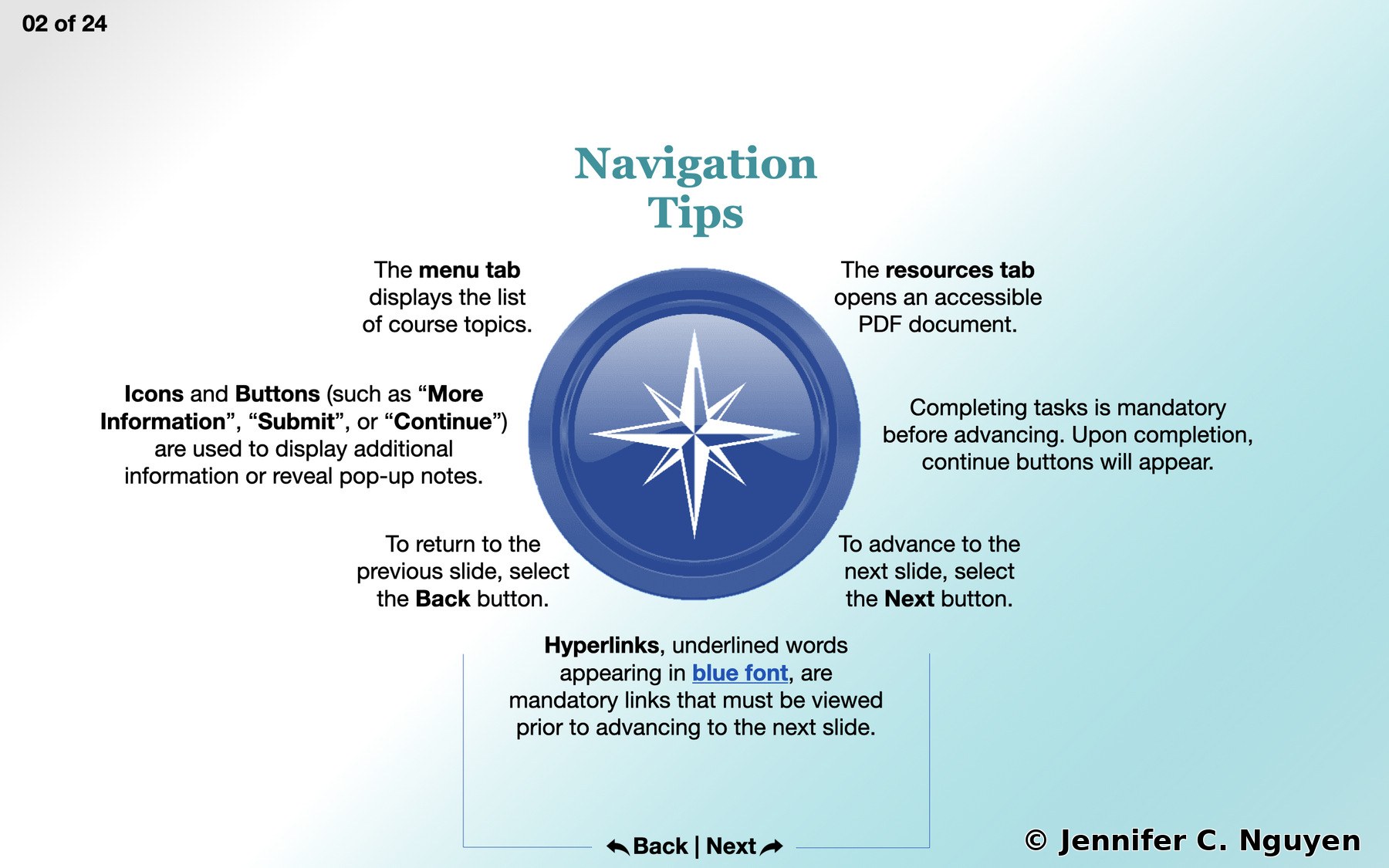
Navigation tips slide with a teal to white gradient background and a slide counter reading 02 of 24 in the top left, featuring a blue compass rose graphic in the center, navigation instructions arranged radially around it covering the menu tab, resources tab, icons and buttons, mandatory task completion, the Back and Next buttons, and hyperlinks shown in blue fontNavigation Tips — radial compass design with six navigation instructions
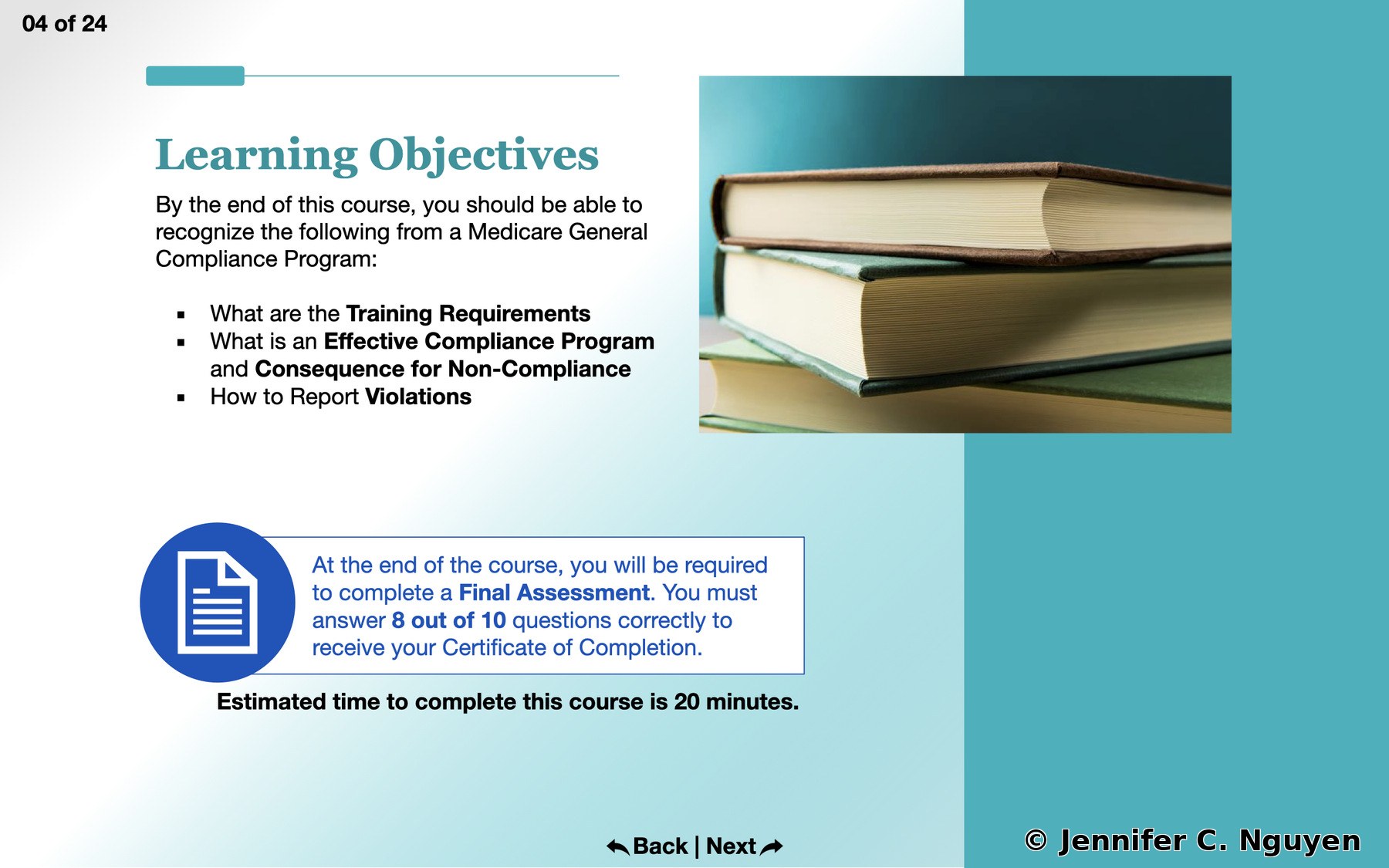
Learning objectives slide with a teal gradient background and a slide counter reading 04 of 24 in the top left, white left content panel with a teal Learning Objectives title and three bold bullet points covering training requirements, effective compliance program and consequences, and how to report violations, right panel showing a stacked books photo, blue document icon callout noting the final assessment requires 8 out of 10 correct answers, and an estimated 20 minute completion timeLearning Objectives — three objectives with final assessment and completion time callout
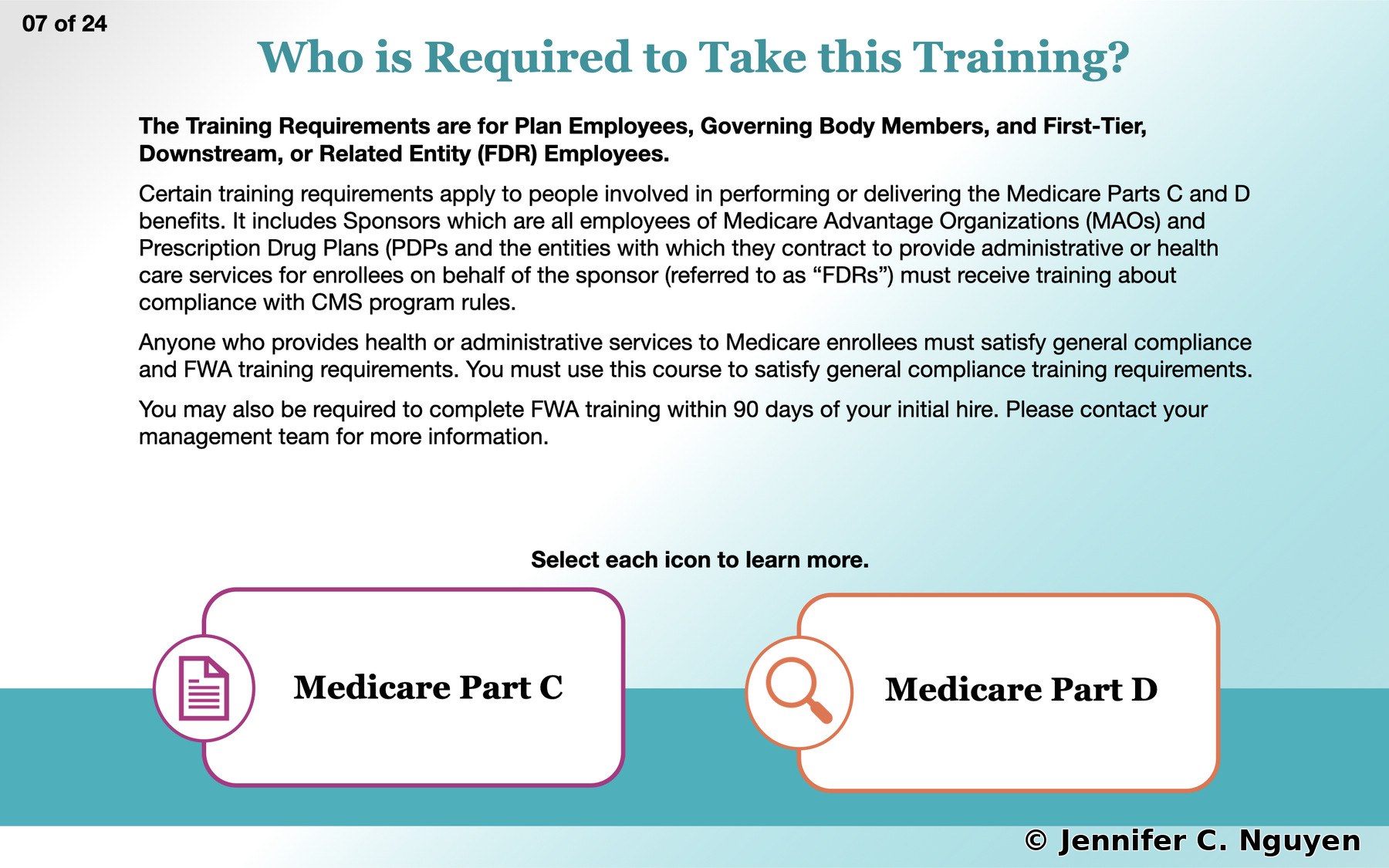
Who is Required to Take this Training slide with a teal gradient background and a slide counter reading 07 of 24 in the top left, large teal heading, bold subtitle listing Plan Employees, Governing Body Members, and FDR Employees, three left-aligned paragraphs covering Medicare Parts C and D training requirements including FWA training within 90 days, straight-edged teal band at the bottom with two rounded clickable cards overlapping its top edge, one for Medicare Part C with a pink document icon and one for Medicare Part D with an orange magnifying glass iconWho is Required to Take this Training — Medicare Parts C and D interactive topic buttons

Medicare Part D branching reveal popup with a teal top panel featuring a photo of an older woman reviewing documents at a desk, light salmon bottom panel with an orange magnifying glass icon card showing the Medicare Part D title and a description of the Prescription Drug Benefit covering enrollment in PDP or MA-PD plans, bold instruction at the bottom reading Select the X button to exit this window, teal X close button in the top right cornerMedicare Part D — branching reveal with photo and prescription drug benefit description
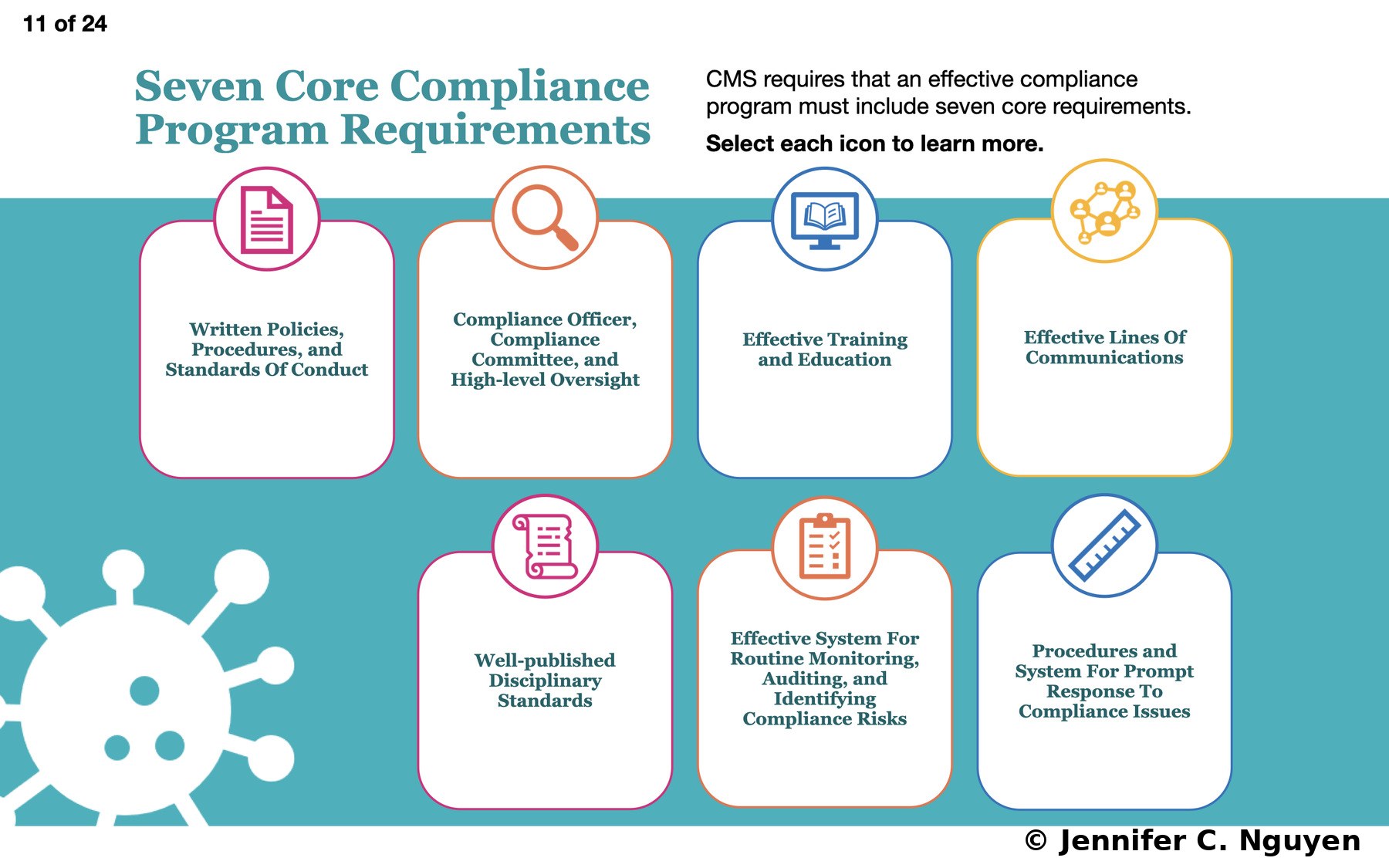
Seven Core Compliance Program Requirements slide with a teal background and a slide counter reading 11 of 24 in the top left, large teal serif title on the white upper section, right side text noting CMS requires seven core requirements with a Select each icon to learn more instruction, seven rounded rectangle icon cards arranged in two rows with colorful icons for Written Policies, Compliance Officer, Effective Training, Effective Lines of Communications, Well-published Disciplinary Standards, Effective System for Monitoring, and Procedures for Prompt Response, white molecular graphic accent in the bottom leftSeven Core Compliance Requirements — seven interactive icon cards covering CMS program requirements

Effective Lines of Communication branching reveal popup with a teal top panel featuring a photo of four diverse professionals in discussion in a glass-walled meeting room, light yellow bottom panel with a gold network icon card showing the Effective Lines of Communication title and body text about accessible confidential anonymous reporting, bold instruction at the bottom reading Select the X button to exit this window, teal X close button in the top right cornerEffective Lines of Communication — branching reveal with team photo and anonymous reporting
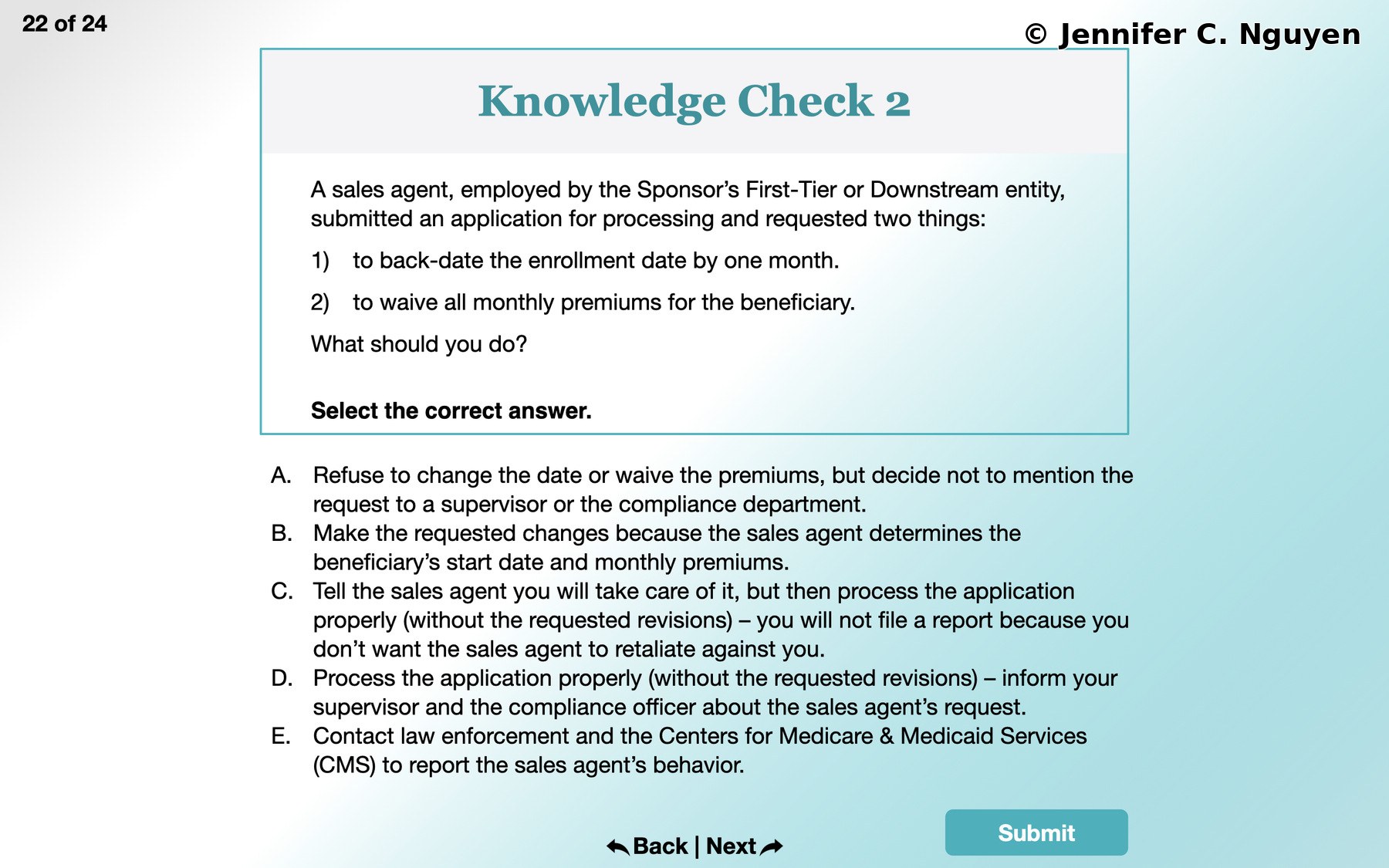
Knowledge Check 2 quiz slide with a slide counter reading 22 of 24 in the top left, white background with a thin teal border box containing a scenario question about a sales agent requesting to back-date an enrollment and waive premiums, bold instruction reading Select the correct answer, five multiple choice options A through E below covering different possible responses to the request, Back and Next text with arrows in the bottom left, teal Submit button in the bottom right cornerKnowledge Check 2 — scenario-based multiple choice question on compliance reporting
03
Privacy & Data Protection in Wealth Management

Aimed at wealth management advisors, this course pairs a green money motif with image-driven interactivity, branching popups, and numbered scenarios covering unauthorized data sharing, phishing, insider risks, and improper data disposal. The green palette doubles as a memorable, intuitive cue, tying the visual theme directly to the money at stake.

Wealth ManagementData PrivacyBranching PopupsImage-Driven InteractivityNumbered Scenarios
Privacy and Data Protection in Wealth Management course start page with a dark green background featuring concentric circles framing a circular photo of a glass office building with a BANK sign visible on its facade, right panel split with architectural glass building photography in the top right and bottom right corners, white Company Logo Placeholder bar, white arrow-shaped Start button, and a green Confidentiality Placeholder bar at the bottomStart Page — Privacy and Data Protection in Wealth Management
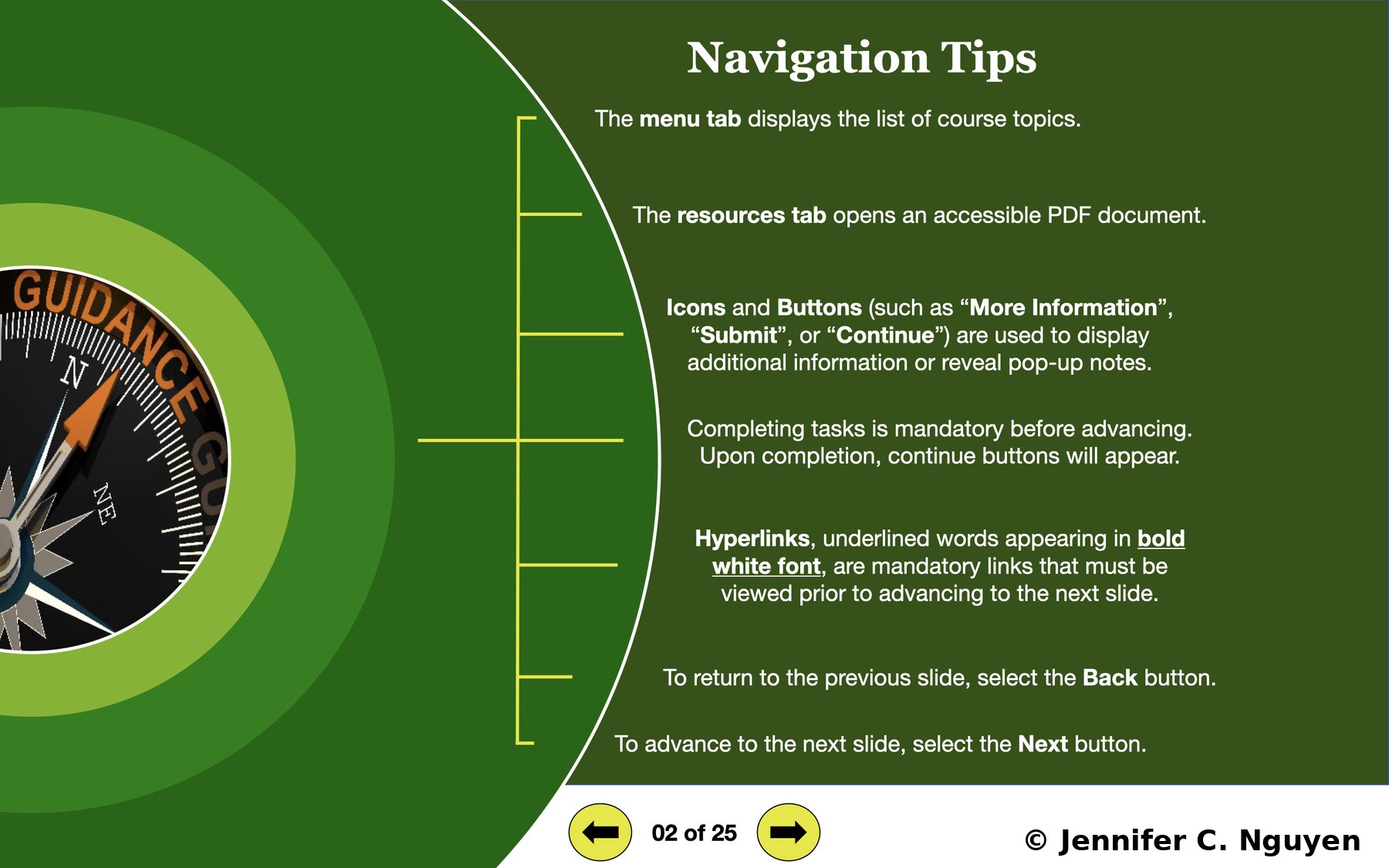
Navigation tips slide with a dark green background and a guidance compass graphic on the left inside concentric green circles, seven navigation instructions listed vertically on the right separated by yellow tick marks, covering the menu tab, resources tab, icons and buttons, mandatory task completion, hyperlinks in bold white font, and the Back and Next buttons, white footer with yellow circular Back and Next arrow buttons and a slide counter reading 02 of 25Navigation Tips — guidance compass design with seven vertical navigation instructions
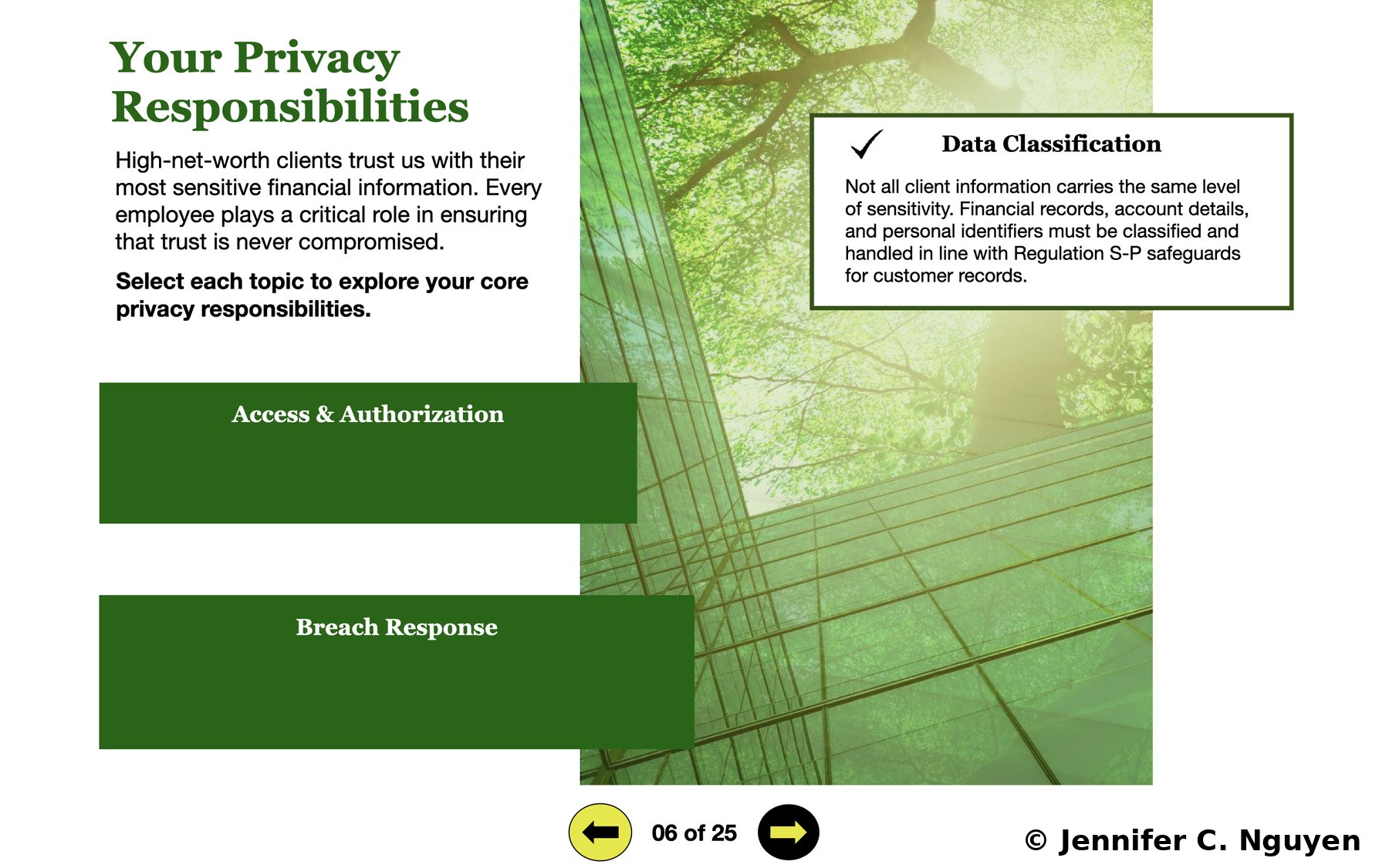
Your Privacy Responsibilities slide with a slide counter reading 06 of 25 in the bottom left, white left panel showing the title, two paragraphs of body text, and a Select each topic instruction, right panel showing a glass building with a green tree canopy overlay, a white bordered Data Classification box with a checkmark showing its visited state and content citing Regulation S-P safeguards for customer records, two dark green clickable topic bars below for Access and Authorization and Breach ResponseYour Privacy Responsibilities — three interactive topic bars with Data Classification visited state shown
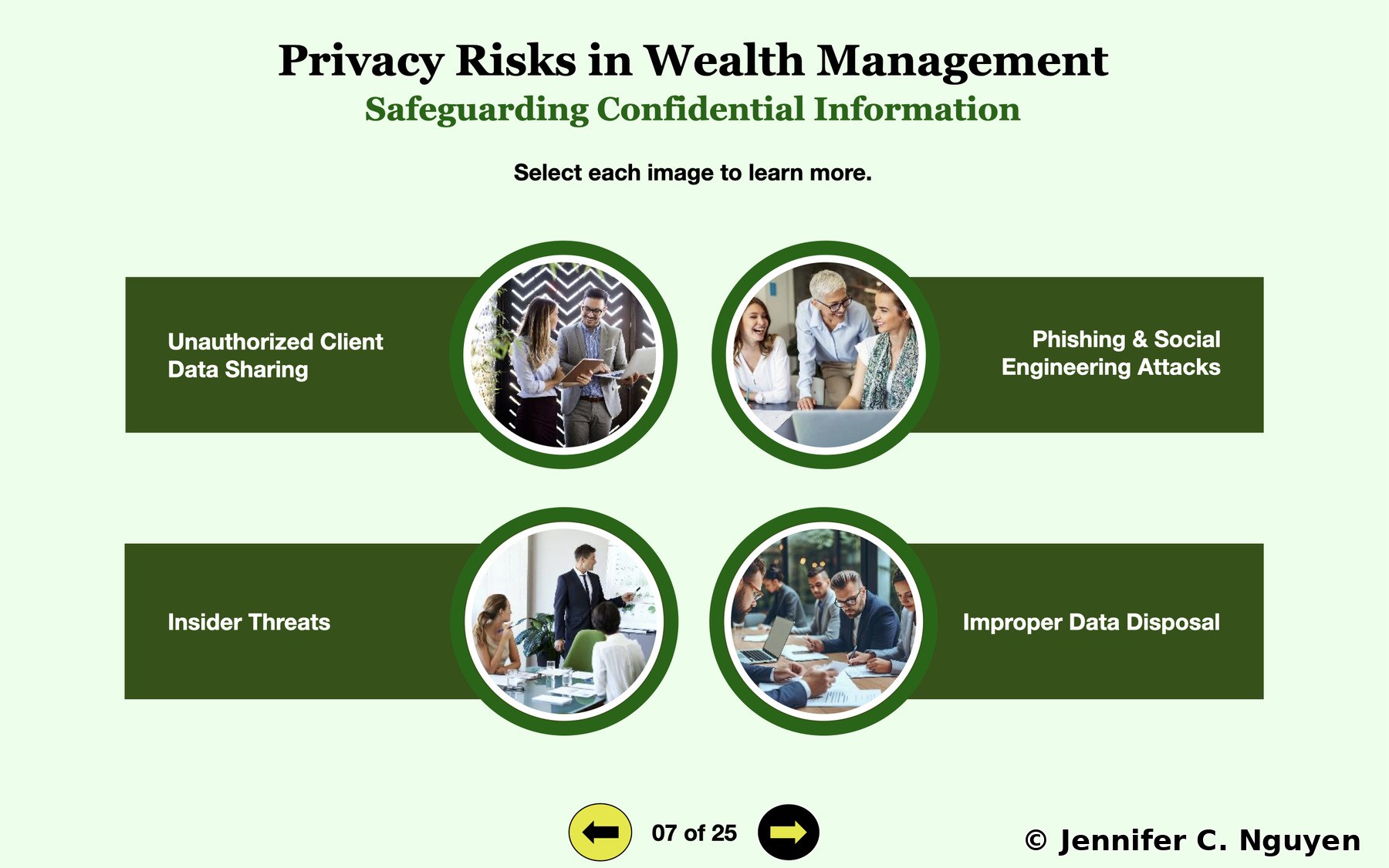
Privacy Risks in Wealth Management slide with a mint green background and a slide counter reading 07 of 25 in the bottom left, bold black title with a dark green subtitle reading Safeguarding Confidential Information, instruction reading Select each image to learn more, four dark green horizontal bars each with a circular professional photo and topic label for Unauthorized Client Data Sharing, Phishing and Social Engineering Attacks, Insider Threats, and Improper Data DisposalPrivacy Risks in Wealth Management — four interactive image bars covering key data privacy risk topics
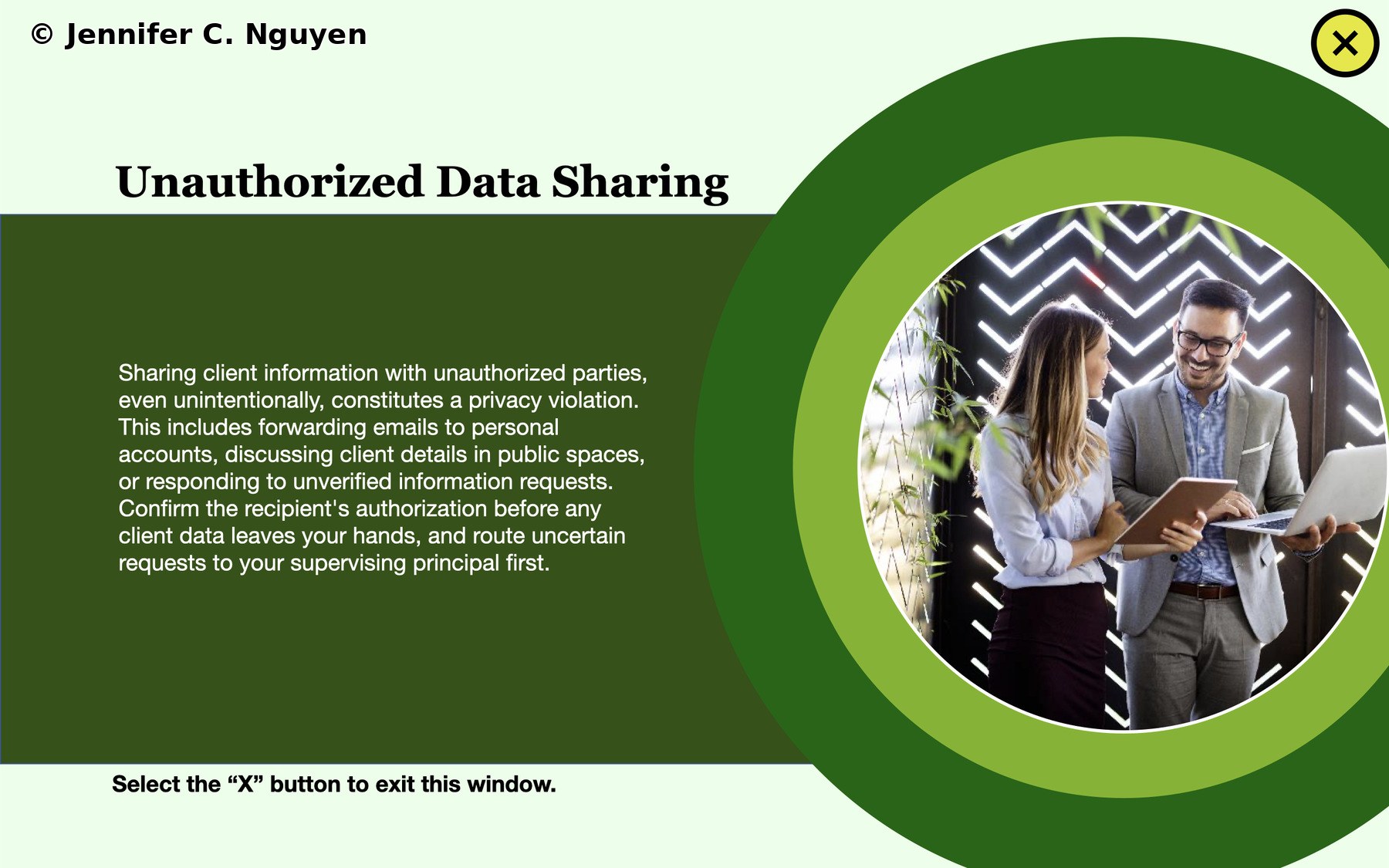
Unauthorized Data Sharing branching reveal popup with a black serif title on a light mint upper section, dark green lower left panel with white body text describing client data sharing violations and recommending uncertain requests be routed to a supervising principal, right side featuring a circular professional photo of two colleagues reviewing a tablet within concentric green circles, bold black instruction at the bottom reading Select the X button to exit this window, black X close button outlined in yellow in the top right cornerUnauthorized Client Data Sharing — branching reveal with colleague photo and violation guidance
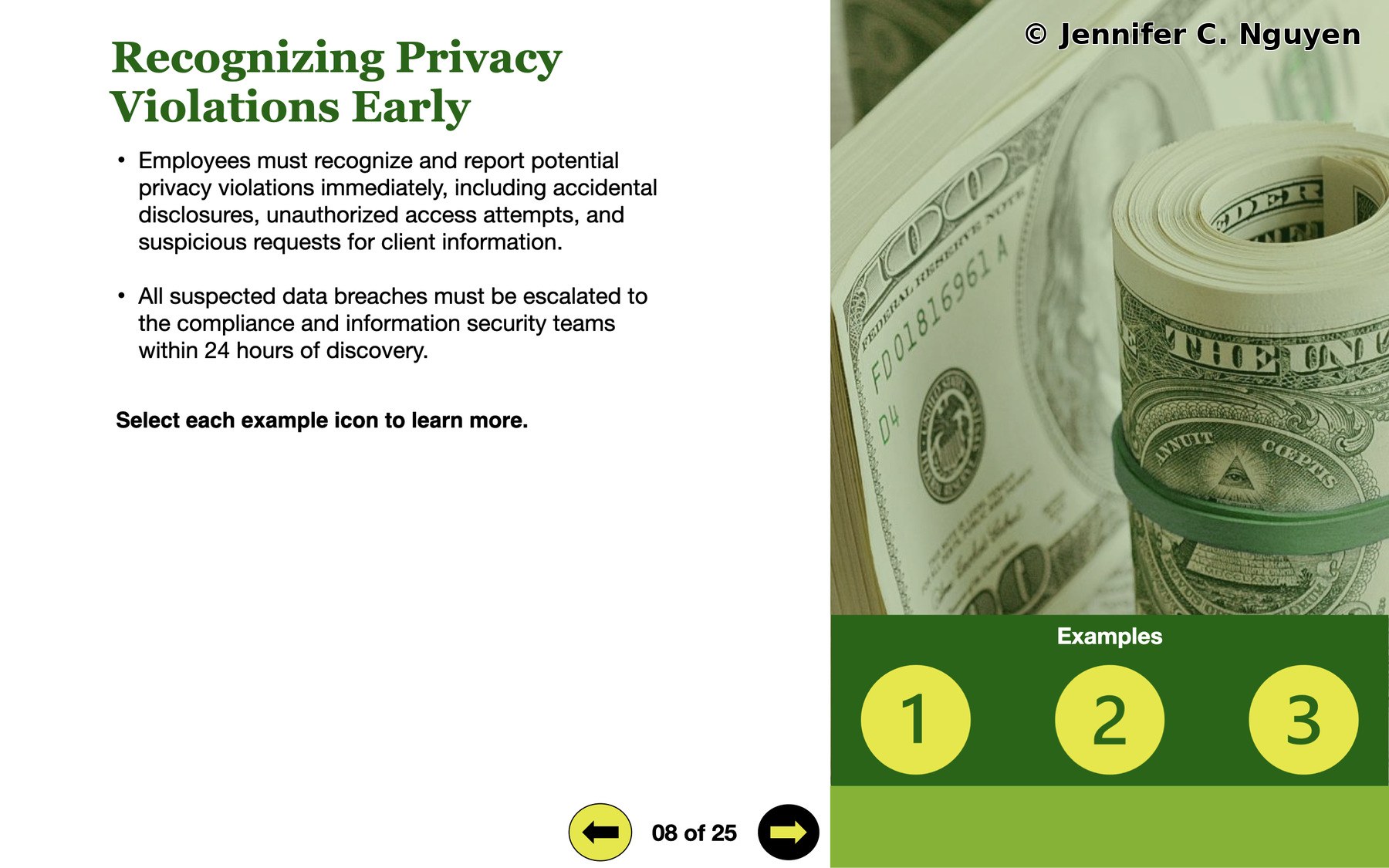
Recognizing Privacy Violations Early slide with a slide counter reading 08 of 25 in the bottom left, white left panel showing the title in dark green, two bullet points about reporting violations immediately and escalating suspected data breaches to compliance and information security within 24 hours, a Select each example icon instruction, right panel showing a rolled cash bills photo with a green tint, dark green Examples band with three yellow numbered circle buttonsRecognizing Privacy Violations Early — two key bullets with three numbered example interaction buttons
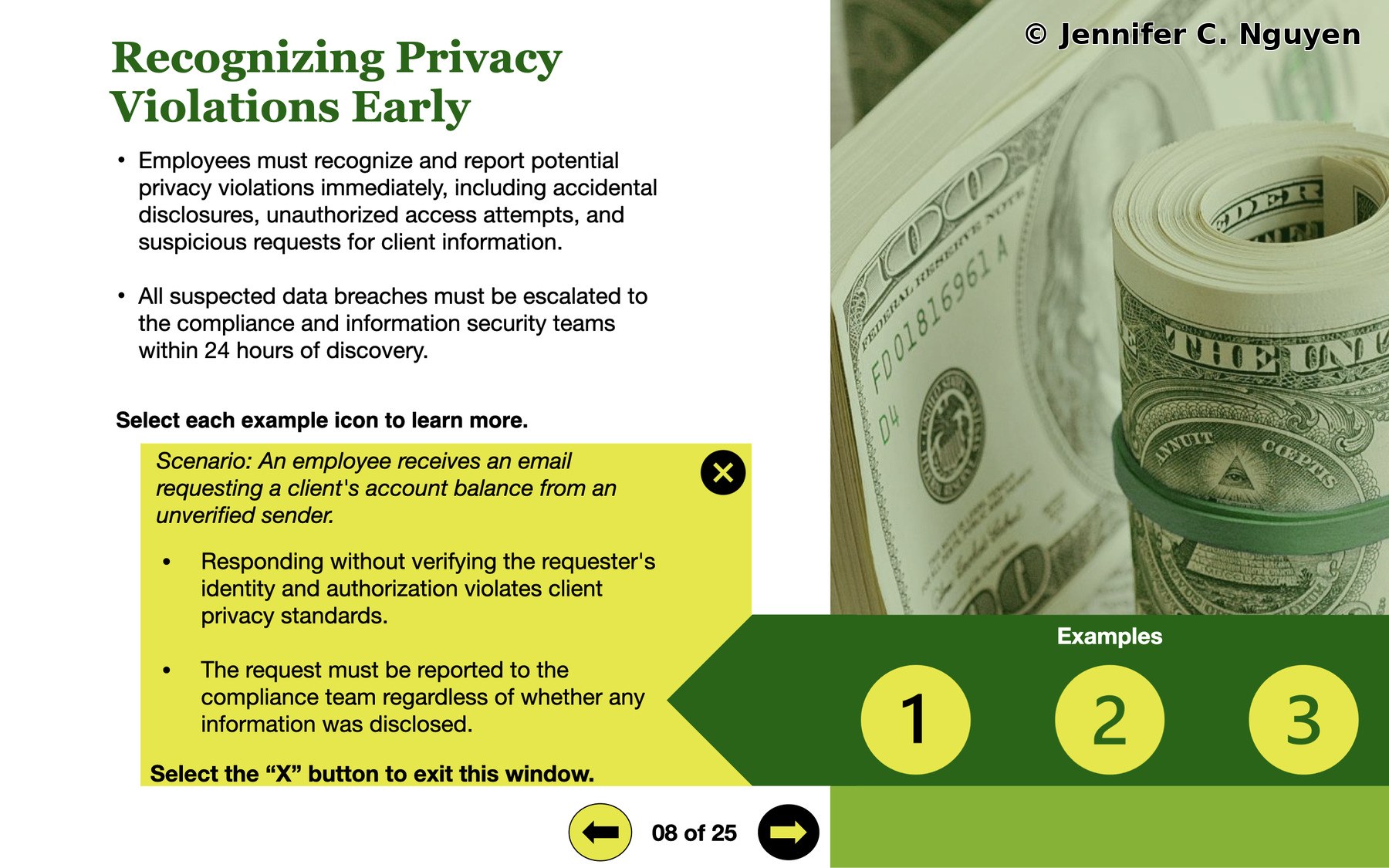
Recognizing Privacy Violations Early slide showing the Example 1 popup in a yellow panel with an italic scenario about an unverified email requesting a client's account balance, two dark bullet points about verifying requester identity and reporting to the compliance team regardless of disclosure, bold text reading Select the X button to exit this window, black X close button, three numbered yellow circle example buttons visible in the lower right, slide counter reading 08 of 25 in the bottom leftExample 1 Reveal — unverified email scenario with two action bullets
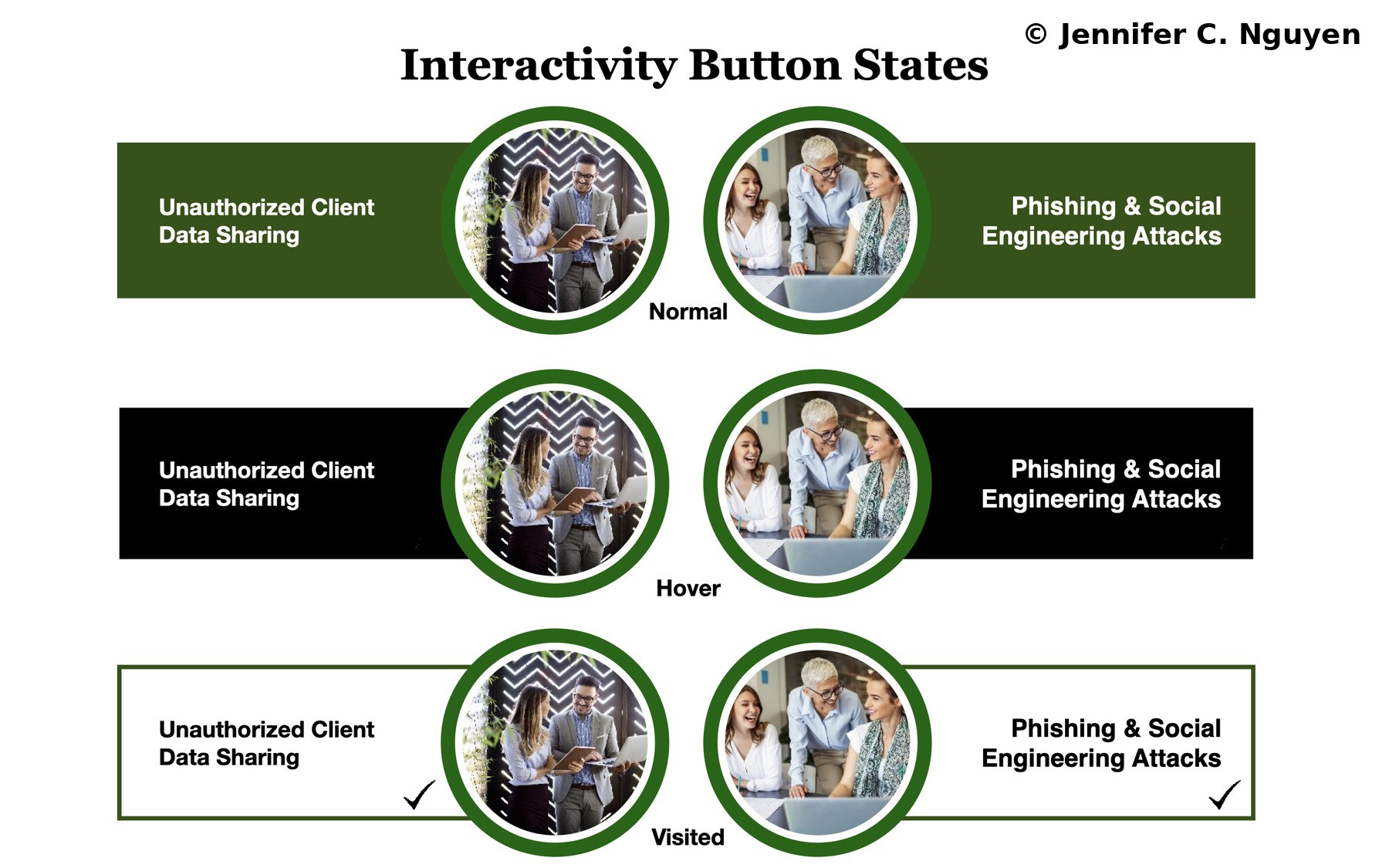
Interactivity button states reference slide on white background showing three rows for Normal dark green, Hover black, and Visited white border states, each row displaying two circular image buttons for Unauthorized Client Data Sharing and Phishing and Social Engineering Attacks with checkmarks visible in Visited rowInteractivity Button States — Normal, Hover, and Visited states for image-based navigation buttons
04
Legal & Regulatory Risk in Banking

Built for banking professionals in regulatory and legal departments, this course uses a subtle muted pastel palette of teal, tan, and burgundy to convey sophistication and authority. Layered card interactivity and thematic legal photography guide learners through federal oversight, consumer protection frameworks, and escalation protocols. Checkmarks and a border color shift keep progress clear for everyone, especially colorblind learners.

LegalRegulatory RiskBankingLayered InteractivityIcon-Driven Design
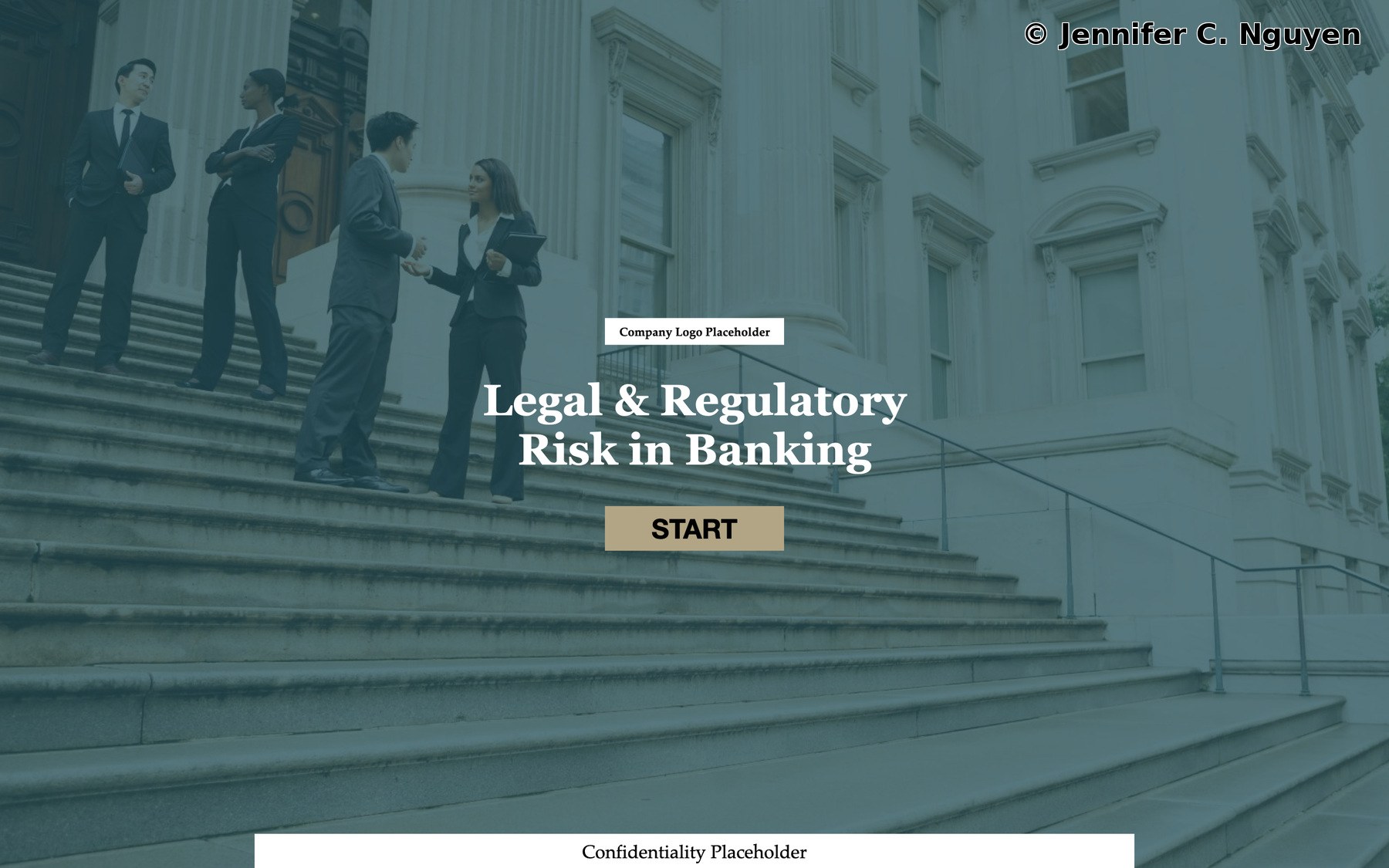
Legal and Regulatory Risk in Banking course start page with full-bleed photography of diverse professionals conversing on courthouse steps under a teal overlay, bold white serif course title positioned right of center, small white Company Logo Placeholder box above the title, gold tan START button below, white Confidentiality Placeholder bar at the bottomStart Page — Legal and Regulatory Risk in Banking with courthouse steps photography
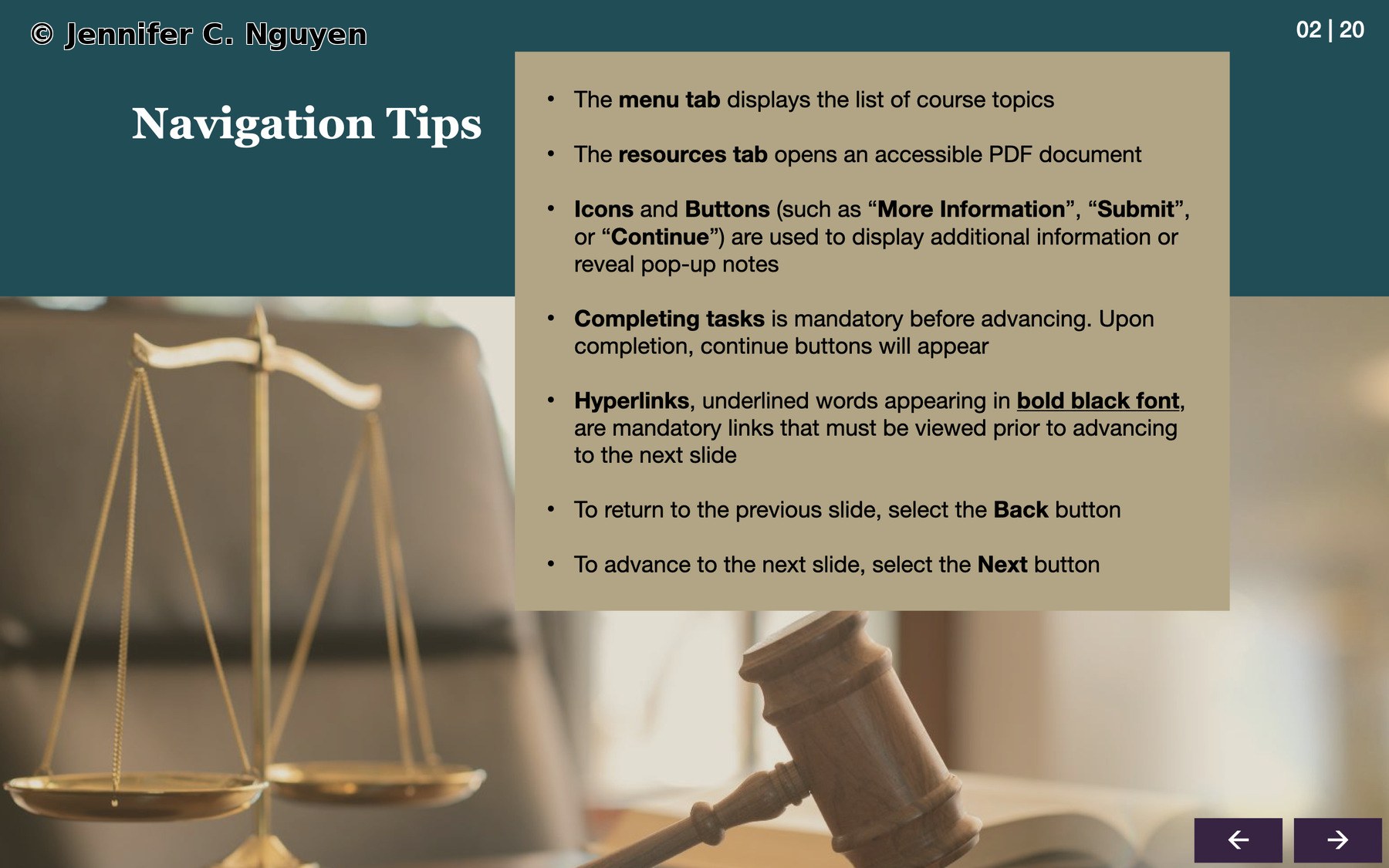
Navigation tips slide with a scales of justice and gavel background photo and a slide counter reading 02 | 20 in the top right, teal header band with white Navigation Tips title on the left, tan content panel on the right listing seven navigation instructions covering the menu tab, resources tab, icons and buttons, mandatory task completion, hyperlinks in bold black font, and the Back and Next buttonsNavigation Tips — scales of justice and gavel background with tan content panel
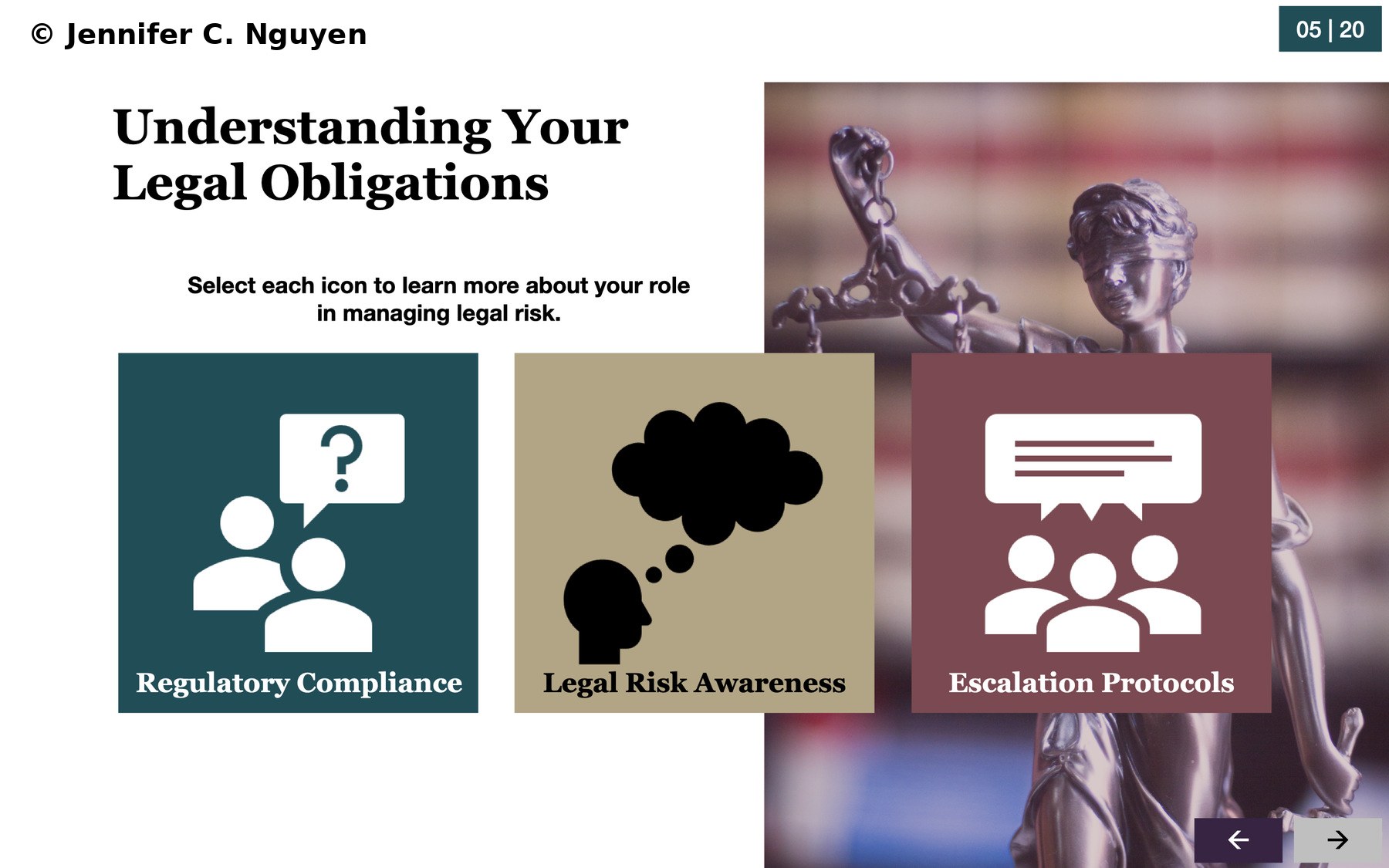
Understanding Your Legal Obligations interactivity slide with a slide counter reading 05 | 20 in the top right, showing normal state with a Lady Justice background photo, three large square icon cards in teal with a question mark and people icon, tan with a thought bubble icon, and burgundy with a group discussion icon, labeled Regulatory Compliance, Legal Risk Awareness, and Escalation ProtocolsUnderstanding Your Legal Obligations — three icon cards in normal state with Lady Justice background
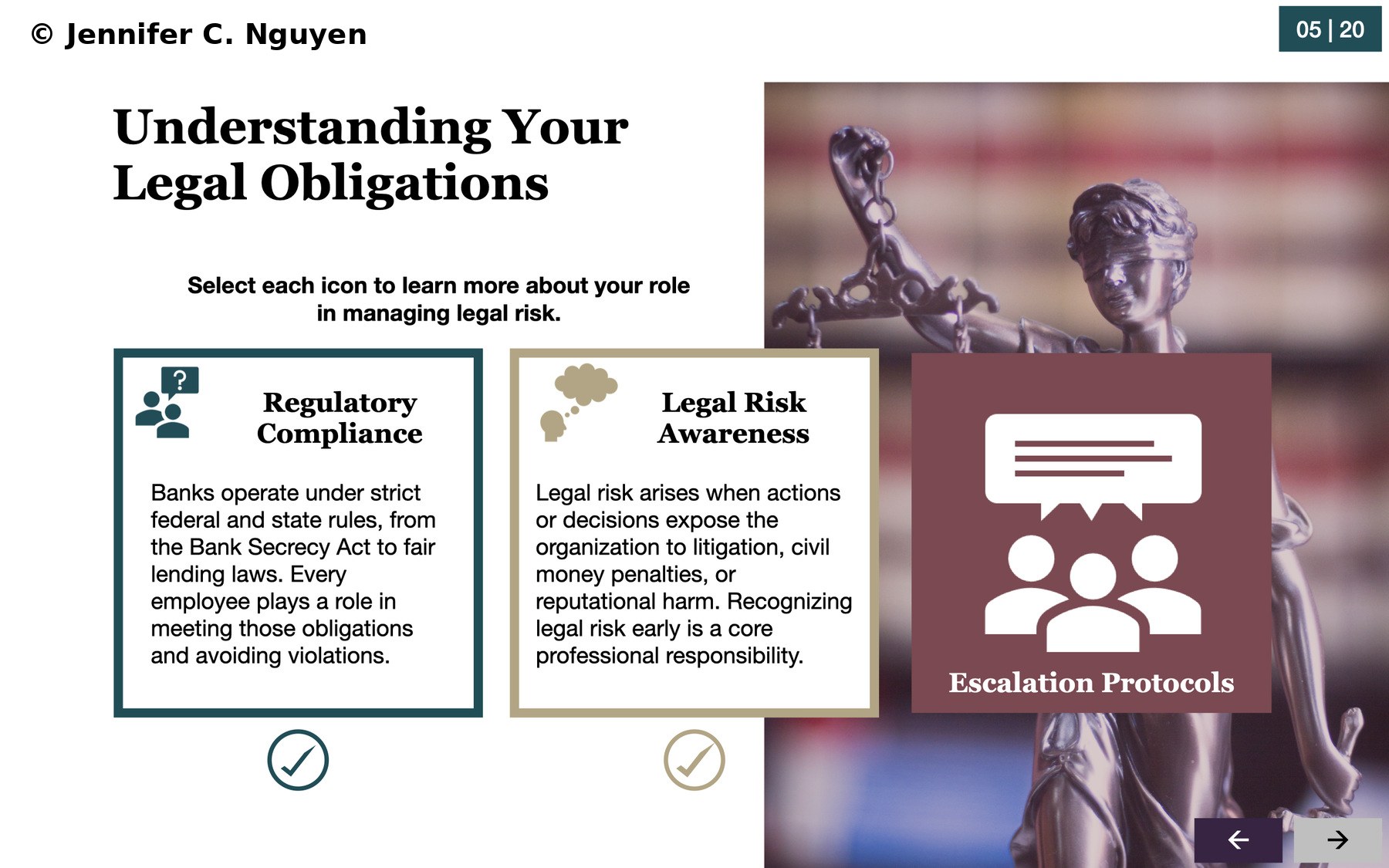
Understanding Your Legal Obligations interactivity slide with a slide counter reading 05 | 20 in the top right, showing visited state with the first two cards expanded revealing content, teal card showing a Regulatory Compliance description citing the Bank Secrecy Act and fair lending laws, tan card showing a Legal Risk Awareness description about litigation and reputational harm, teal and tan checkmarks below the completed cards, burgundy Escalation Protocols card still in normal stateUnderstanding Your Legal Obligations — visited state with two expanded cards showing content and checkmarks
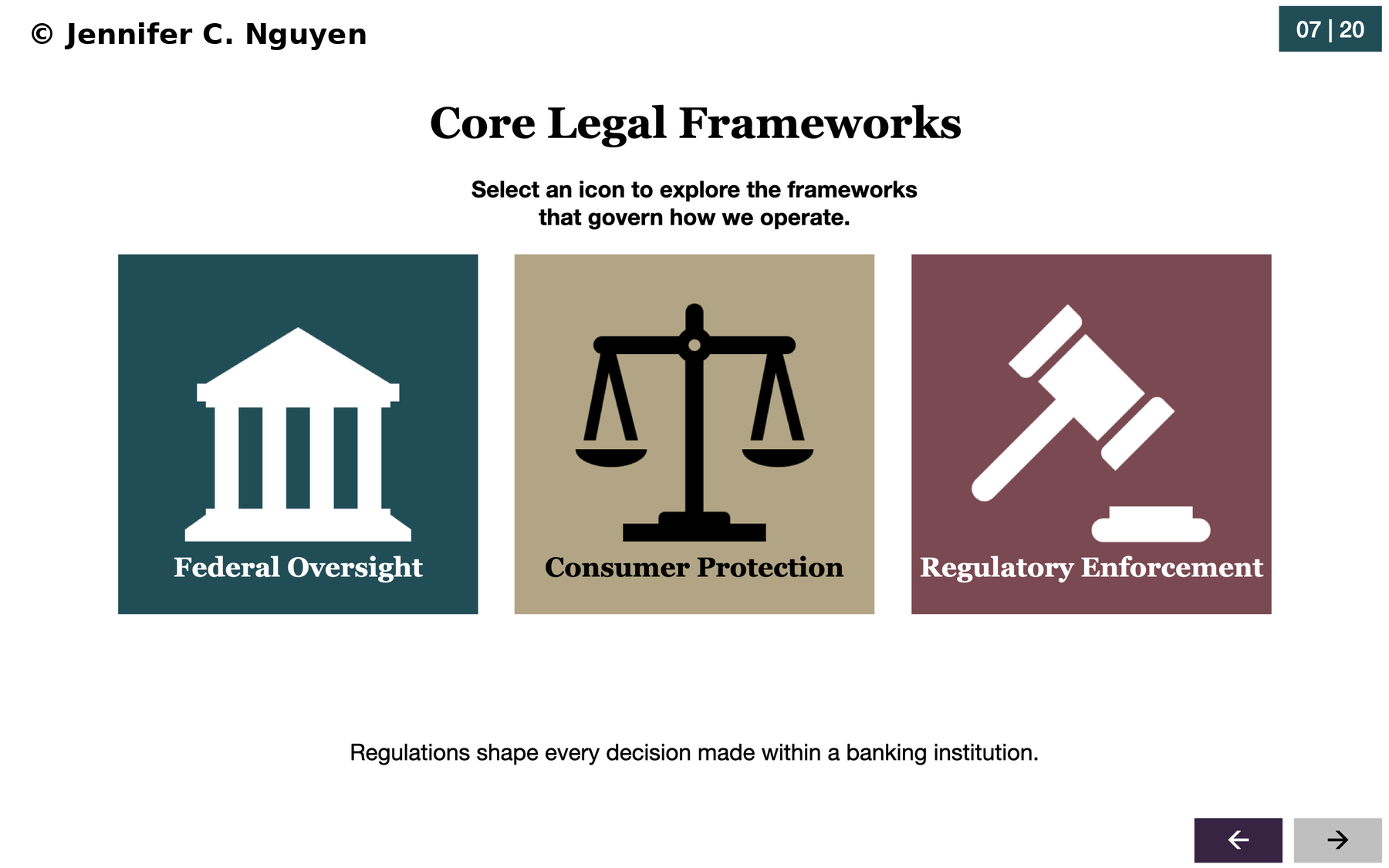
Core Legal Frameworks slide with a white background and a slide counter reading 07 | 20 in the top right, showing three large square icon cards in teal with a white courthouse icon labeled Federal Oversight, tan with a black scales of justice icon labeled Consumer Protection, and burgundy with a white gavel icon labeled Regulatory Enforcement, centered bold title, instructional text above the cards, and a relatable sentence belowCore Legal Frameworks — Federal Oversight, Consumer Protection, and Regulatory Enforcement icon cards
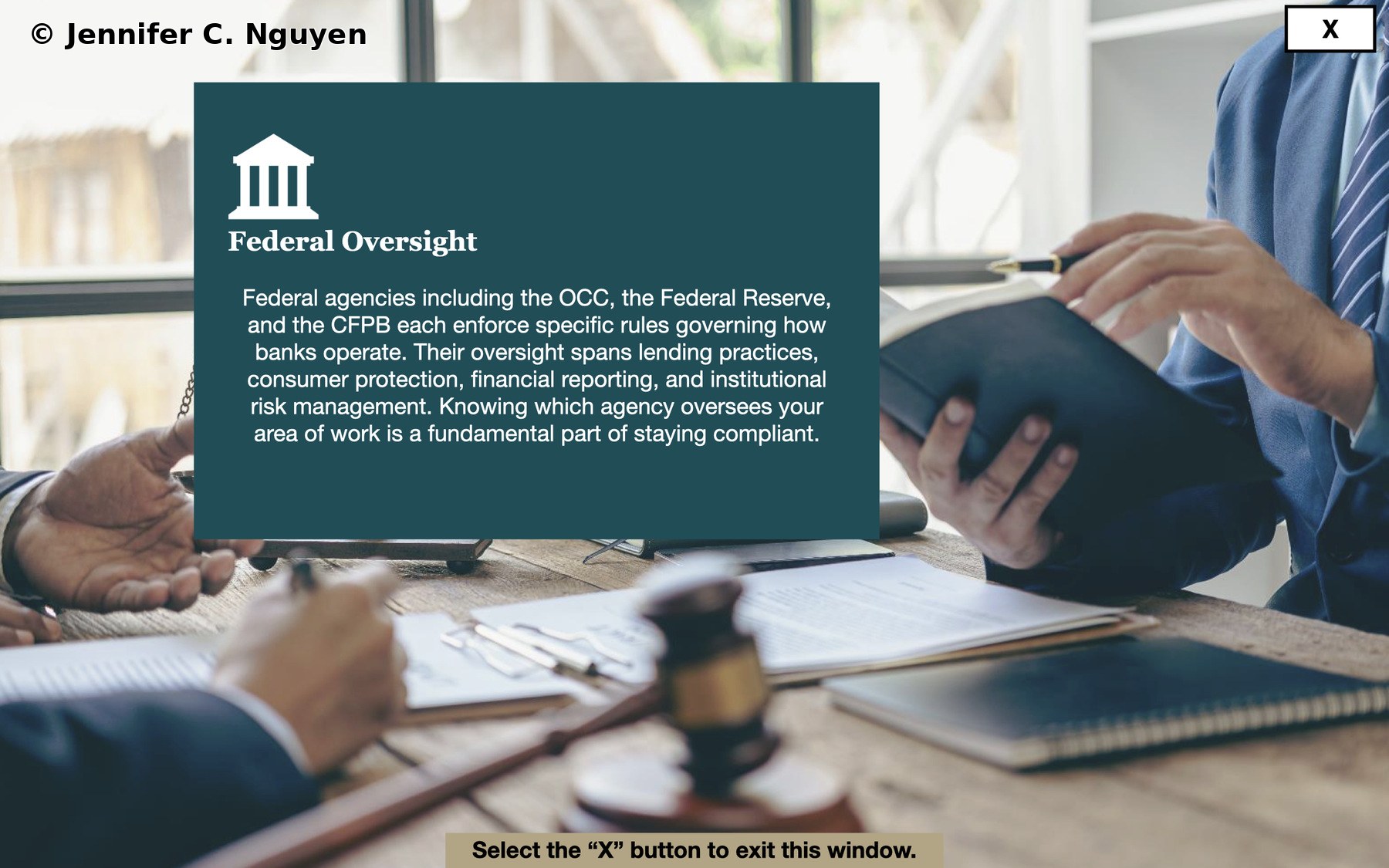
Federal Oversight branching reveal popup overlaid on a legal meeting photo showing two professionals at a table with a gavel, teal content panel on the left with a white courthouse icon, Federal Oversight title, and a three sentence description about OCC, Federal Reserve, and CFPB oversight spanning lending, consumer protection, financial reporting, and institutional risk management, white square X close button outlined in black in the top right corner, gold tan bar at the bottom reading Select the X button to exit this windowFederal Oversight — branching reveal with legal meeting photo and federal agency oversight description
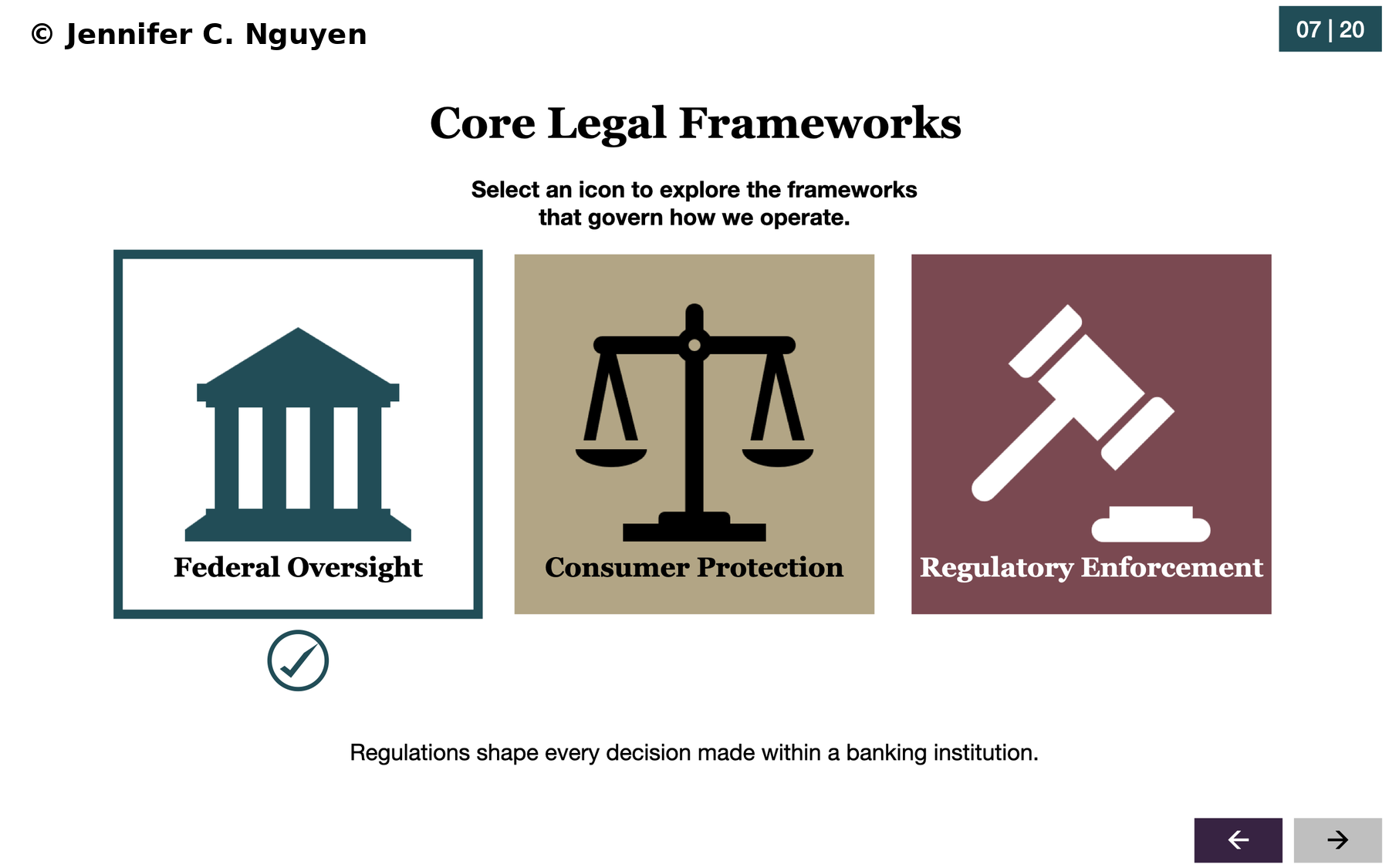
Core Legal Frameworks slide with a slide counter reading 07 | 20 in the top right, showing visited state with the Federal Oversight card now displaying a white background, teal border, and teal courthouse icon indicating completion, teal checkmark below the card, Consumer Protection and Regulatory Enforcement cards remaining in normal stateCore Legal Frameworks — visited state showing Federal Oversight completed with teal border and checkmark
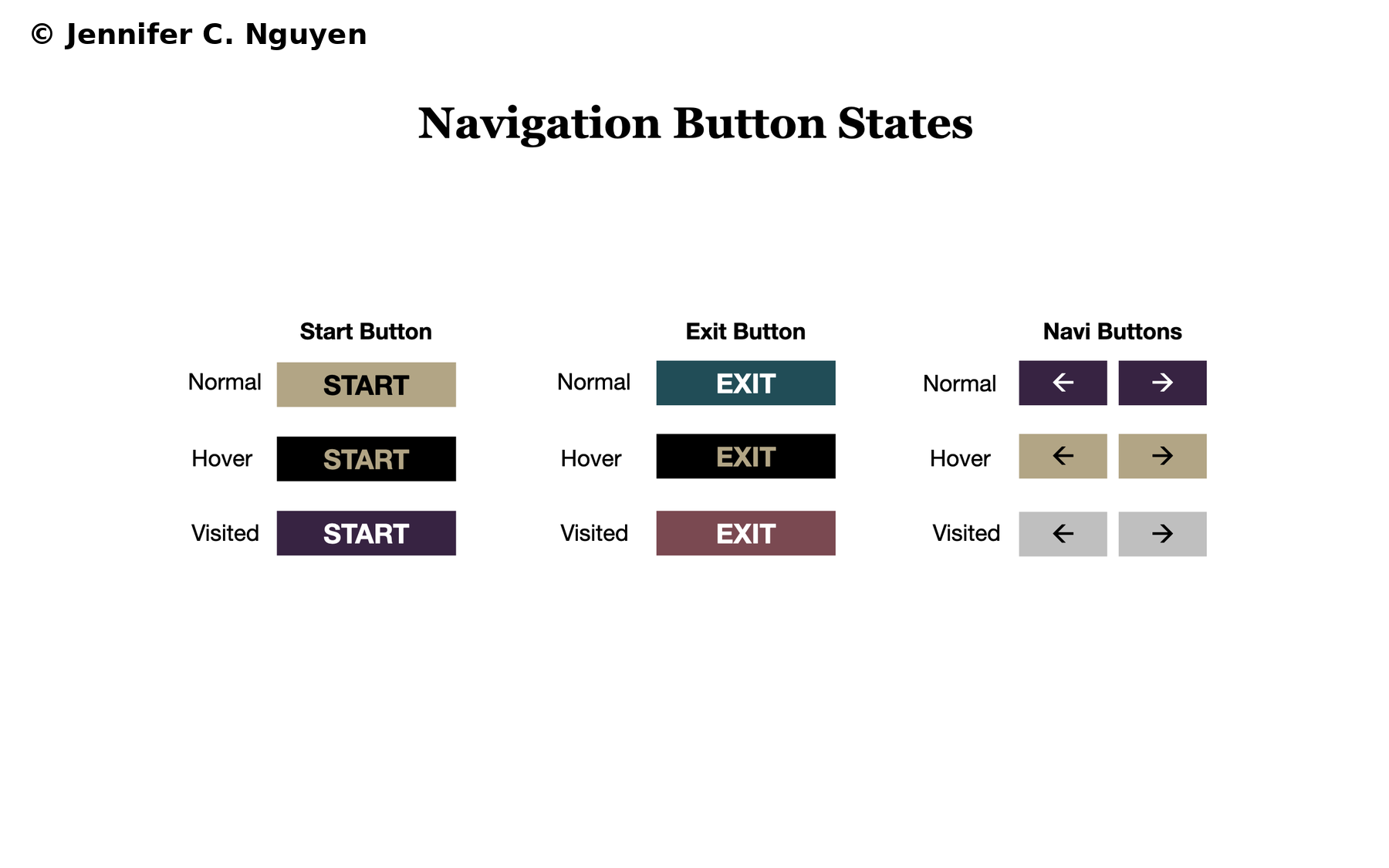
Navigation Button States reference slide on white background showing three columns for Start Button, Exit Button, and Navi Buttons, each with Normal, Hover, and Visited states using tan to black to purple progression for Start, teal to black to burgundy for Exit, and purple to tan to grey for the navigation arrowsNavigation Button States — Normal, Hover, and Visited states for Start, Exit, and Navigation buttons

05
Regulation K: International Banking Operations

Designed for international banking professionals, this course uses a dynamic bold blue theme to convey reliability and authority, guiding learners through Regulation K requirements including Edge corporation activities, foreign branch operations, and cross-border investment limits. Tap-to-reveal banners and four-tier investment cards break this dense, technical framework into pieces learners can absorb one at a time.

International BankingRegulation KFederal ReserveTiered InteractivityGeometric Design
Regulation K International Banking Operations course start page with an aerial photo of seven people around a conference table, blue and grey split background, angled navy and blue triangle logo mark in the upper left, white banner containing Company Logo Placeholder text above the bold course title, white arrow-shaped Start Course banner, white arrow-shaped Confidentiality Placeholder banner at the bottomStart Page — Regulation K International Banking Operations with aerial meeting photography
Navigation Tips slide on white background with angled blue and navy triangle accents in all four corners, seven navigation instructions arranged in two columns covering Menu Tab, Resources Tab, Icons and Buttons, Completing Tasks, Hyperlinks in bold blue font, To Return, and To Advance above black rounded Back and Next navigation buttons, slide counter reading 02 | 27Navigation Tips — geometric triangle corner accents framing seven navigation instructions
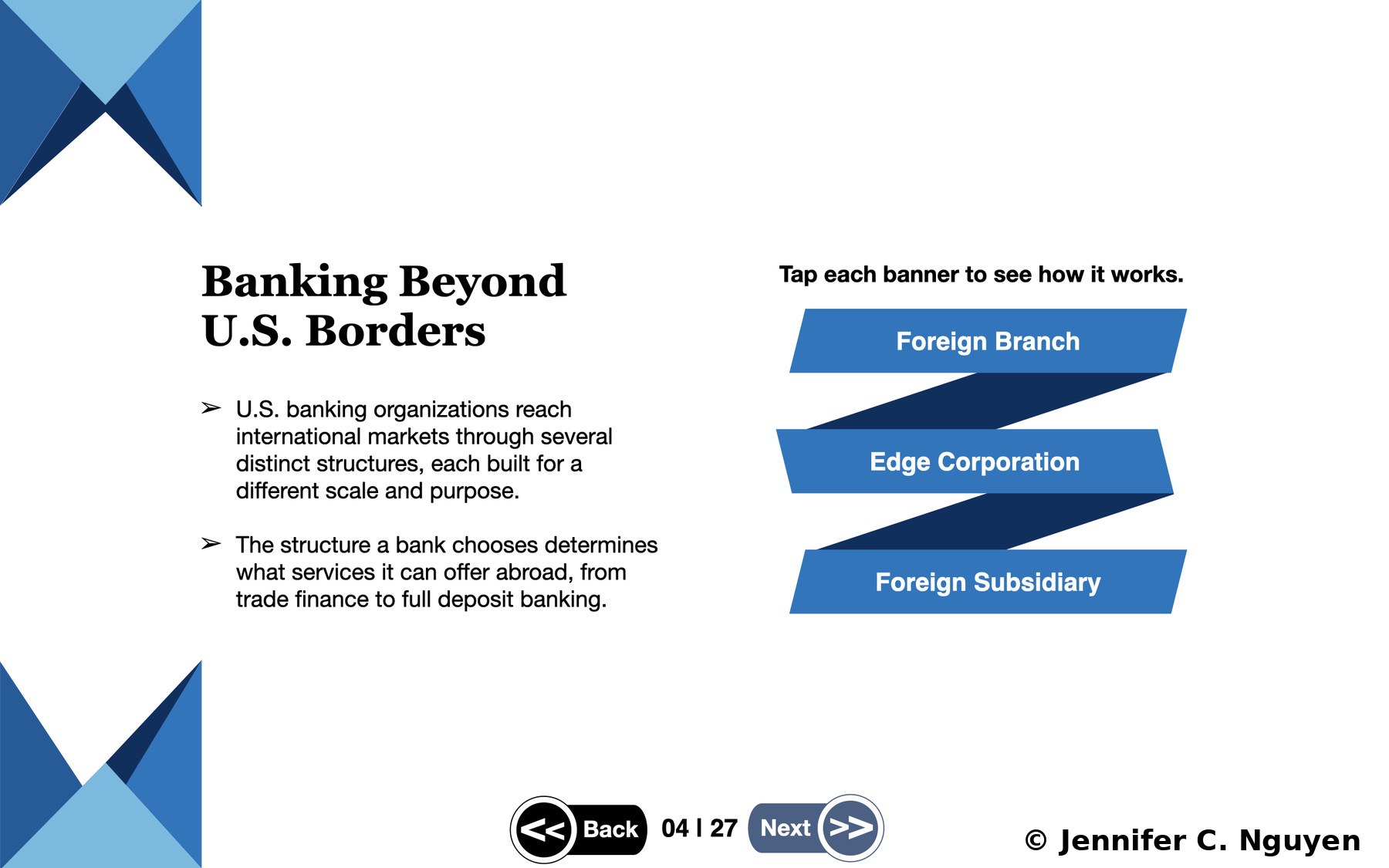
Banking Beyond U.S. Borders slide with bold title and two bullet points on left about international banking structures, three angled blue ribbon banners on right labeled Foreign Branch, Edge Corporation, and Foreign Subsidiary in normal unvisited state, Tap each banner to see how it works instruction, slide counter reading 04 | 27Banking Beyond U.S. Borders — three ribbon banners in normal state

Foreign Branch branching reveal popup with X close button in upper right corner, bold title Foreign Branch, description paragraph and two bullet points about parent bank ownership and serving corporate clients abroad, photo of two banking professionals reviewing a tablet together, dark navy divider bar, Select the X button to exit this window instruction at bottomForeign Branch — branching reveal with professional photography and structure description
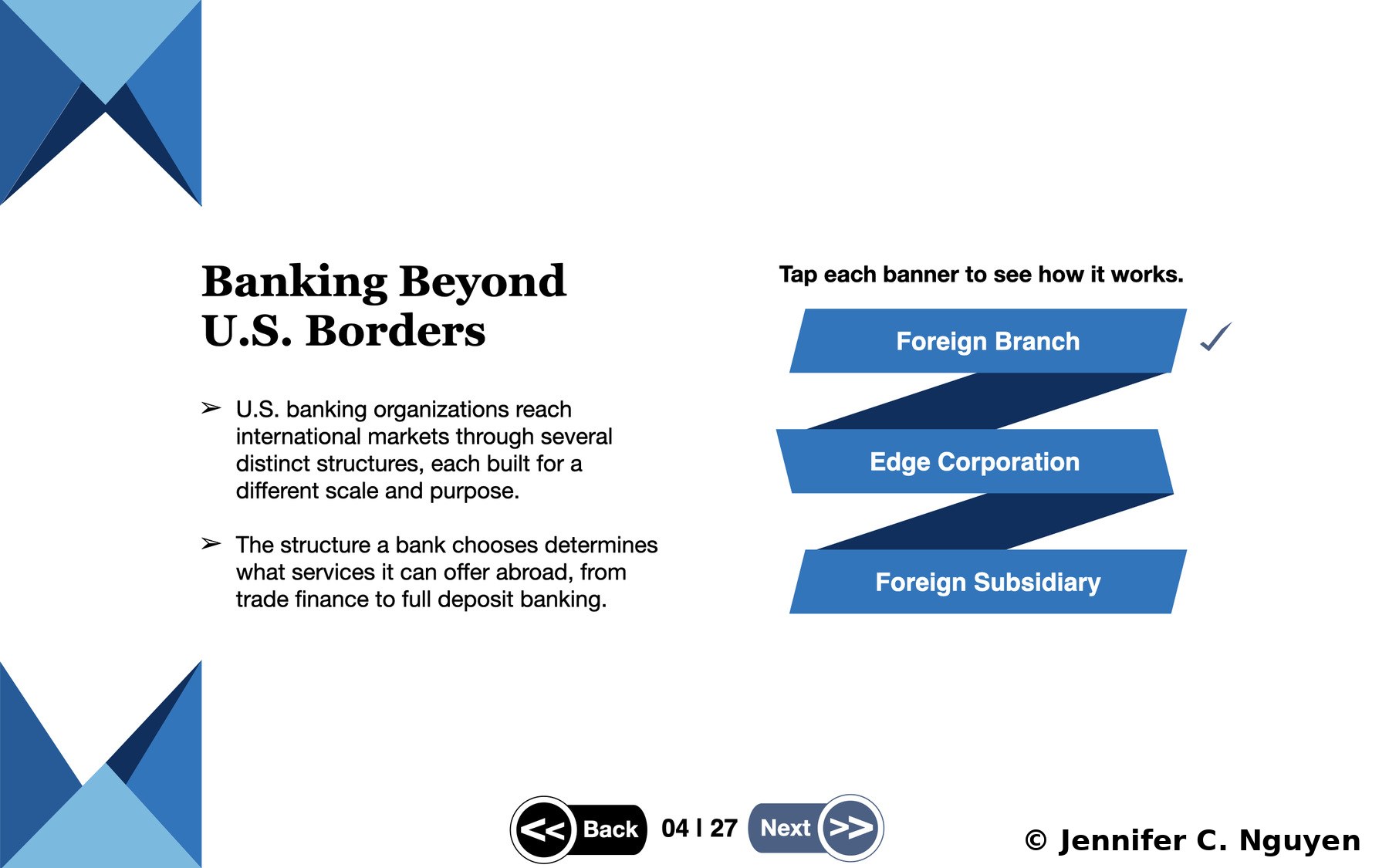
Banking Beyond U.S. Borders slide showing visited state with two bullet points on left about international banking structures, three angled blue ribbon banners on right labeled Foreign Branch, Edge Corporation, and Foreign Subsidiary, checkmark visible next to the completed Foreign Branch banner, Tap each banner to see how it works instruction, slide counter reading 04 | 27Banking Beyond U.S. Borders — visited state with checkmark on completed Foreign Branch banner
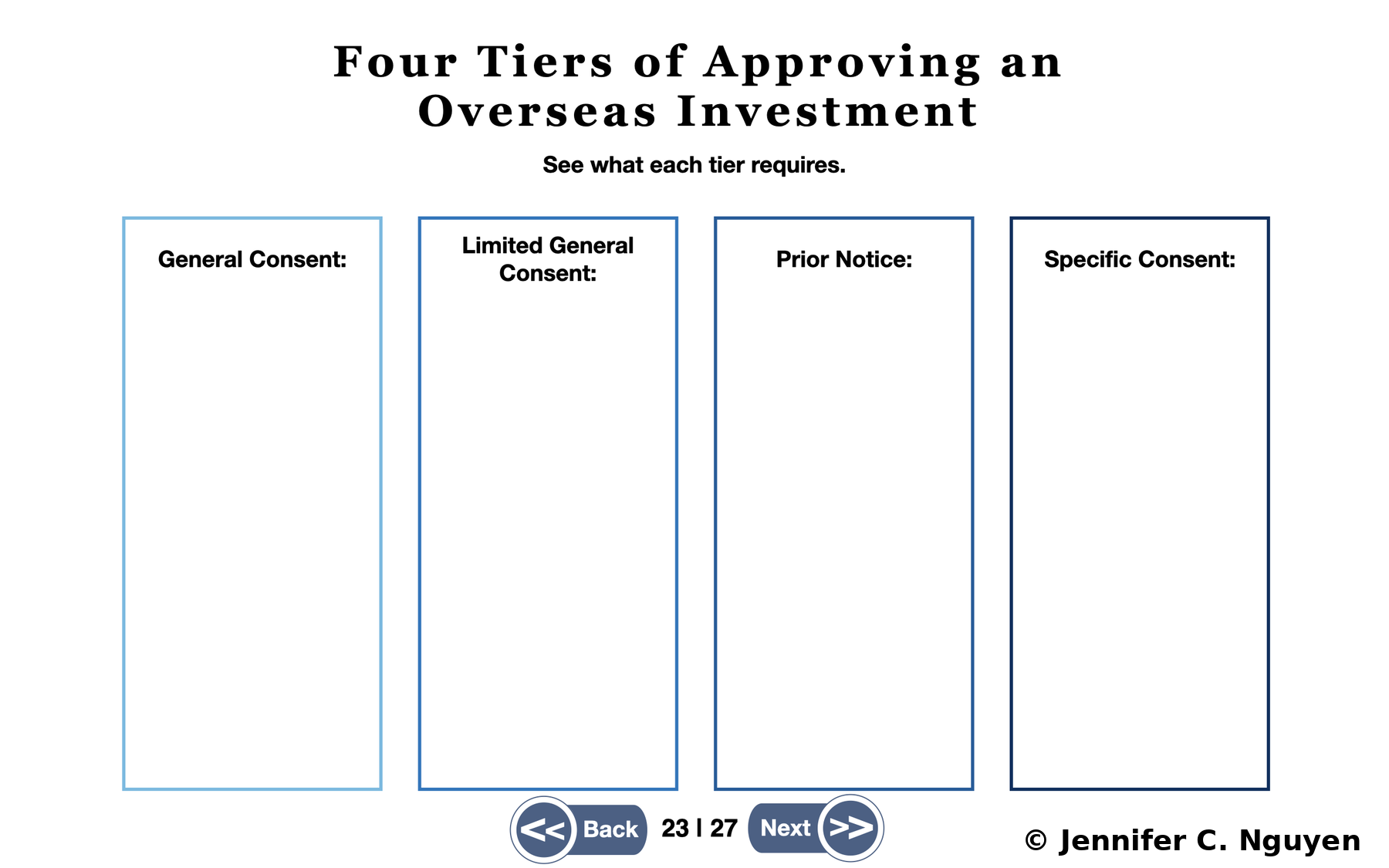
Four Tiers of Approving an Overseas Investment slide with bold centered title, See what each tier requires instruction, four empty white rectangular columns each outlined in an ascending shade of blue border labeled General Consent, Limited General Consent, Prior Notice, and Specific Consent, black rounded Back and Next navigation buttons, slide counter reading 23 | 27Four Tiers of Approving an Overseas Investment — four-column tiered interactivity layout
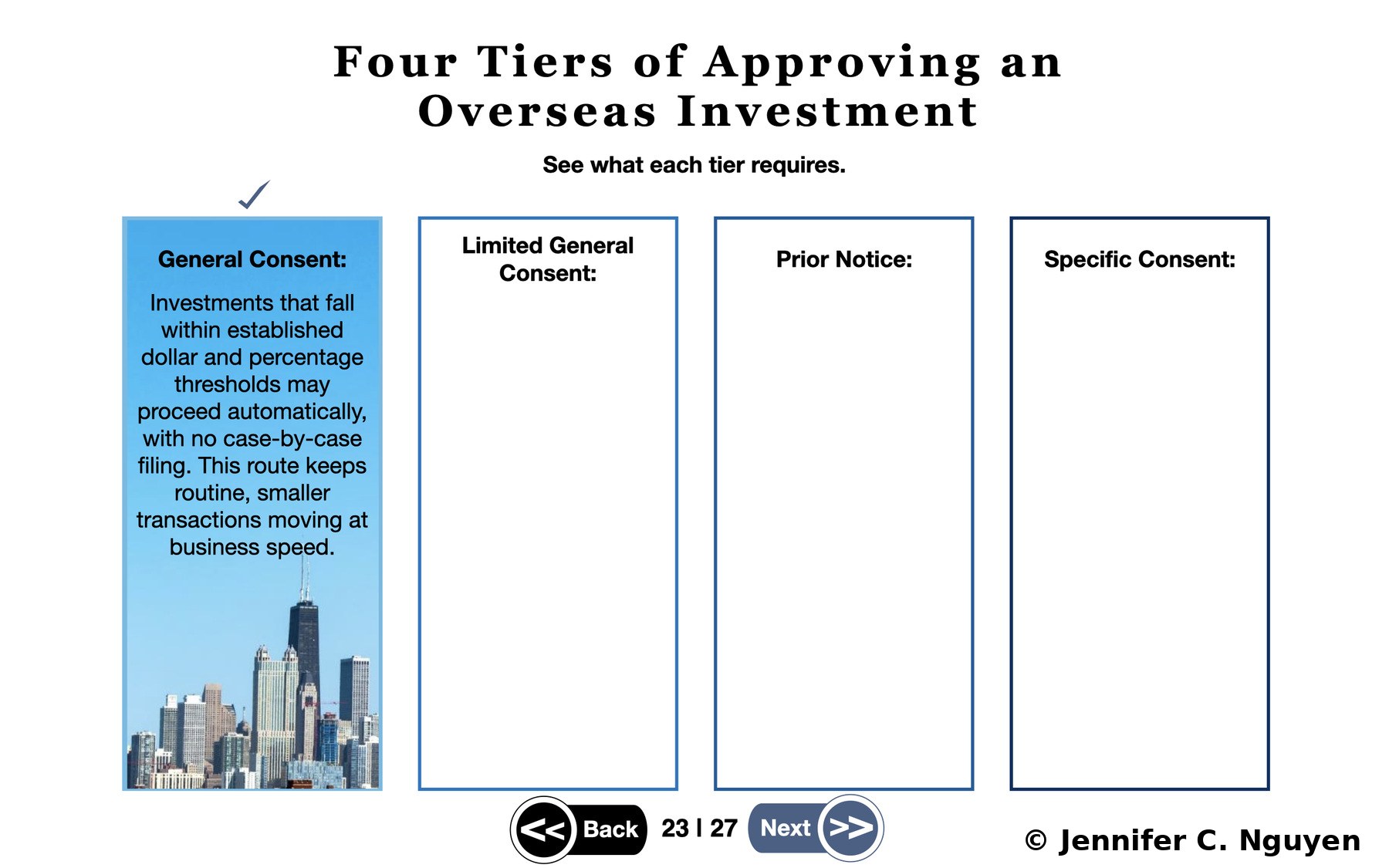
Four Tiers of Approving an Overseas Investment slide showing first tier revealed, General Consent column expanded in light blue with checkmark above and description text about dollar and percentage thresholds, Chicago skyline photograph at the base of the column, remaining three columns still empty and unvisited, slide counter reading 23 | 27Four Tiers — General Consent revealed with skyline photography and threshold description
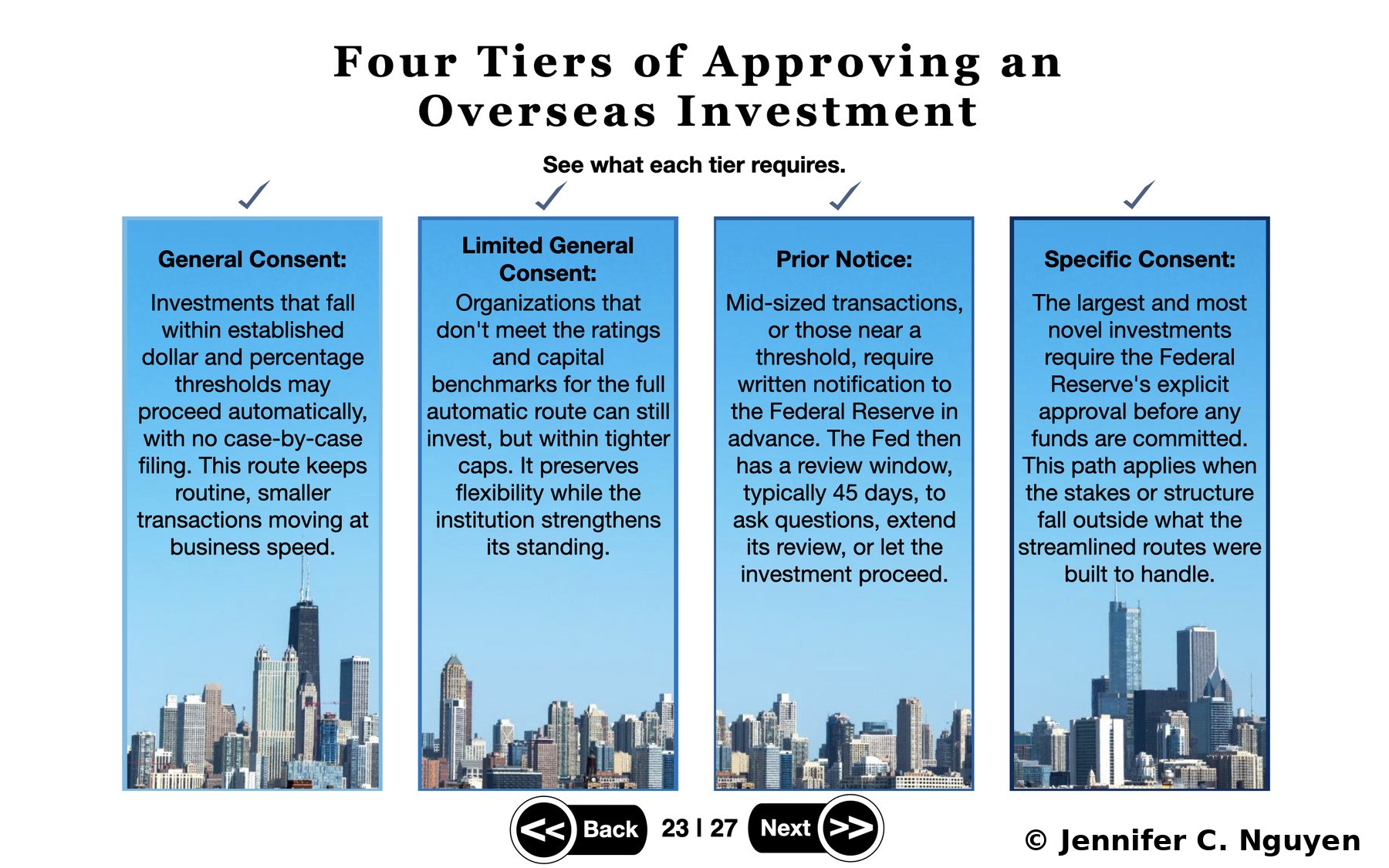
Four Tiers of Approving an Overseas Investment slide showing all four tiers fully revealed, each column expanded in blue with a checkmark above and description text for General Consent, Limited General Consent, Prior Notice, and Specific Consent, matching Chicago skyline photography anchoring the base of each column, slide counter reading 23 | 27Four Tiers — all four tiers in visited state with checkmarks, showing complete investment approval requirements
06
Policy Exception Request and Approval Procedures

For a large bank's regulations department, this course uses a rich red and regal theme to convey authority and structure, layering progressive accordion reveals with role-based scenario cards that mark visited stops with a checkmark alongside the color shift, so progress stays clear for everyone, especially those with color vision differences. Diverse, inclusive photography appears throughout the course design.

Policy ProceduresInternal GovernanceAccordion InteractivityRole-Based ScenariosInclusive Photography
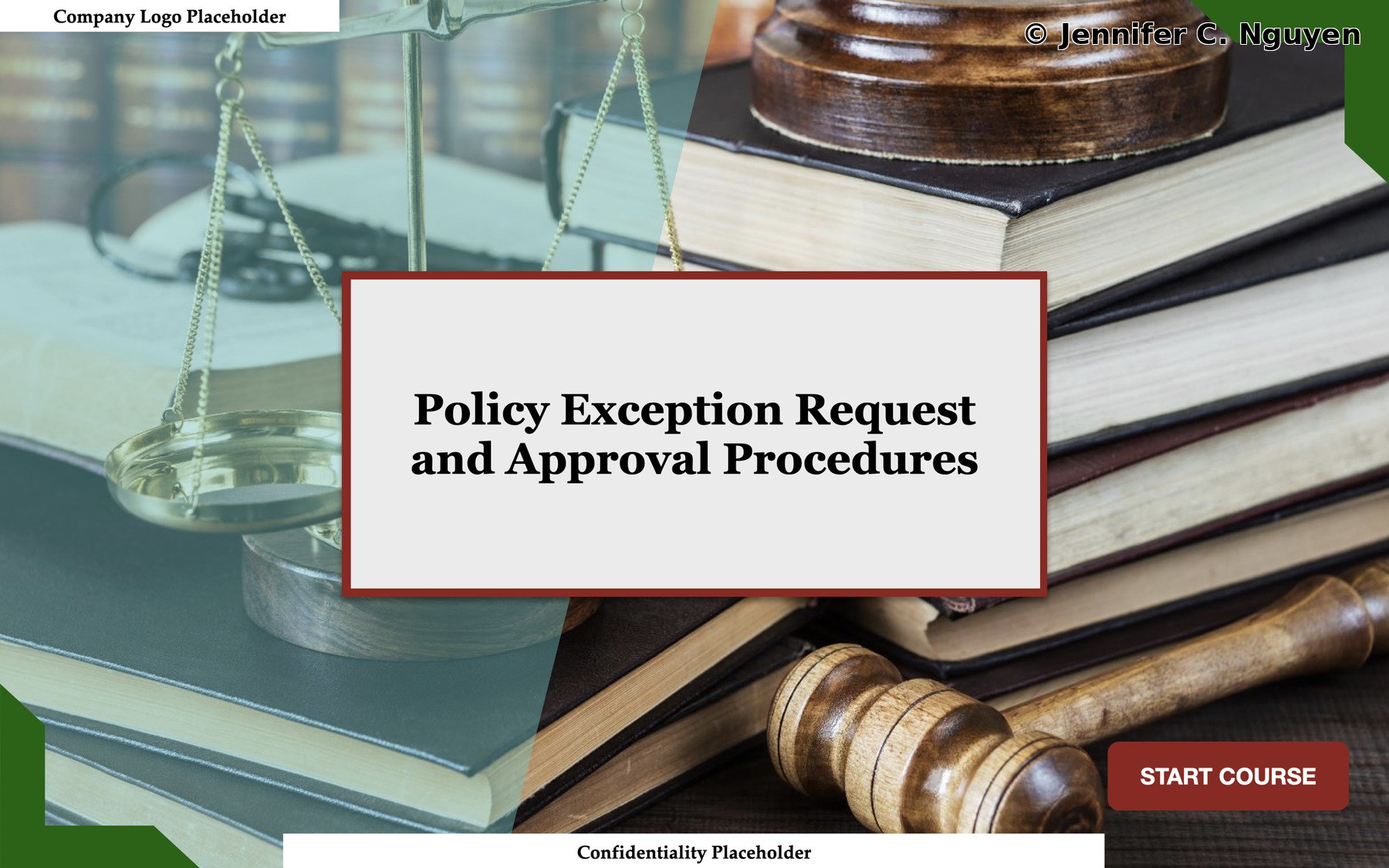
Policy Exception Request and Approval Procedures course start page with layered photograph of a scale of justice, law books, and a gavel in green and red tones, white Company Logo placeholder banner top left, red-bordered title box centered on the image, red Start Course button lower right, Confidentiality placeholder banner at bottomStart Page — Policy Exception Request and Approval Procedures with layered legal photography
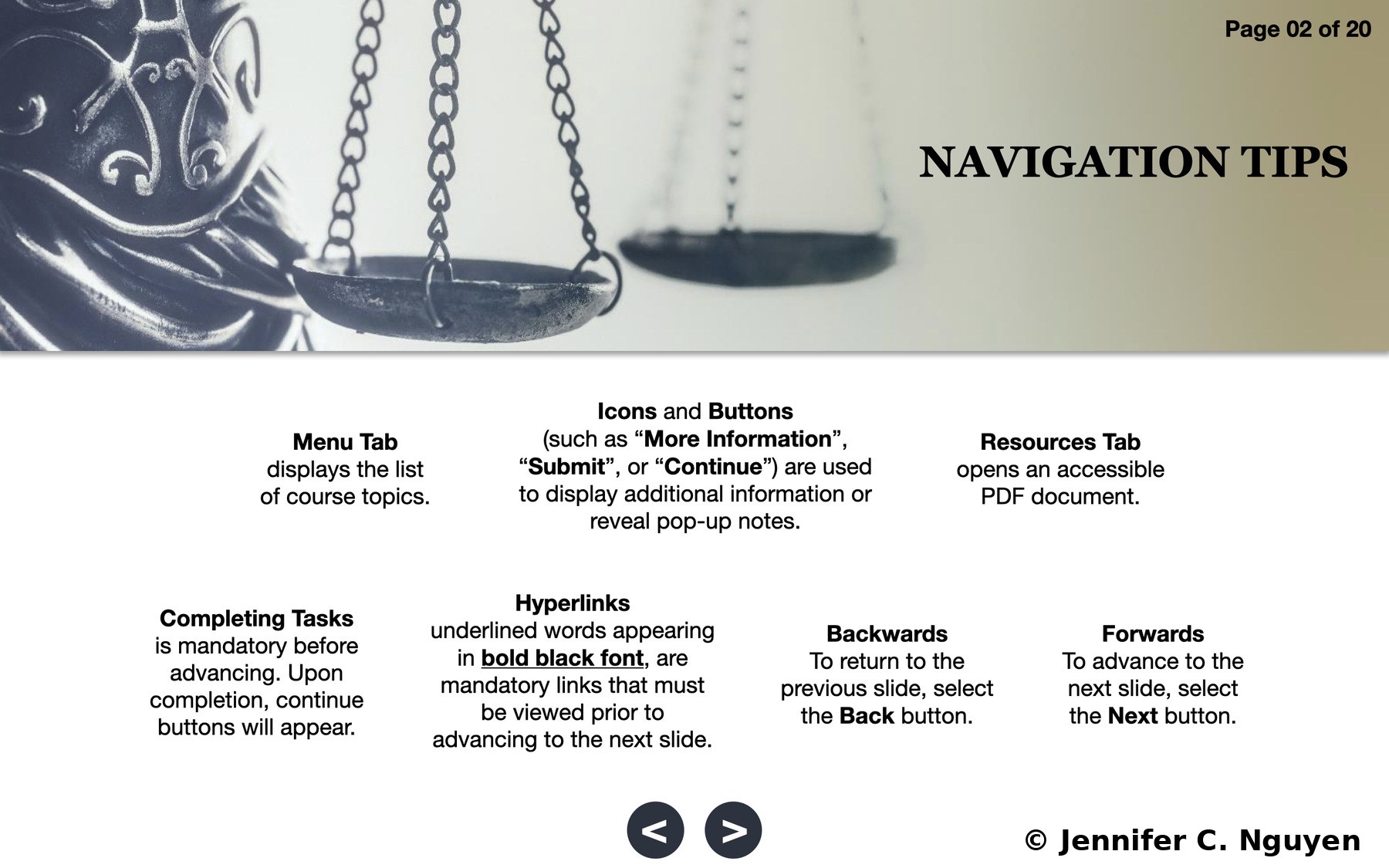
Navigation Tips slide with black and white photo of a hanging scale of justice across the top banner, bold serif Navigation Tips heading, seven navigation instructions arranged in a two-row grid covering Menu Tab, Icons and Buttons, Resources Tab, Completing Tasks, Hyperlinks in bold black font, Backwards, and Forwards, dark rounded Back and Next navigation buttons, slide counter reading Page 02 of 20Navigation Tips — scale of justice photography framing seven navigation instructions
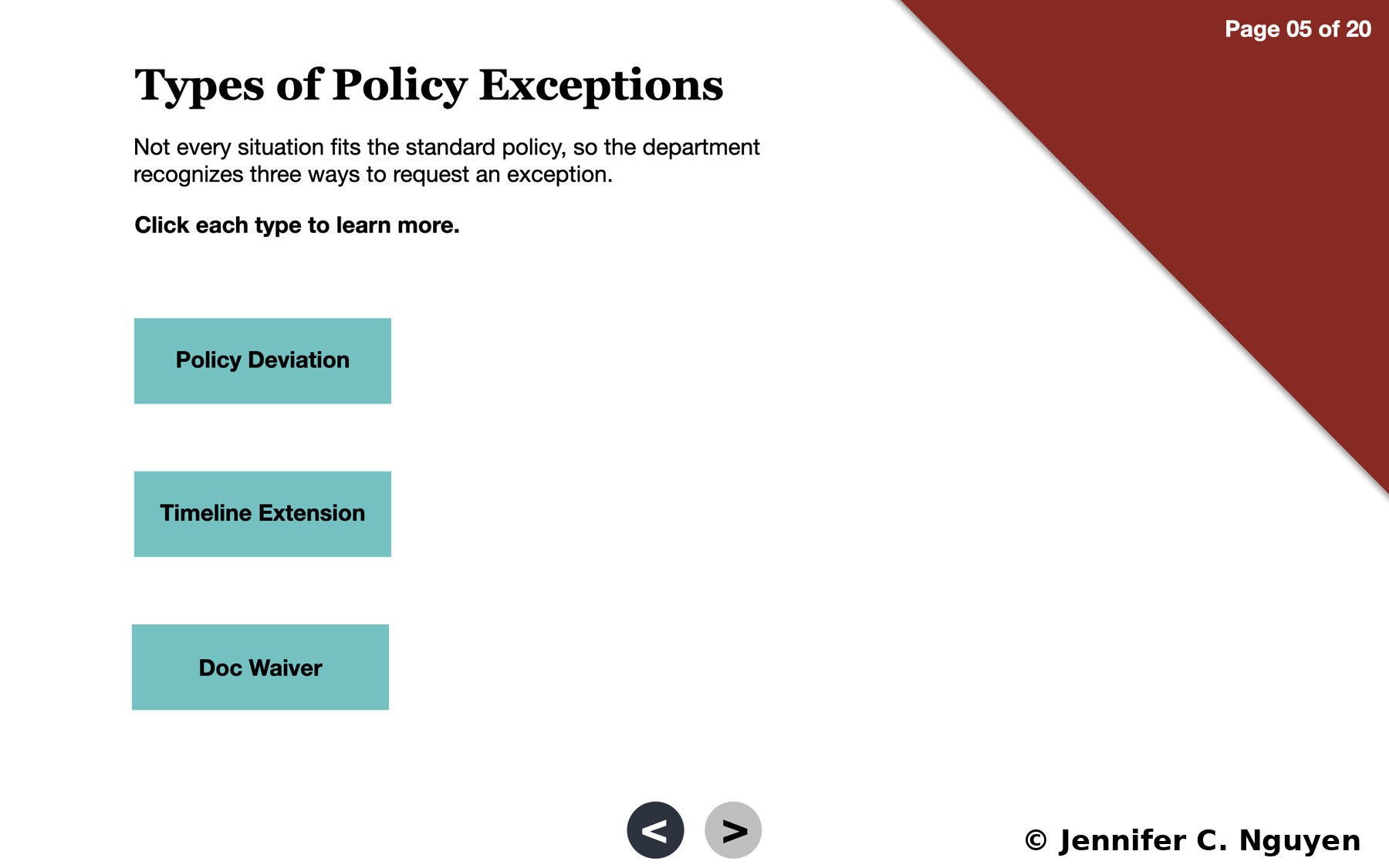
Types of Policy Exceptions slide with bold serif title, introductory sentence about the department recognizing three ways to request an exception, Click each type to learn more instruction, three teal accordion buttons labeled Policy Deviation, Timeline Extension, and Doc Waiver in unrevealed state, red triangle accent in upper right corner, slide counter reading Page 05 of 20Types of Policy Exceptions — three-item accordion in unrevealed state
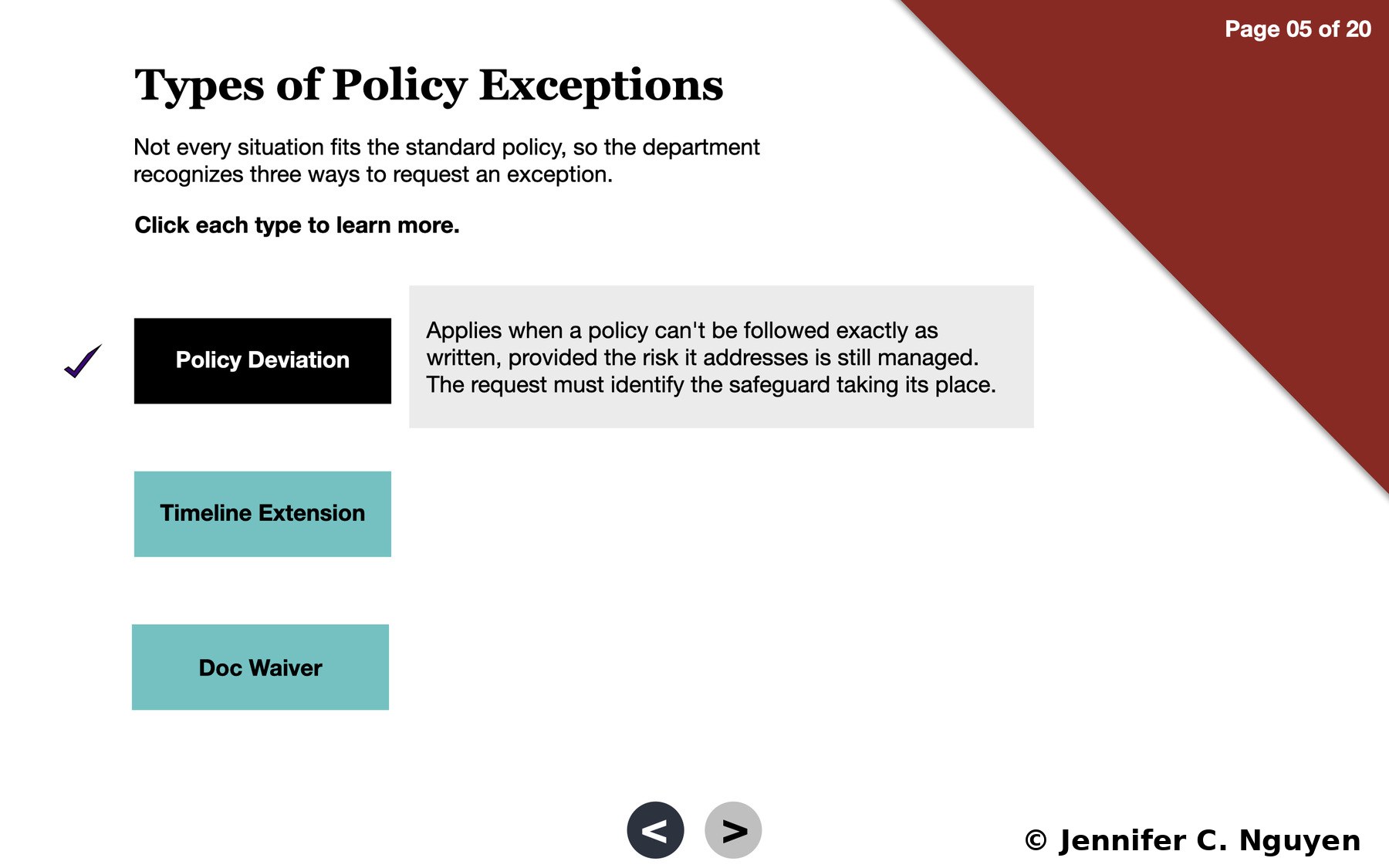
Types of Policy Exceptions slide with the Policy Deviation accordion button revealed in black with a checkmark, grey content box showing description text about applying when a policy can't be followed exactly as written provided the risk it addresses is still managed, Timeline Extension and Doc Waiver buttons still in teal unrevealed state, slide counter reading Page 05 of 20Types of Policy Exceptions — Policy Deviation revealed with checkmark and description
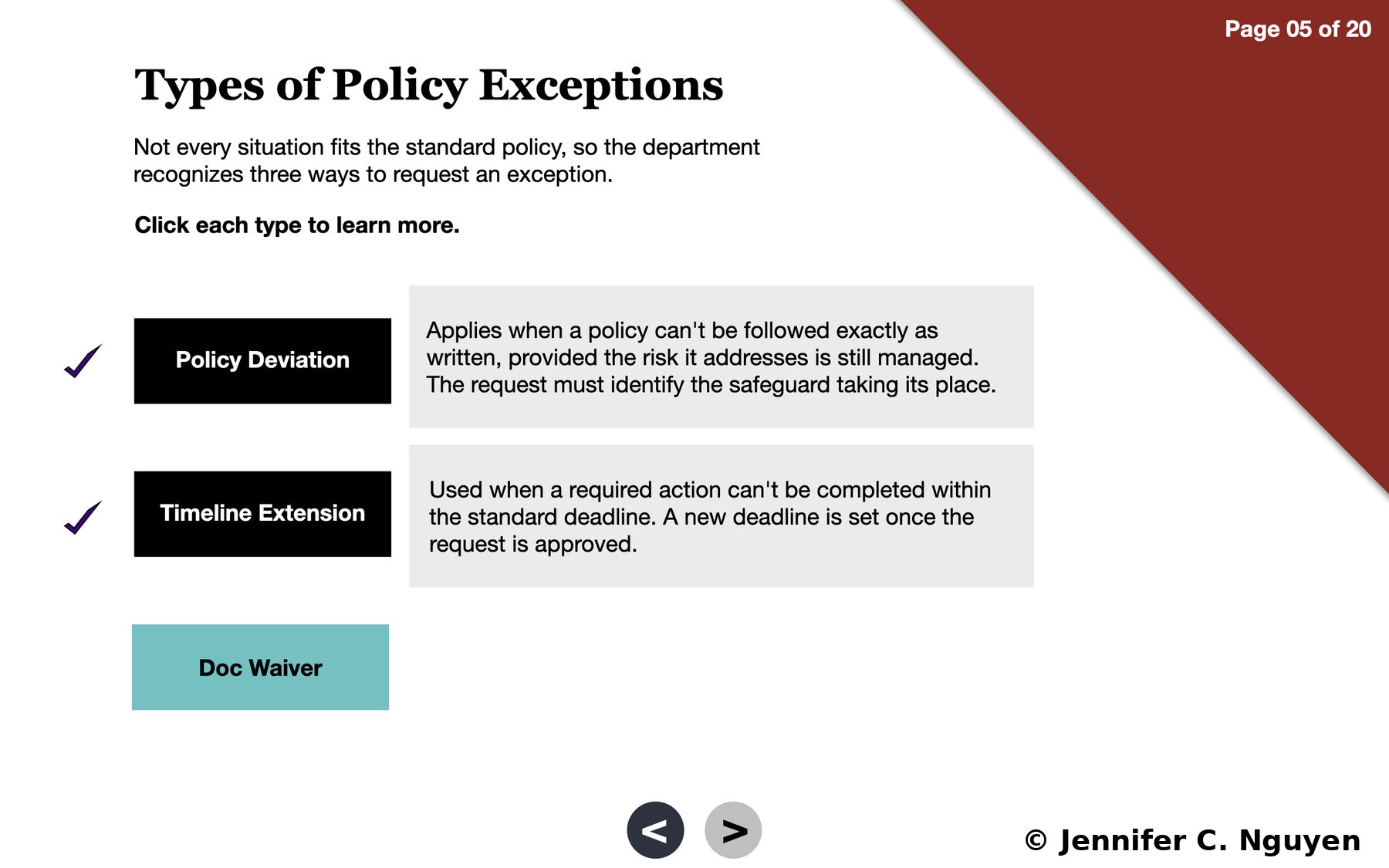
Types of Policy Exceptions slide with Policy Deviation and Timeline Extension accordion buttons both revealed in black with checkmarks and grey content boxes describing each exception type, Doc Waiver button still in teal unrevealed state, slide counter reading Page 05 of 20Types of Policy Exceptions — two of three accordion items revealed
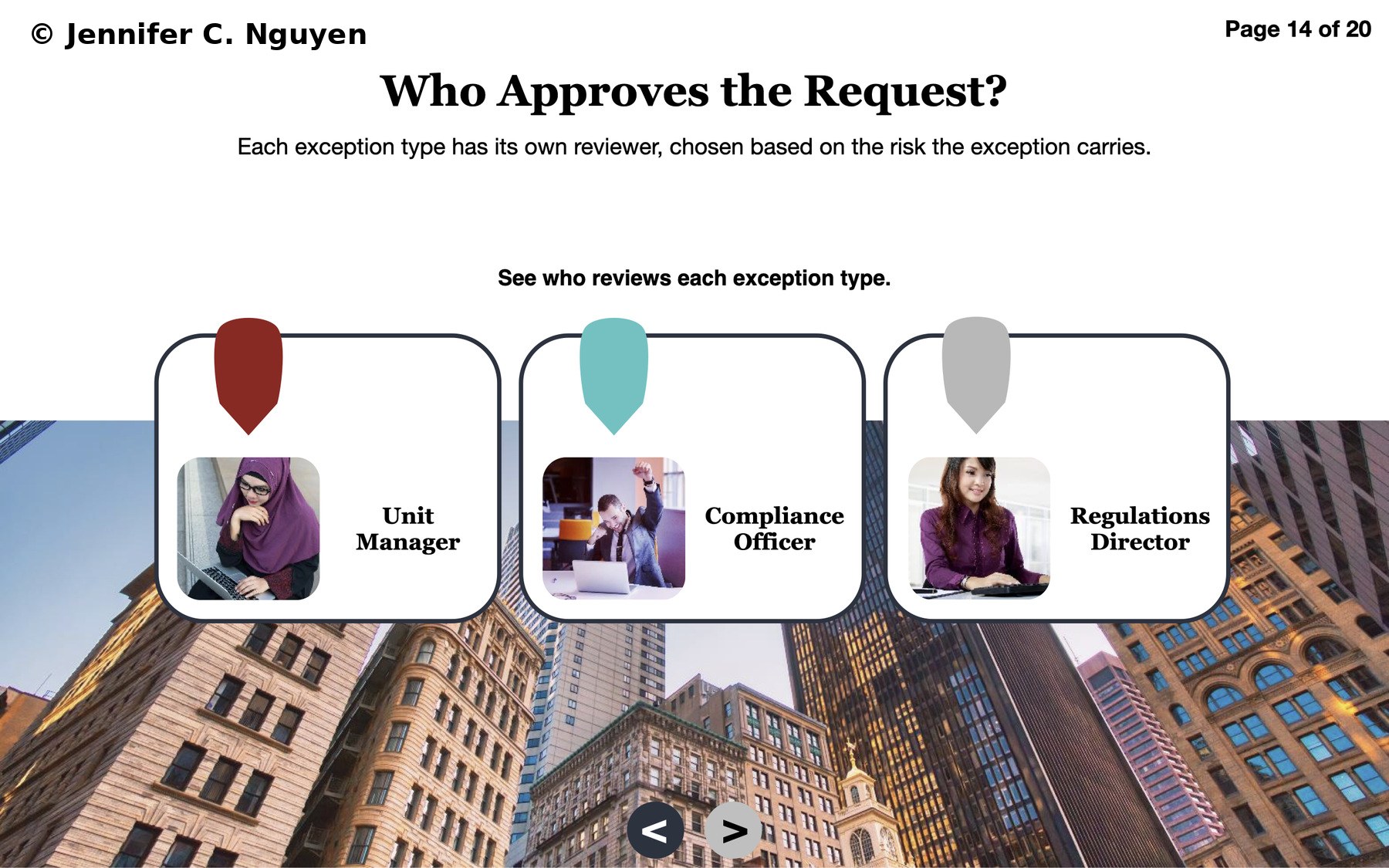
Who Approves the Request? slide with bold serif title, sentence explaining each exception type has its own reviewer chosen based on risk, See who reviews each exception type instruction, three rounded photo cards over a city skyline photograph labeled Unit Manager, Compliance Officer, and Regulations Director with color-coded pin markers in red, teal, and grey, slide counter reading Page 14 of 20Who Approves the Request — three role-based photo cards over city skyline photography

Unit Manager branching reveal popup with X close button in upper right corner, photo of a woman in a purple hijab and glasses working on a laptop, red header bar with bold Unit Manager title, scenario paragraph describing a wire transfer over $10,000 that can't meet the standard two-signature requirement, second paragraph about the compensating control confirmed before approval, Select the X button to exit this window instruction at bottomUnit Manager — branching reveal with wire transfer exception scenario
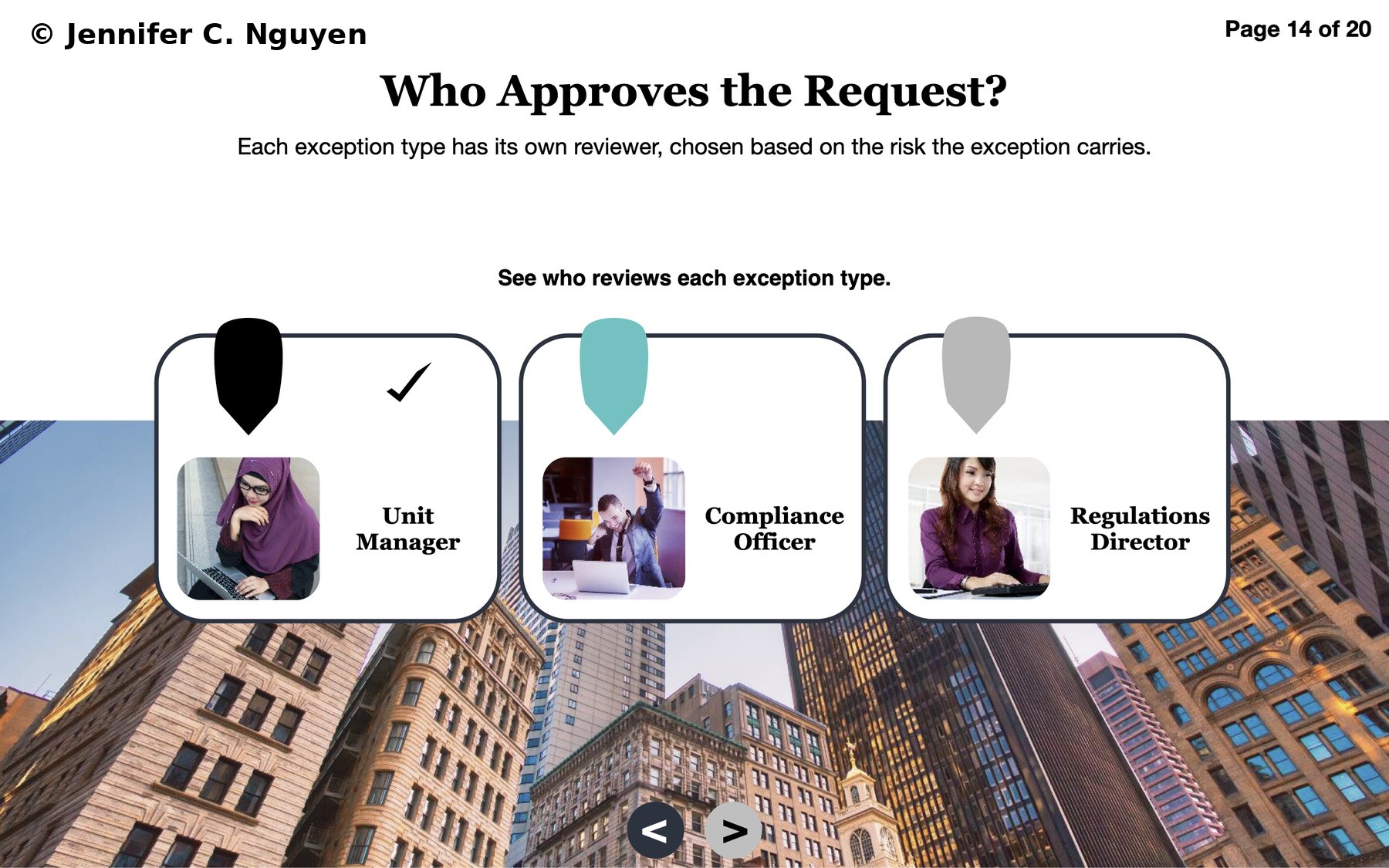
Who Approves the Request? slide showing the Unit Manager card fully visited with a checkmark and black pin marker, Compliance Officer and Regulations Director cards still in their original teal and grey unvisited pin colors, city skyline photograph anchoring the base of all three cards, slide counter reading Page 14 of 20Who Approves the Request — Unit Manager card in visited state with checkmark
07
Regulation E: Electronic Fund Transfer Error Resolution

Bringing a playful purple 3D theme to a financial institution's regulations department, this course pairs dimensional illustrated objects with checkmark-tracked buttons that reveal one dispute scenario at a time. Left-aligned, ragged-right popup text keeps reading easier for everyone, especially low-vision and dyslexic learners, showing that regulation training doesn't have to feel intimidating.

Regulation EConsumer BankingError Resolution3D IllustrationVisited-State Tracking
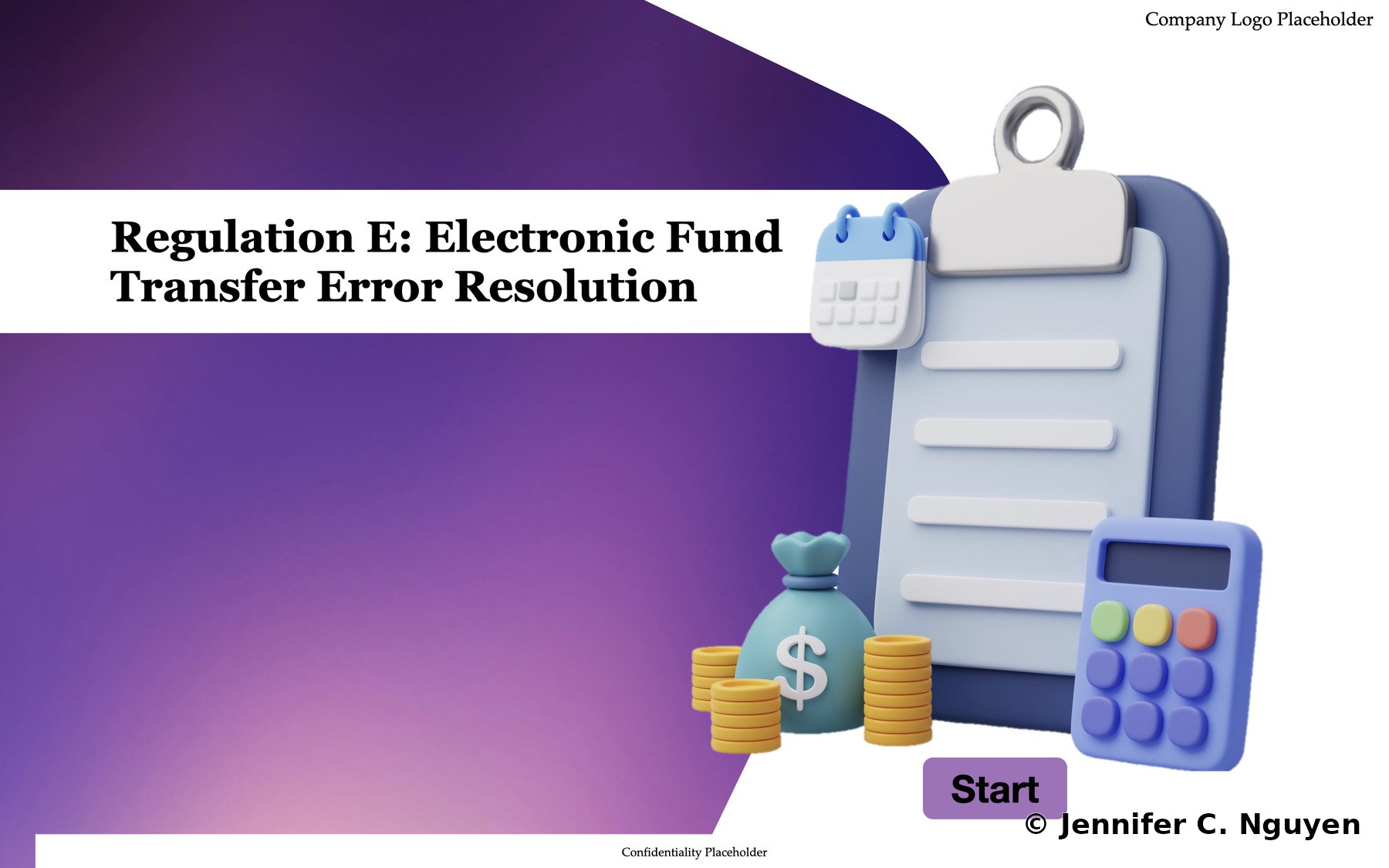
Regulation E Electronic Fund Transfer Error Resolution course start page with playful purple 3D theme, dimensional illustrated clipboard, calendar, calculator, money bag, and coin stacks, white Company Logo placeholder banner top right, bold title box on white banner across the middle, purple rounded Start button lower right, Confidentiality placeholder banner at bottomStart Page — Regulation E course title over playful purple 3D illustration
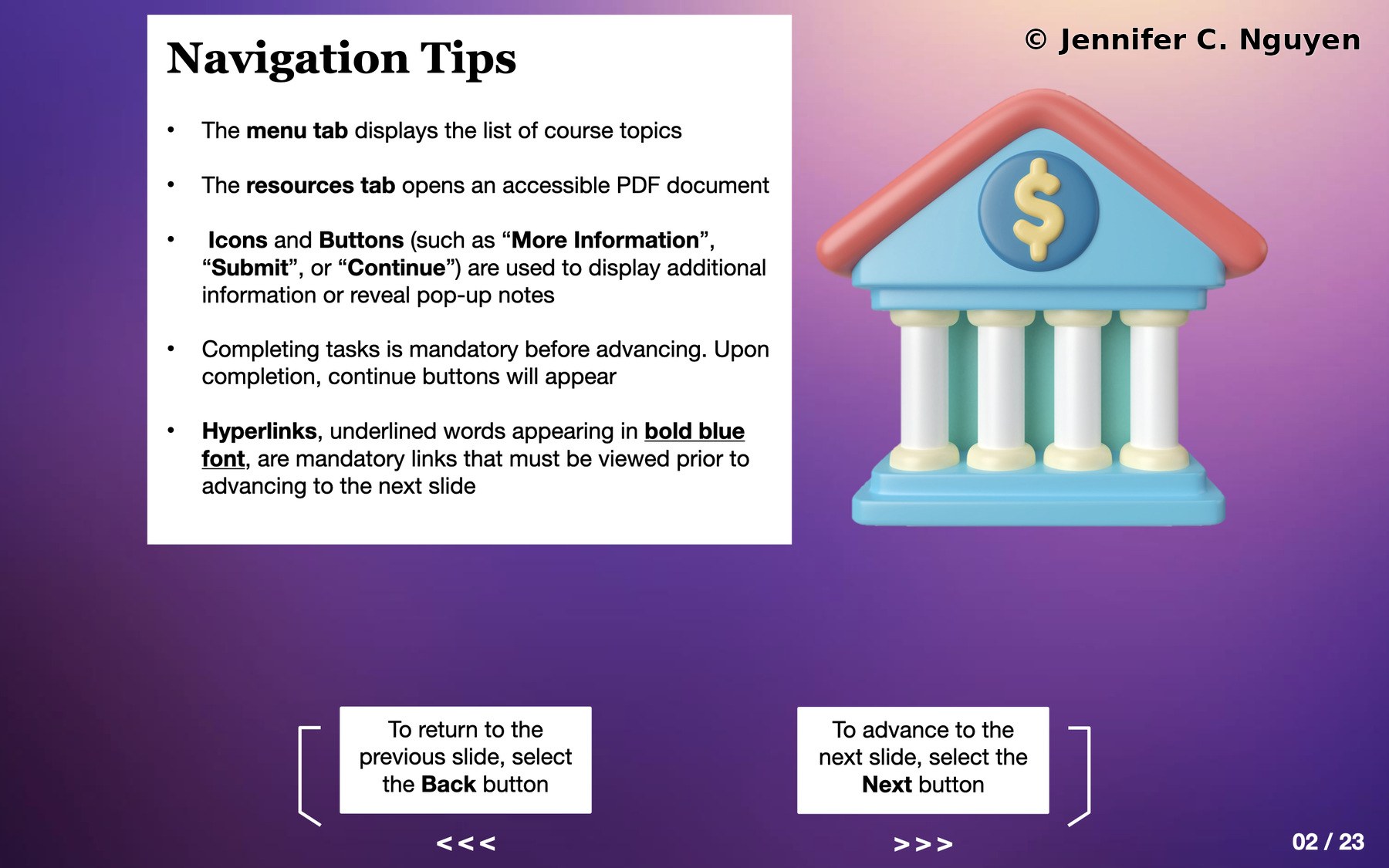
Navigation Tips slide with white card listing five navigation instructions covering the menu tab, resources tab, icons and buttons, mandatory task completion, and hyperlinks, dimensional illustrated bank building with a dollar sign medallion on a purple to peach gradient background, back and next bracket callouts at the bottom, slide counter reading 02 of 23Navigation Tips — illustrated bank icon framing seven navigation instructions
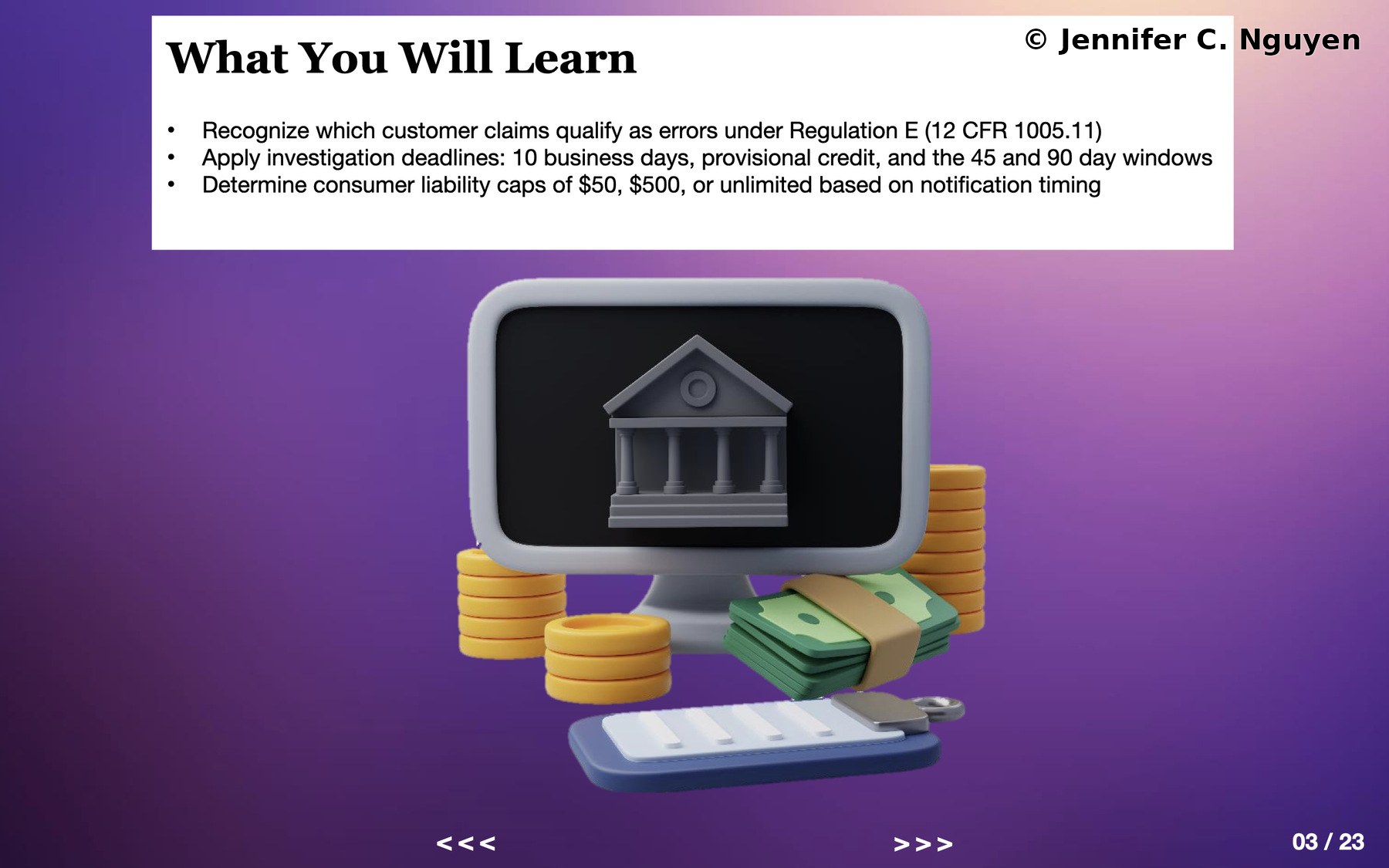
What You Will Learn objectives slide with three bullet points covering recognizing qualifying errors under Regulation E citing 12 CFR 1005.11, applying investigation deadlines including the 10 business day, 45 day, and 90 day windows, and determining consumer liability caps of $50, $500, or unlimited based on notification timing, dimensional illustrated computer monitor displaying a bank icon surrounded by coin stacks and cash on a purple gradient background, slide counter reading 03 of 23What You Will Learn — three measurable objectives over illustrated money and computer graphics
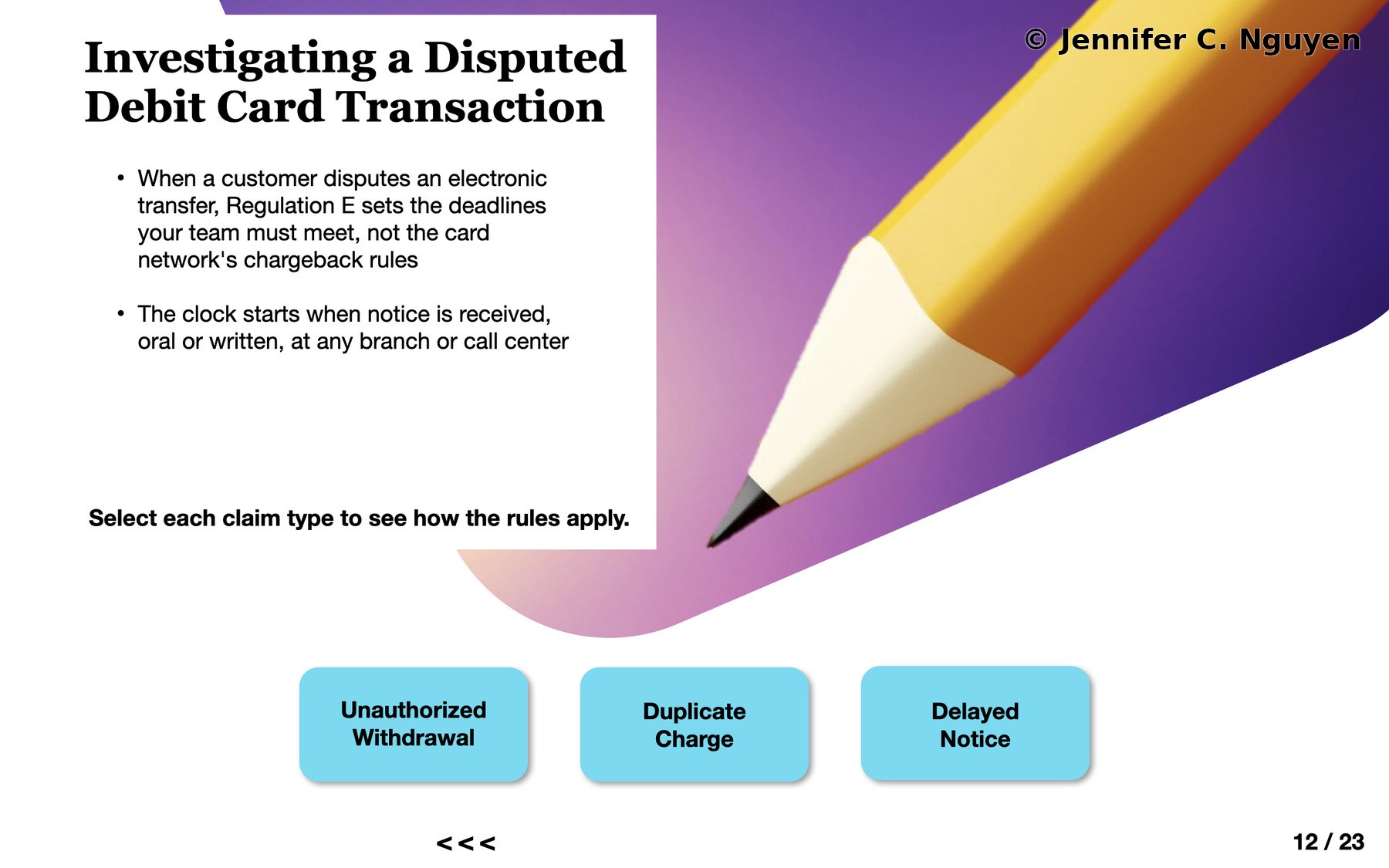
Investigating a Disputed Debit Card Transaction slide with two introductory bullet points explaining Regulation E deadlines and notice timing, giant illustrated pencil pointing toward three unrevealed sky blue buttons labeled Unauthorized Withdrawal, Duplicate Charge, and Delayed Notice, instruction reading Select each claim type to see how the rules apply, slide counter reading 12 of 23Investigating a Disputed Debit Card Transaction — three claim-type buttons in unrevealed state
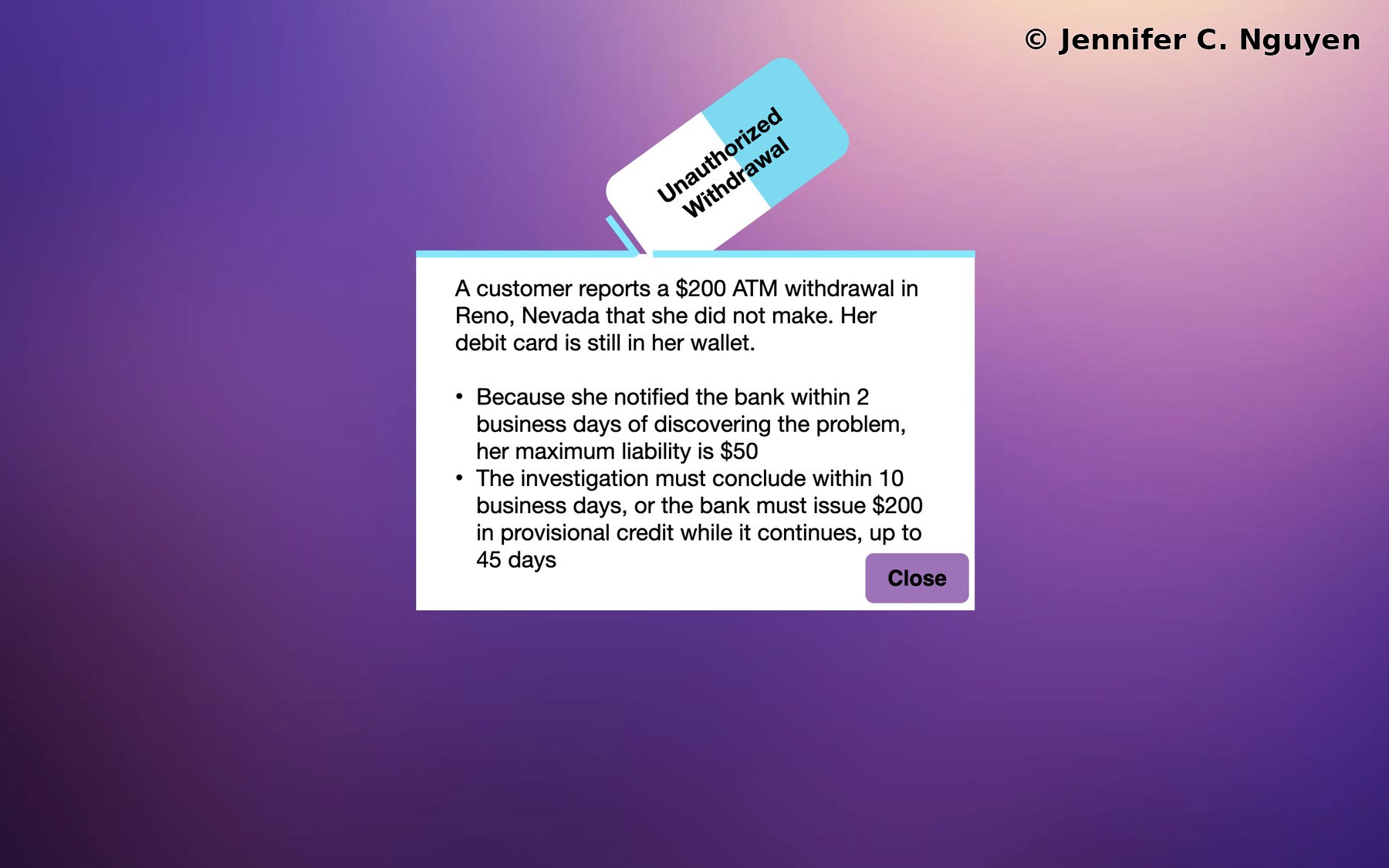
Unauthorized Withdrawal popup with an illustrated eraser peeling back to reveal a white card, left-aligned scenario paragraph describing a disputed two hundred dollar ATM withdrawal in Reno Nevada with the card still in the customer's wallet, two bullet points covering the fifty dollar liability cap for notifying within 2 business days and the ten business day investigation deadline requiring $200 in provisional credit for up to 45 days, purple Close button in the lower right cornerUnauthorized Withdrawal — eraser-reveal popup with liability cap and investigation deadline
Investigating a Disputed Debit Card Transaction slide showing the Unauthorized Withdrawal button in visited state with a checkmark and split white and sky blue fill, Duplicate Charge and Delayed Notice buttons still unrevealed, giant illustrated pencil on purple gradient background, slide counter reading 12 of 23Investigating a Disputed Debit Card Transaction — one of three claim types visited
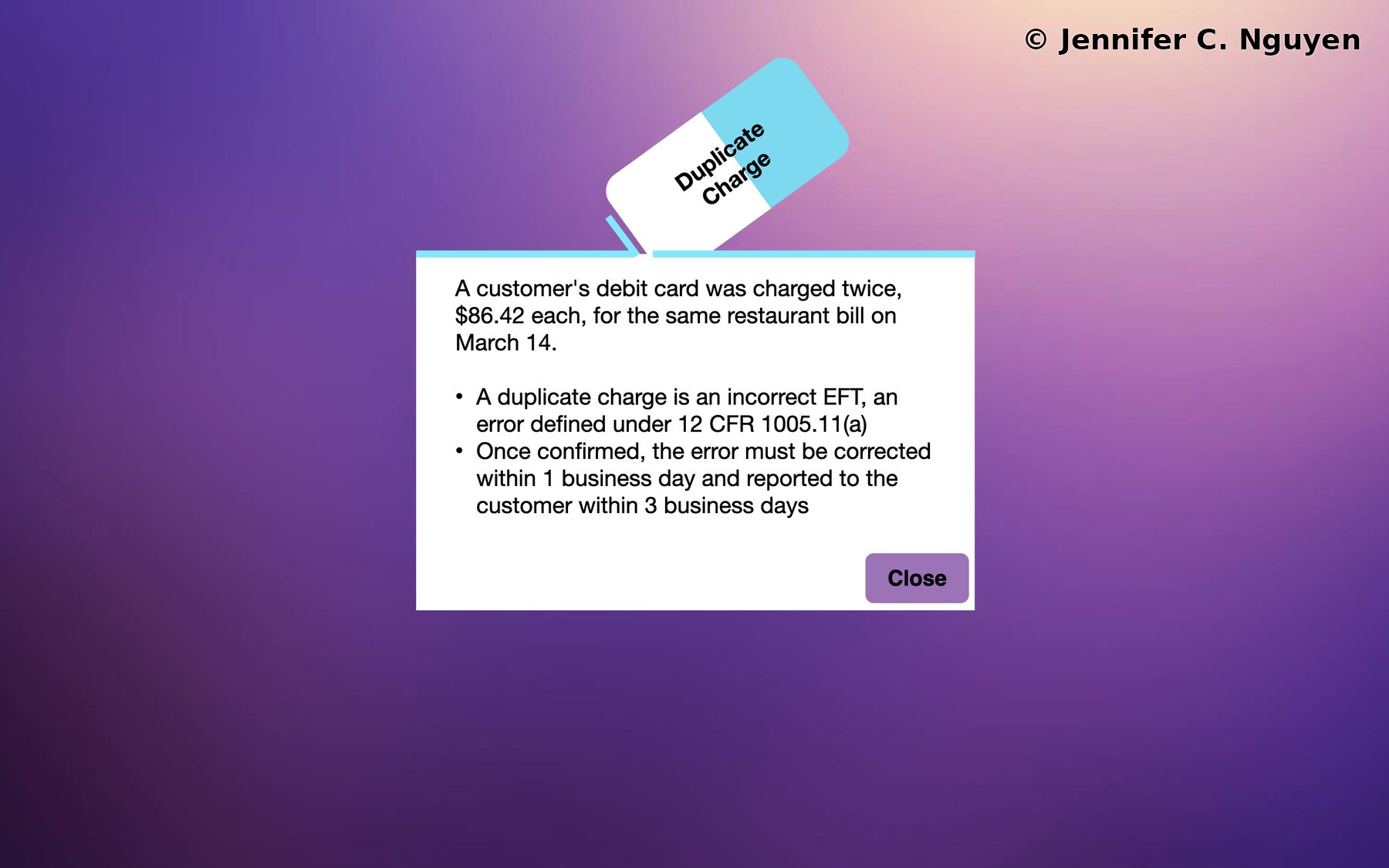
Duplicate Charge popup with an illustrated eraser peeling back to reveal a white card, left-aligned scenario paragraph describing an eighty six dollar and forty two cent restaurant charge posted twice on March 14, two bullet points covering the Regulation E error definition citing 12 CFR 1005.11(a) and the requirement to correct within 1 business day and report to the customer within 3 business days, purple Close button in the lower right cornerDuplicate Charge — eraser-reveal popup with error definition and correction deadline
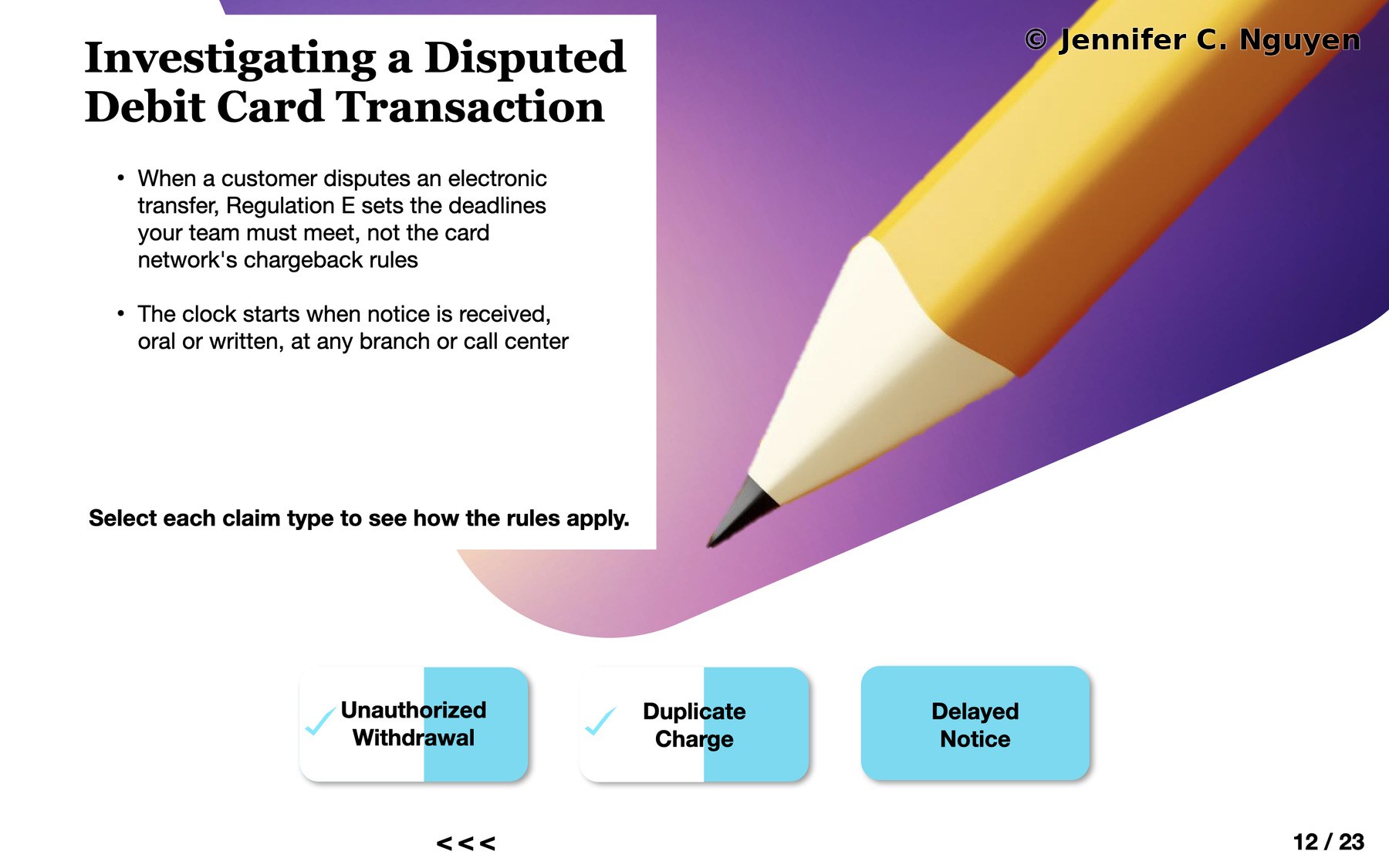
Investigating a Disputed Debit Card Transaction slide showing Unauthorized Withdrawal and Duplicate Charge buttons both in visited state with checkmarks and split white and sky blue fill, Delayed Notice button still unrevealed, giant illustrated pencil on purple gradient background, slide counter reading 12 of 23Investigating a Disputed Debit Card Transaction — two of three claim types visited
08
Fair Credit Reporting Act: Requesting and Using Consumer Reports

Conveying a grand, timeless feel, this course pairs an elegant blue theme with neoclassical column photography for a large financial institution's regulations department. Pin markers act as a wayfinding metaphor, revealing photographed scenarios with checkmark-and-color visited states accessible for everyone, especially colorblind learners, while guiding employees through FCRA permissible purpose and adverse action requirements.

FCRAConsumer ReportingAdverse ActionPhoto-Based InteractivityPin-Marker Navigation
Fair Credit Reporting Act Requesting and Using Consumer Reports course start page with photograph of grand neoclassical stone columns, navy title box centered on the image with white serif course title, white Company Logo placeholder banner, tan rounded Start button, light blue Confidentiality placeholder banner at bottomStart Page — FCRA course title over grand neoclassical column photography
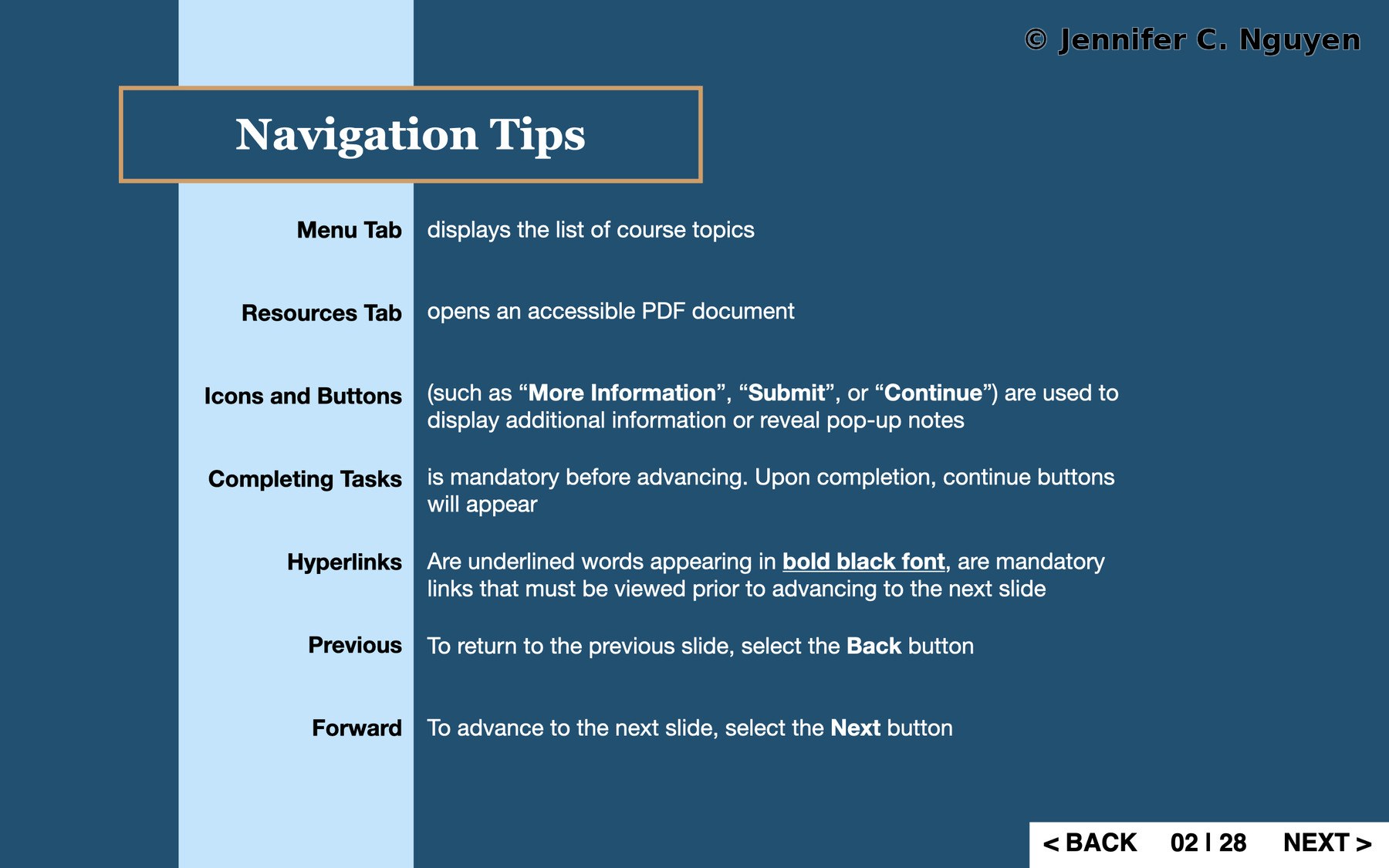
Navigation Tips slide on navy background with light blue vertical stripe accent, tan-bordered title box, seven navigation instructions arranged in two columns covering menu tab, resources tab, icons and buttons, completing tasks, hyperlinks, previous, and forward, back and next buttons in bottom right, slide counter reading 02 | 28Navigation Tips — seven navigation instructions on navy and light blue background
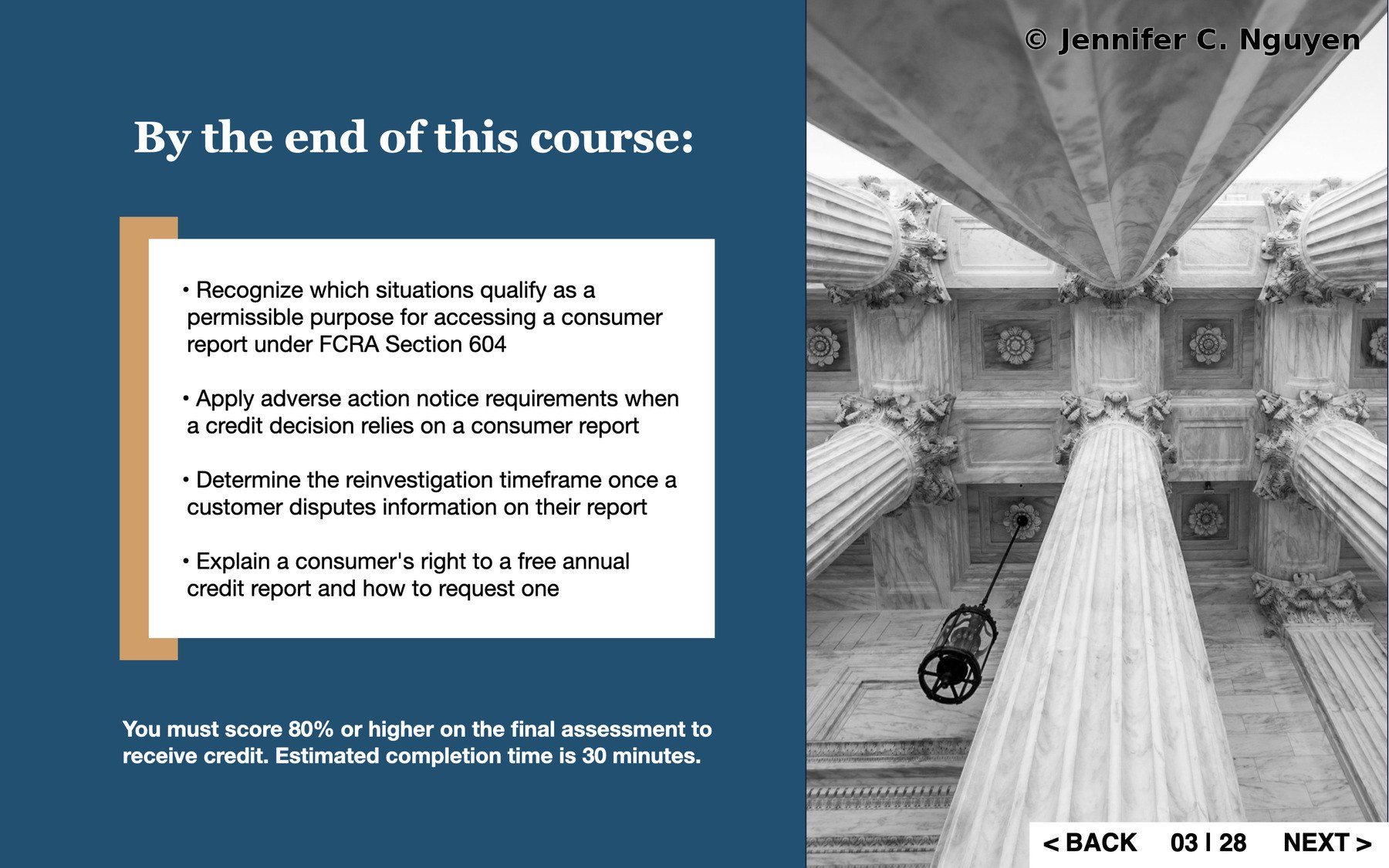
By the end of this course objectives slide with tan accent bar and white content box listing four bullet points covering recognizing permissible purpose under FCRA Section 604, adverse action notice requirements, reinvestigation timeframes, and free annual credit report rights, black and white photograph of ornate column capitals and ceiling detail, bold text noting an 80 percent passing score and 30 minute estimated completion time, slide counter reading 03 | 28By the End of This Course — four objectives with passing score and completion time noted
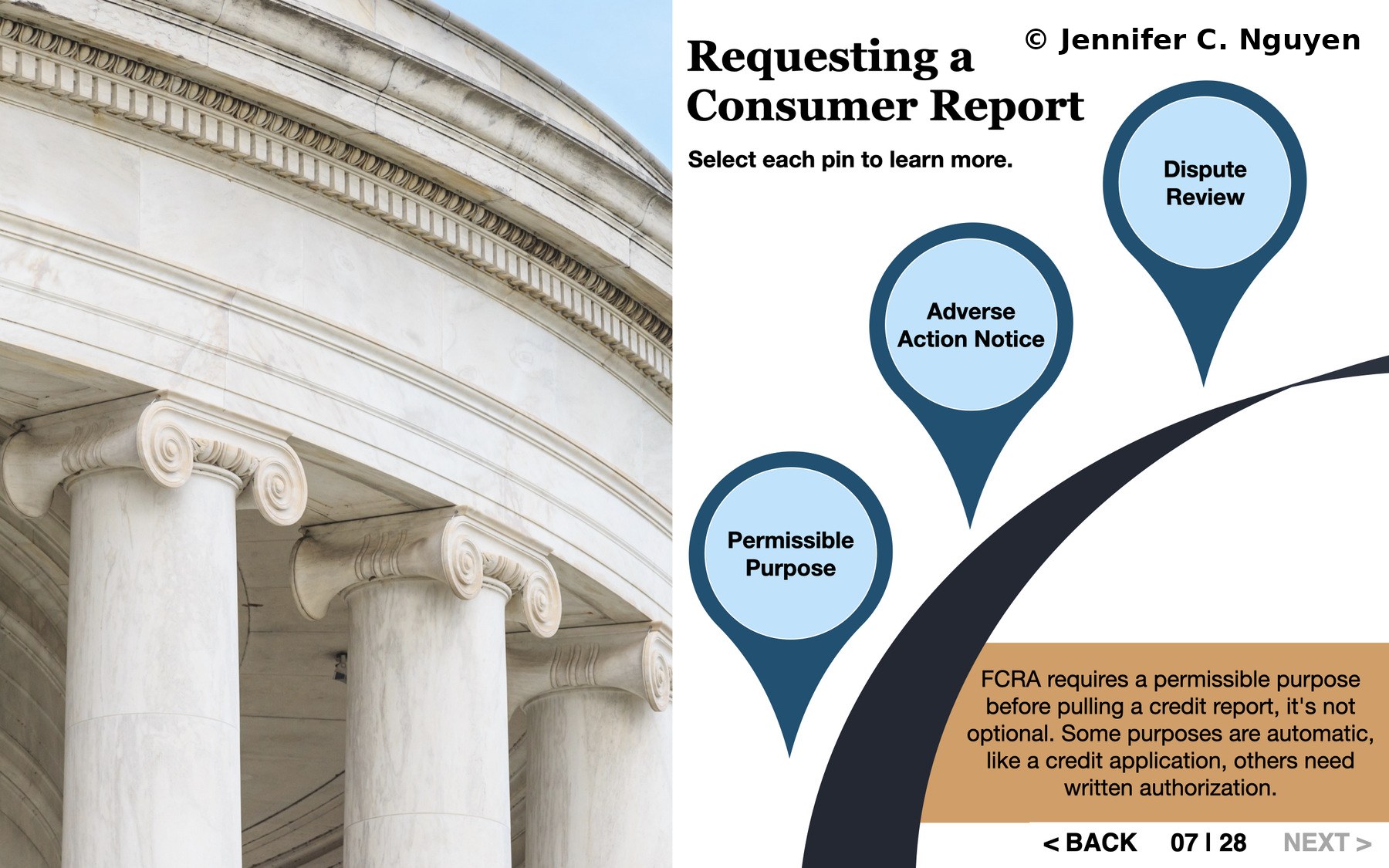
Requesting a Consumer Report slide with close-up photograph of ionic column capitals on the left, three unrevealed navy-bordered light blue pin markers labeled Permissible Purpose, Adverse Action Notice, and Dispute Review on the right, instruction reading Select each pin to learn more, slide counter reading 07 | 28Requesting a Consumer Report — three pin markers in unrevealed state over column photography

Permissible Purpose popup on dark navy background with a white teardrop pin shape framing a tan-bordered photograph of three business professionals walking together, white serif heading, paragraph describing a loan officer pulling a credit report for a fifteen thousand dollar auto loan citing FCRA Section 604(a)(3)(A) and civil liability starting at $100 per violation, X close button in the upper right cornerPermissible Purpose — pin-shaped photo popup with FCRA Section 604 scenario
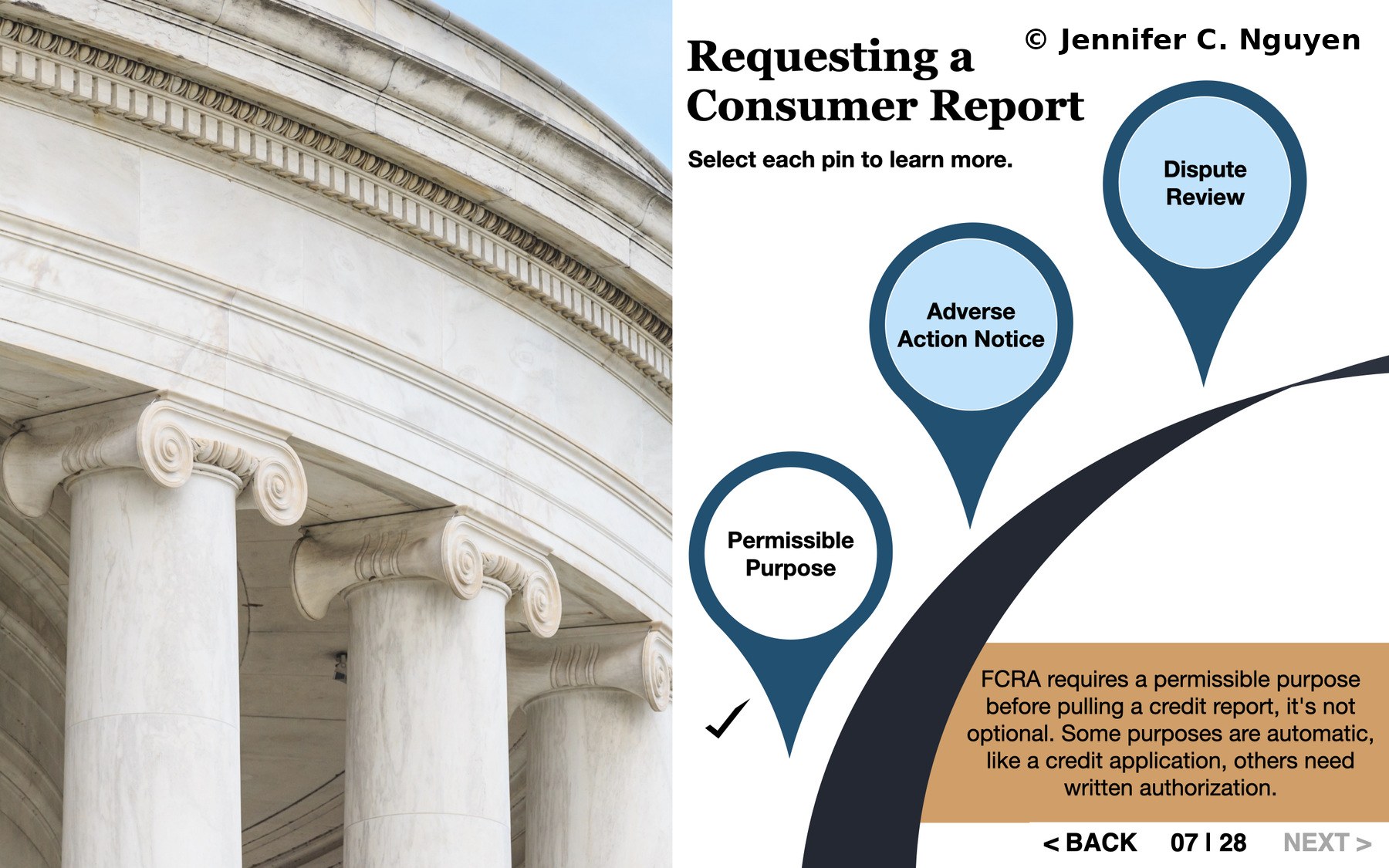
Requesting a Consumer Report slide showing the Permissible Purpose pin marker in visited state with a checkmark below it, a tan content box reading that FCRA requires a permissible purpose before pulling a credit report, some purposes automatic like a credit application and others needing written authorization, Adverse Action Notice and Dispute Review pins still in their original unrevealed light blue fill, column photograph on the left, slide counter reading 07 | 28Requesting a Consumer Report — one of three pin markers visited
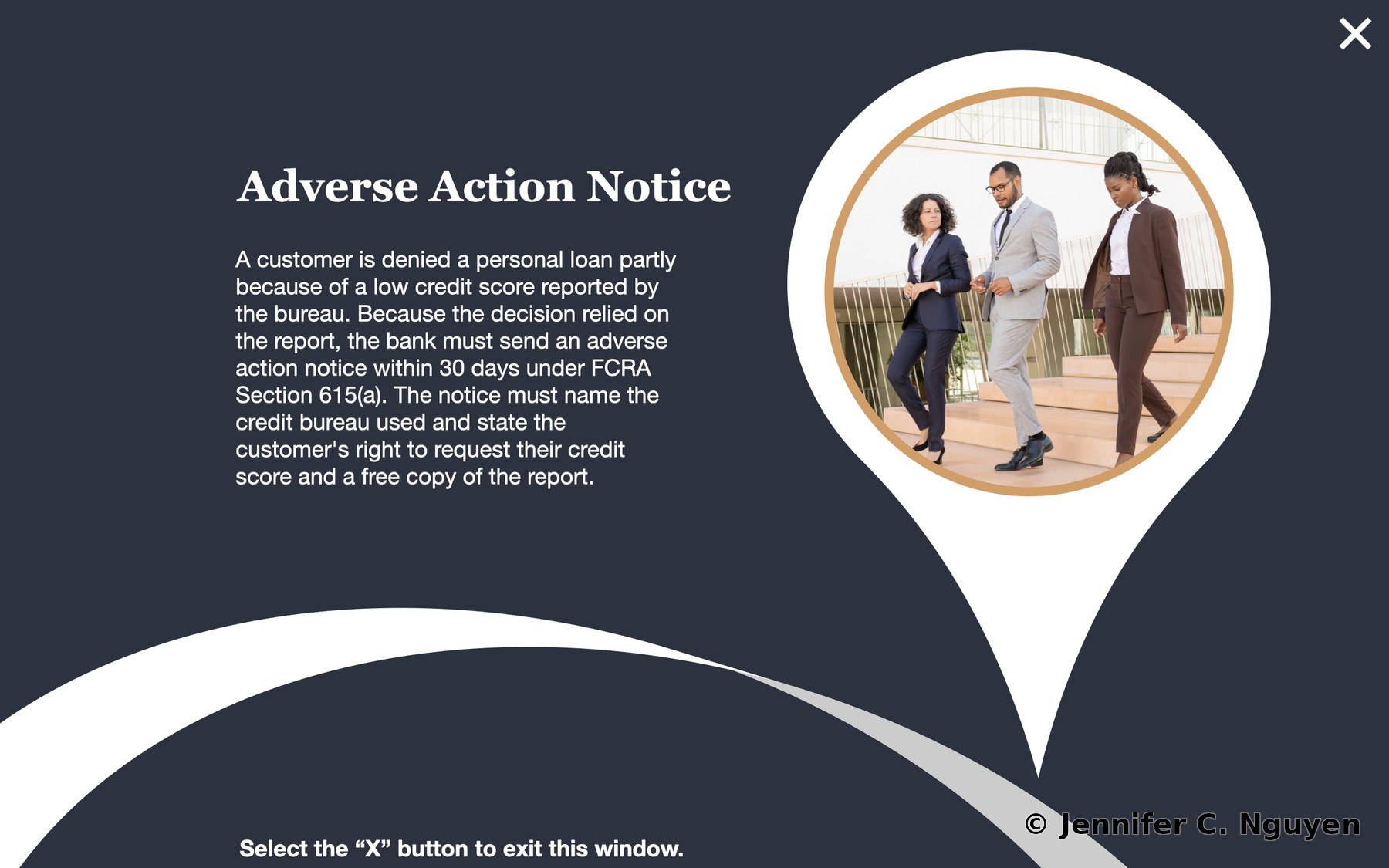
Adverse Action Notice popup on dark navy background with a white teardrop pin shape framing a tan-bordered photograph of three business professionals descending outdoor stairs, white serif heading, paragraph describing a loan denial tied to a low credit score requiring an adverse action notice within 30 days under FCRA Section 615(a), naming the credit bureau and stating the right to a free credit score and report, X close button in the upper right cornerAdverse Action — pin-shaped photo popup with FCRA Section 615 notice requirements
Interactive Elements Reference slide on white background showing Normal, Hover, Visited, and Disabled states for Back and Next text links, Start and Exit Course buttons in tan, black, and navy, and circular pin markers with Text, Image Placeholder, and checkmark variations, plus a numbered progress bar showing unvisited, hover, and visited statesInteractive Elements Reference — button, pin, and progress bar states across four conditions
09
Combatting Medicare Parts C and D Fraud, Waste, and Abuse

A companion to the Medicare General Compliance training, this course shifts focus to identifying and correcting fraud, waste, and abuse under Medicare Parts C and D. Icon-triggered examples and mandatory step-by-step gating keep navigation locked until each concept is reviewed, a built-in pacing structure that also benefits learners who process information best in sequence.

Fraud Waste and AbuseMedicare Parts C and DGated NavigationIcon-Based RevealsCompanion Course
Combatting Medicare Parts C and D Fraud Waste and Abuse course start page with teal desk photography of a laptop, notebook, and glasses, teal accent line above bold black course title and teal subtitle, teal Start button lower right, Company Logo and Confidentiality placeholder text in the cornersStart Page — course title over a soft teal desk photography backdrop
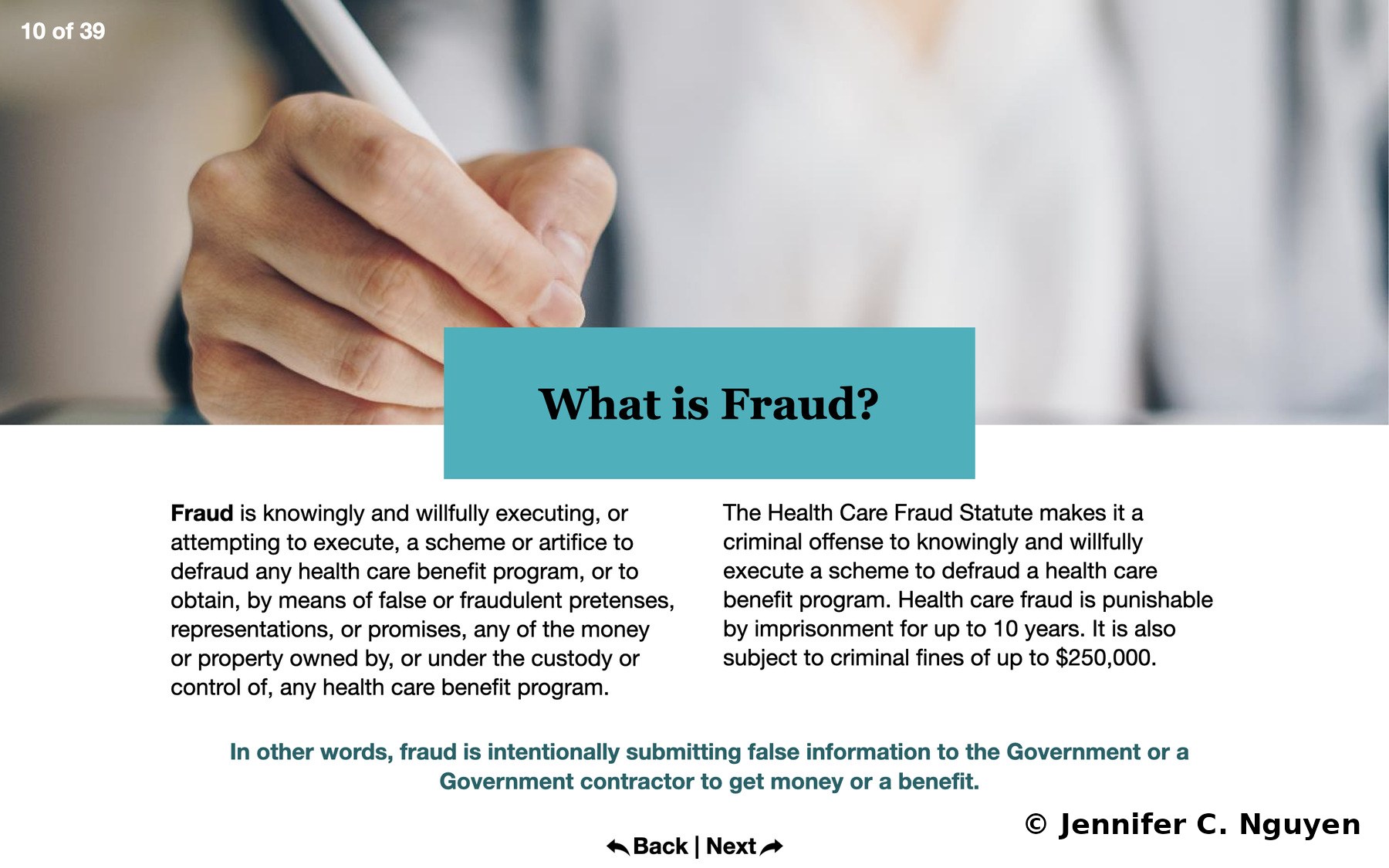
What is Fraud? slide with a close-up photograph of a hand holding a stylus over a document, teal title callout box, two columns of black body text defining fraud and citing the Health Care Fraud Statute penalties of up to 10 years imprisonment and fines up to $250,000, bolded teal summary sentence at the bottom, back and next links, slide counter reading 10 of 39What is Fraud — statute definition with penalty details and a plain-language summary
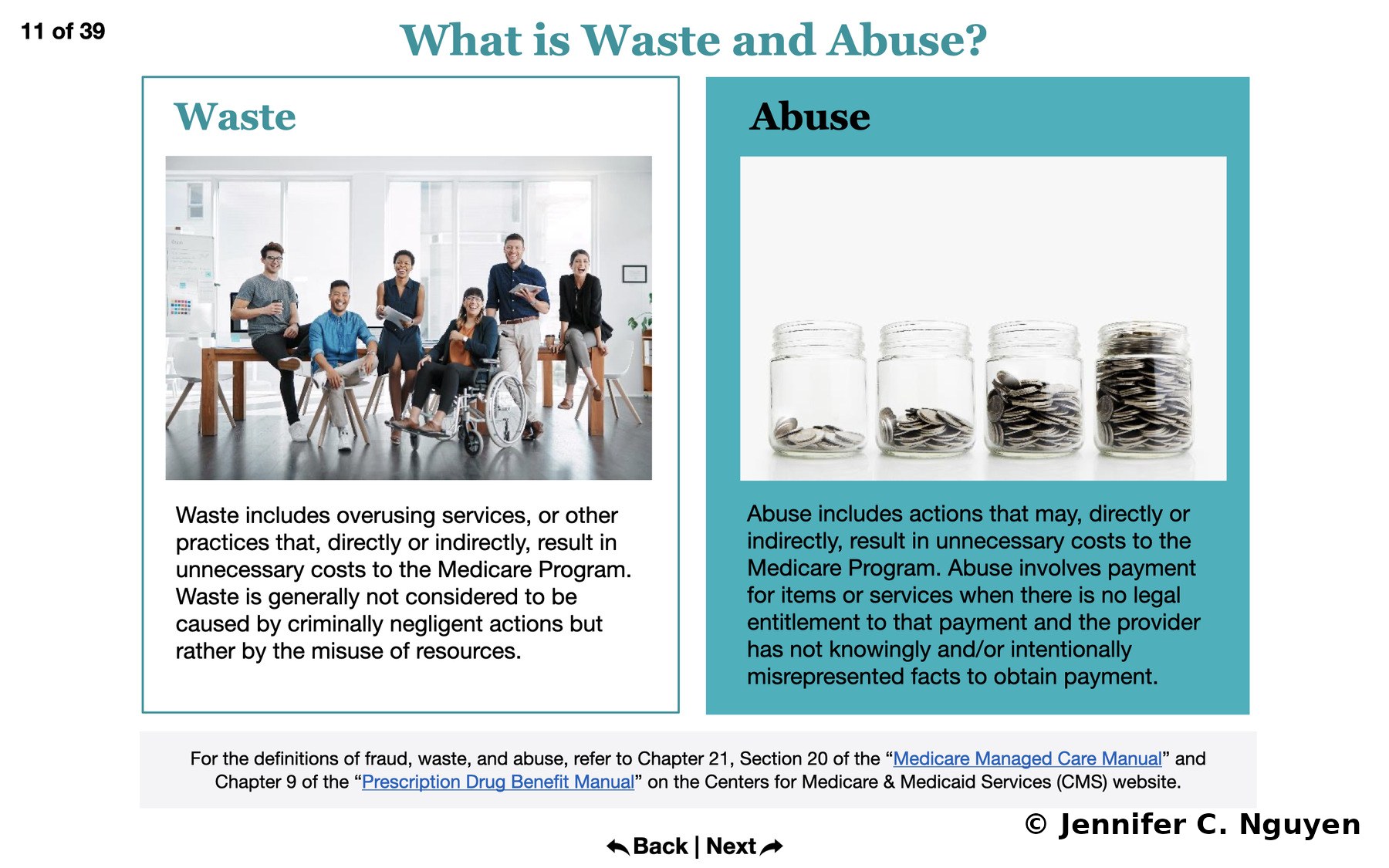
What is Waste and Abuse? slide with two side-by-side bordered panels, a white panel with a group photograph and definition of waste, and a teal panel with a photograph of coin-filled jars and a definition of abuse, gray citation bar below citing Chapter 21 Section 20 of the Medicare Managed Care Manual and Chapter 9 of the Prescription Drug Benefit Manual, slide counter reading 11 of 39What is Waste and Abuse — side-by-side definitions with a Medicare manual citation
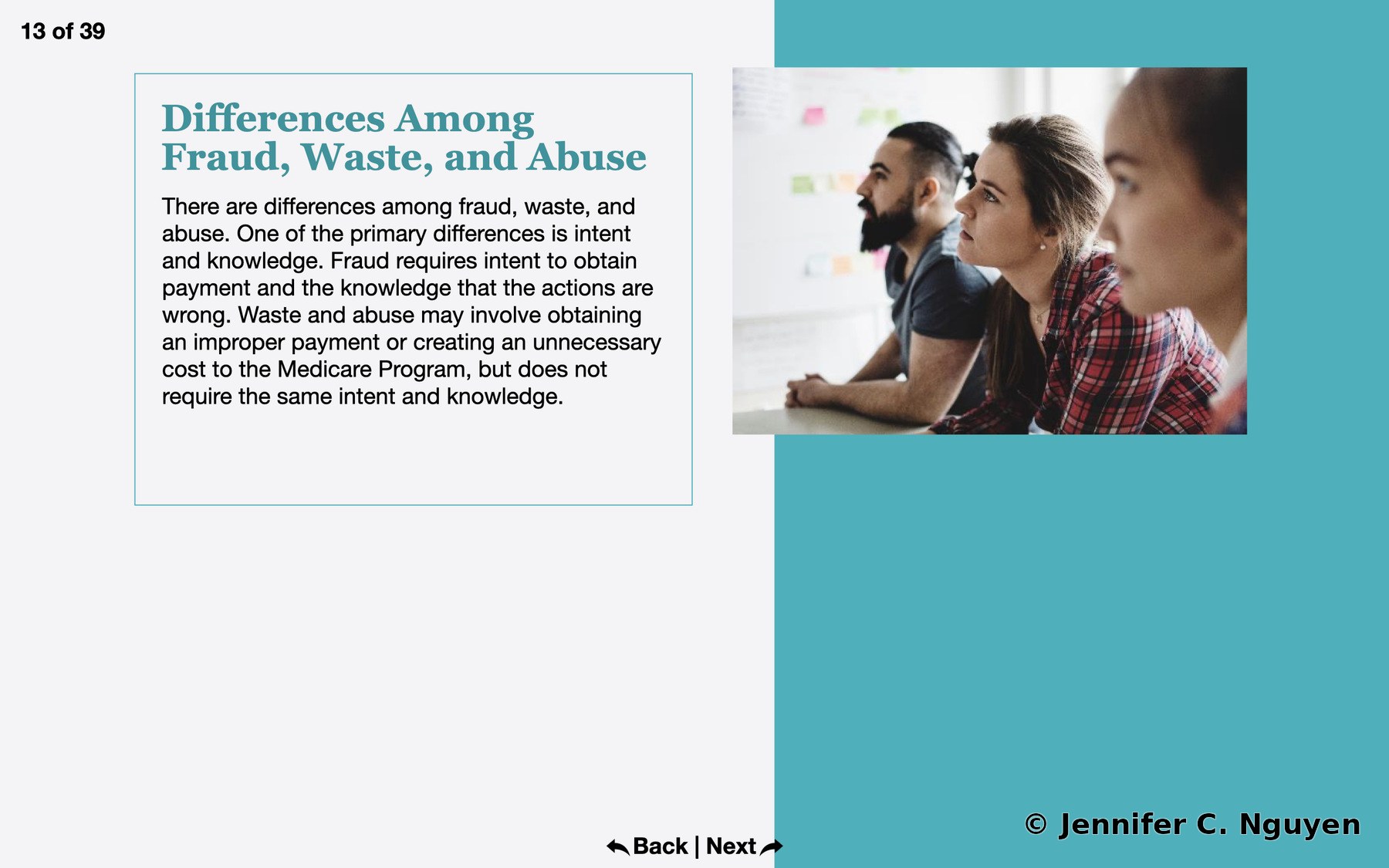
Differences Among Fraud Waste and Abuse slide with a teal-bordered text box explaining the intent and knowledge distinction, photograph of three colleagues looking off camera to the right, teal background block, slide counter reading 13 of 39Differences Among Fraud, Waste, and Abuse — intent and knowledge distinctions explained
Health Insurance Portability and Accountability Act (HIPAA) slide in unrevealed state, teal panel on the left with HIPAA background text and a hyperlink, two empty outlined boxes on the right labeled Example and Damages and Penalties each topped with a colored icon, instruction reading Select each icon to learn more, slide counter reading 23 of 39HIPAA — Example and Damages and Penalties icons in unrevealed state
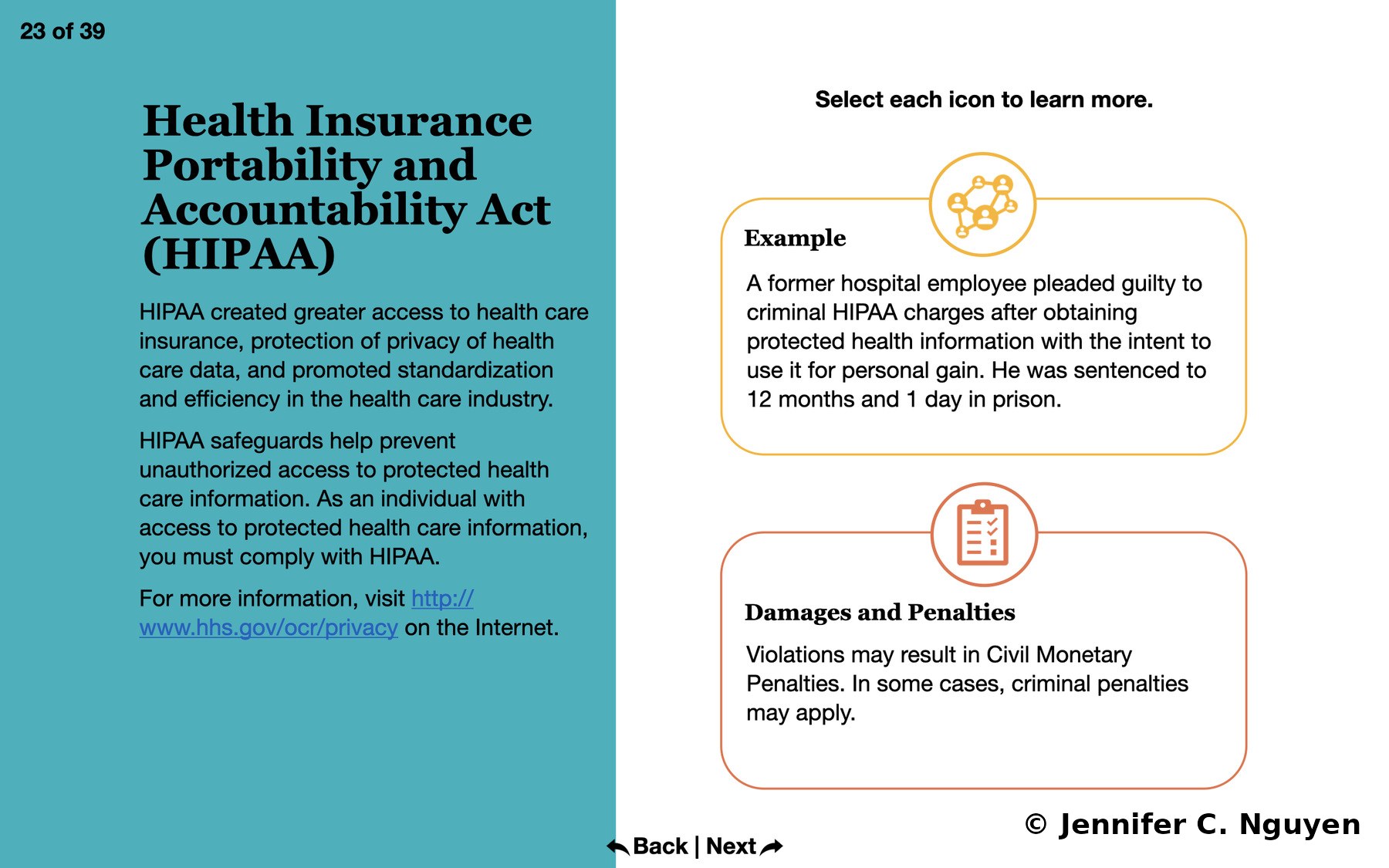
Health Insurance Portability and Accountability Act (HIPAA) slide with both boxes revealed, Example box describing a former hospital employee's criminal HIPAA case resulting in a 12 month and 1 day prison sentence, Damages and Penalties box describing civil monetary and criminal penalties, back and next links visible, slide counter reading 23 of 39HIPAA — both icons revealed with a real-world case example and penalty details
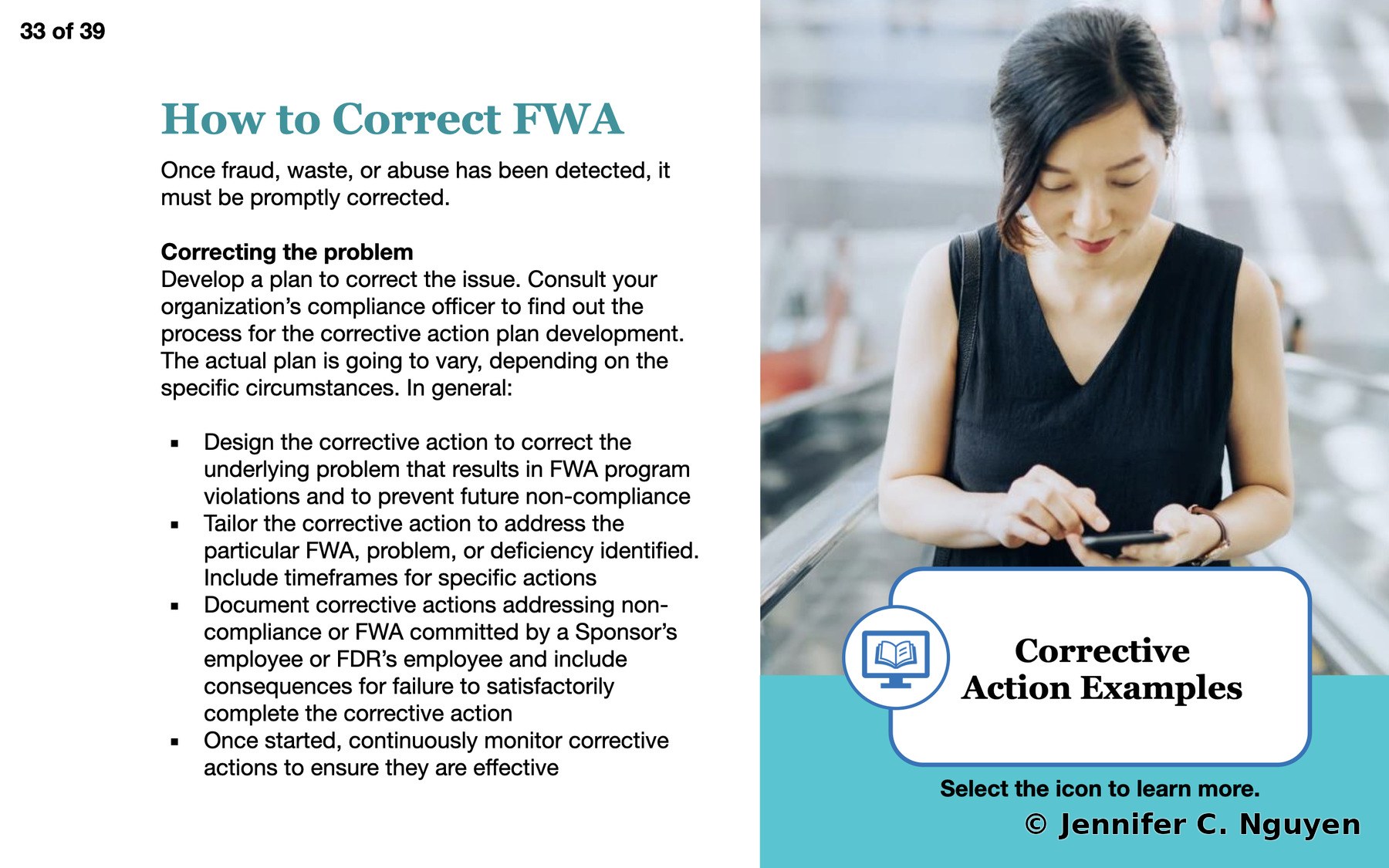
How to Correct FWA slide with black body text outlining a four-item bulleted corrective action plan process under a Correcting the problem subheading, photograph of a woman checking her phone on the right, white rounded callout box reading Corrective Action Examples with a workbook icon, instruction reading Select the icon to learn more, slide counter reading 33 of 39How to Correct FWA — five-step corrective action process with an examples callout
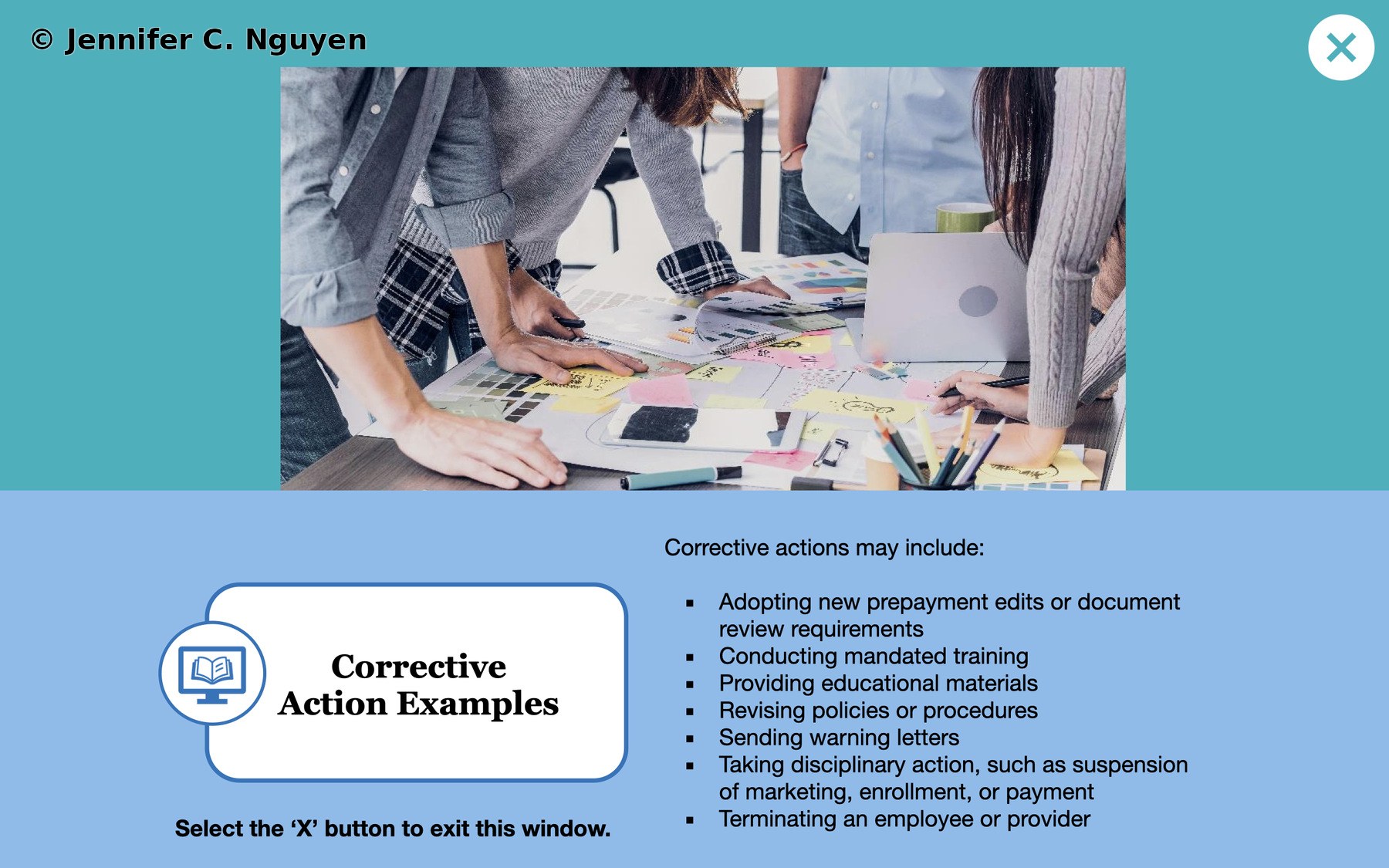
Corrective Action Examples popup with a teal header photograph of colleagues collaborating around sticky notes, light blue lower panel listing seven bulleted corrective action examples including prepayment edits, mandated training, and termination, white rounded Corrective Action Examples label with a workbook icon, bold instruction reading Select the X button to exit this window, teal X close button in the upper right cornerCorrective Action Examples — popup listing seven possible remediation steps

Articulate Rise Responsive · Mobile-Friendly · Web-Based

Compliance & Regulatory Course Library

A working reference of the compliance, regulatory, and workplace training courses built and maintained in Articulate Rise during my time at First Republic Bank, spanning BSA/AML, fair lending, data privacy, wealth management and trust regulation, information security, and HR/workplace policy. Grouped by subject area below — select a category to expand it.

First Republic BankArticulate RiseCompliance TrainingRegulatory TrainingCourse Catalog
BSA/AML, KYC & OFAC Compliance
  • BSA/AML Enterprise-wide Training
  • BSA/AML Training for Deposits
  • BSA/AML Training for FRIM-FRSC
  • BSA/AML Training for FRTC
  • BSA/AML Training for FX
  • BSA/AML Training for Lending
  • Private Wealth Management KYC New Hire Training
  • Remedial: BSA/AML Enterprise-wide Training
  • Remedial: BSA/AML Training for Deposits
  • Remedial: BSA/AML Training for FRIM-FRSC
  • Remedial: BSA/AML Training for FRTC
  • Remedial: BSA/AML Training for FX
  • Remedial: BSA/AML Training for Lending
  • OFAC Gradifi-Specific Training
Fraud Prevention & Financial Crimes
  • Community Reinvestment Act
  • Bankruptcy Session 1
  • Bankruptcy Session 2
  • FNMA Final Assessment
  • Relationship Management Associates: Securities Licensing and Registration
  • Check Fraud Awareness
  • Email Compromise and Fraud Risk to the Bank Attestation
  • Email Compromise and Fraud Risk to the Bank Training
  • ID Theft Red Flags Rule
  • Identity Theft
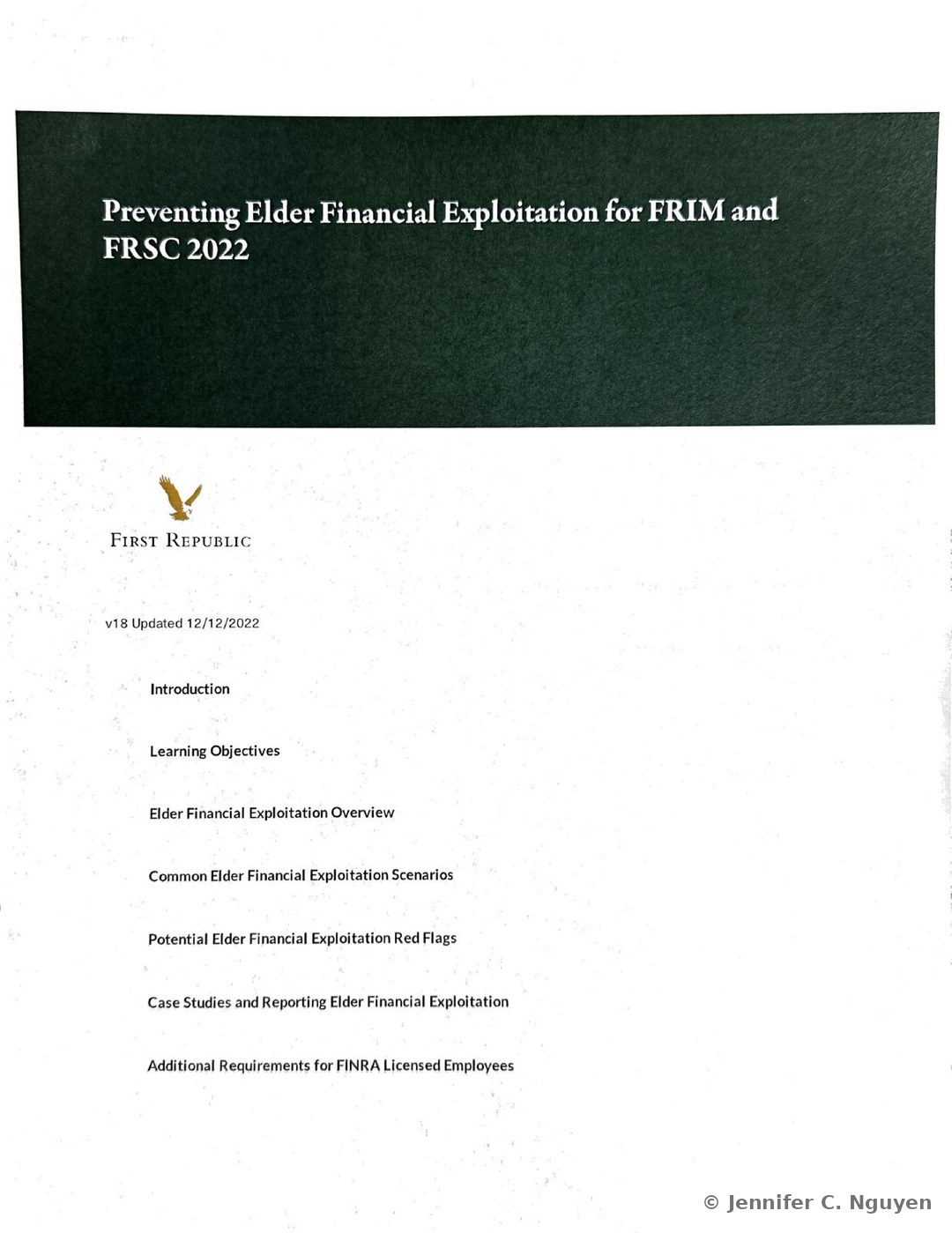
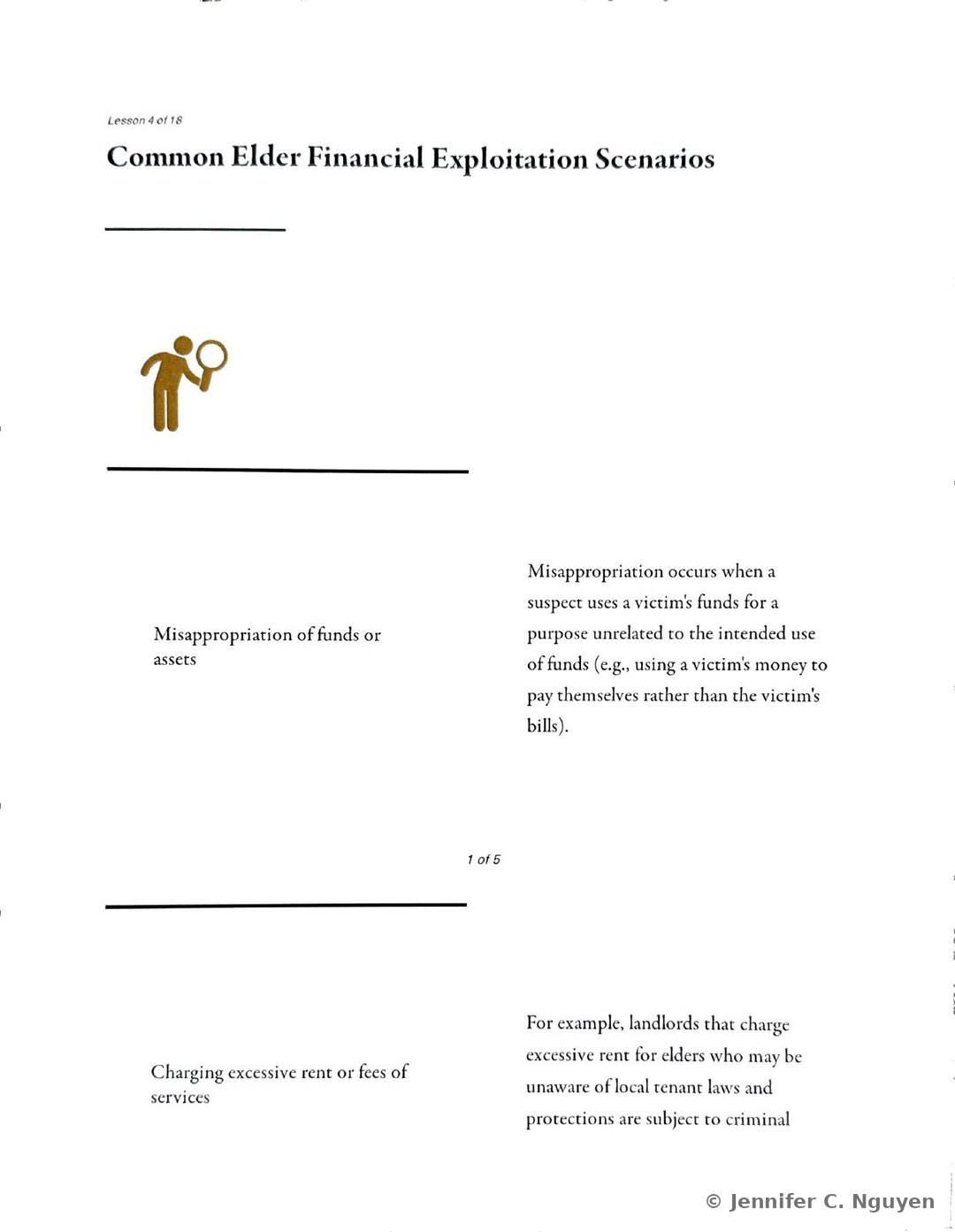
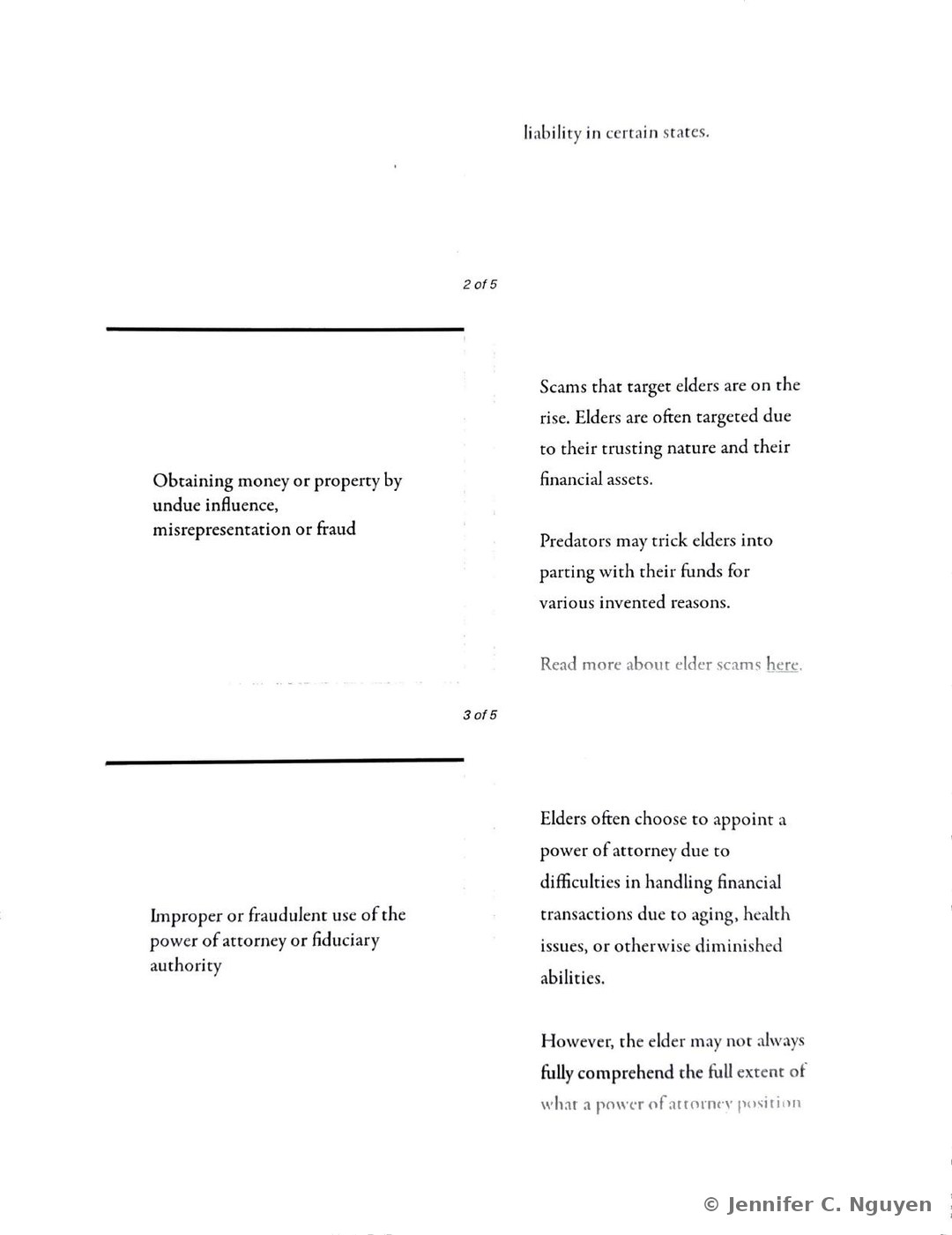
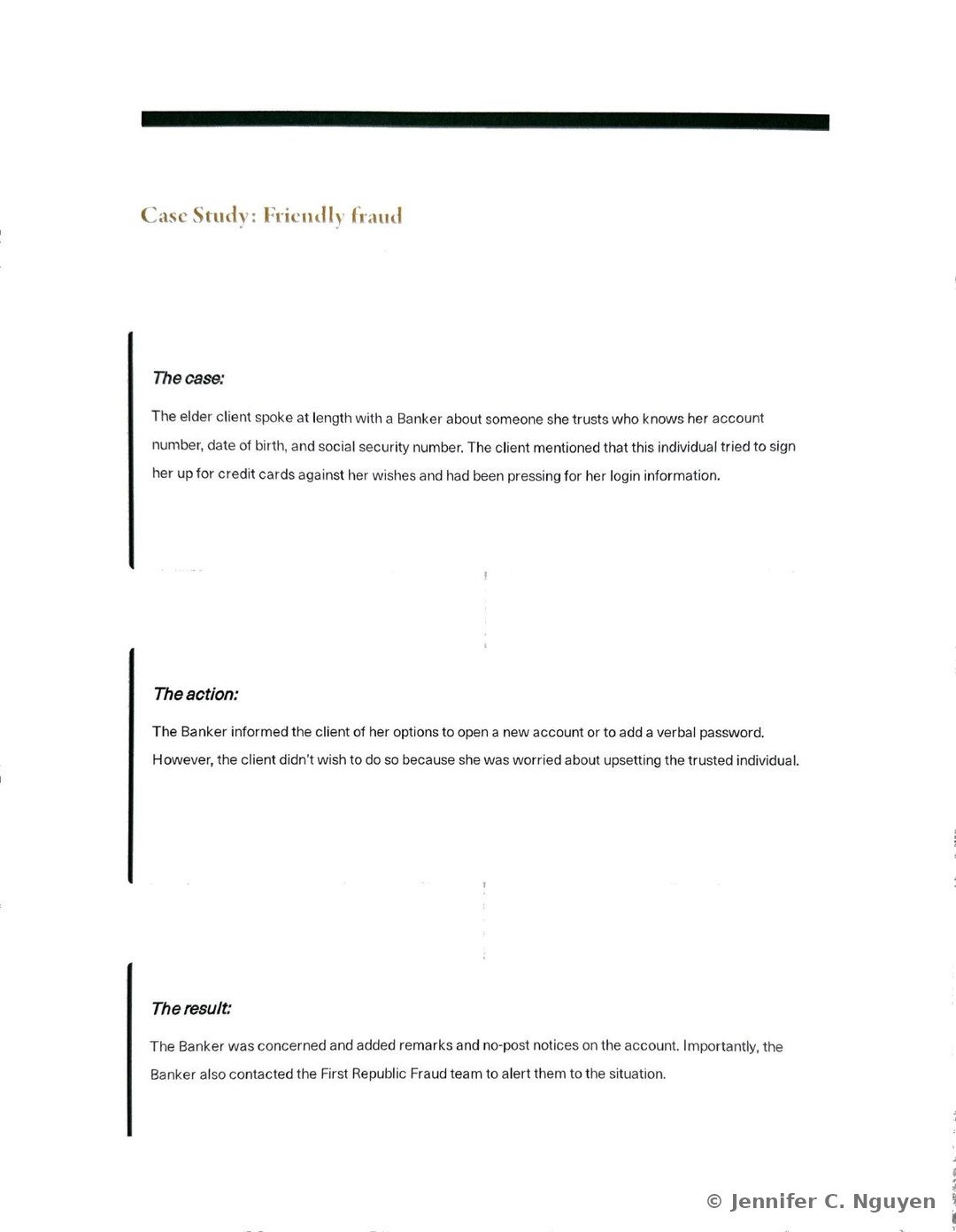
  • Preventing Elder Financial Exploitation
  • Preventing Elder Financial Exploitation for FRIM and FRSC
  • Violence in the Workplace
Deposit Operations & Banking Regulations
  • Deposit University Level II: Final Certification
  • Deposit University: Business Accounts Basics
  • Deposit University: Business Ownership and Vesting
  • Deposit University: Consumer Accounts Basics
  • Deposit University: Consumer Lending Basics
  • Deposit University: Consumer Ownership and Vesting
  • Deposit University: Deposit Promotions Enrollment
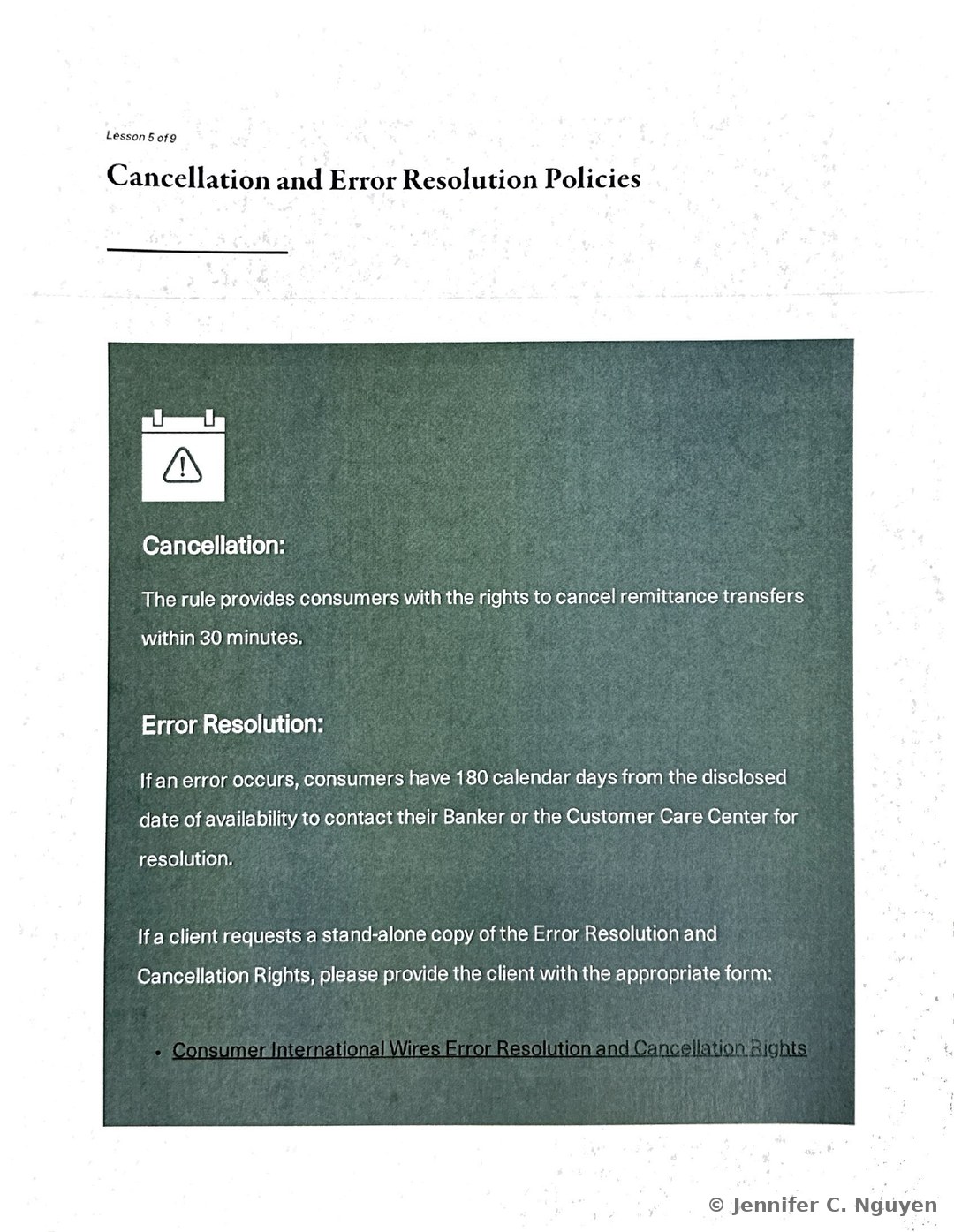
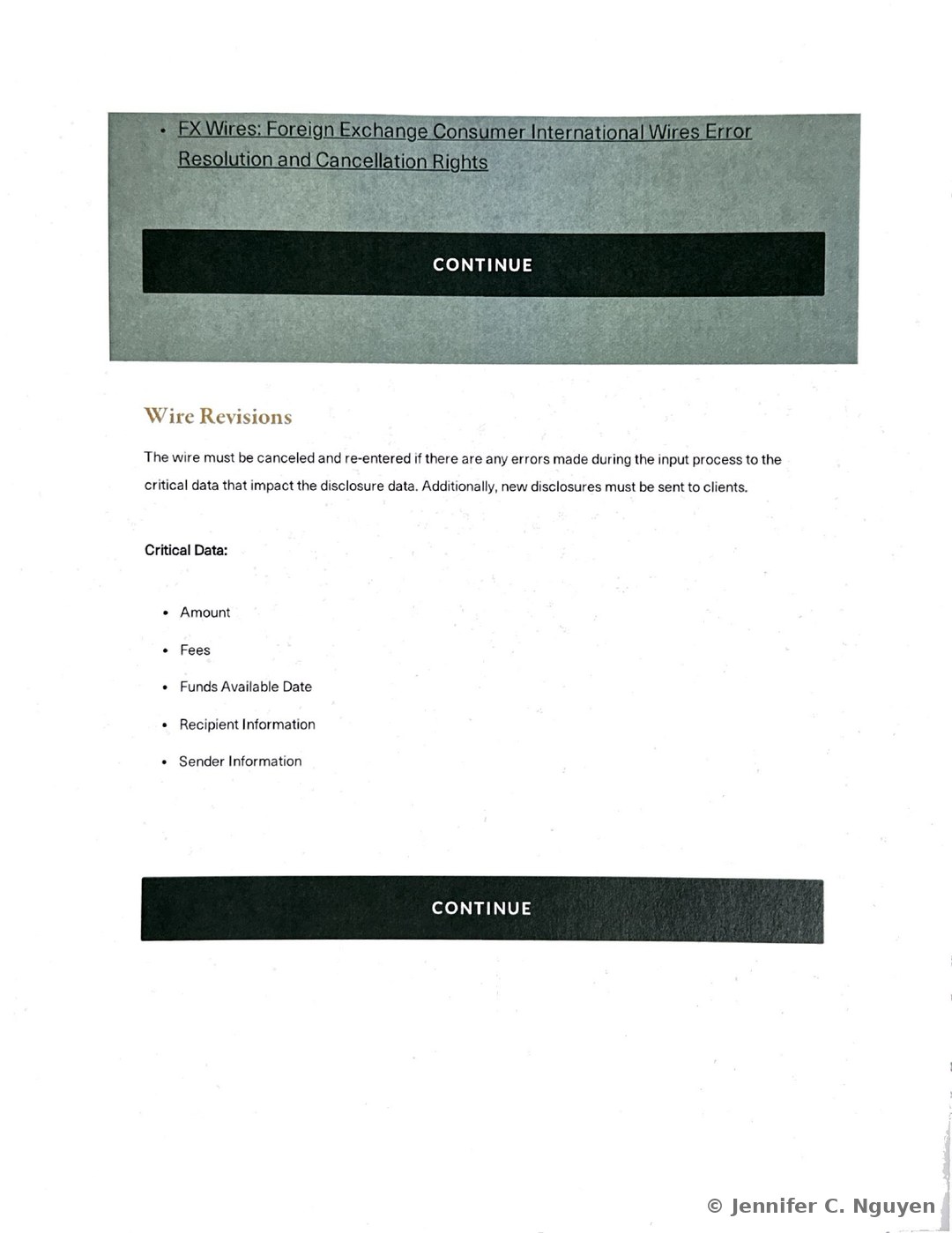
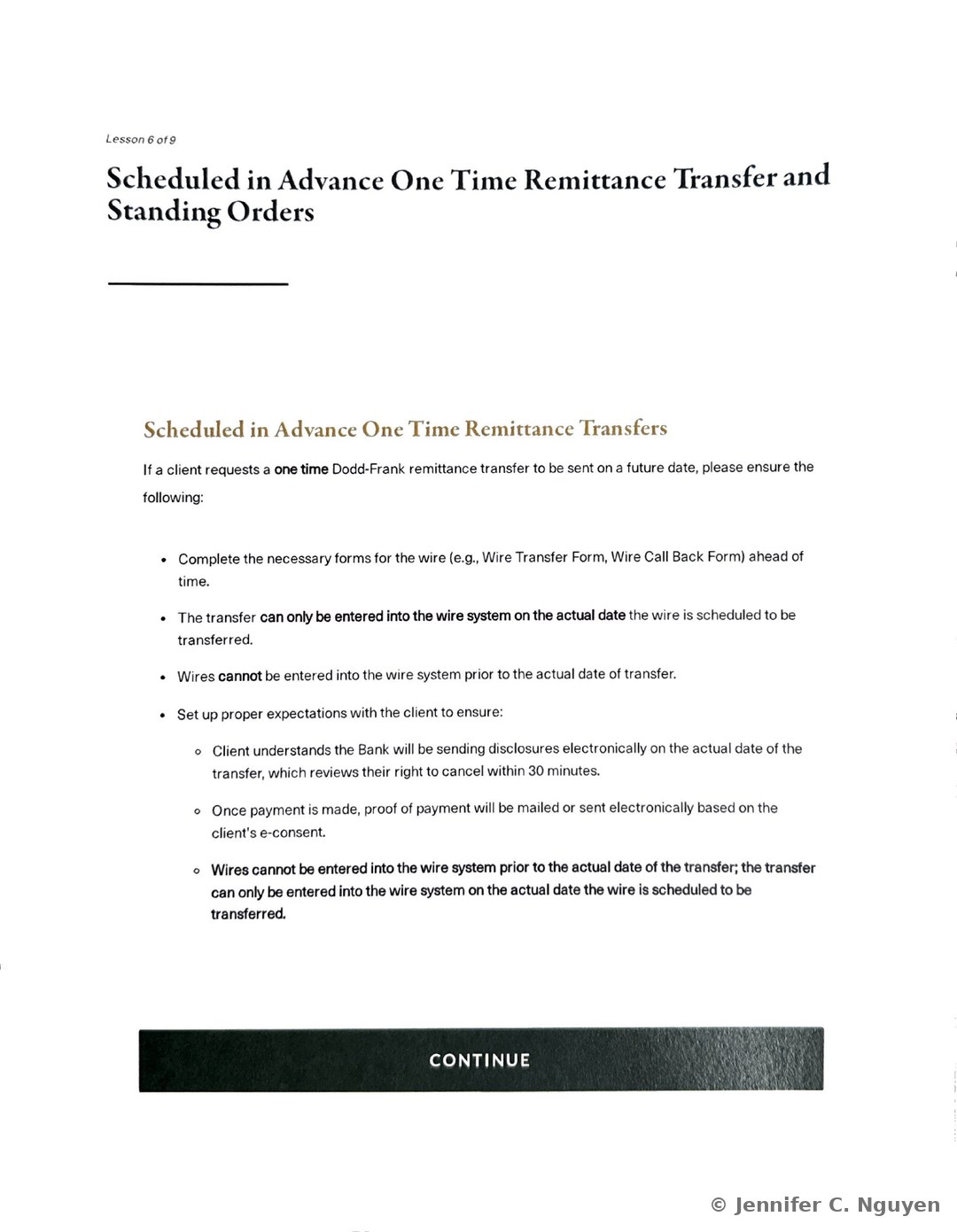
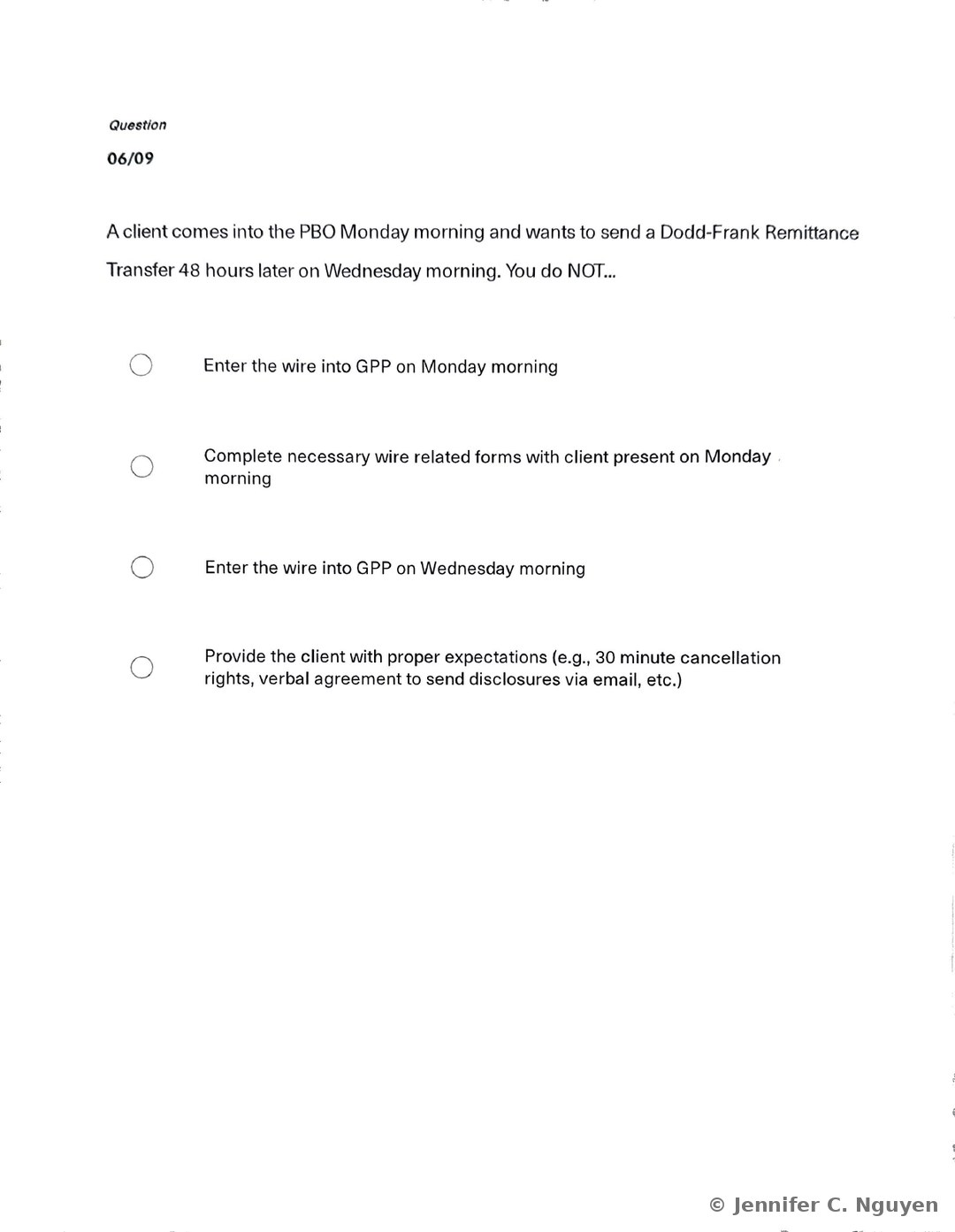
  • Dodd-Frank Remittance Transfer Rule
  • Electronic Funds Transfer and Error Resolution
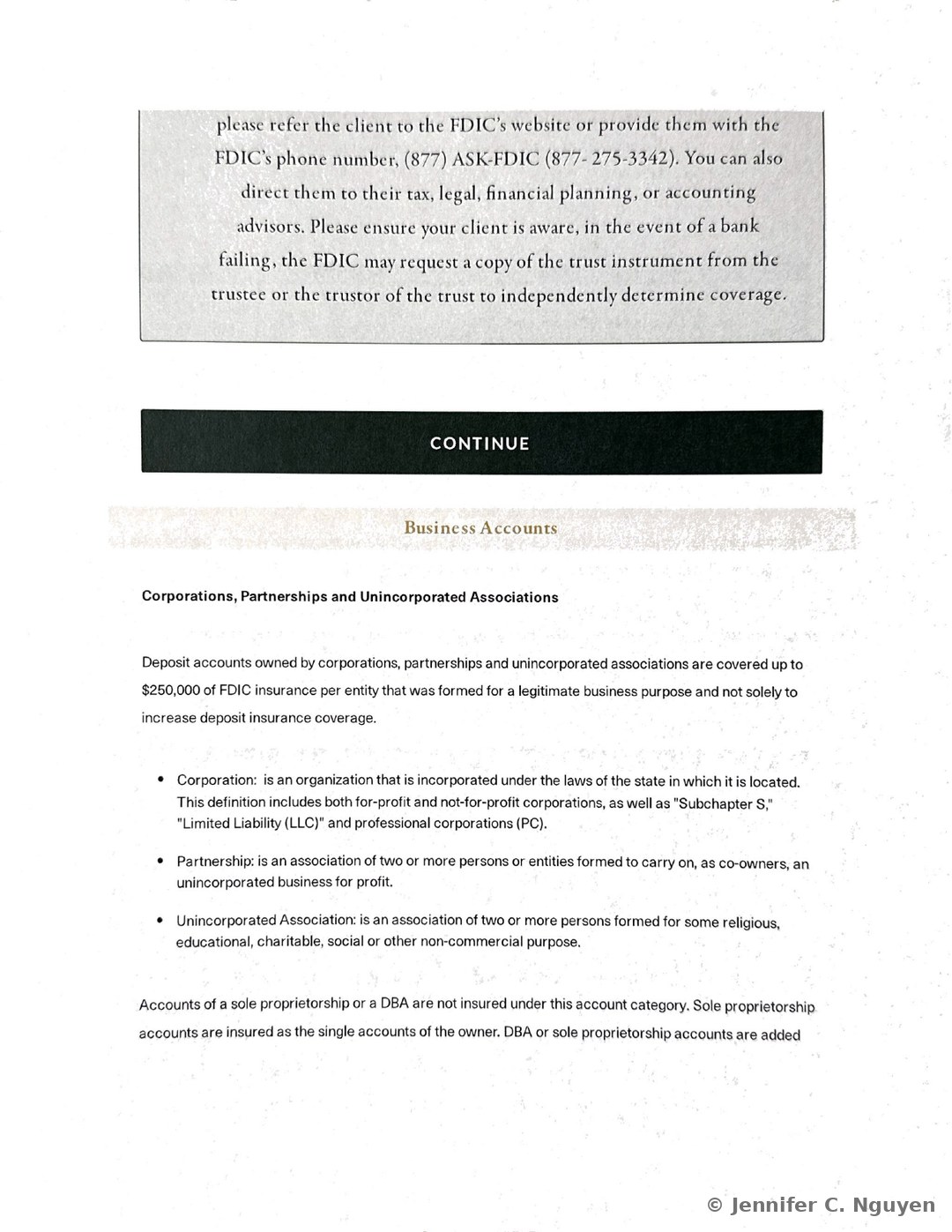
  • FDIC Insurance Basics
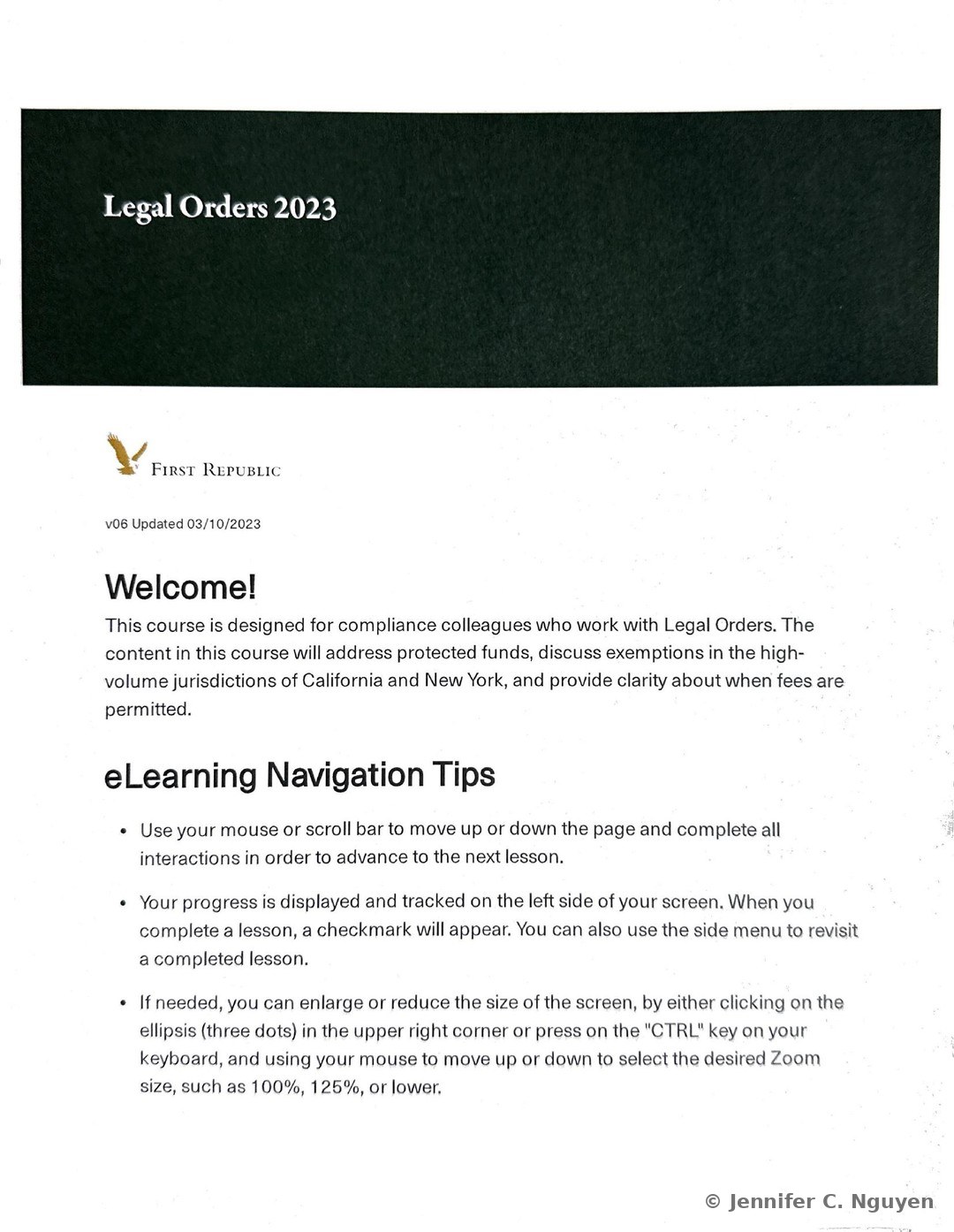
  • Legal Orders
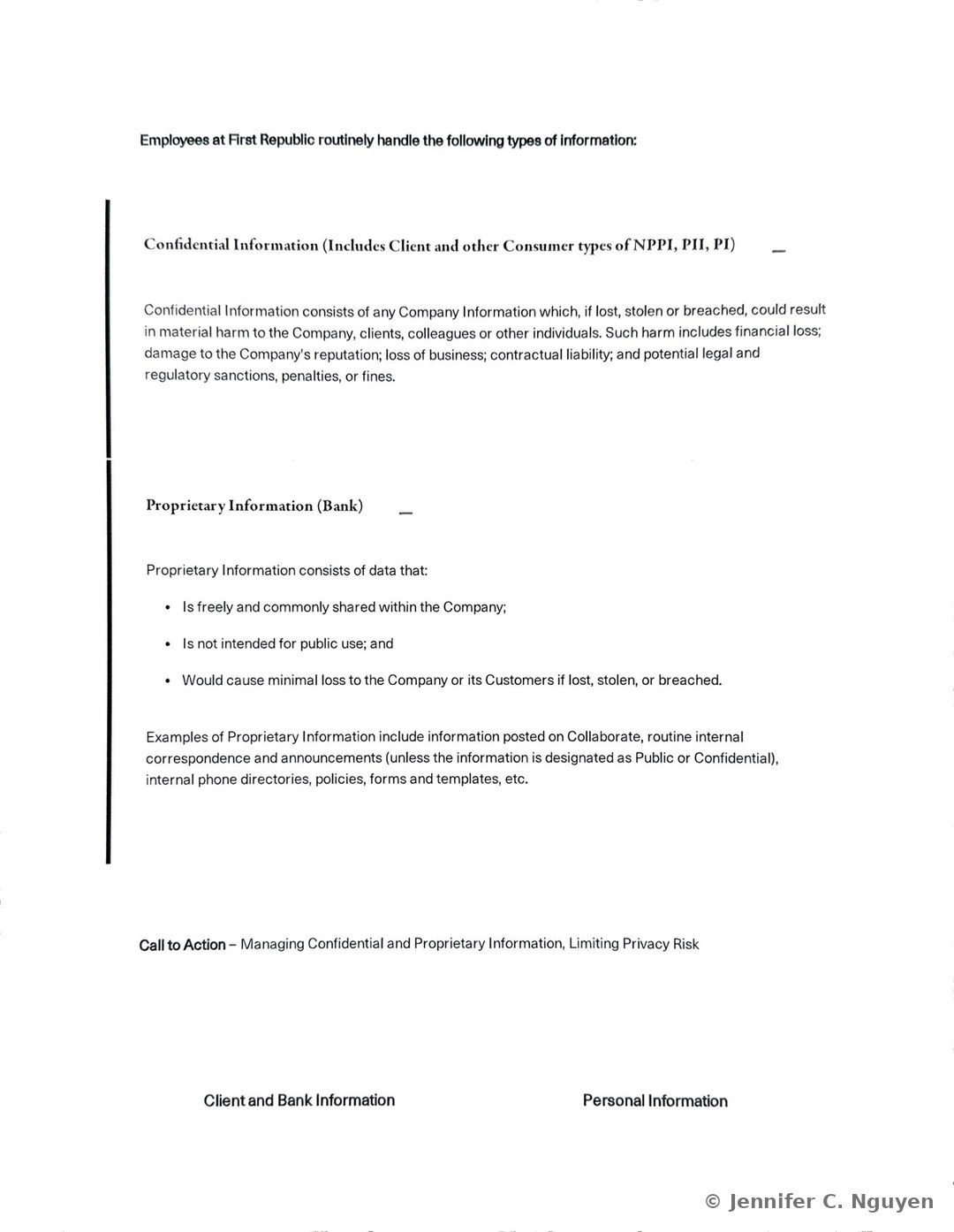
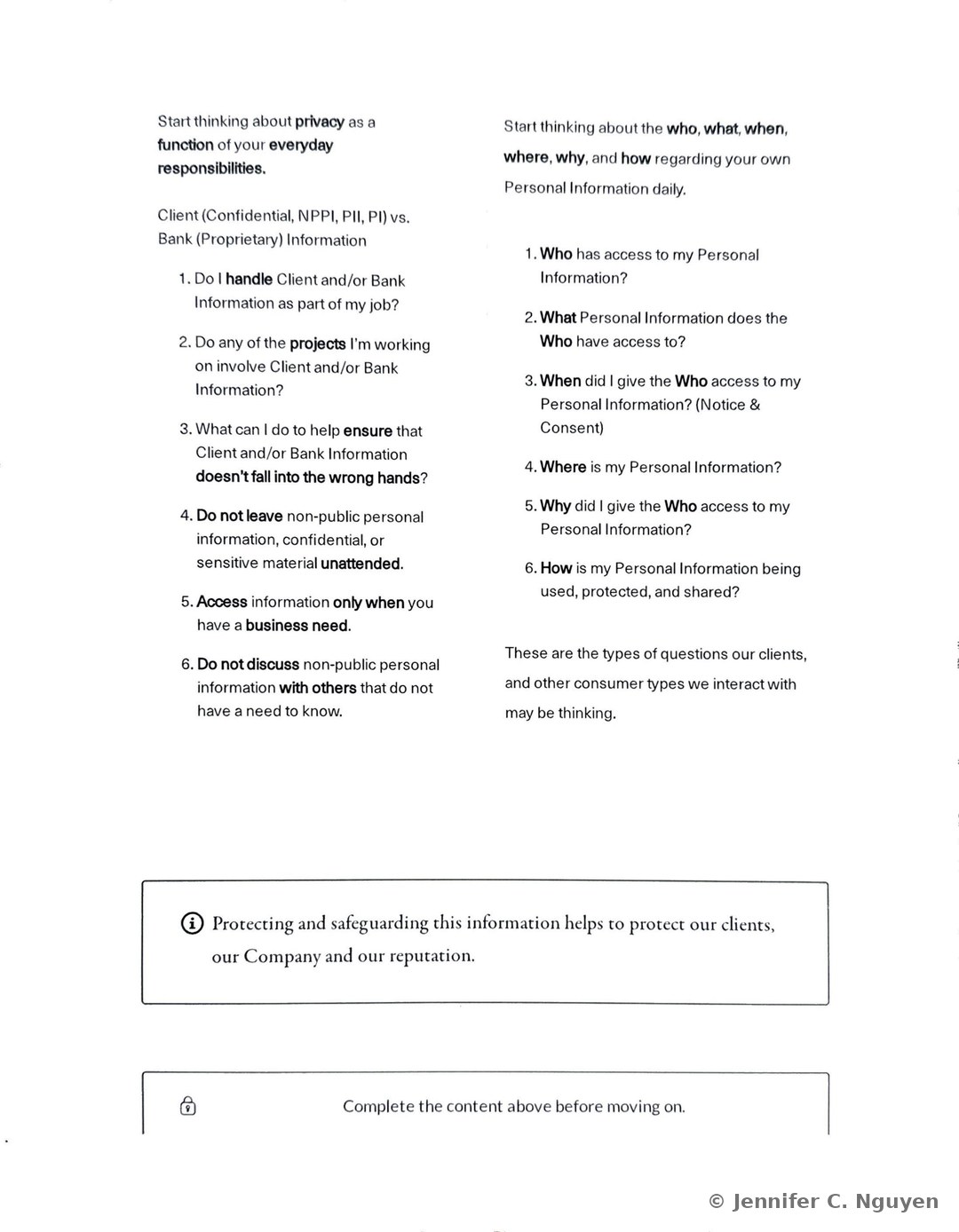
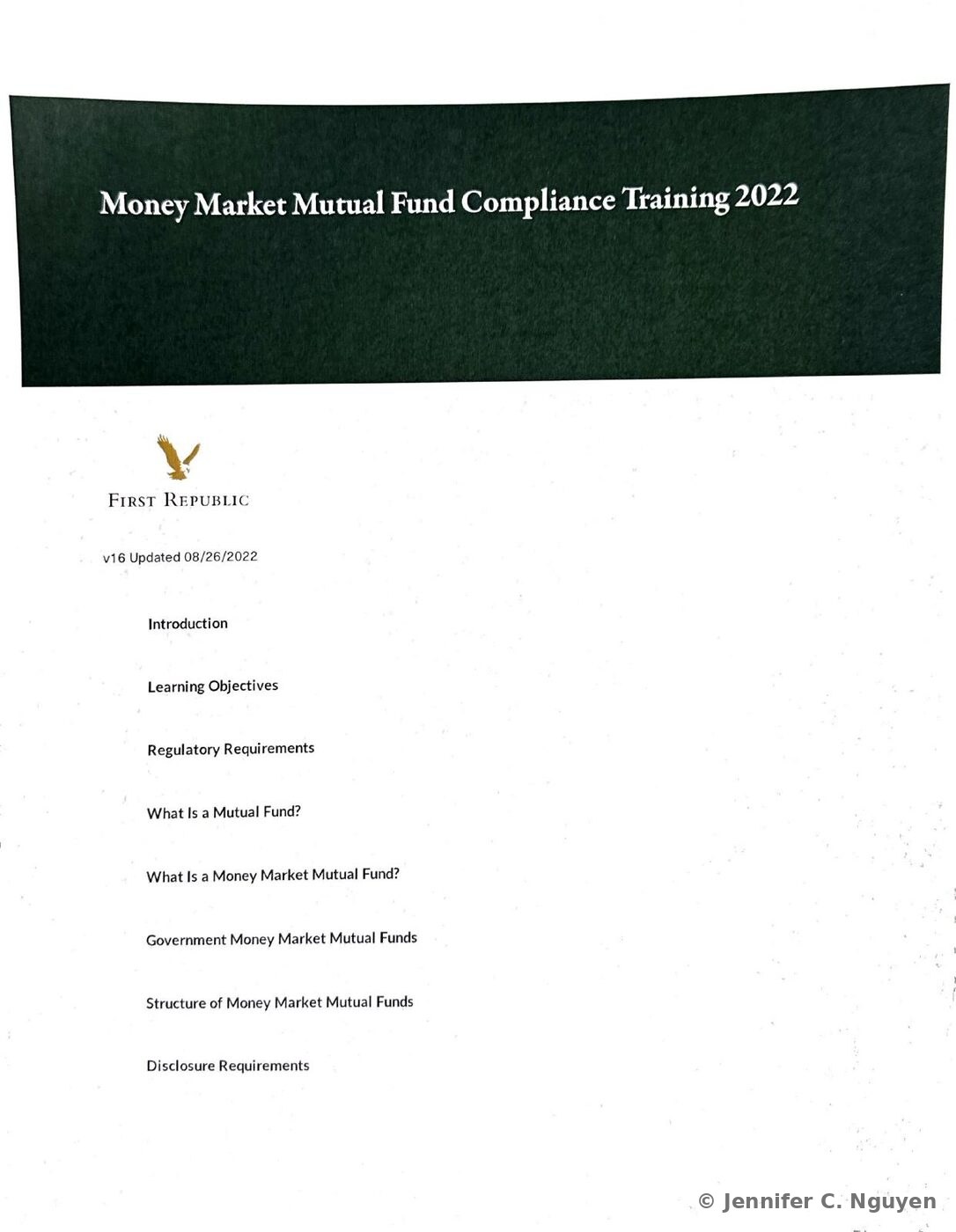
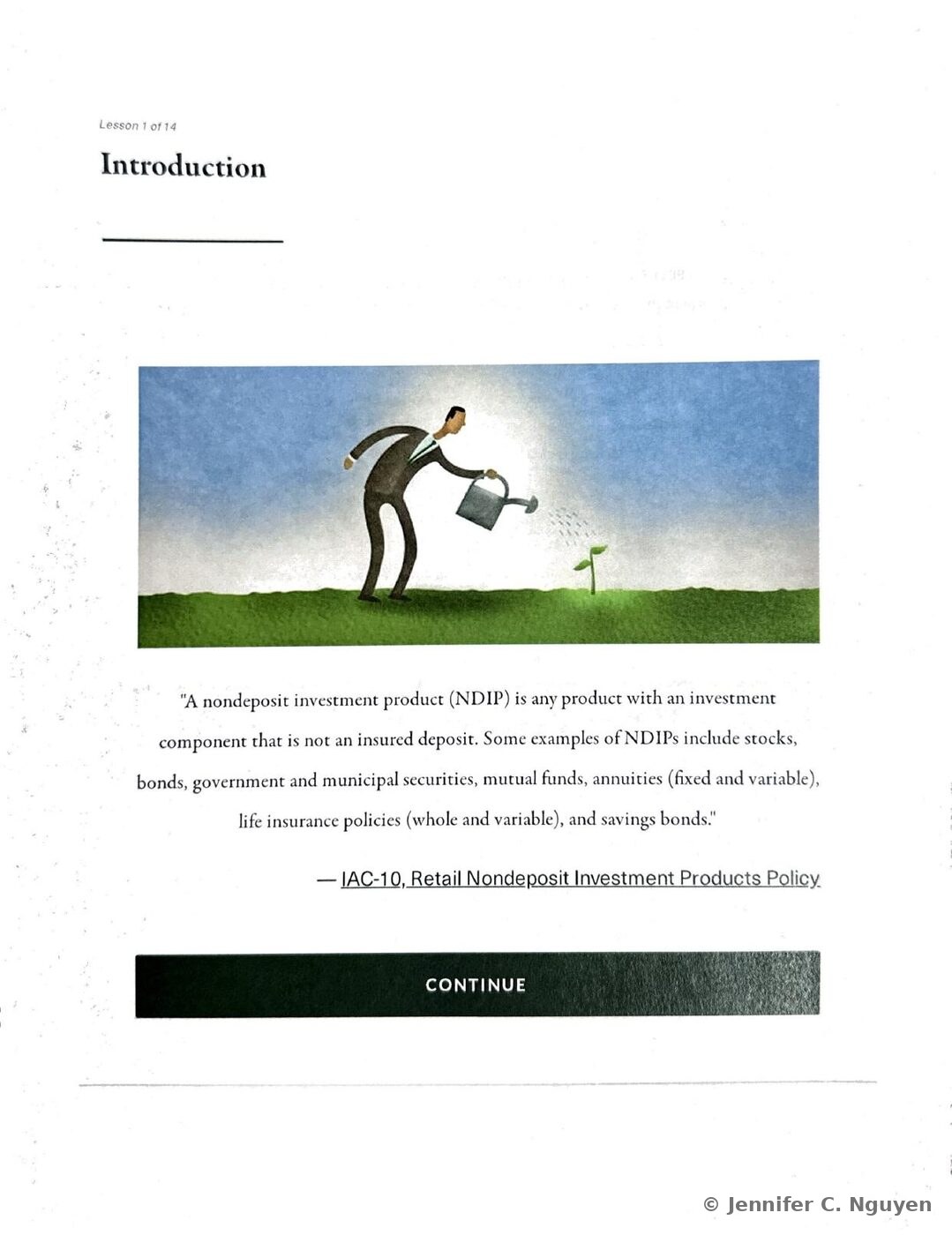
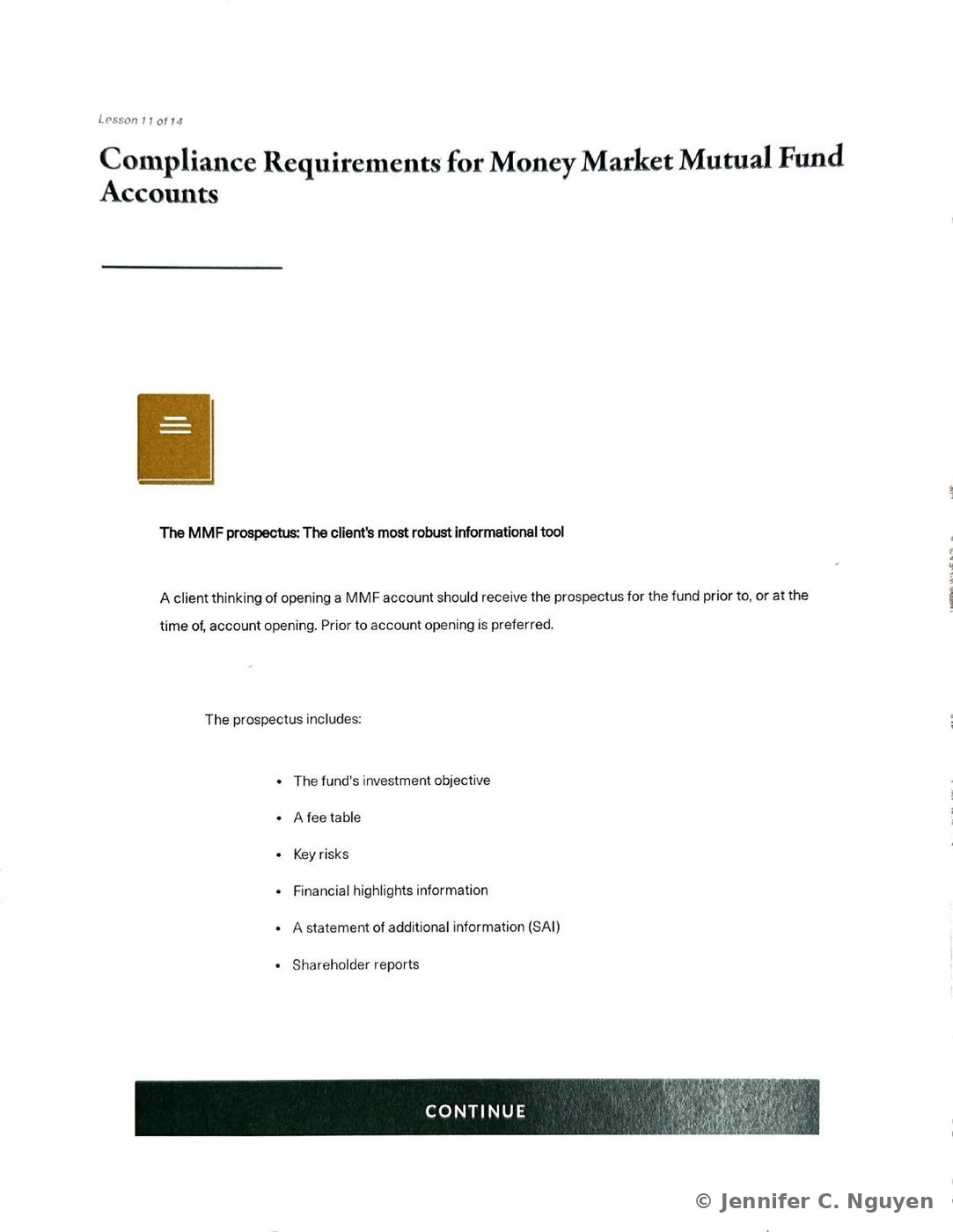
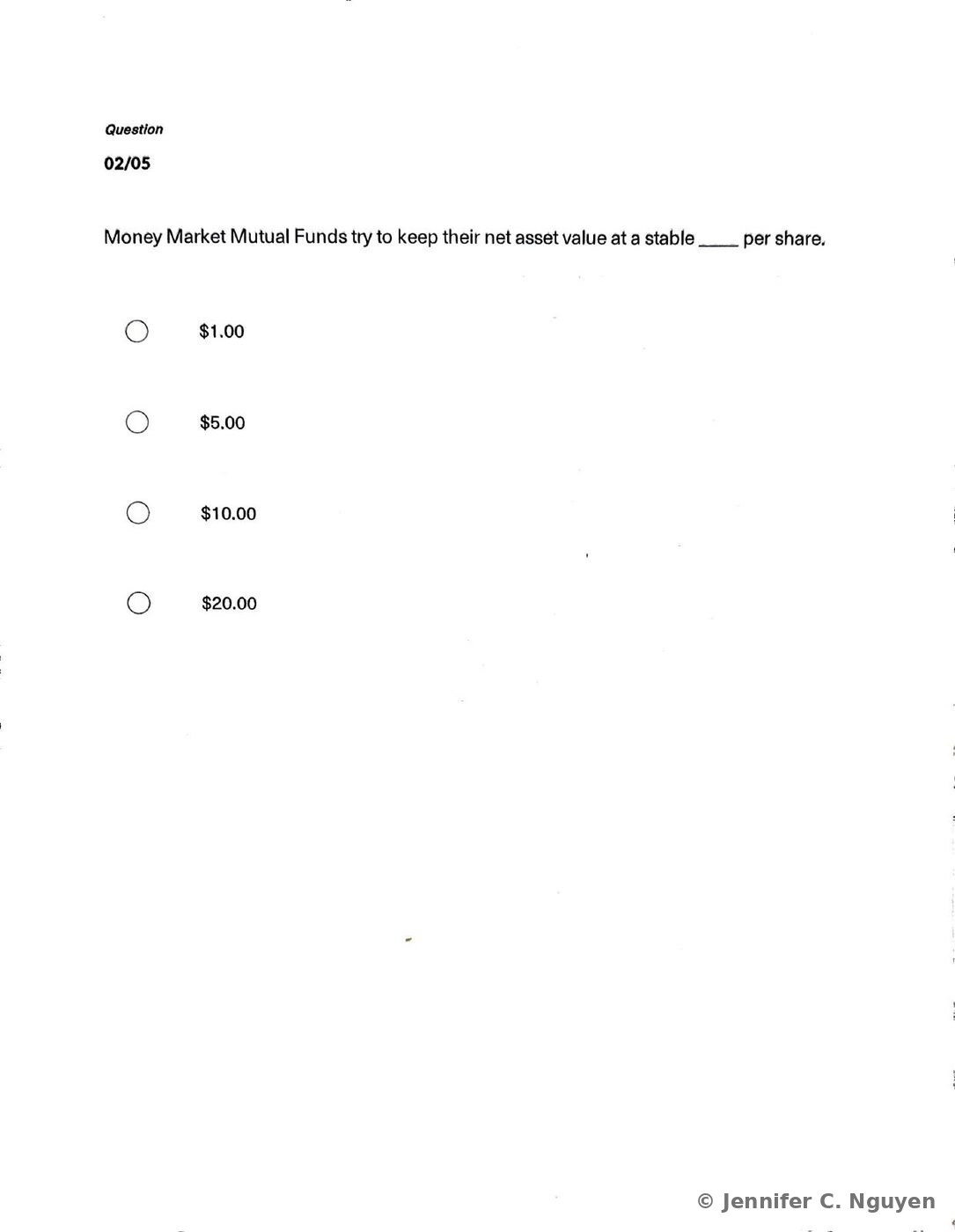
  • Money Market Mutual Fund Compliance Training
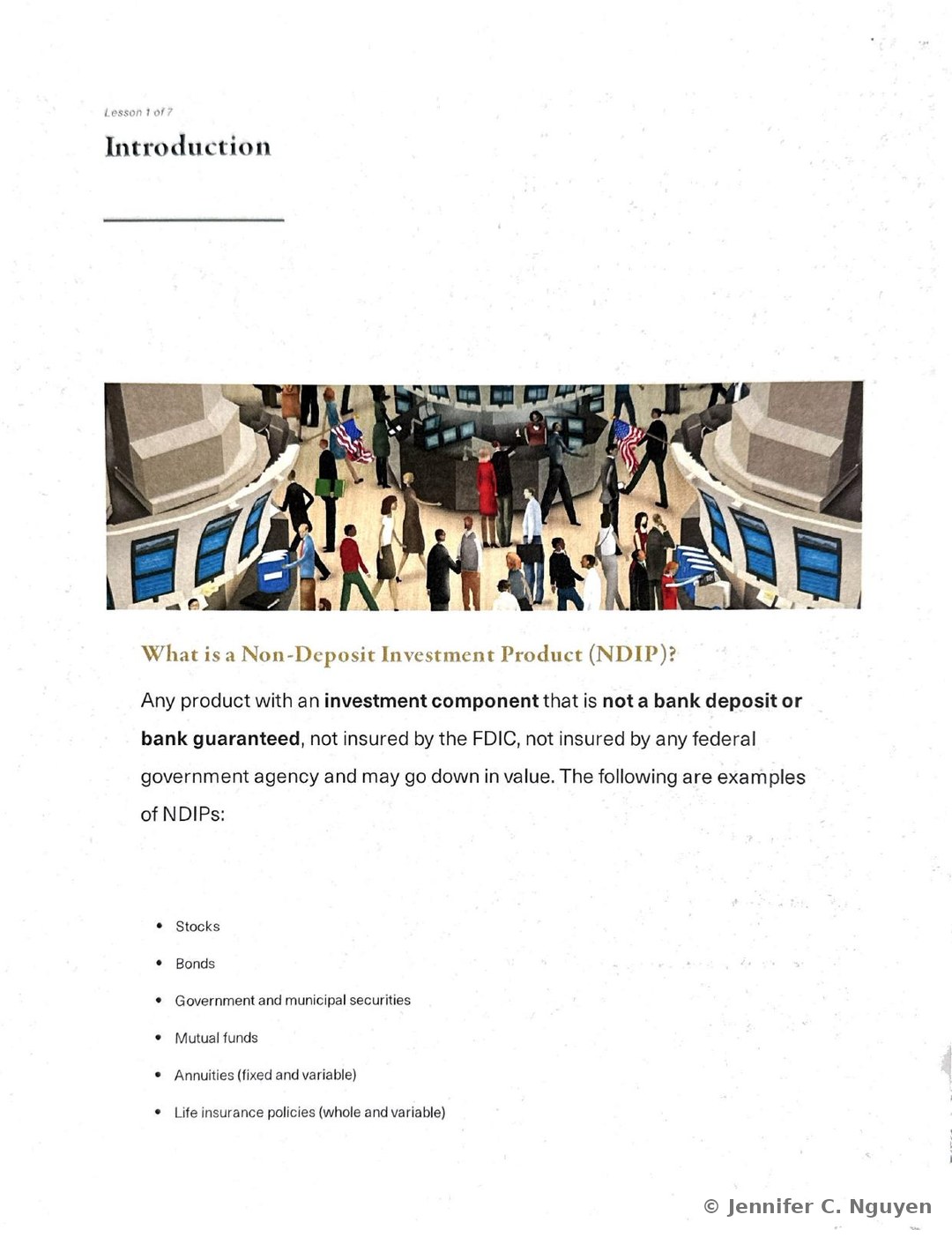
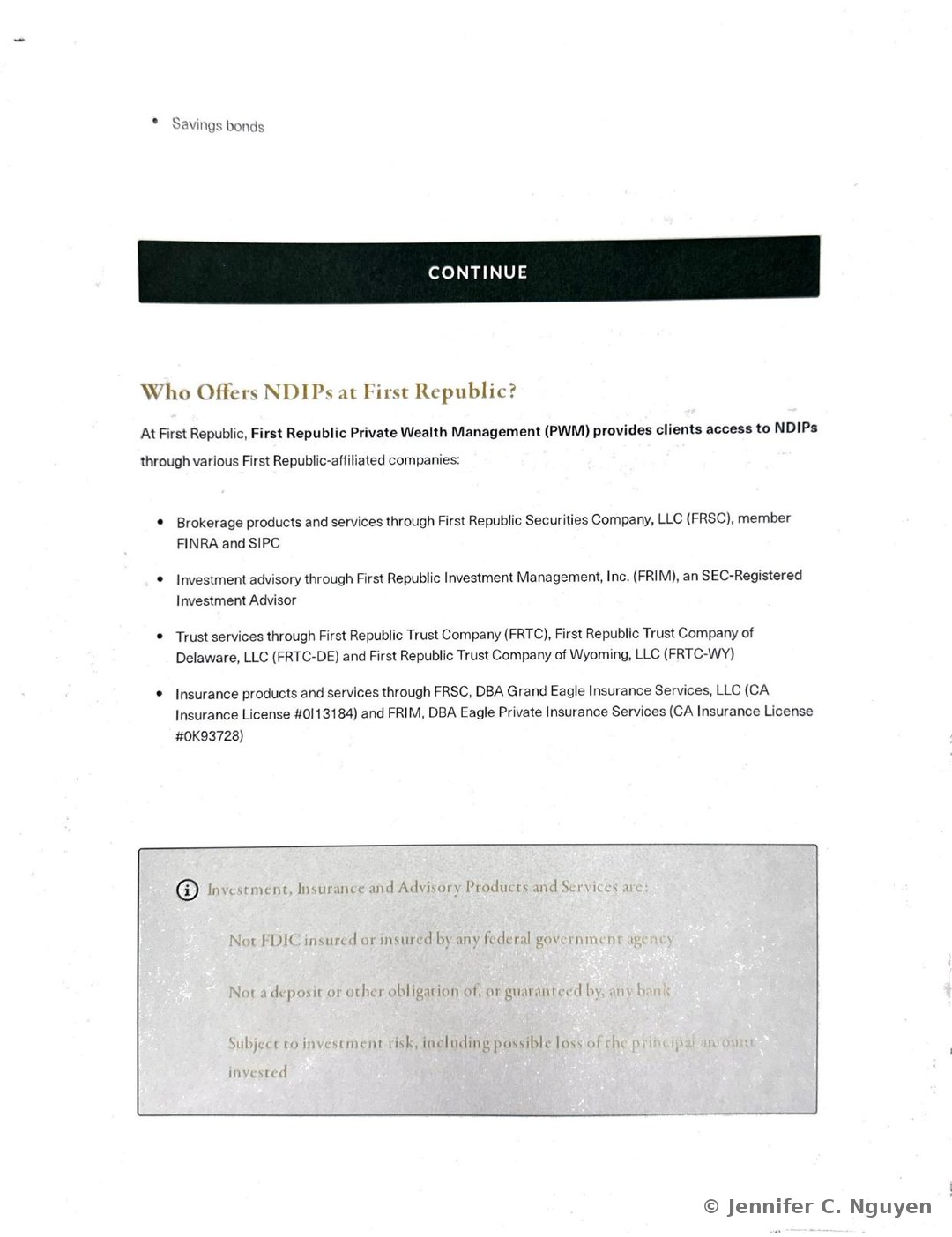
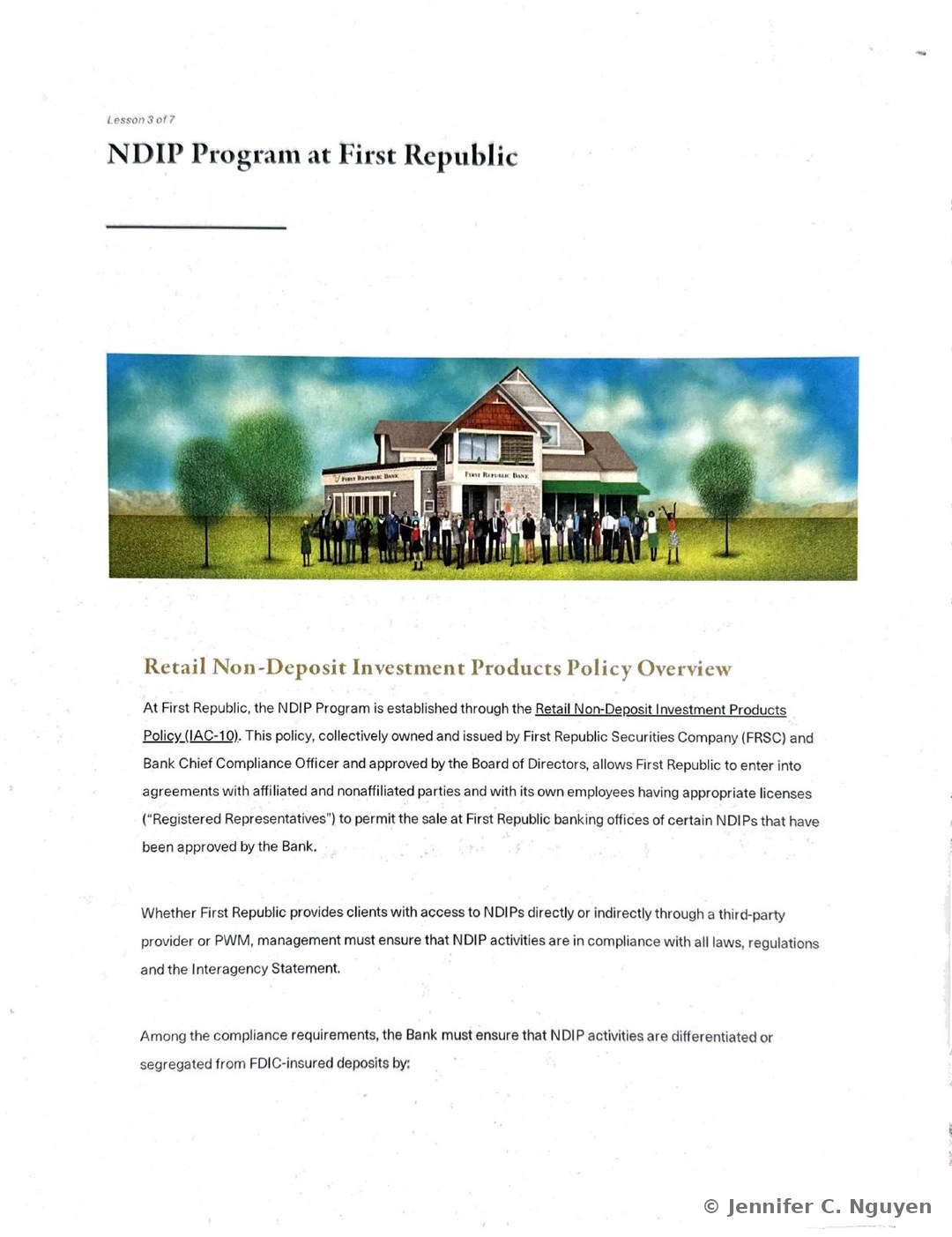
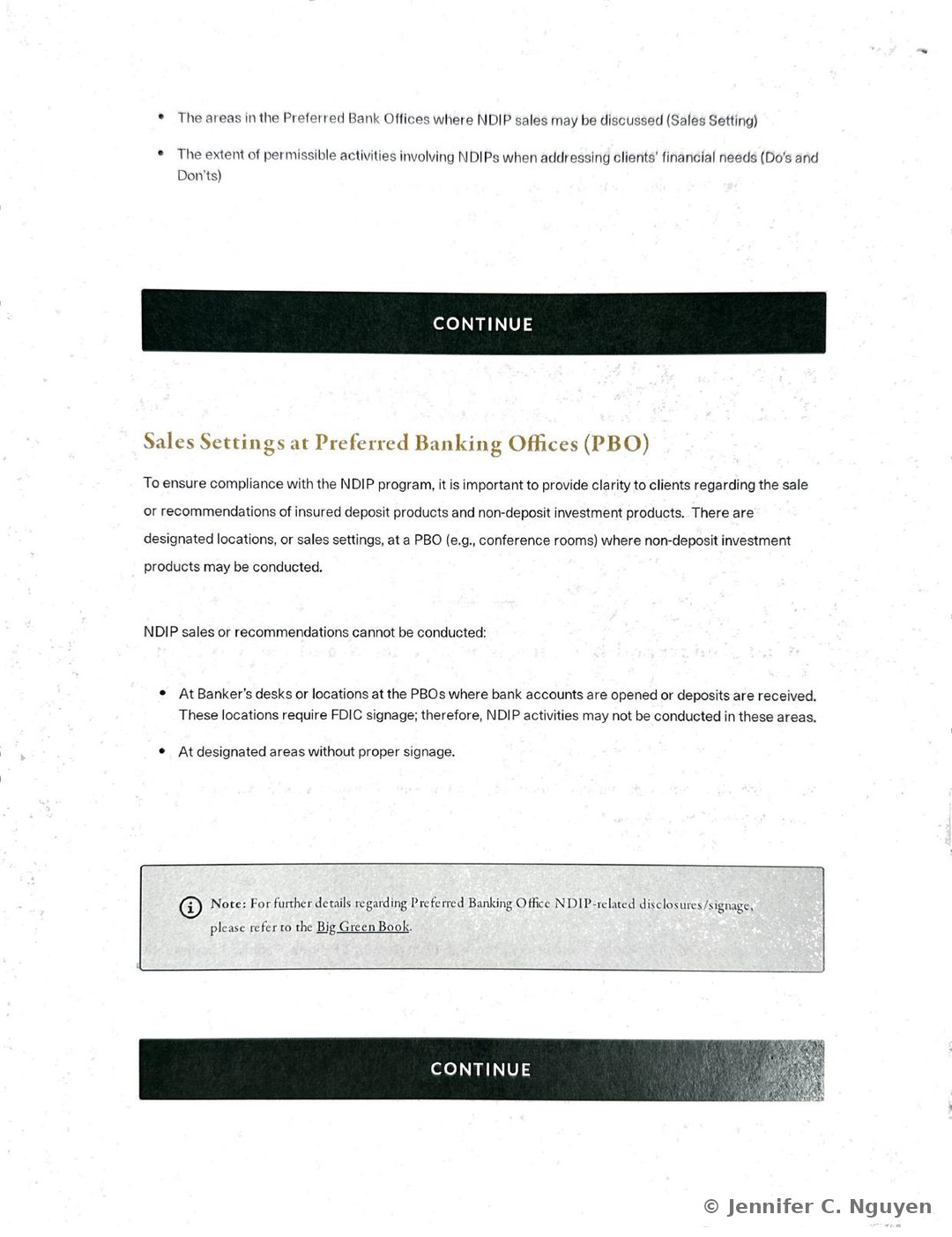
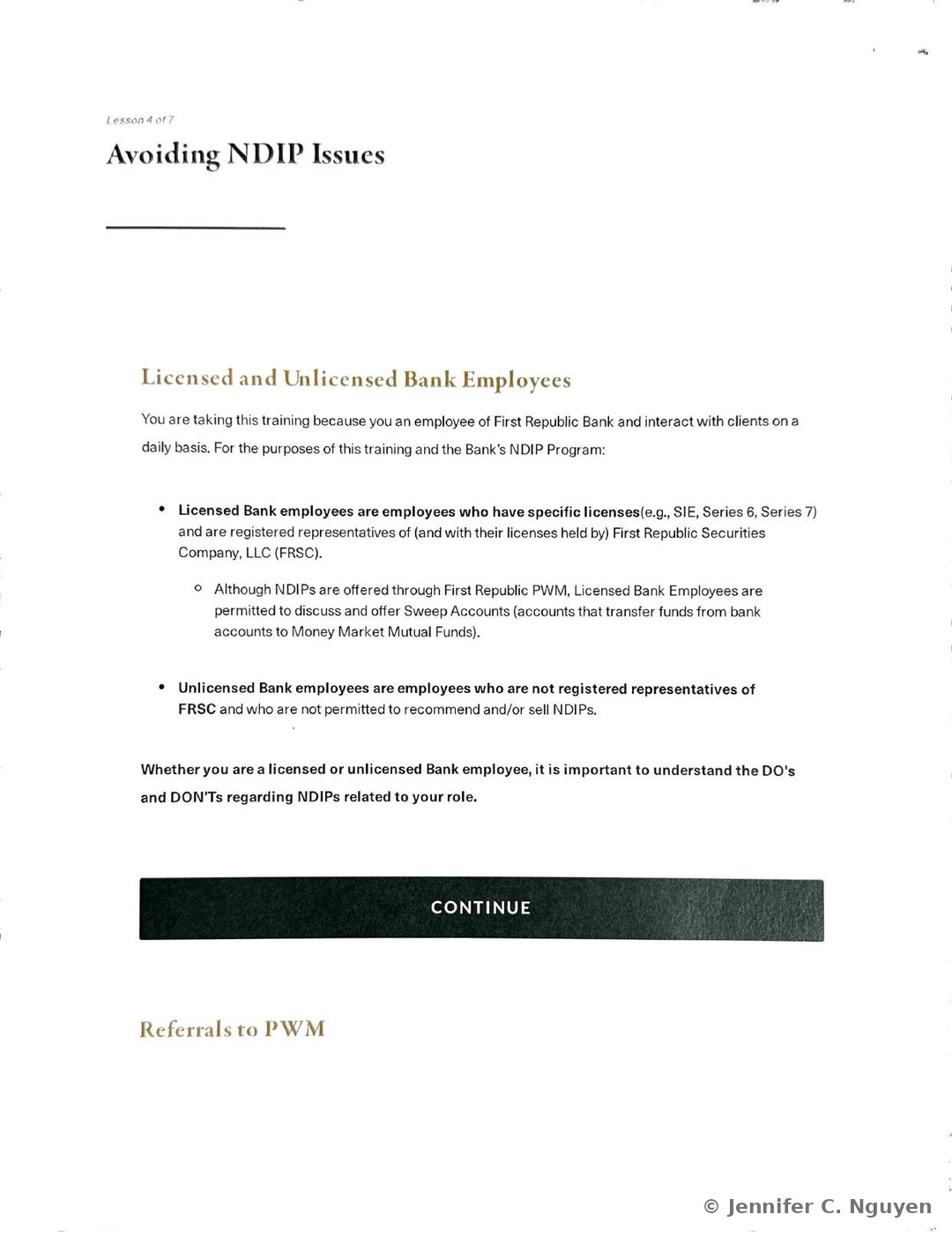
  • Non-Deposit Investment Products Compliance Training for Licensed Colleagues
  • Non-Deposit Investment Products Compliance Training for Unlicensed Colleagues
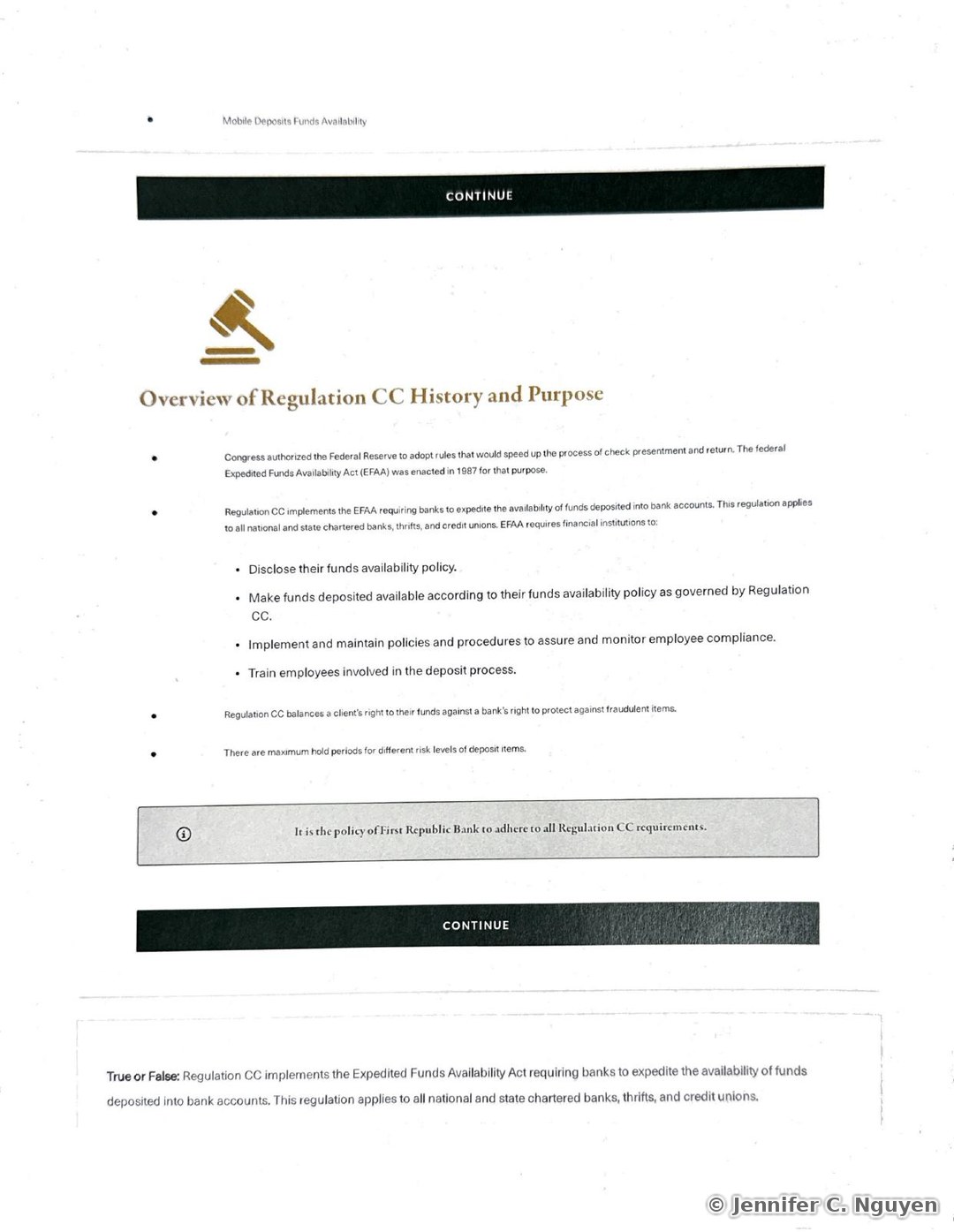
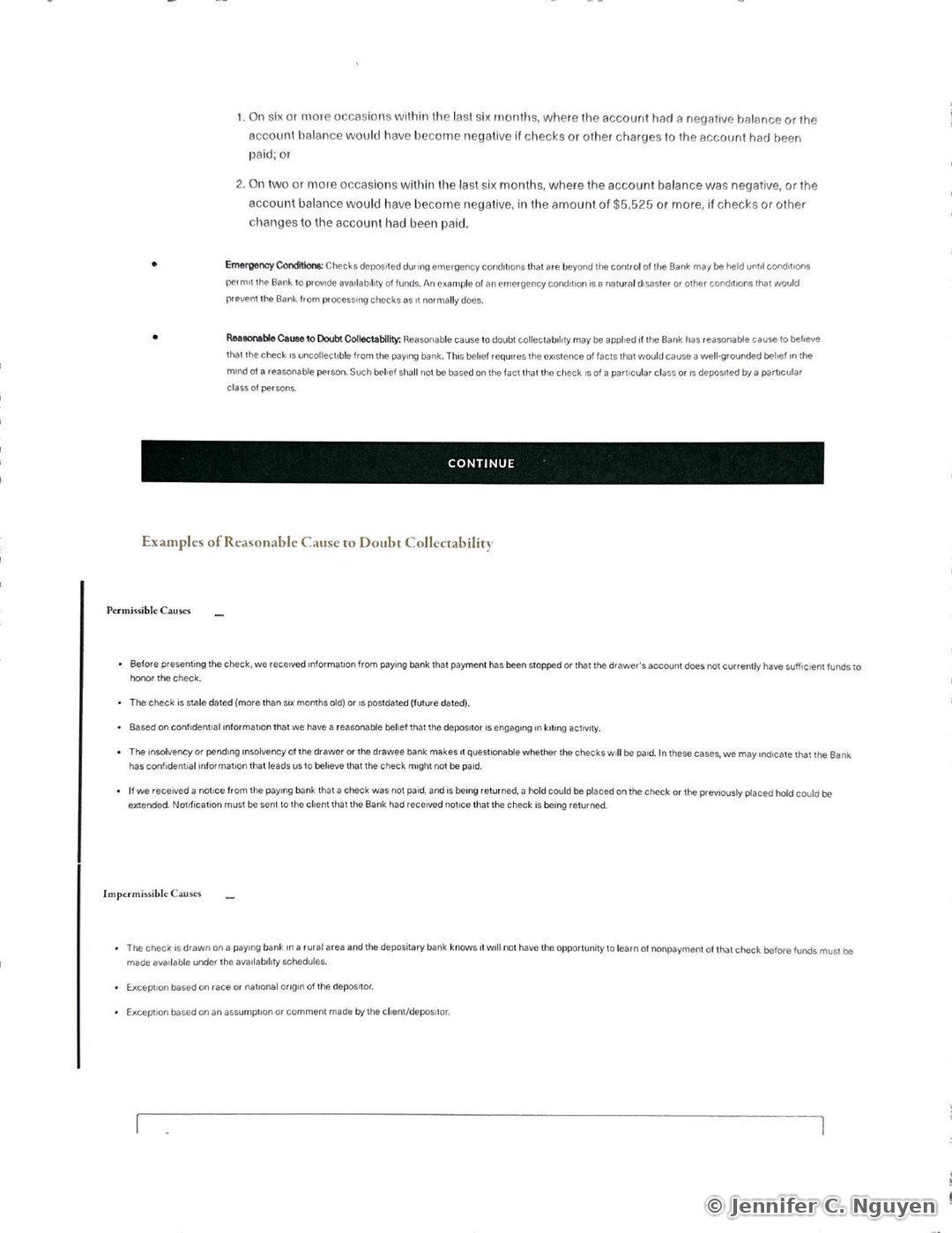
  • Regulation CC and Funds Availability Enhanced Compliance Review Training
  • Regulation CC and Funds Availability Enhanced Compliance Training
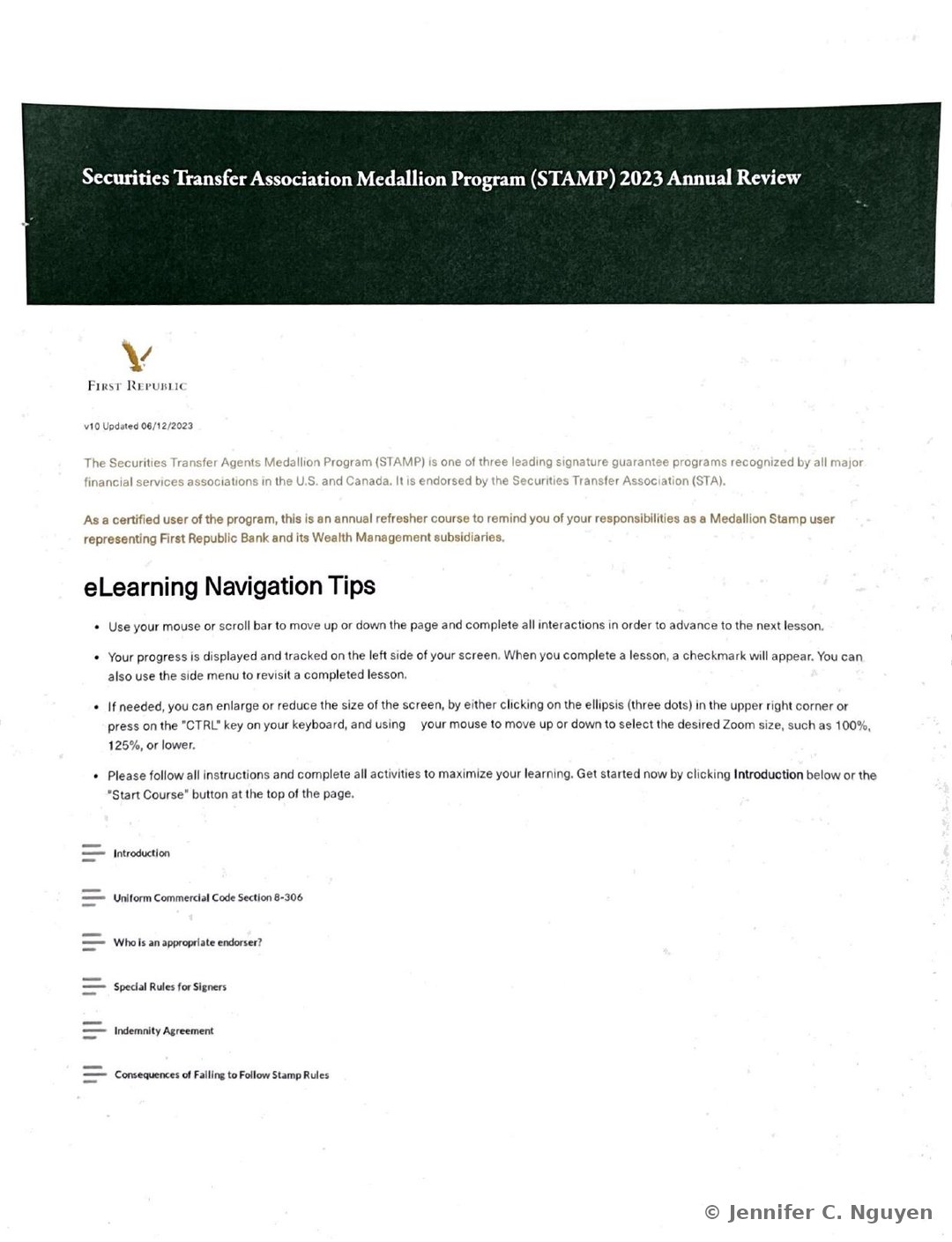
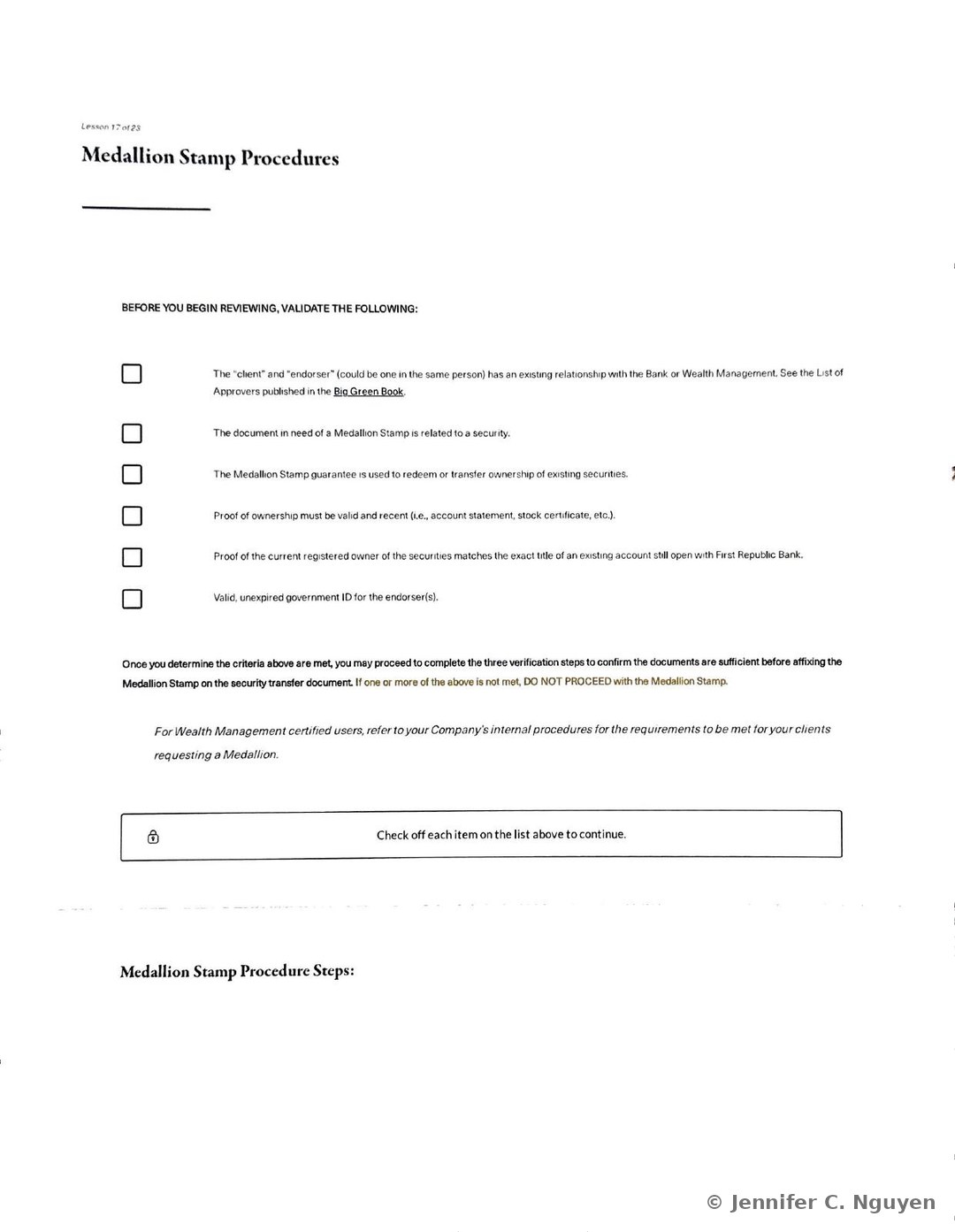
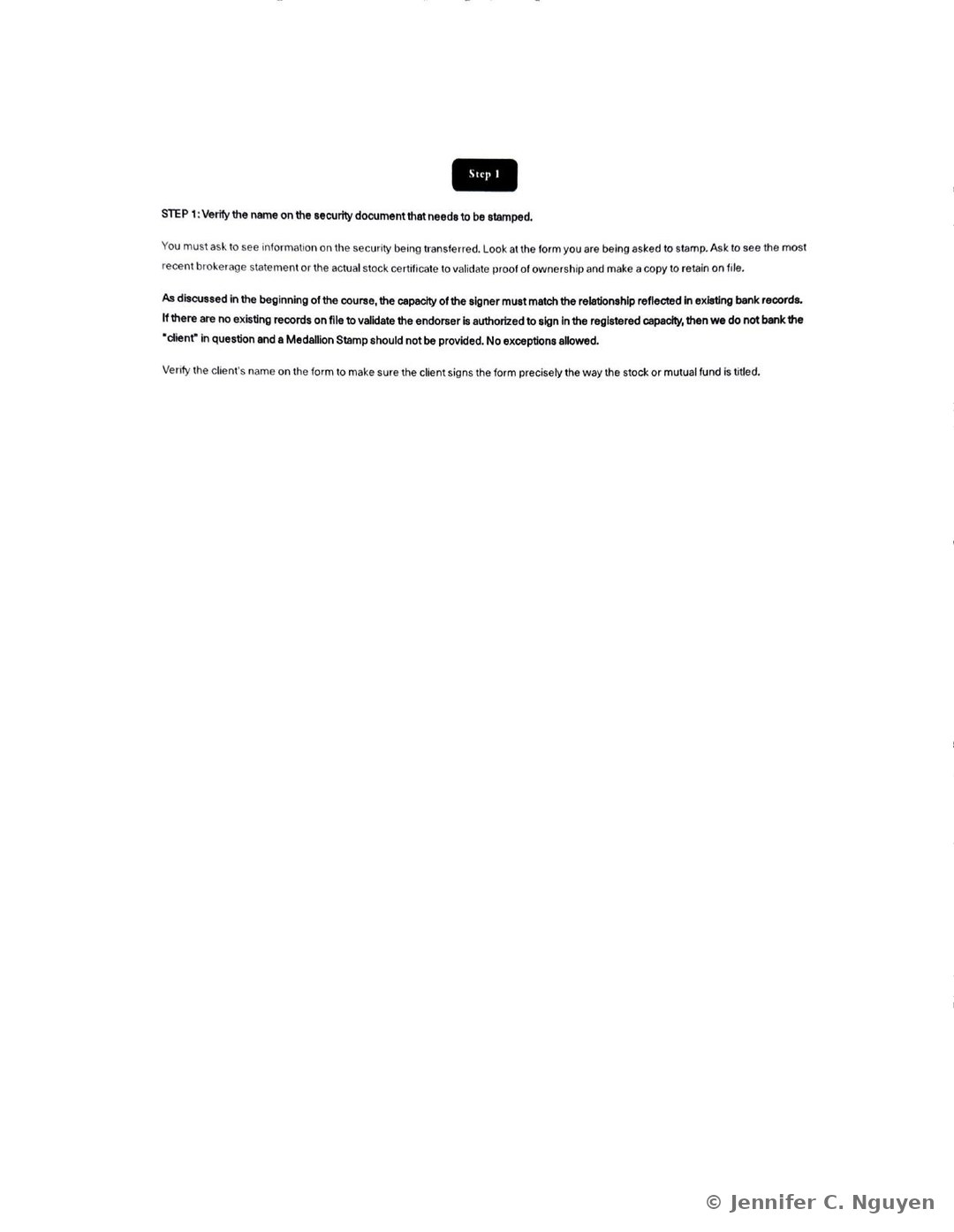
  • Securities Transfer Association Medallion Program (STAMP) Annual Review
  • Time Deposit Compliance Training
  • Regulation DD: Truth in Savings Act Training
Privacy, Data Protection & Client Communications
  • Client Verification Attestation
  • Consumer Online Password Resets for PWM
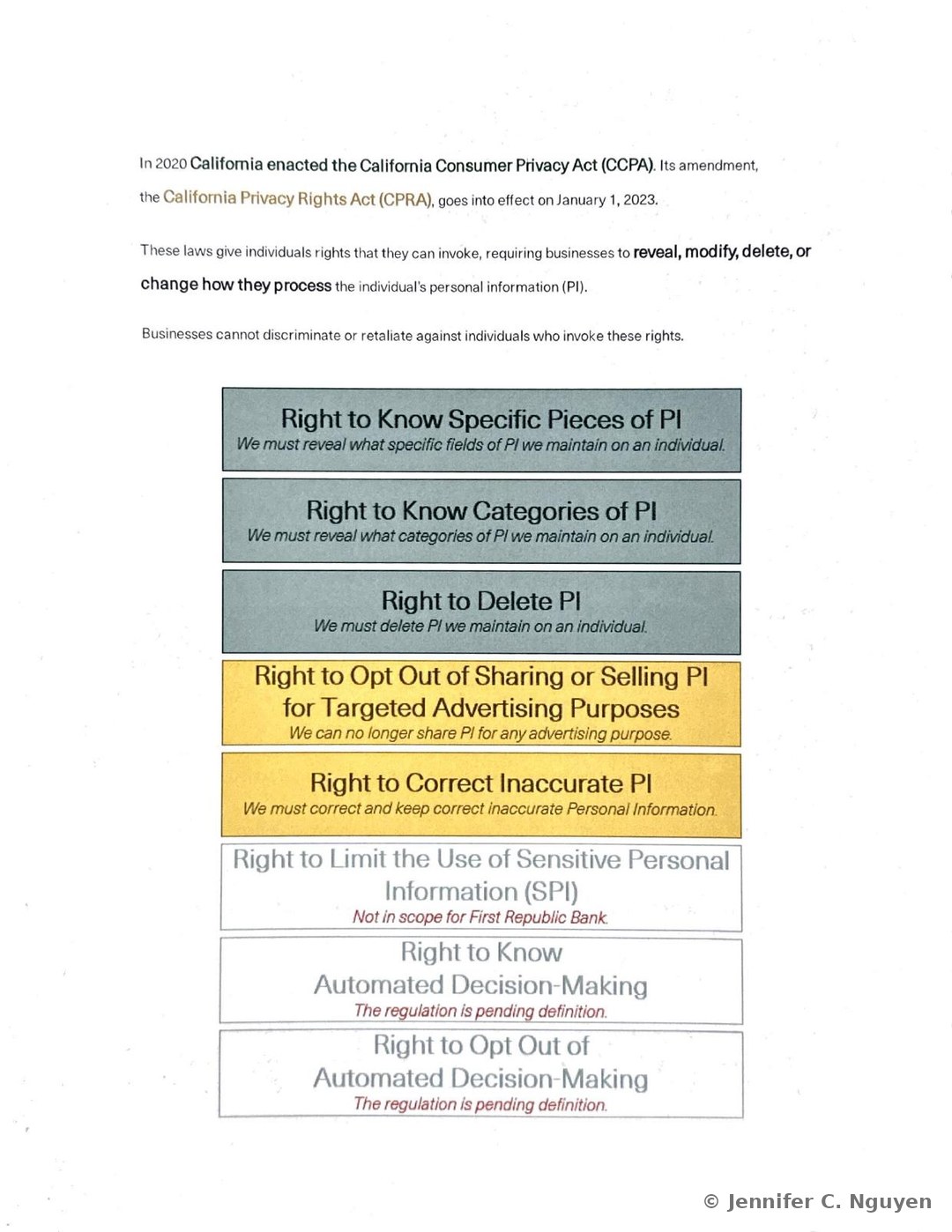
  • California Consumer Privacy Act (CCPA) Training: Piper 2.0
  • California Consumer Privacy Act Training
  • California Consumer Privacy Act Training for Client-Facing Colleagues
  • California Student Borrower Bill of Rights Training
  • CAN-SPAM Compliance: Sending Email with "Send Compliant" Button
  • Code of Ethics and Corporate Conduct Acknowledgment
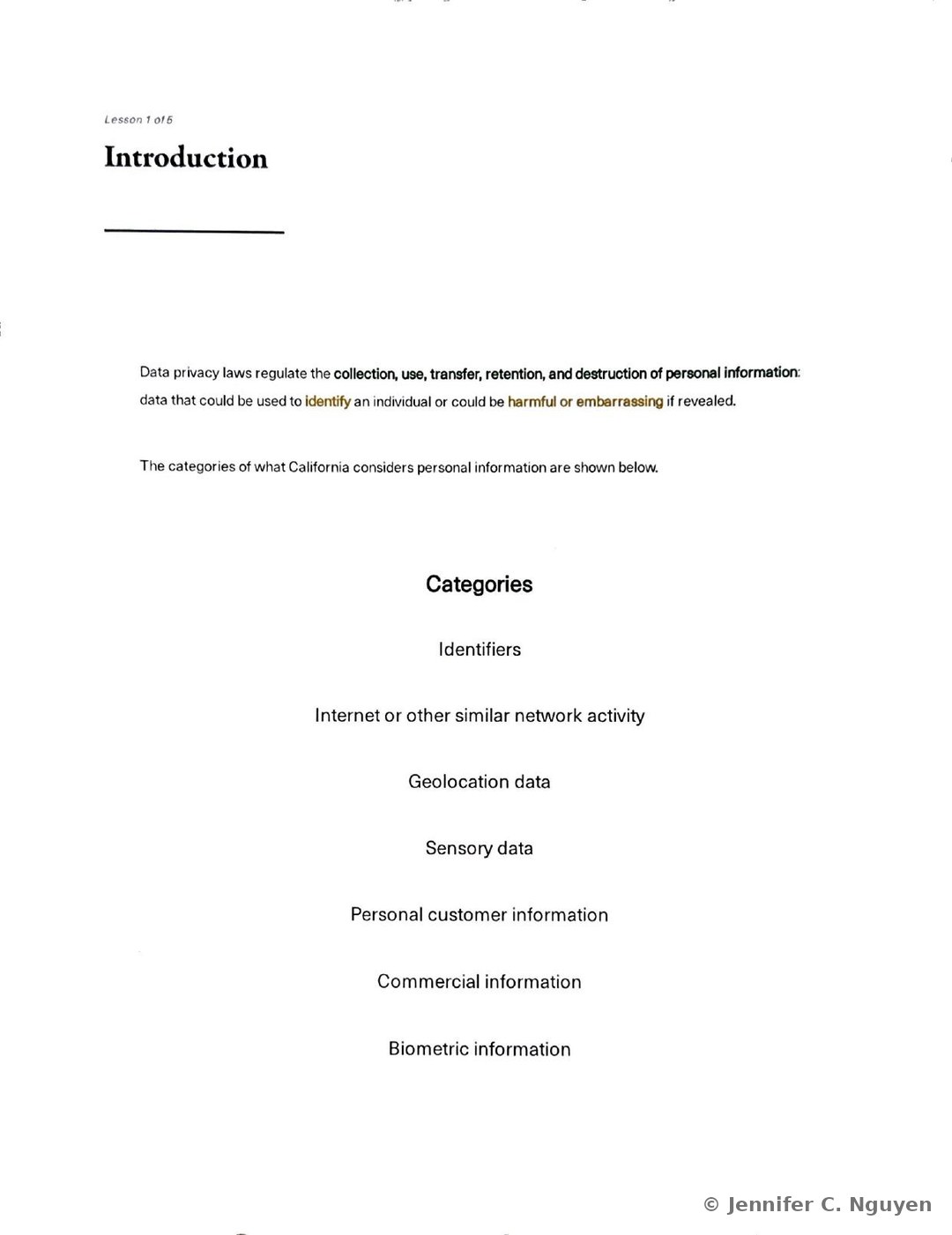
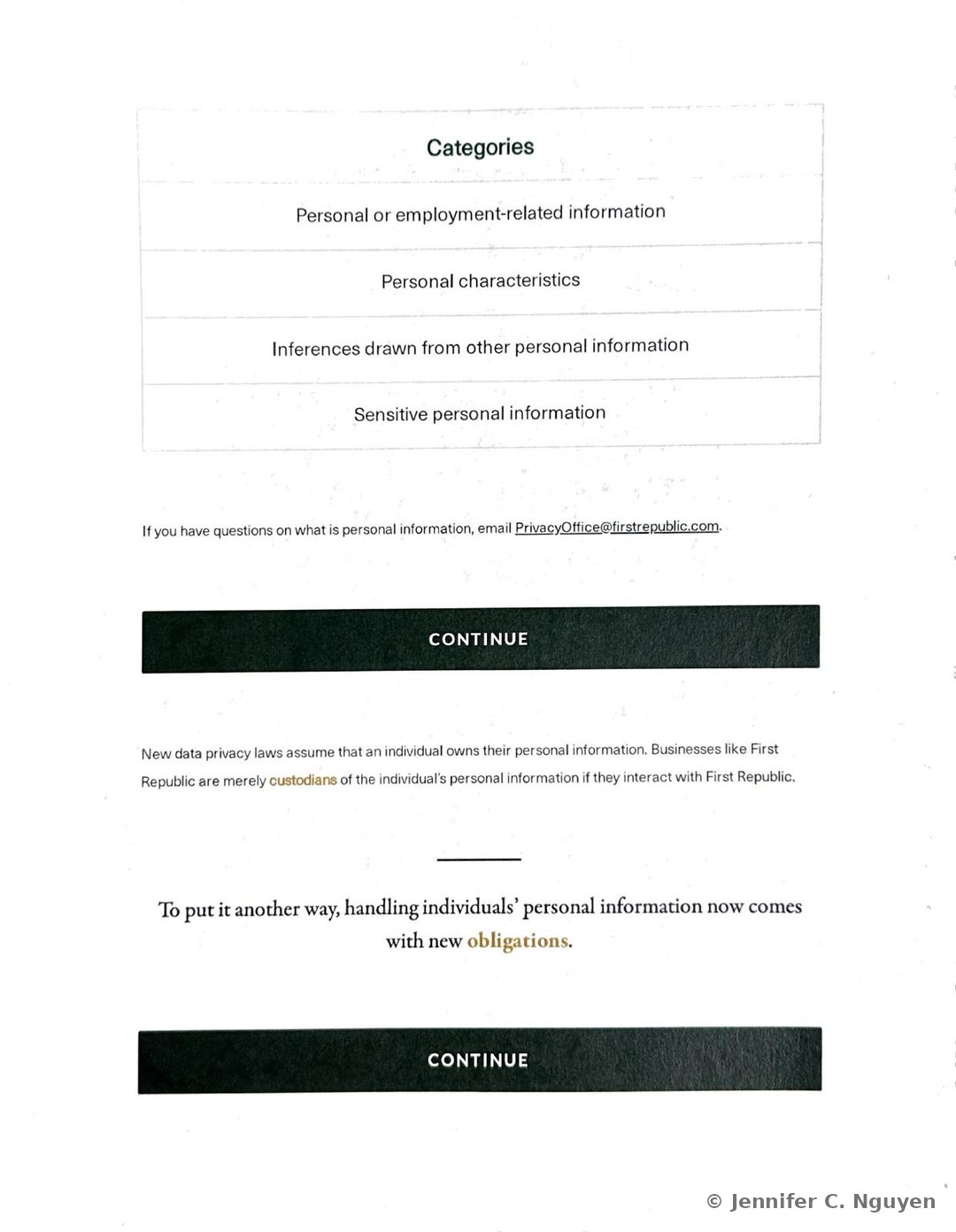
  • Data Privacy Training for CCPA and CPRA
  • Electronic Communications Certification
  • Employee, Job Candidate and Consultant Privacy Policy Acknowledgment
  • Handling Client Complaints
  • Handling Client Complaints for FRSC and FRIM Colleagues
  • Handling Client Complaints for FRTC, FRTC-DE, and FRTC-WY Colleagues
  • Introduction to First Republic's Privacy Program
  • Legal and Compliance Training for New Lending Colleagues
  • New Colleague Compliance Training for FRIM and FRSC Colleagues
  • Reputational Risk and Social Media Compliance
  • Wildfires, Hurricanes, and Power Outages — Preparing for the Season
Fair Lending, Enterprise & Vendor Risk
  • New Colleagues Enterprise Risk Management Overview
  • Fair and Responsible Lending and Regulation B
  • Introduction to Fair and Responsible Banking
  • UDAAP
  • Eagle Community Home Loan Program
  • Data Harmonization Tool
  • Vendor Management Training
People, Culture & Workplace Compliance
  • Administrative and Executive Assistants: Essentials Part 1
  • Administrative and Executive Assistants: Essentials Part 2
  • California Meal Period Waiver Agreement
  • Colleague Handbook Acknowledgment for New Colleagues
  • Colleague Handbook Acknowledgment
  • COVID-19 Policy Acknowledgment
  • COVID-19 Return to Work Policy
  • DEI Recruiting 101
  • Delivering Effective Feedback
  • Exempt and Non-Exempt Manager Training
  • Harassment and Discrimination Prevention Training for Connecticut Supervisors
  • Harassment and Discrimination Prevention Training for Delaware Supervisors
  • Harassment and Discrimination Prevention Training for New York Supervisors
  • Harassment and Discrimination Prevention Training for Supervisors
  • HIPPA Privacy and Security Training
  • Inclusive Leadership
  • Management Essentials: Empowerment
  • Management Essentials: Growing Our Team
  • Management Essentials: Performance Management
  • Management Essentials: Professional Development
  • NYC Pay Transparency Law Training for Managers
  • Phone Basics for Assistances
  • Primary Duty Absence Policy Acknowledgment
  • Promoting Inclusive Behaviors at First Republic
  • Promoting Inclusive Behaviors at First Republic for Client-Facing Colleagues
  • Promoting Inclusive Behaviors at First Republic for Client-Facing Managers
  • Promoting Inclusive Behaviors at First Republic for Florida Client-Facing Colleagues
  • Promoting Inclusive Behaviors at First Republic for Florida Client-Facing Managers
  • Promoting Inclusive Behaviors at First Republic for Florida Colleagues
  • Promoting Inclusive Behaviors at First Republic for Florida Managers
  • Promoting Inclusive Behaviors at First Republic for Managers
  • Respect the Team: Harassment and Discrimination Prevention
  • Respect the Team: Harassment and Discrimination Prevention for Connecticut Colleagues
  • Respect the Team: Harassment and Discrimination Prevention for Delaware Colleagues
  • Respect the Team: Harassment and Discrimination Prevention for New York Colleagues
  • Return to Work Requirements and Practices Acknowledgment
  • Return to Office Training
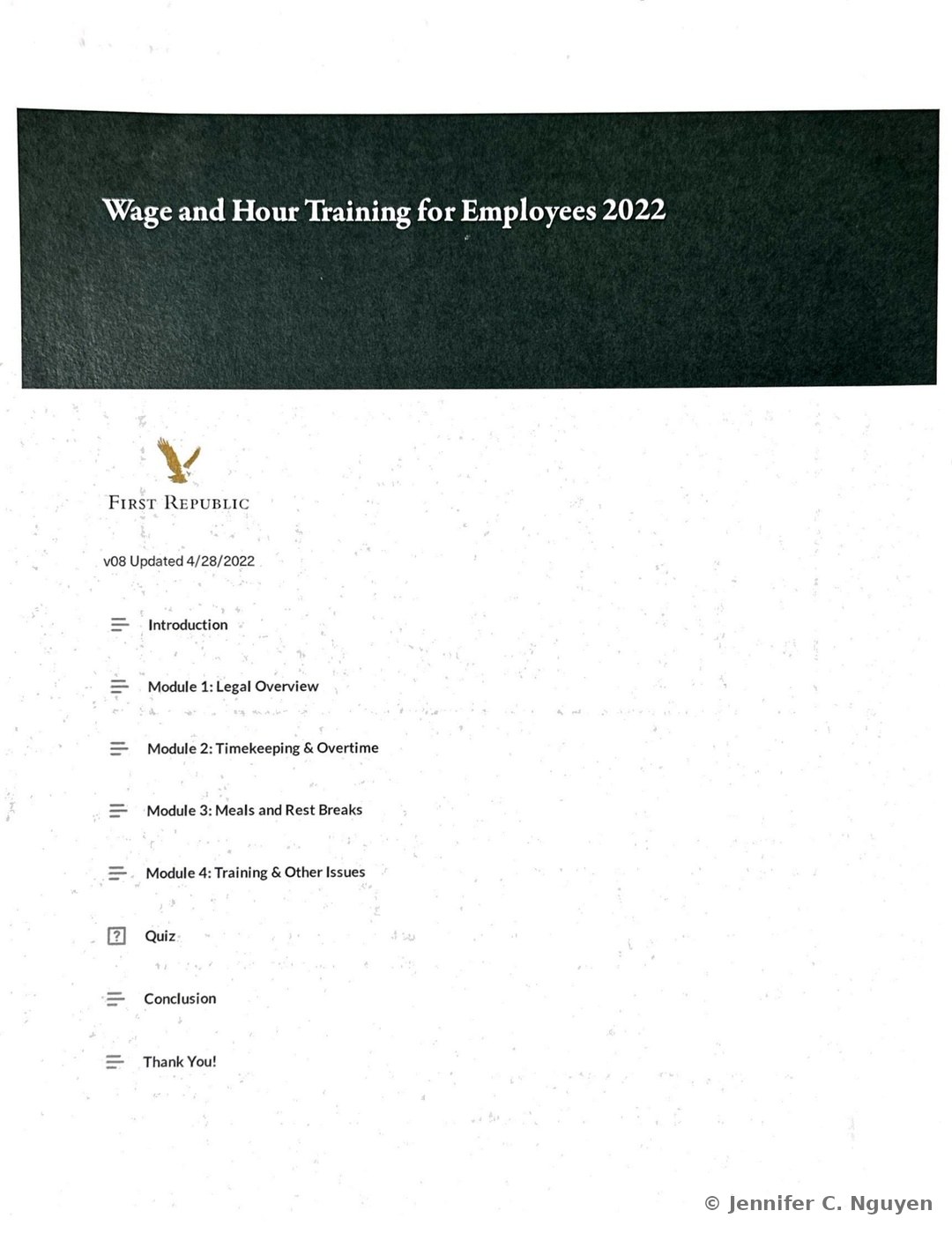
  • Wage and Hour Training for Employees
  • Wage and Hour Training for Managers
  • Workplace Wellness and COVID-19 Training and Policy Acknowledgment
Business Continuity & Information Security
  • Archer Business Continuity Refresh Process Training
  • Business Continuity
  • Clean Desk Acknowledgment
  • Crisis Management Team Training
  • Disaster Recovery Testing for Business Units Training
  • Disaster Recovery Testing for Information Services Training
  • Identifying Phishing Indicators
  • Information and Systems Appropriate Use Policy Acknowledgment
  • Information Security Awareness
  • Information Security Awareness for New Hires
  • Phishing Awareness
Technology & Engineering
  • A Service-First Product Mindset
  • Bring Your Own Device Policy Agreement
  • Change Management Policy Attestation
  • Change Management Process Introduction
  • Cloud Engineering Introduction
  • Data Center Access Policy Agreement
  • Data Handling Standard Acknowledgment
  • Defending AWS
  • Event Management Introduction
  • Identity & Access Management for Azure Course Exam
  • Information Services Workplace Flexibility Acknowledgment
  • Major Incident Management Process Overview
  • OWASP Top Ten
  • Secure Coding Annual Refresher
  • Software Development Lifecycle Governance for Information Services Professionals
Legal, Regulatory Foundations & Specialty Training
  • First Republic's Unique Business Model Disrupting the Banking Sector Since 1985
  • Regulation Fair Disclosure
  • Exploring Attorney-Client Privilege Training
  • Facilities Team Training with Seyfarth Shaw
  • Fundamentals of Bankruptcy: Depositor Bankruptcy and Relevant Issues Training
  • HIPAA Training for Human Resources
  • Lease Review from the Ground Up: Ground Leases, Major Leases, and Single Tenant Assets
  • Regulation U Training
  • Title Insurance Training with Margaret Redman of Fidelity National Title
Lending, Mortgage & Credit Compliance
  • Attorney-Client Privilege Guidelines Training
  • Fair Credit Reporting Act for Lenders
  • Flood Insurance
  • HMDA: Data Collection
  • HMDA: Transactional Coverage
  • Lending to Regulation O Officers
  • Mortgage Servicing: Payment Processing and Account Maintenance
  • Online Credit Training NLAW: Best Practices
  • Online Credit Training: Financial Calculator
  • Online Credit Training: First Republic Bank by the Numbers
  • Online Credit Training: Investor Loan Sales
  • Online Credit Training: Legal Terms and Documents
  • Online Credit Training: Loan Grading
  • Online Credit Training: Loan Programs
  • Online Credit Training: Memorable Moments at First Republic
  • Online Credit Training: PITI - Principle, Interest, Taxes, & Insurance
  • Online Credit Training: Rate Sheet
  • Online Credit Training: Sources of Liquidity
  • Online Credit Training: Tax Returns — Level 1
  • Online Credit Training: Tax Returns — Level 2
  • Online Credit Training: Tax Returns — Level 3
  • Online Credit Training: Understanding Appraisals
  • Online Credit Training: Understanding Closing Disclosures
  • Online Credit Training: Understanding Credit Reports
  • Online Credit Training: Understanding Lease Agreements
  • Online Credit Training: Understanding Paystubs
  • Online Credit Training: Understanding Preliminary Reports
  • Online Credit Training: Understanding Purchase Contracts
  • Regulation Z: Appraisal Independence Rule
  • SAFE Act MLO Registration Requirements
  • TILA Closed-End for Mortgage Lenders
  • TILA Home Equity Lines of Credit
Sales, Marketing & Productivity Tools
  • CapitalMap Training for Bankers
  • Marketing Compliance
  • PWM Attestation for Adobe Acrobat Professional
  • Seismic 101
  • Workfront Training
  • Writing for Brand
Wealth Management, Trust & Securities Compliance
  • Advanced Look at Insider Trading
  • Check Deposits and Receipt and Delivery of Securities
  • Corporate Culture, Supervision, and Remote Work Challenges
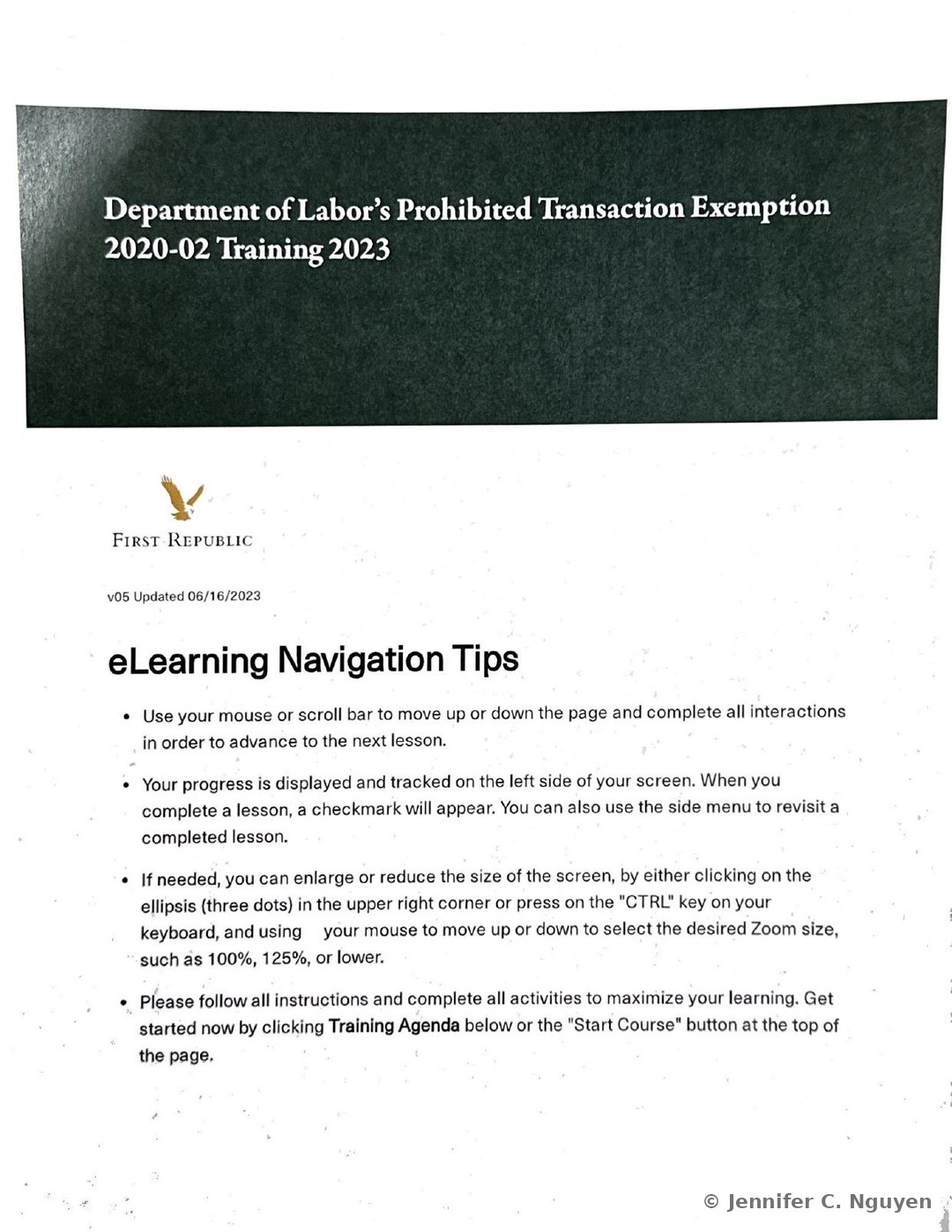
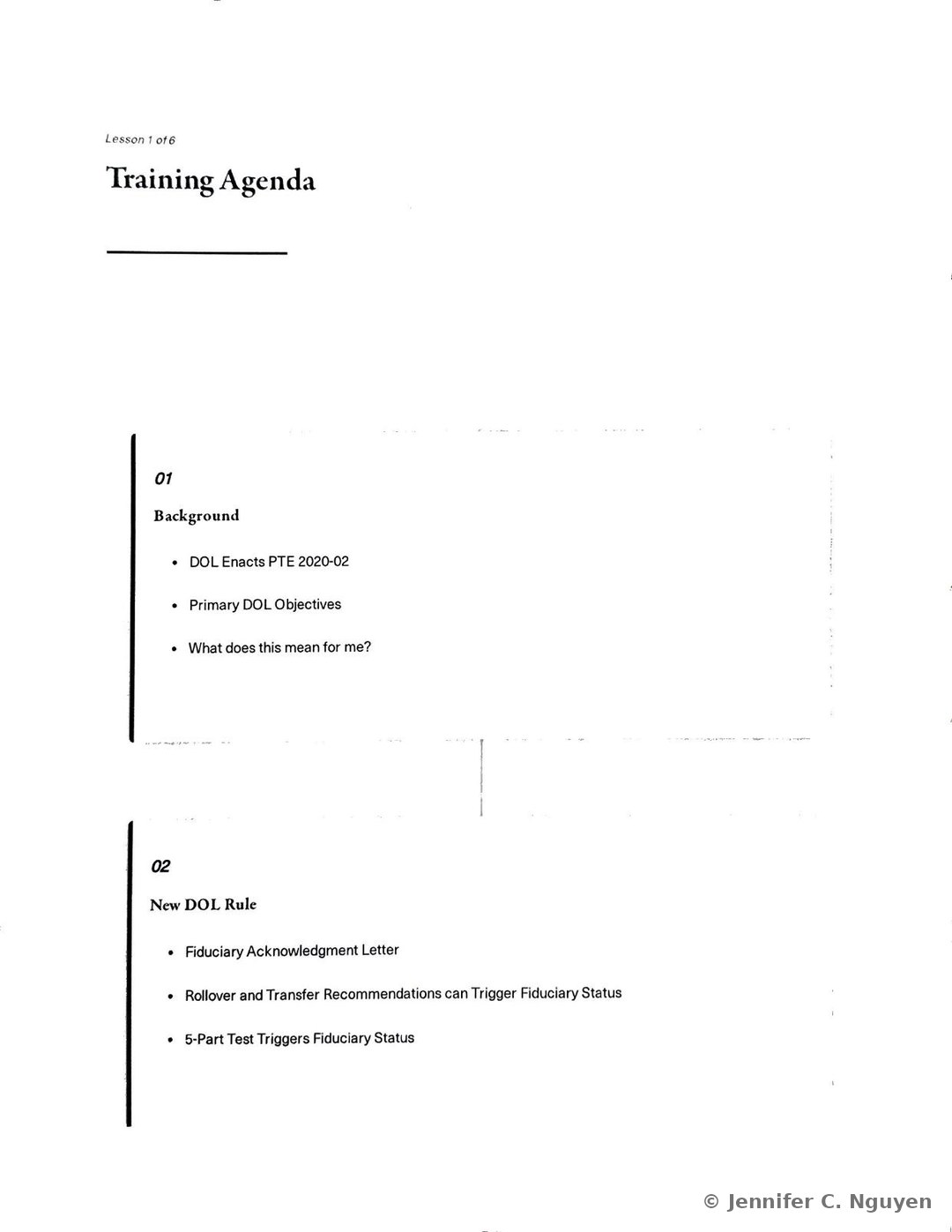
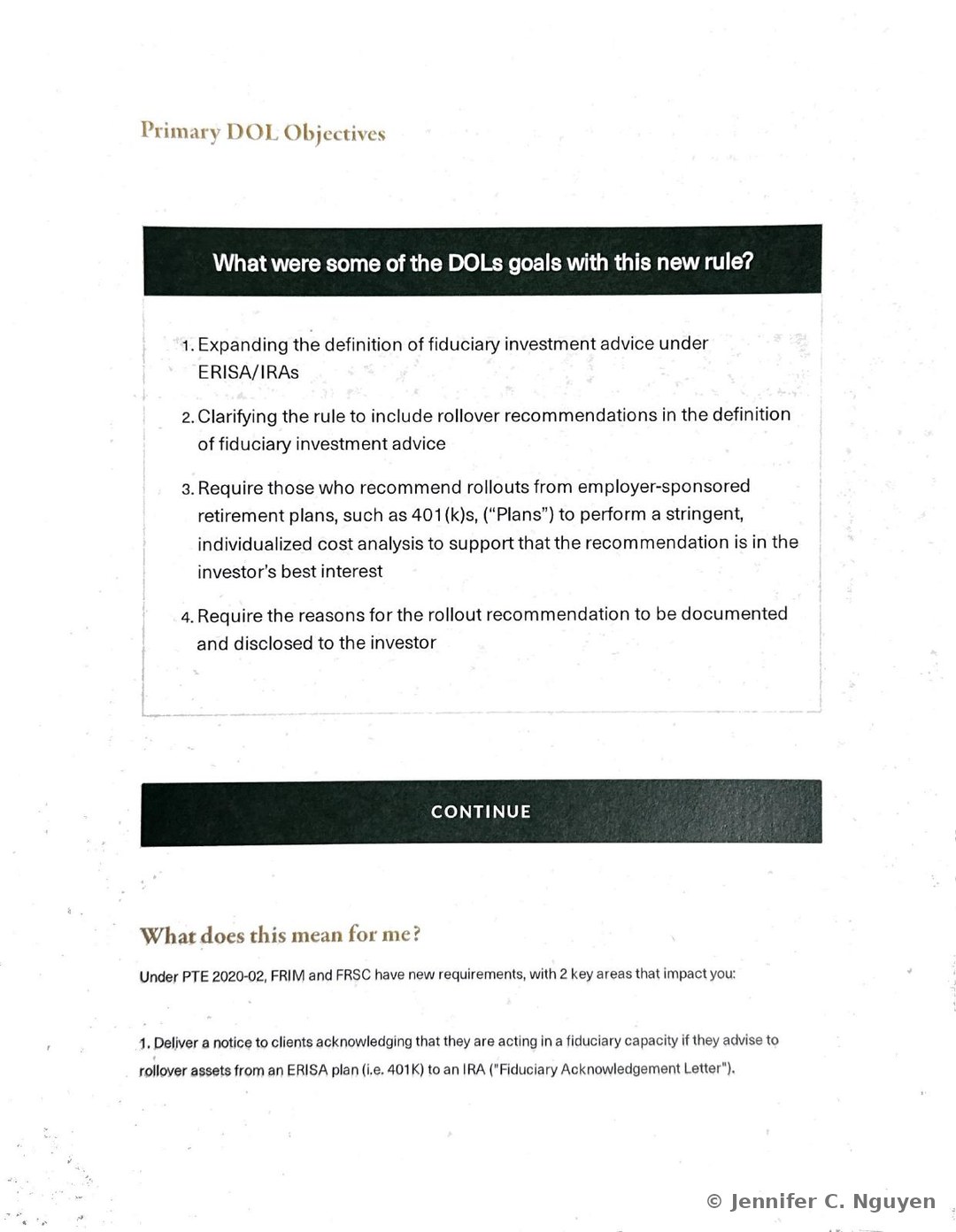
  • Department of Labor's Prohibited Transaction Exemption 2020-02 Training
  • Employee Acknowledgment Form: Referrals
  • ERISA Retirement Plan Training and Certification Program: Session 1 of 3
  • ERISA Retirement Plan Training and Certification Program: Session 2 of 3
  • ERISA Retirement Plan Training and Certification Program: Session 3 of 3
  • Estate and Business Planning at First Republic
  • Ethical Issues Facing the Financial Services Industry
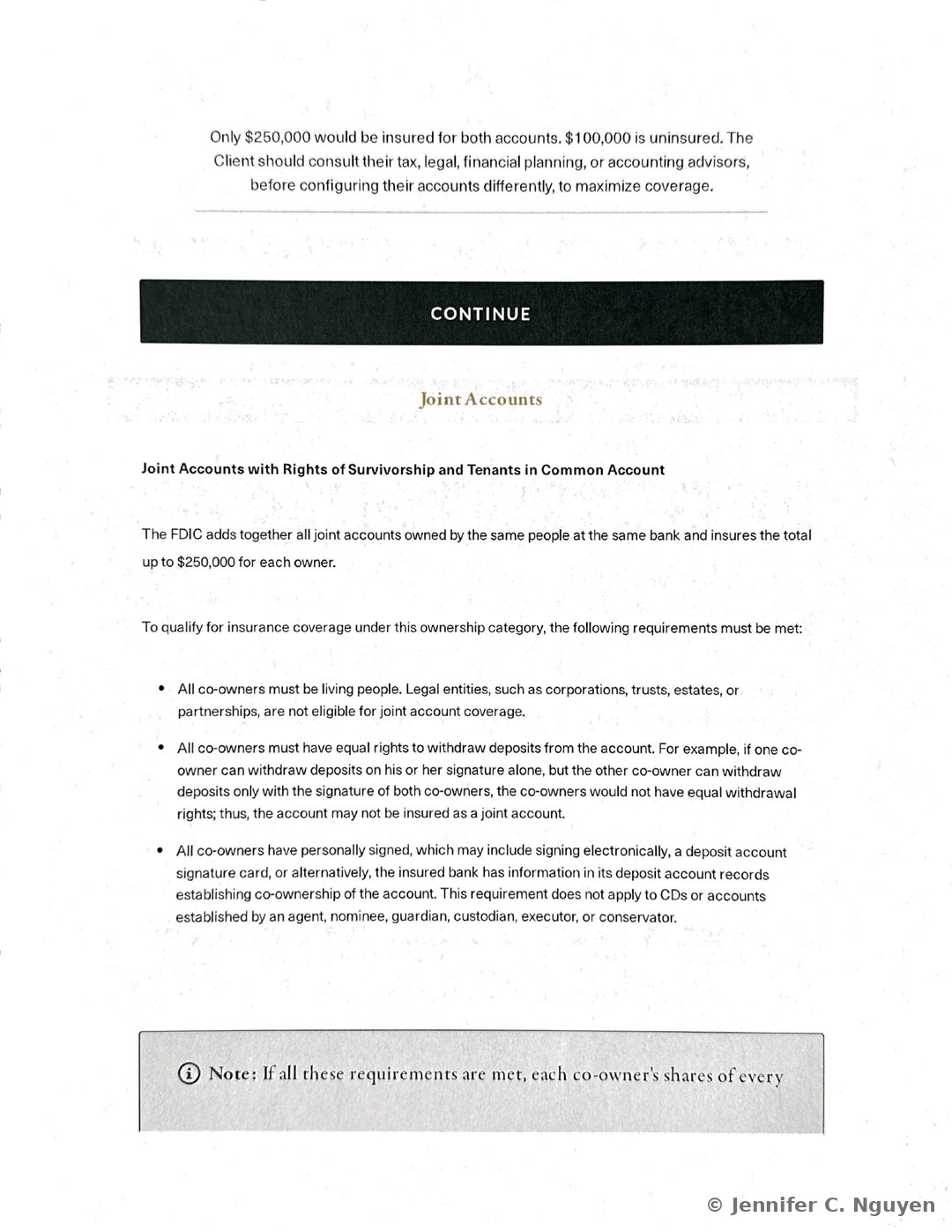
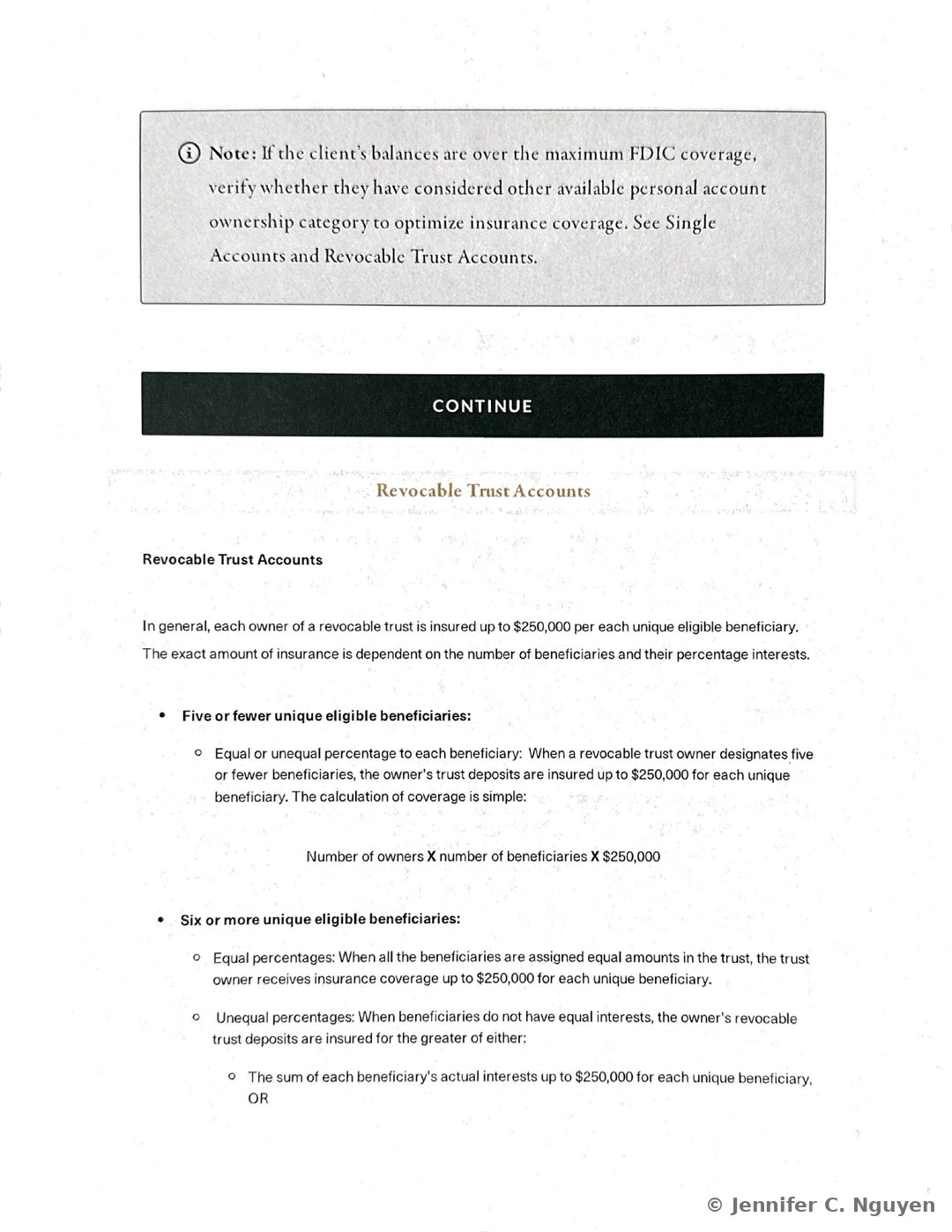
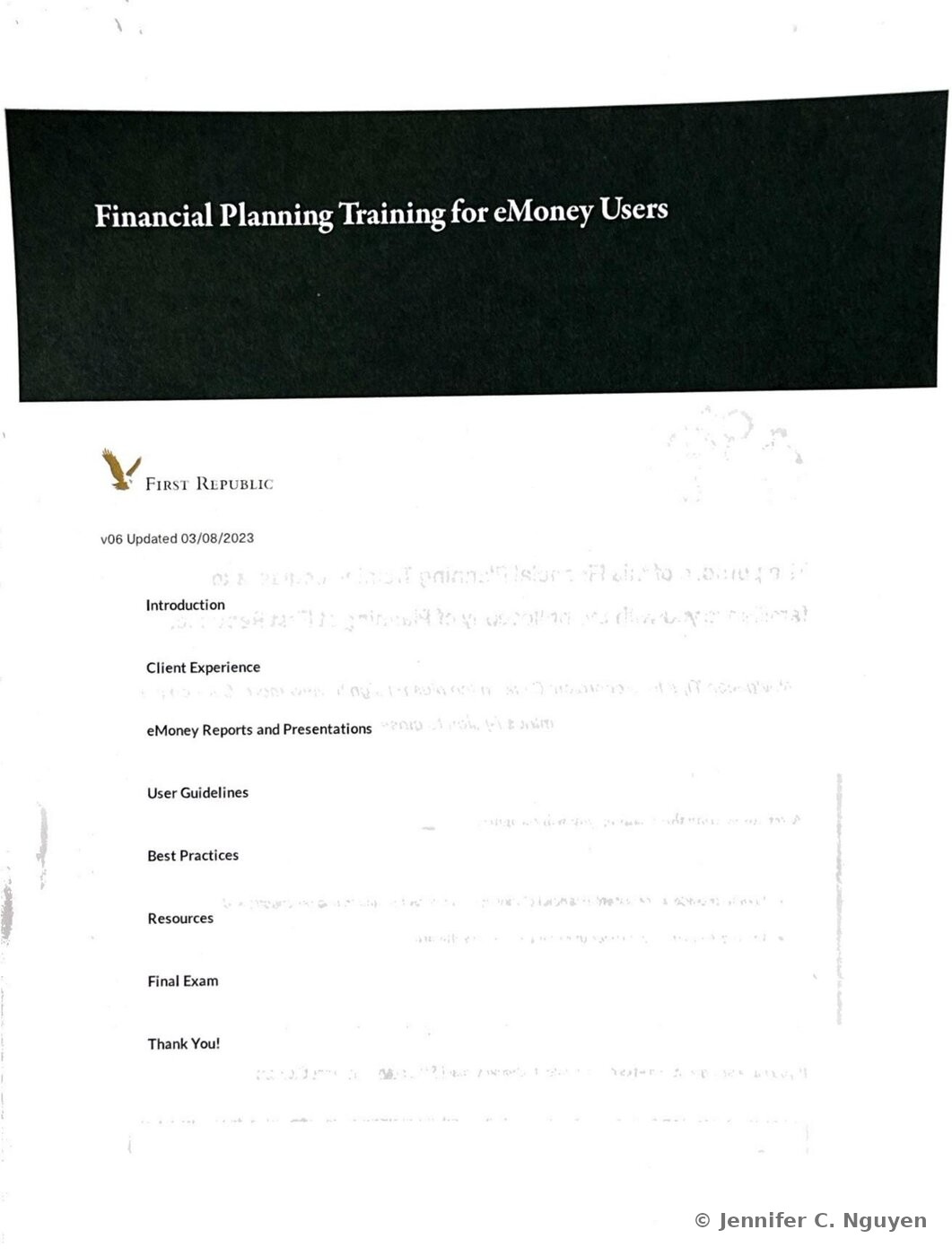
  • Financial Planning Training for eMoney Users
  • FINRA Back-Office Operations
  • First Republic Trust Company Delaware Policies and Procedures Attestation
  • First Republic Trust Company Policies and Procedures Attestation
  • First Republic Trust Company Wyoming Policies and Procedures Attestation
  • Foreign Exchange Awareness Training
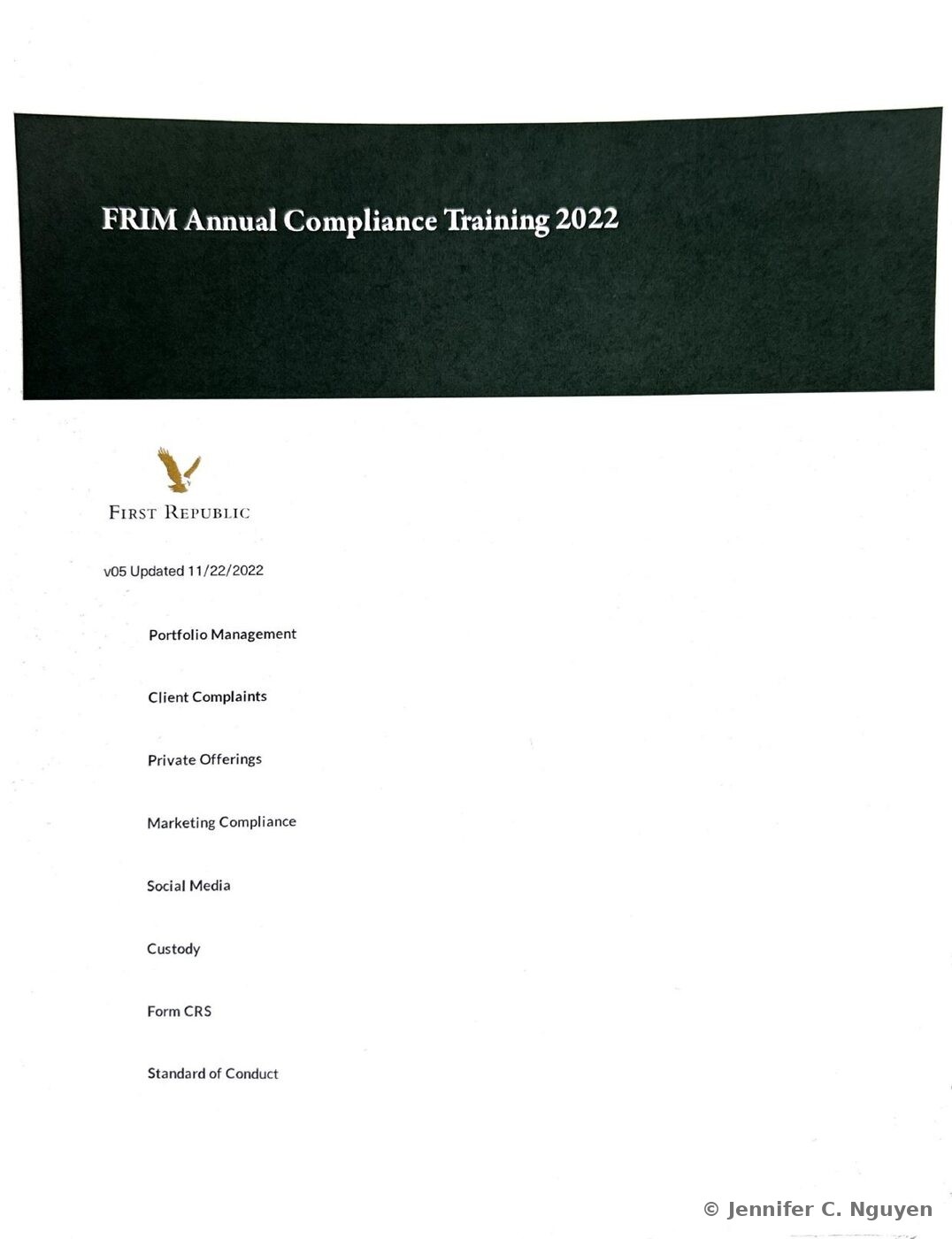
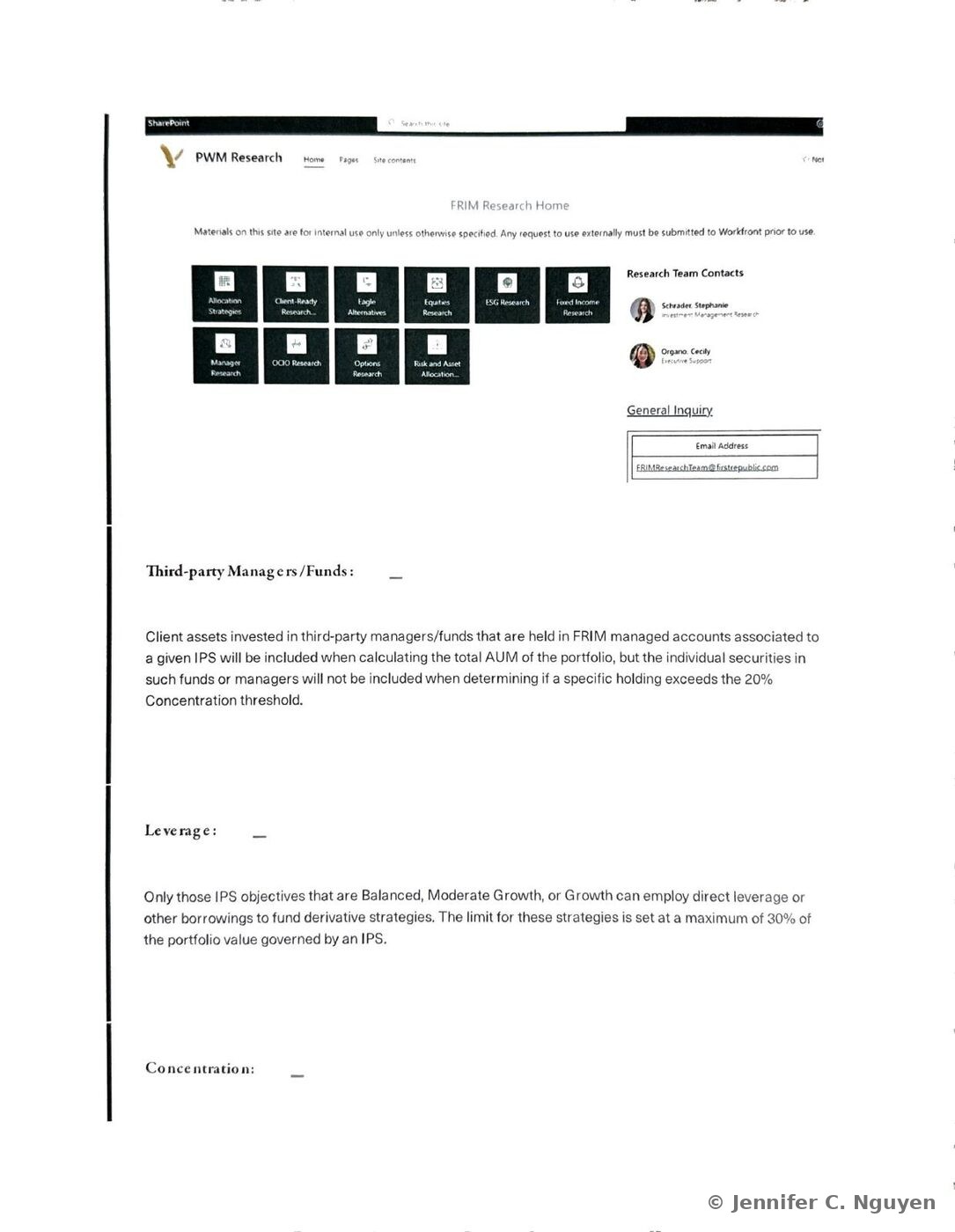
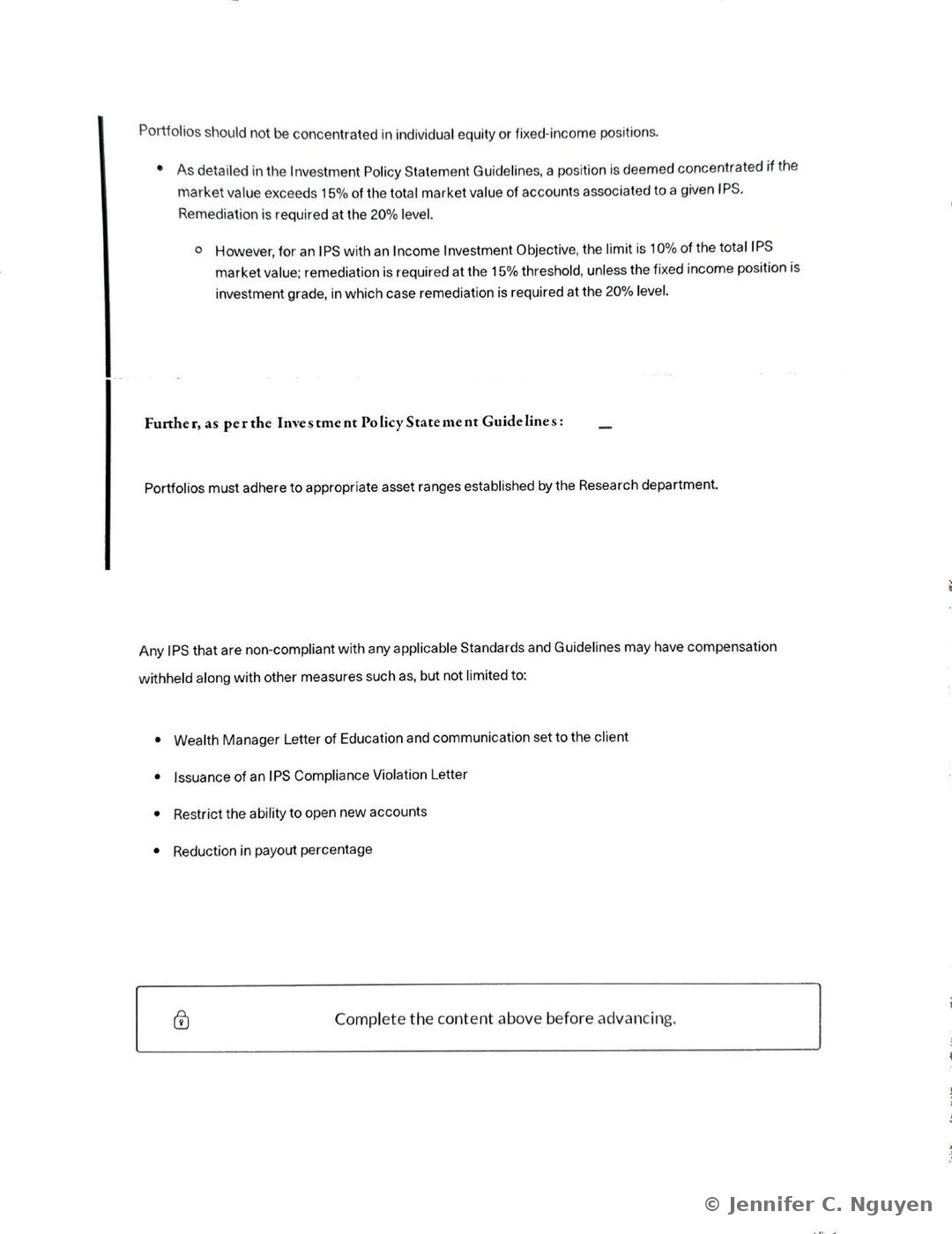
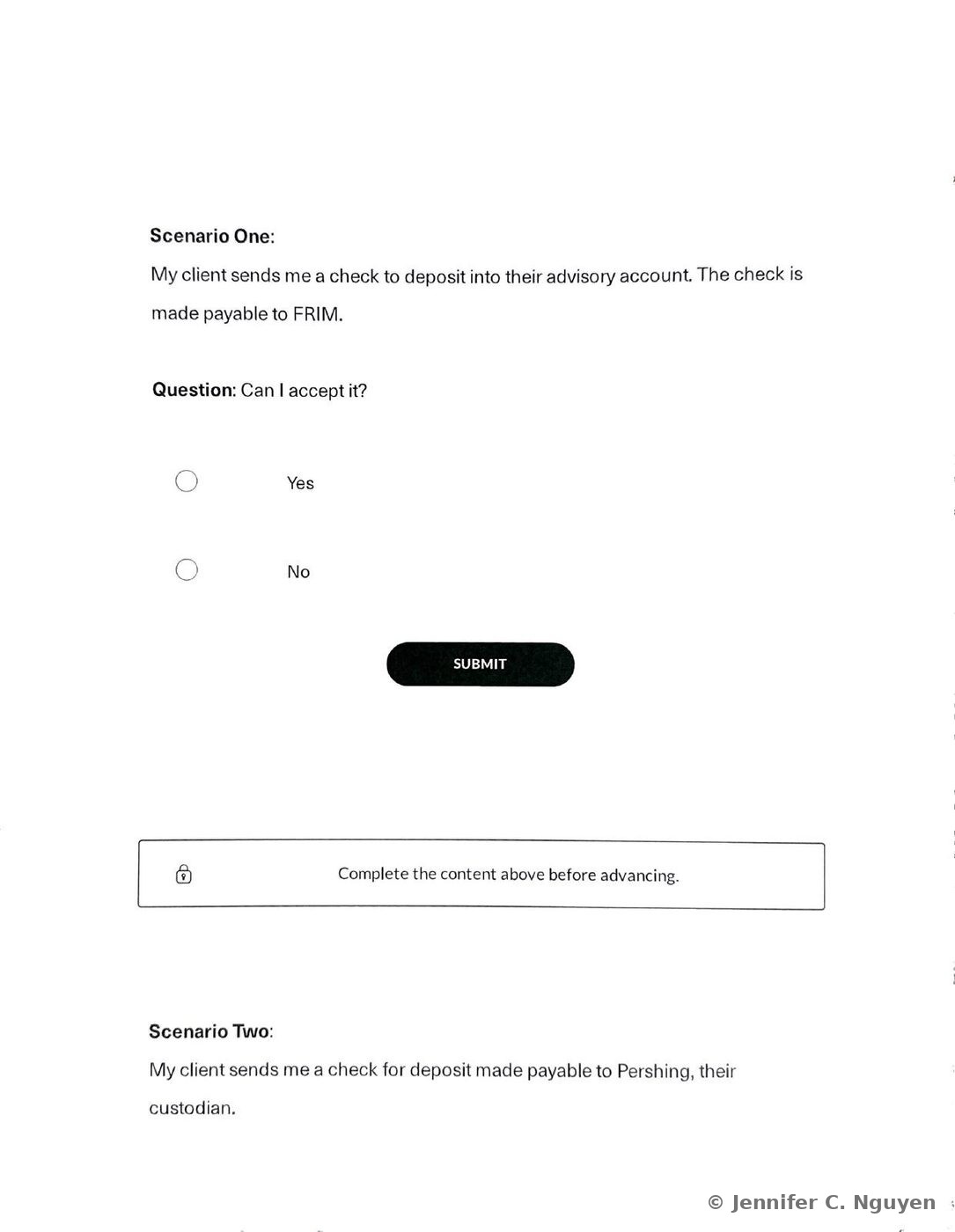
  • FRIM Annual Compliance Training
  • FRSC Annual Compliance Meeting for Private Wealth Management
  • FRSC Annual Compliance Meeting for Securities Licensed Bankers
  • Handling of Client Documents Acknowledgment
  • Handling of Client Verification Acknowledgment
  • Handling of Client Verification, Handling of Client Document & Sharing of Files Acknowledgment
  • Hearsay Training
  • Insurance Licensed Bank Employee Acknowledgment
  • Investment Strategies and Suitability of Share Classes in 529 Plans
  • New SEC Advertising Rule
  • Options Fundamentals Training
  • Options Training Attestation
  • Order Execution Qualifiers
  • Outside Business Activities and Private Securities Transactions
  • PWM Private Placement Offering Requirements and Workflow Training
  • Referring Bank Employee Acknowledgment Form
  • Regulation Best Interest and Form CRS: Documenting Delivery of Form CRS using Wealth Connect
  • Regulation Best Interest and Form CRS: Understanding Triggering Events
  • Regulation Best Interest Considerations for Variable Annuity Recommendations
  • Regulation Best Interest Training 2020: Module 1
  • Regulation Best Interest: Care Obligation
  • Regulation Best Interest: FRSC Firm Element Training
  • Social Media Compliance for FRIM Employees, FRSC Employees, FX Employees and Licensed Bankers
  • Understanding ERISA
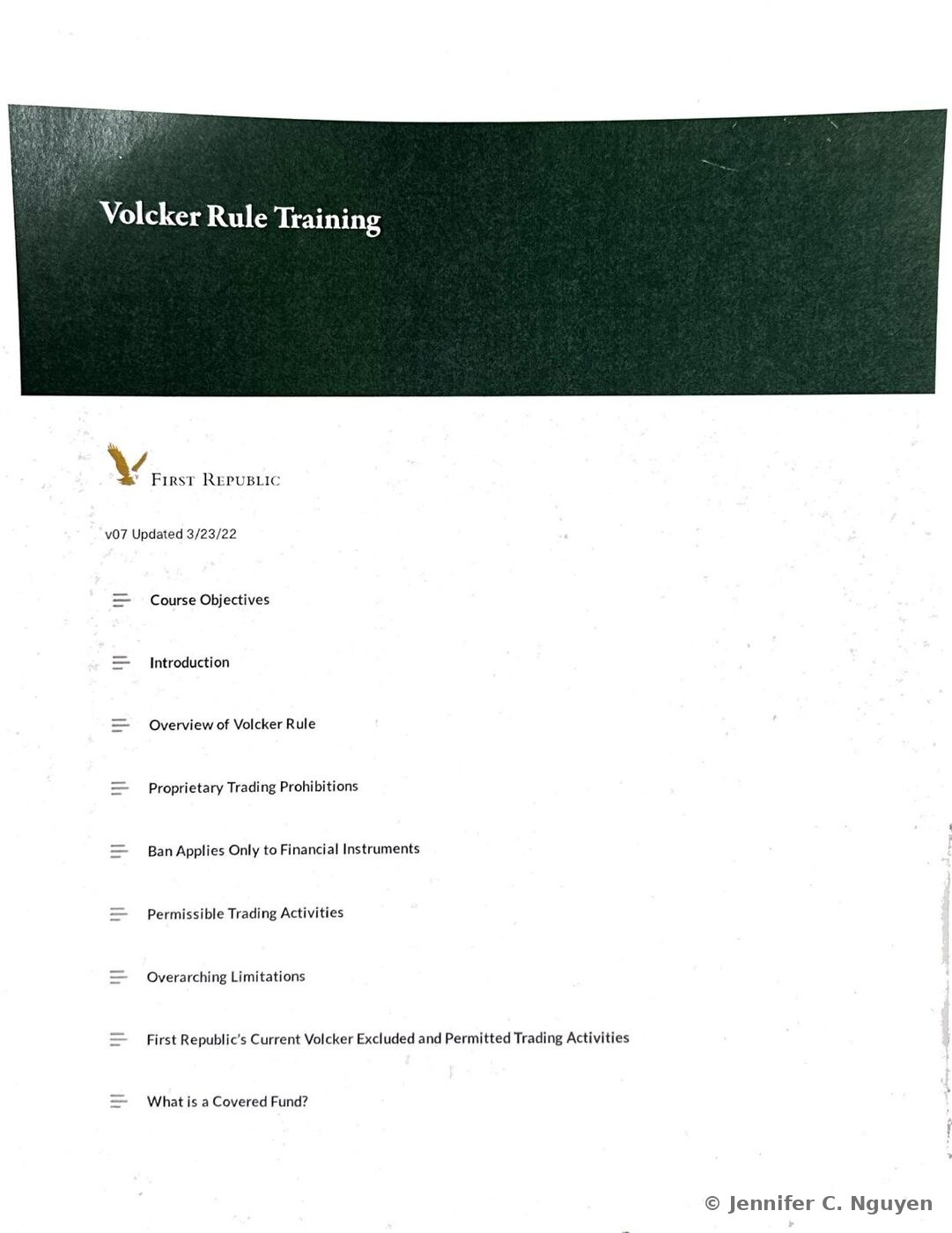
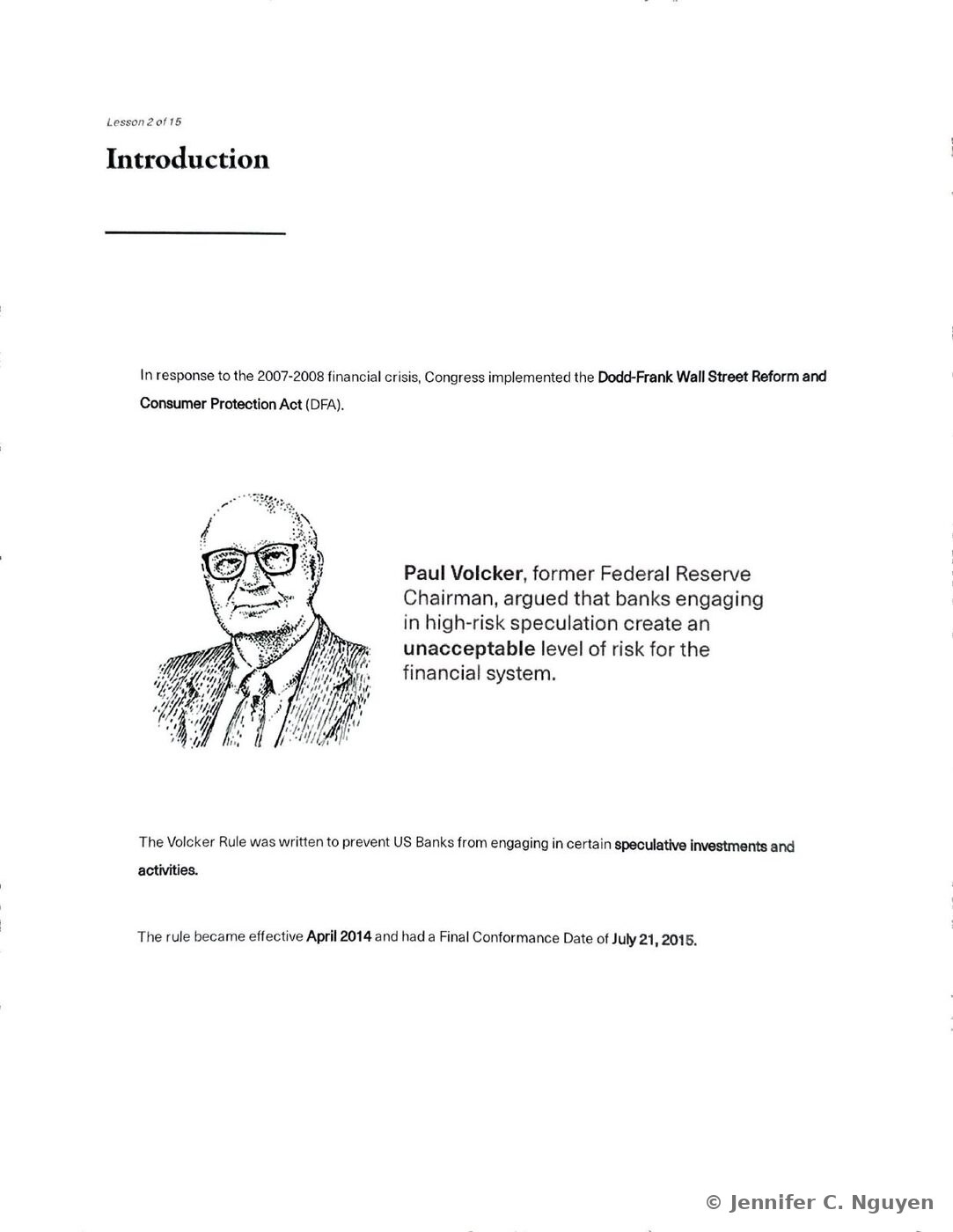
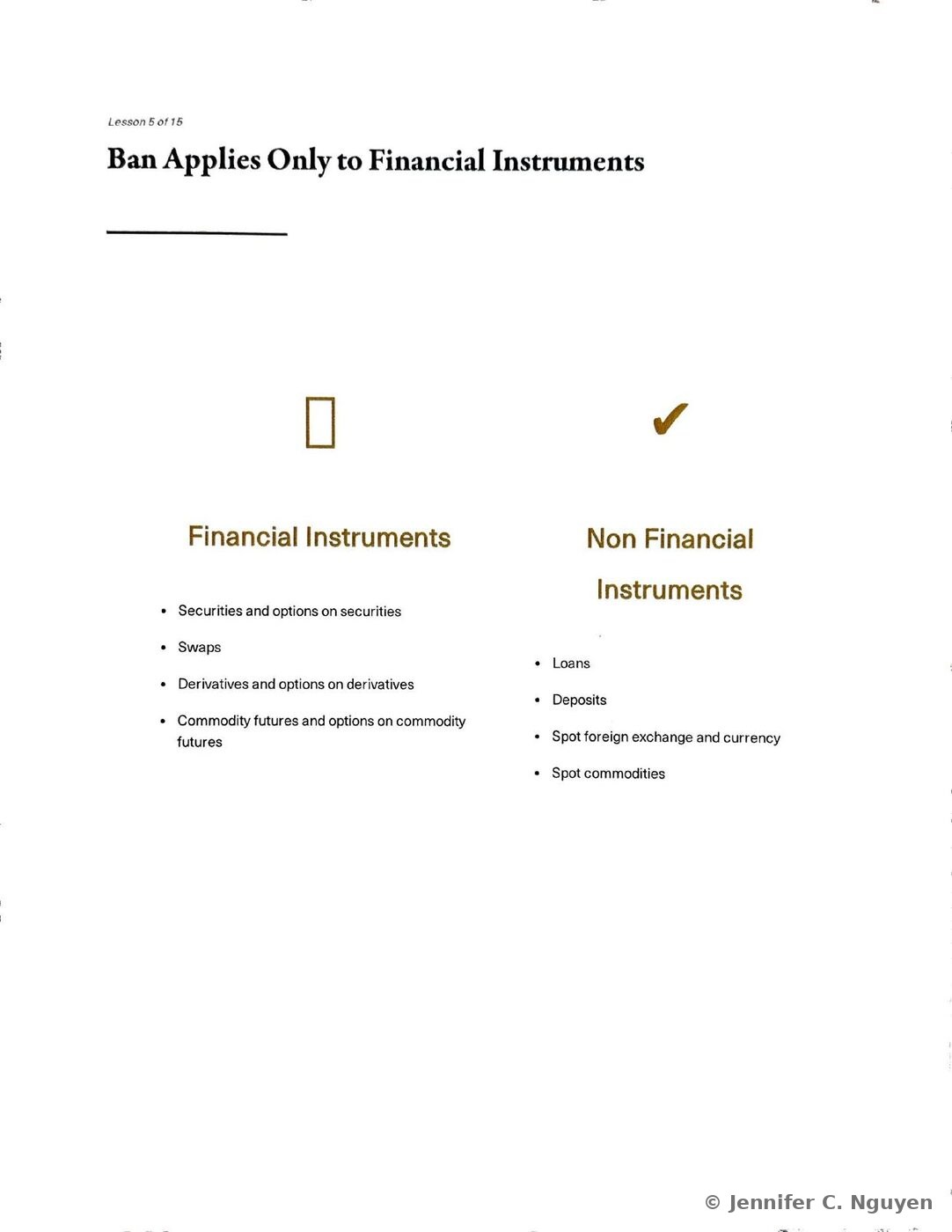
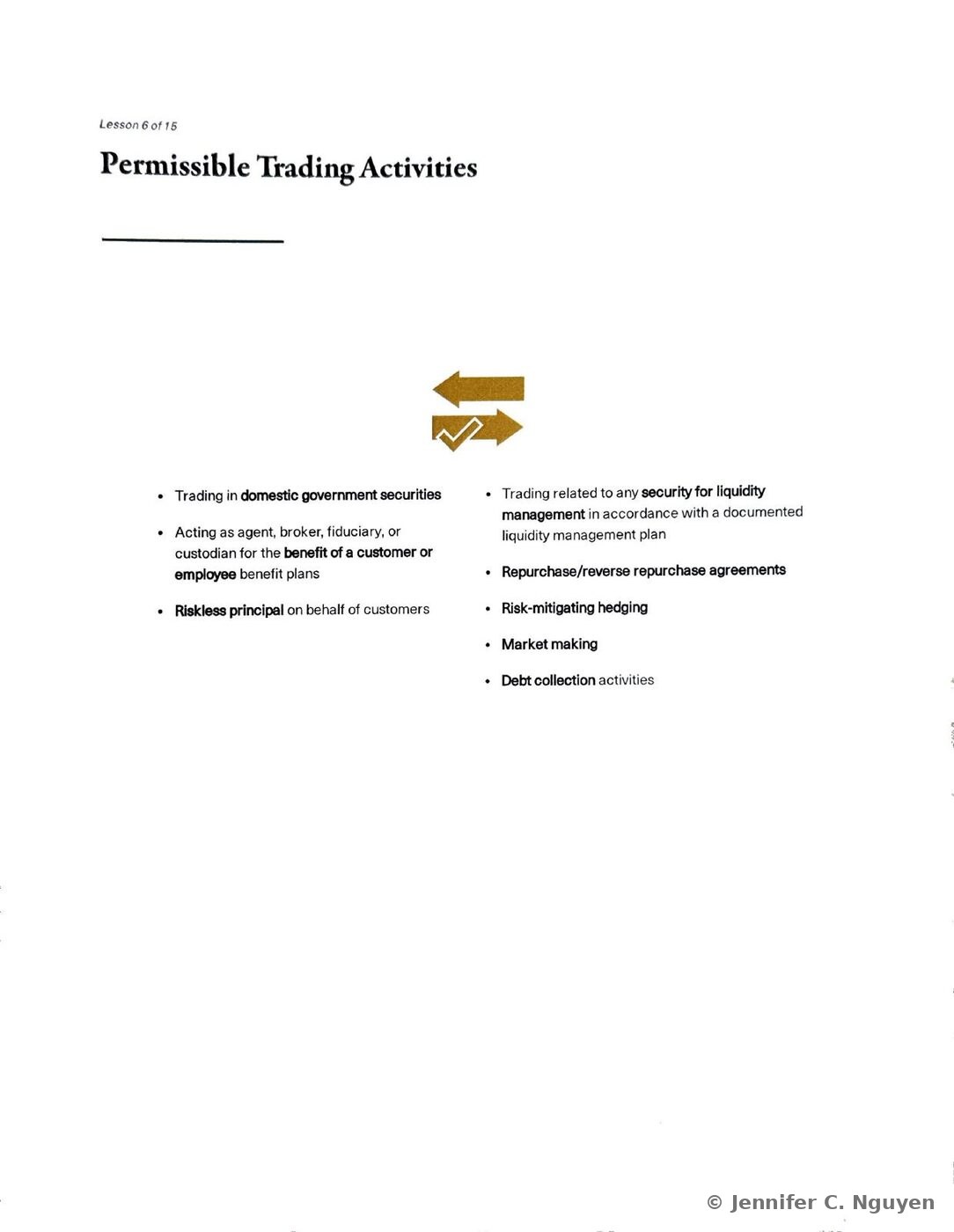
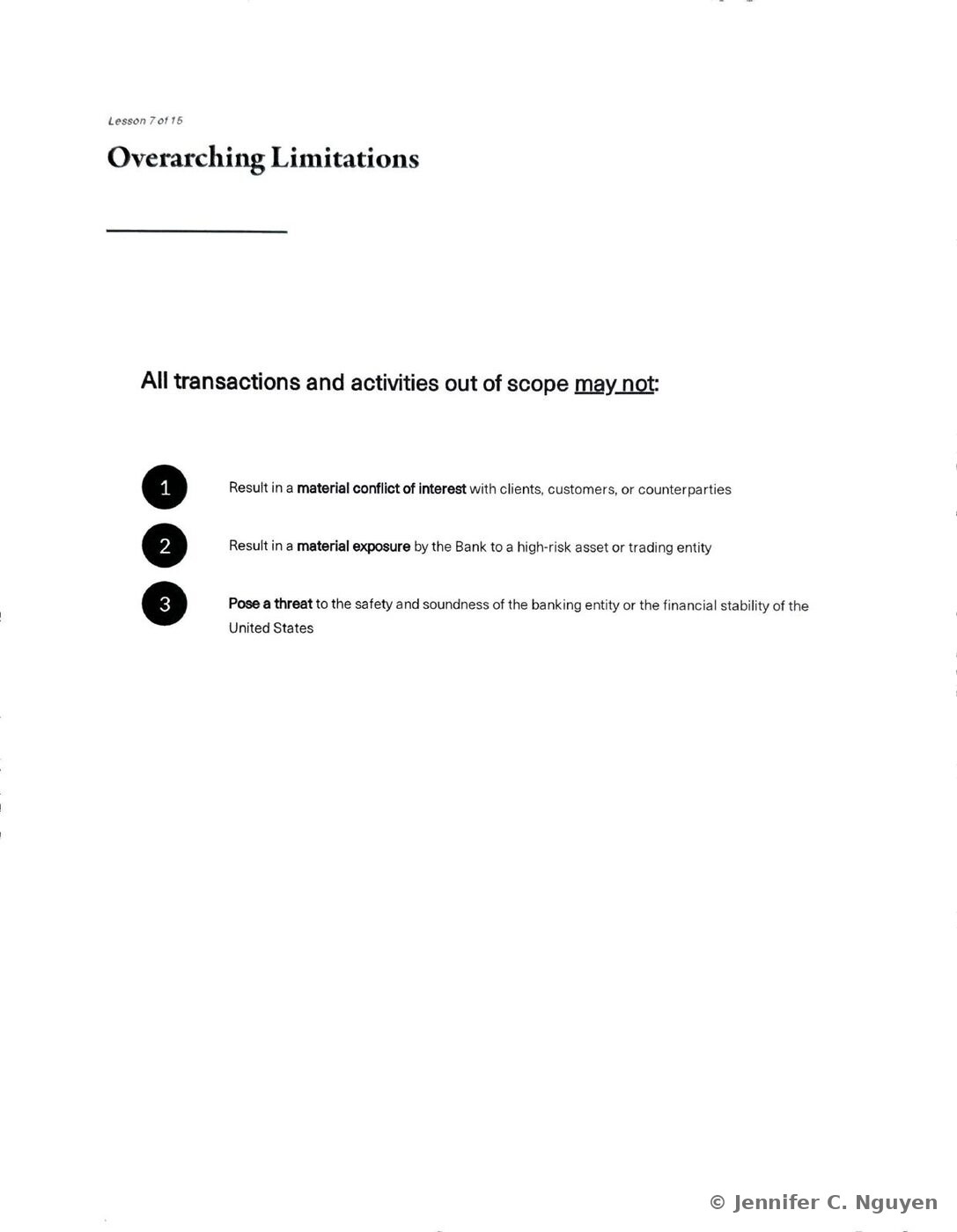
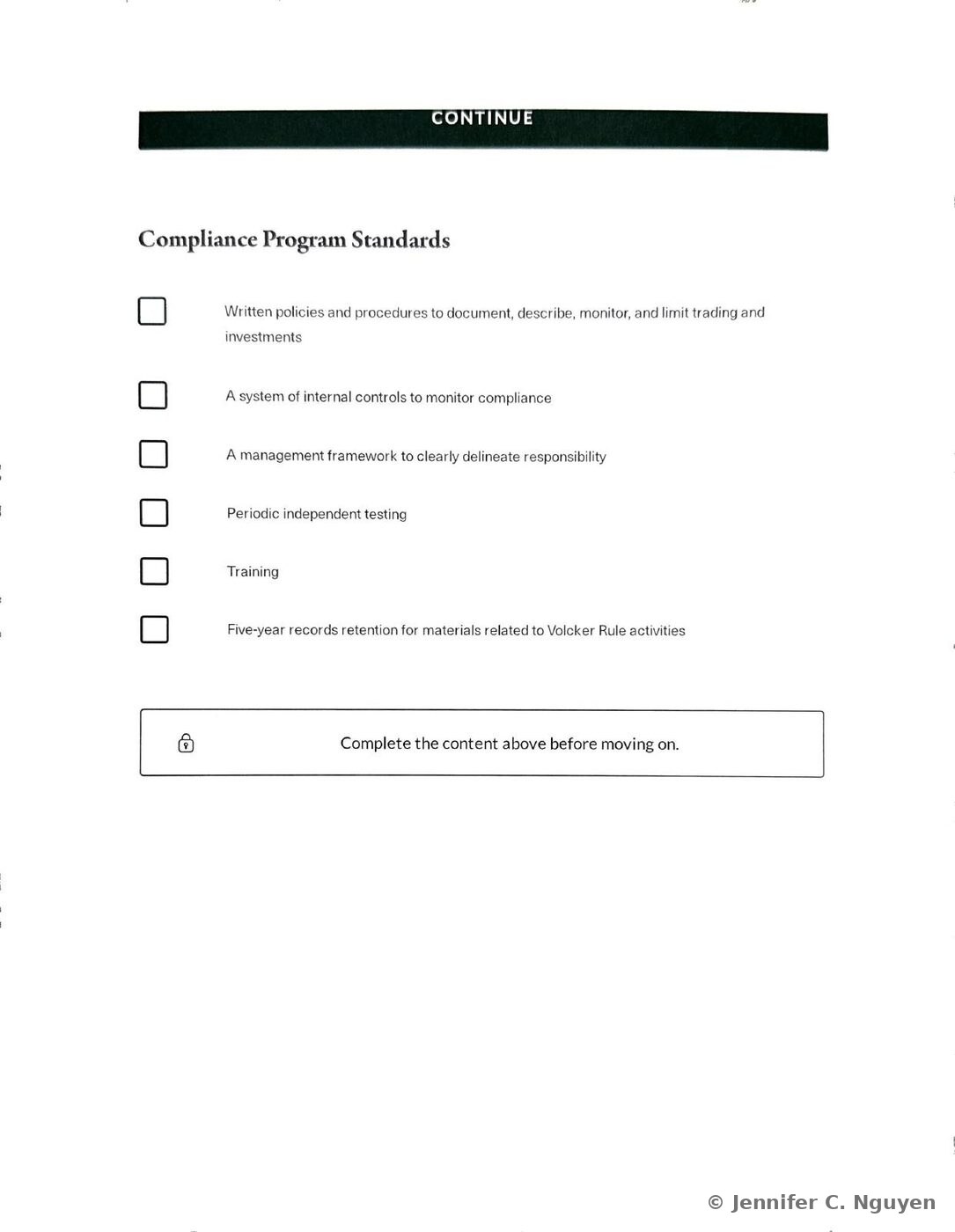
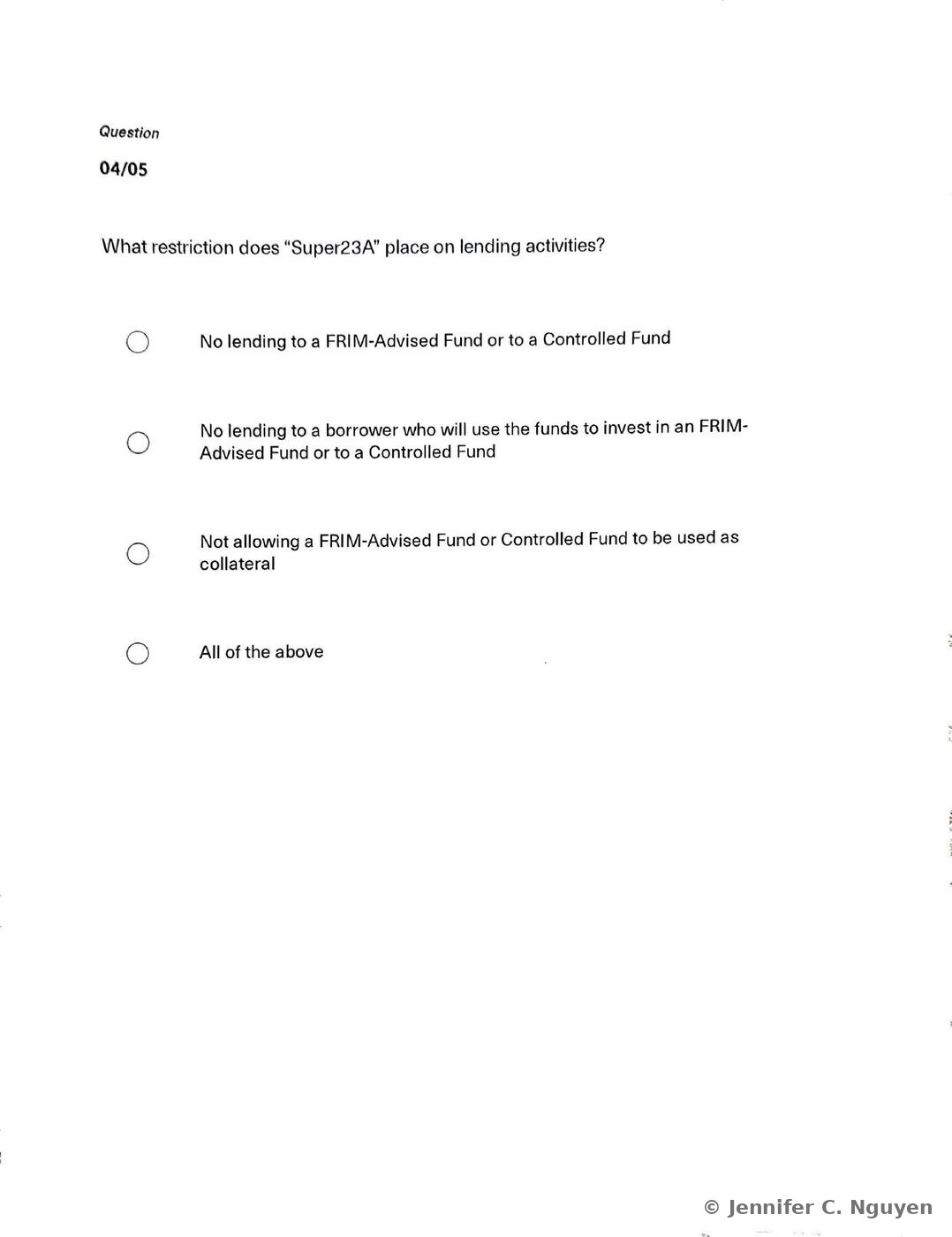
  • Volcker Rule Training
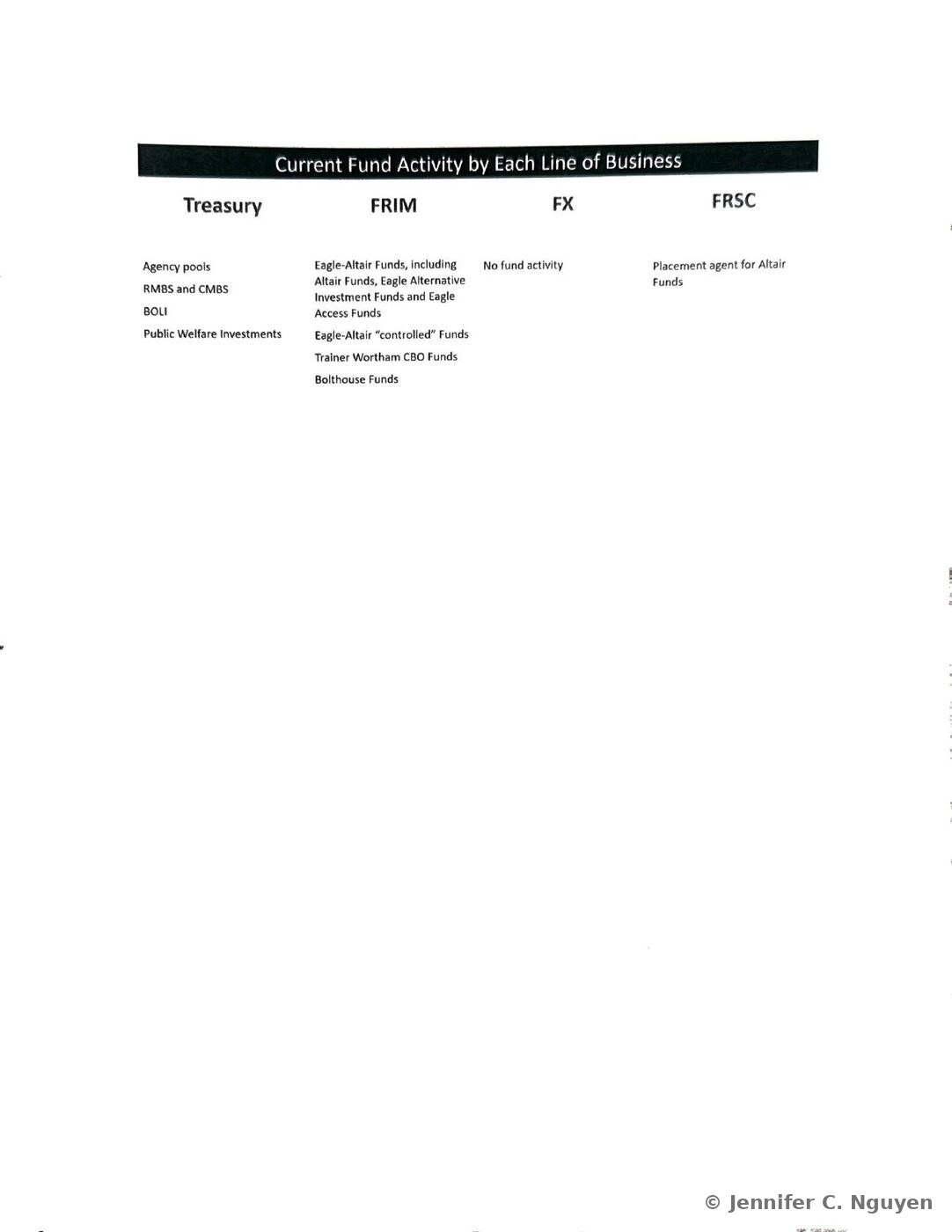
  • Volcker Rule Training for First Republic Investment Management
  • Volcker Rule Training for First Republic Securities Company
  • Volcker Rule Training for Foreign Exchange
  • Volcker Rule Training for Lending
  • Volcker Rule Training for Treasury
01
Bring Your Own Device Policy Agreement

This two-lesson Rise course delivers First Republic's Bring Your Own Device (BYOD) Policy Agreement, walking colleagues through the security, monitoring, and eDiscovery terms that apply when a personal Handheld Device is used to access Confidential Information, before closing with a click-to-acknowledge attestation step. This course is listed in the Compliance & Regulatory Course Library above, under Technology & Engineering.

BYOD Policy AgreementConfidential Information AccessDevice Monitoring & eDiscoveryClick-to-Acknowledge AttestationHandheld Device Security Requirements
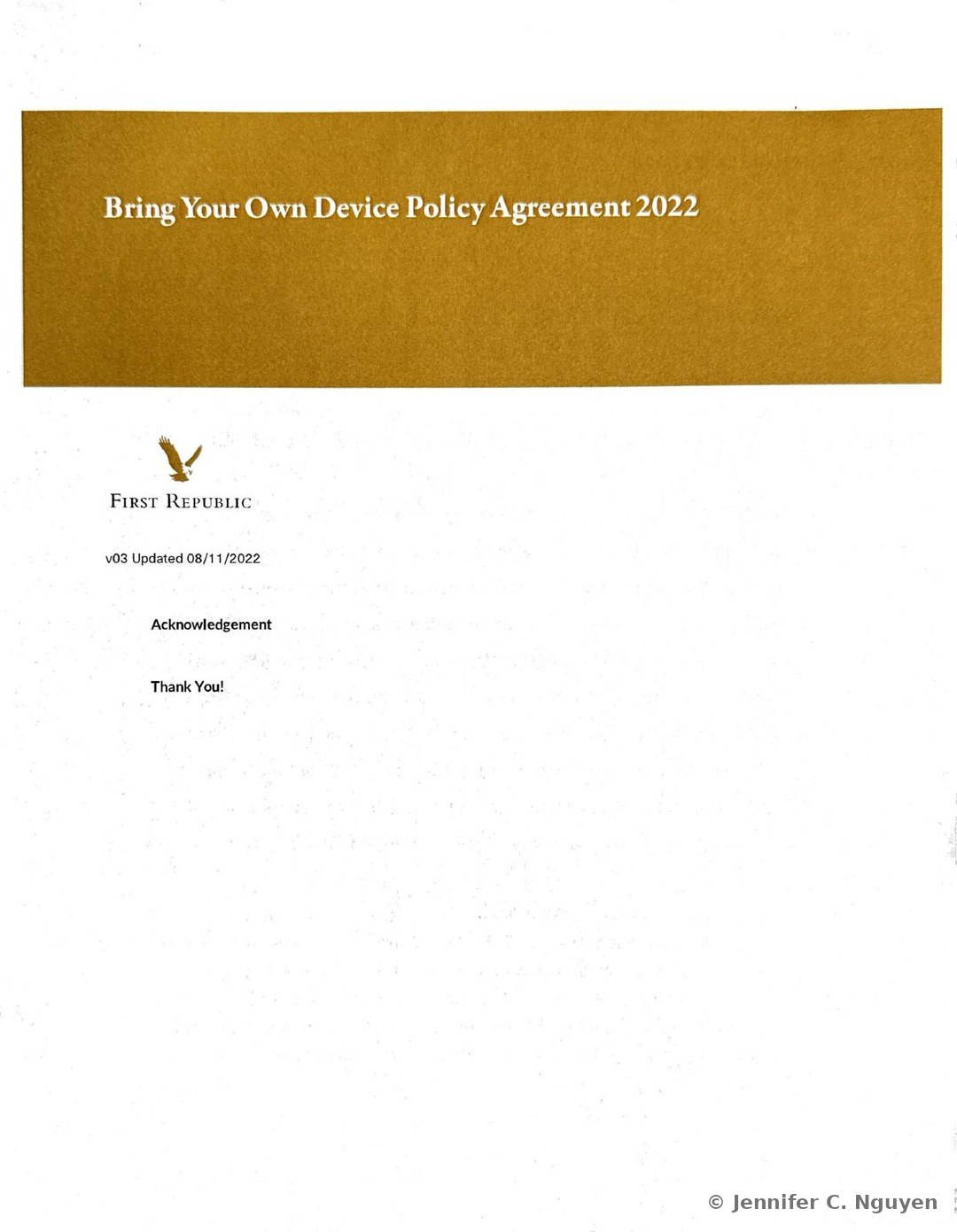
Bring Your Own Device Policy Agreement 2022 course title page with a dark gold header band holding a white serif title, First Republic eagle logo below on a white background, version text reading v03 Updated 08/11/2022, and a short two-item lesson menu listing Acknowledgement and Thank You
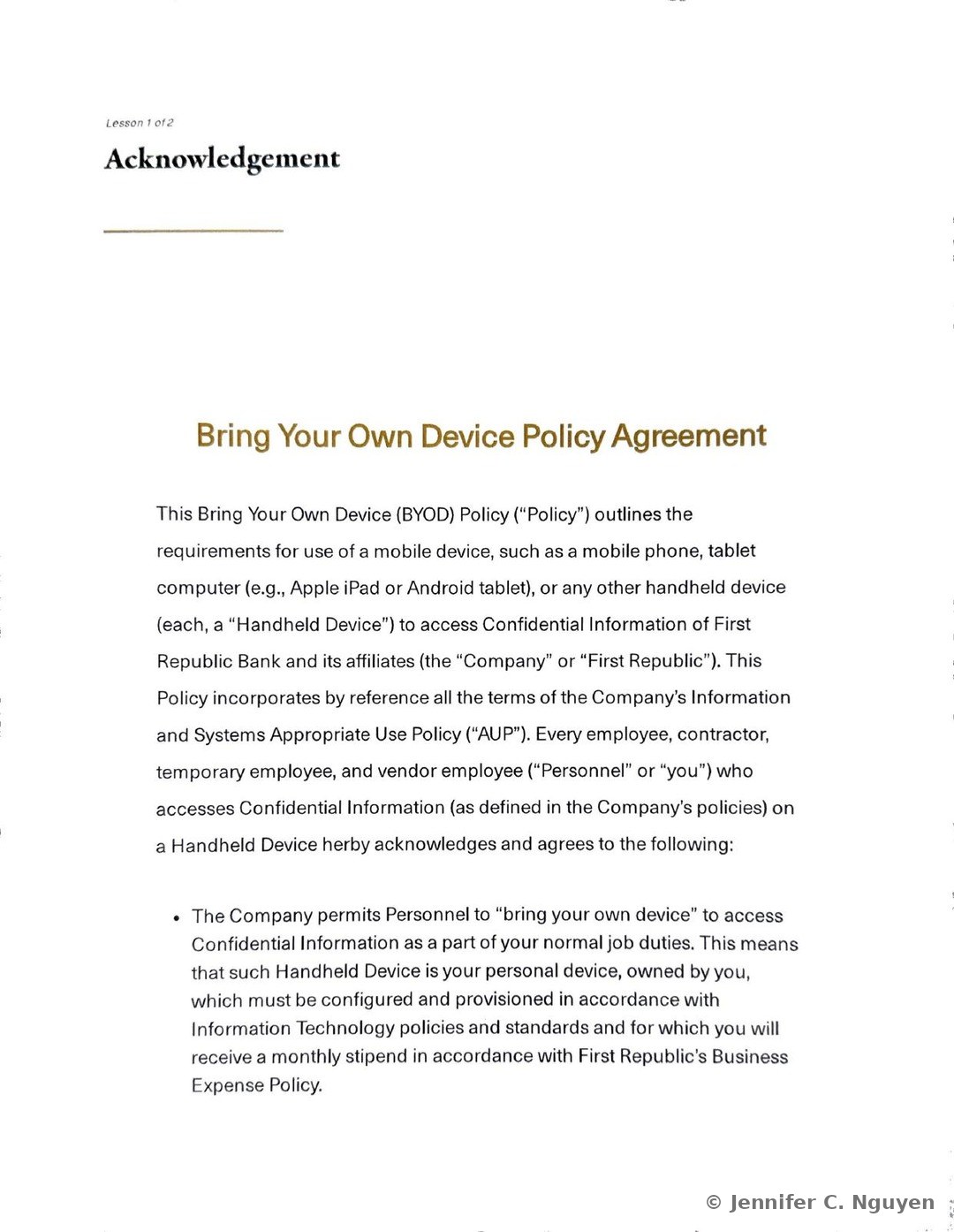
Acknowledgement slide numbered Lesson 1 of 2 with a Bring Your Own Device Policy Agreement heading, paragraph text defining the BYOD Policy, Handheld Device, Confidential Information, and Personnel terms and incorporating the Company's Information and Systems Appropriate Use Policy by reference, followed by the start of a bulleted list explaining that the Company permits Personnel to bring a personally owned Handheld Device to access Confidential Information in exchange for a monthly stipend under First Republic's Business Expense Policy
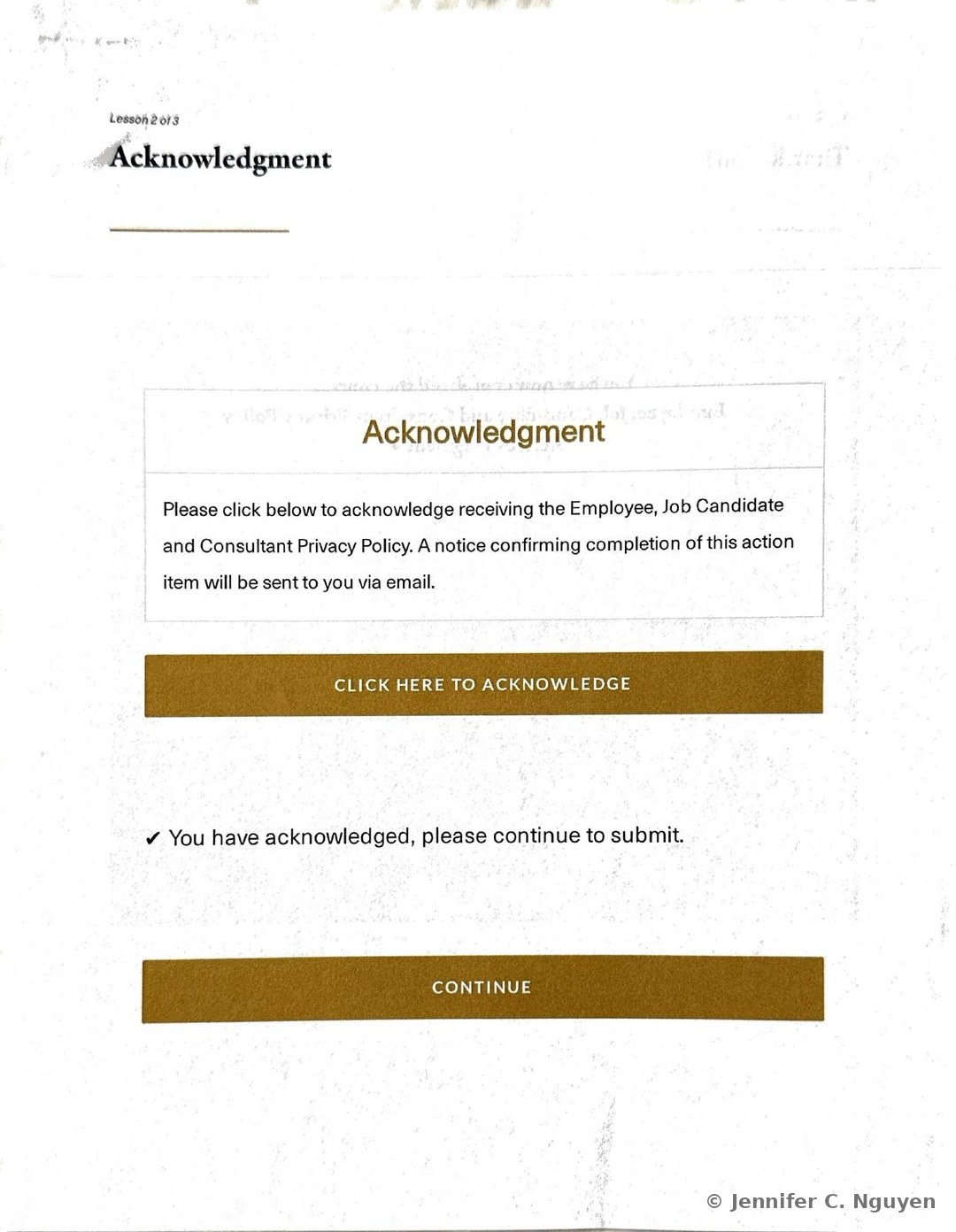
Acknowledgement screen with the page title partially obscured behind a gold Click Here to Acknowledge button, a black checkmark confirmation line below reading You have acknowledged, please continue to submit, and a second gold Continue button beneath it
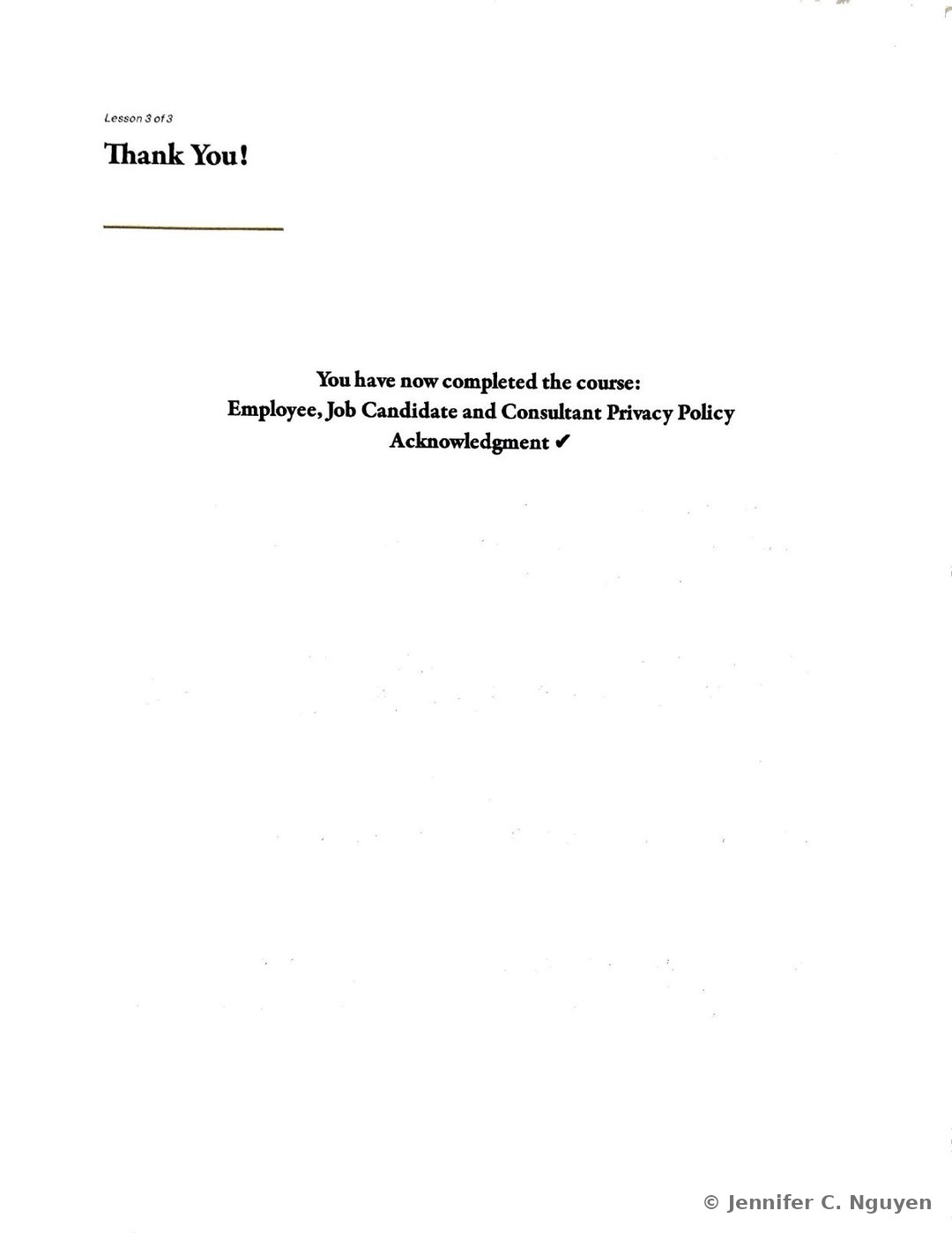
Thank You closing slide reading Lesson 2 of 2 in small black text above a bold black serif Thank You heading and a thin gold horizontal rule, with centered text confirming completion of the course Bring Your Own Device Policy Agreement alongside a black checkmark
02
BSA/AML Enterprise-Wide Training

This seven-lesson Rise course delivers First Republic's enterprise-wide BSA/AML training, opening with a flip-card breakdown of money laundering concealment tactics and an embedded scenario video locked behind the Stages of Money Laundering heading, before moving into program governance through a click-to-reveal Five Pillars diagram and Board of Directors/AMLOC oversight responsibilities. Enhanced Due Diligence, a tabbed Three Lines of Defense graphic, and prohibited-versus-special-approval customer type rules round out the selected screens, and the course directs learners to a separate transcript exam to finish. This course is listed in the Compliance & Regulatory Course Library above, under BSA/AML, KYC & OFAC Compliance.

Bank Secrecy Act ComplianceFive Pillars Program GovernanceClick-to-Reveal DiagramLocked Scenario VideoProhibited & Special Approval Customer Types
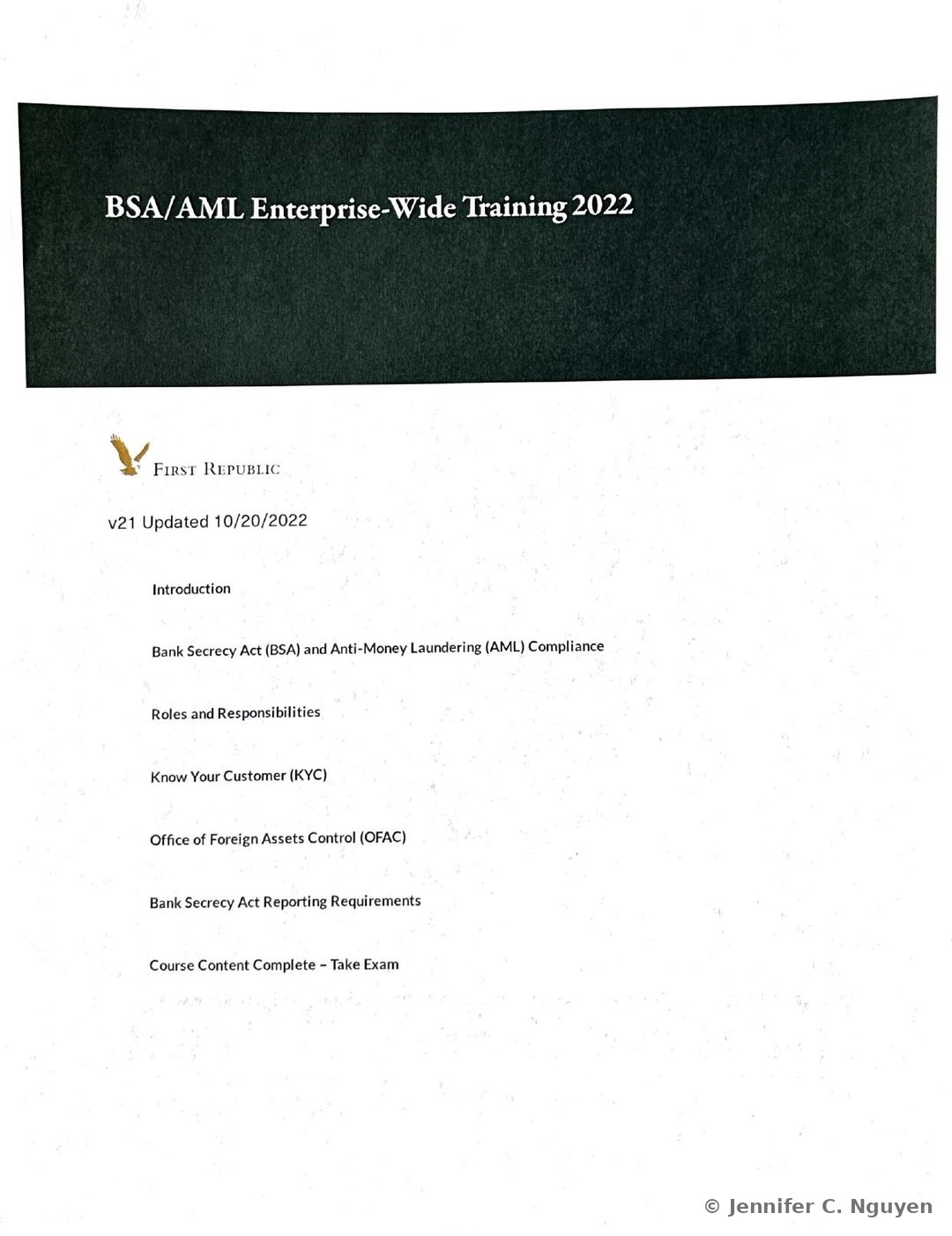
BSA/AML Enterprise-Wide Training 2022 course title page with a dark charcoal header band holding a white serif title, First Republic eagle logo below on a white background, version text reading v21 Updated 10/20/2022, and a vertical lesson menu listing Introduction, Bank Secrecy Act (BSA) and Anti-Money Laundering (AML) Compliance, Roles and Responsibilities, Know Your Customer (KYC), Office of Foreign Assets Control (OFAC), Bank Secrecy Act Reporting Requirements, and Course Content Complete - Take Exam
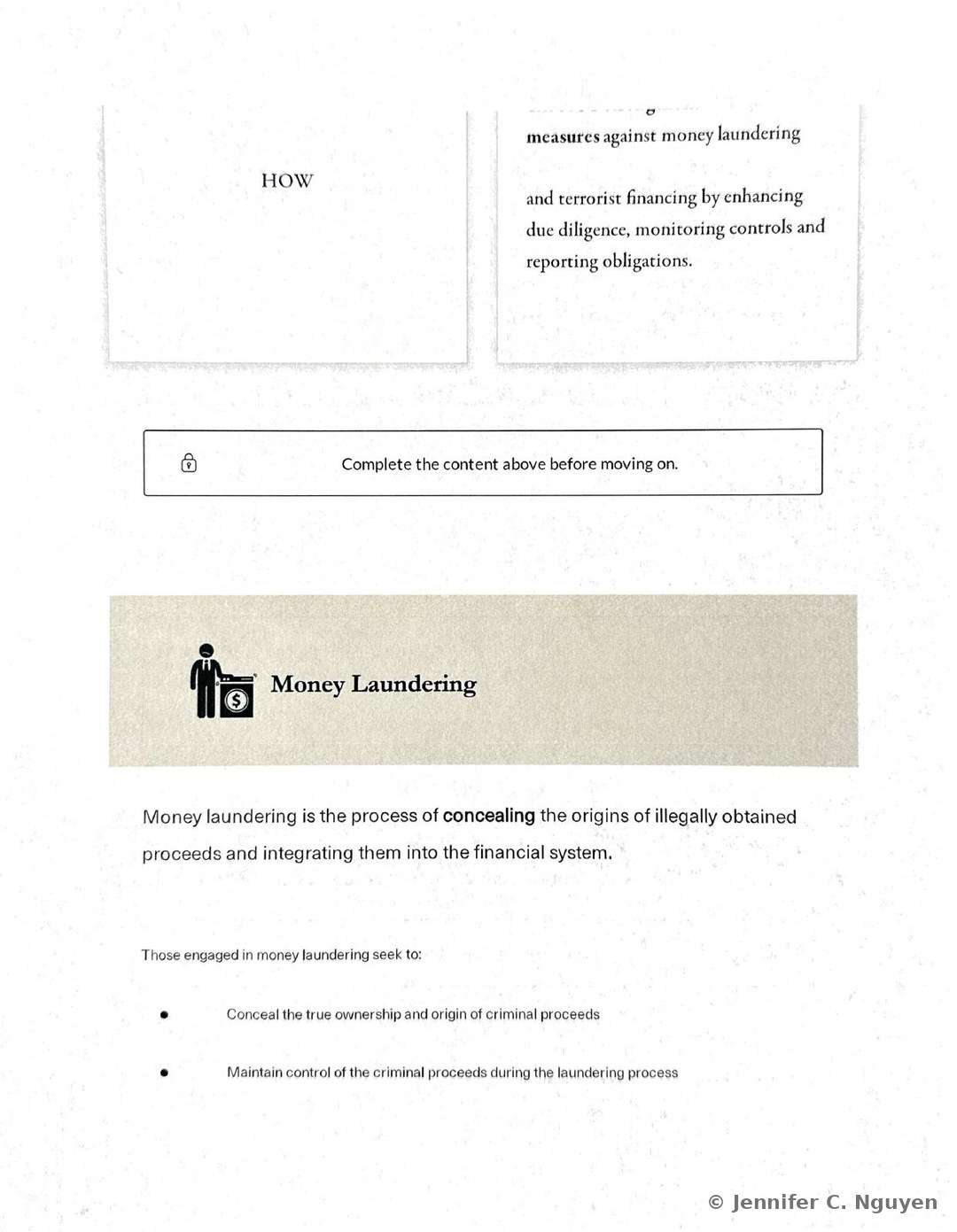
Flip-card knowledge panel showing the revealed HOW answer explaining that the USA PATRIOT Act strengthens measures against money laundering and terrorist financing by enhancing due diligence, monitoring controls, and reporting obligations, with a lock icon and Complete the content above before moving on notice beneath it, followed by the start of a Money Laundering definition section stating that money laundering is the process of concealing the origins of illegally obtained proceeds and integrating them into the financial system
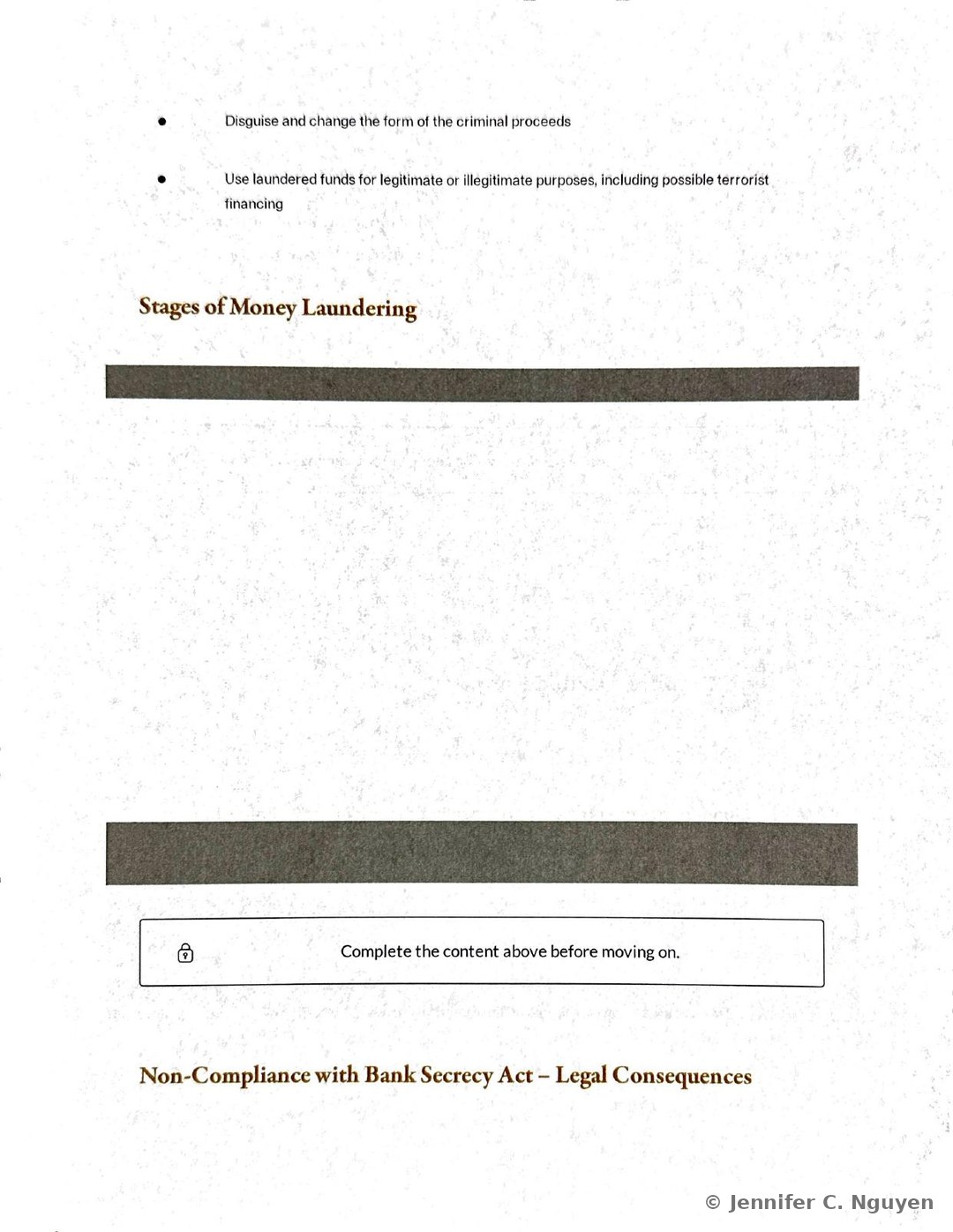
Money laundering bulleted list concluding with disguising and changing the form of criminal proceeds and using laundered funds for legitimate or illegitimate purposes including possible terrorist financing, followed by a Stages of Money Laundering heading positioned above a solid dark placeholder bar where a scenario video sits locked behind a Complete the content above before moving on notice, and the start of a Non-Compliance with Bank Secrecy Act - Legal Consequences heading
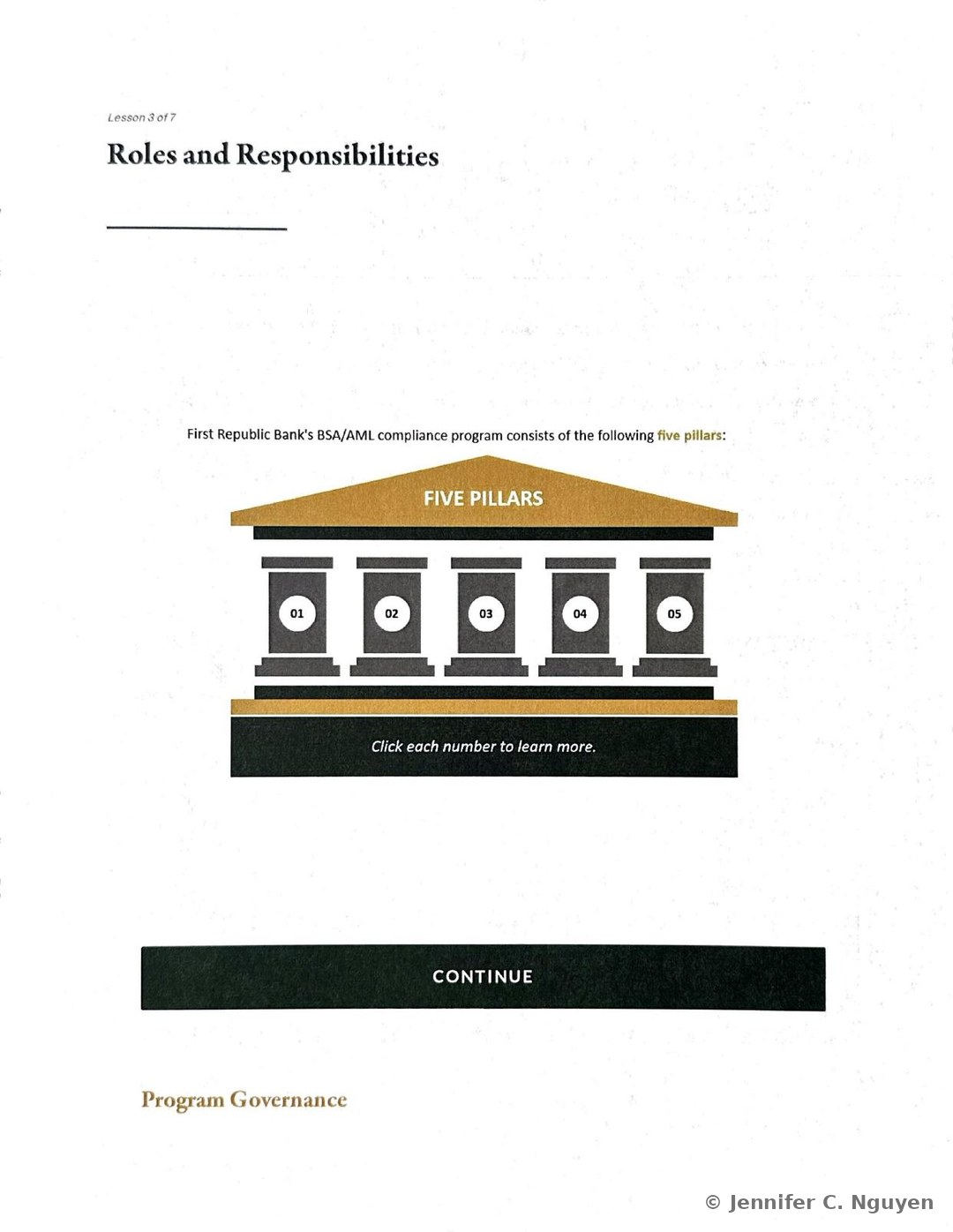
Roles and Responsibilities slide numbered Lesson 3 of 7 stating that First Republic Bank's BSA/AML compliance program consists of five pillars, illustrated by a gold pediment-roofed diagram reading FIVE PILLARS above five numbered columns, a Click each number to learn more caption, a CONTINUE button, and the start of a Program Governance heading
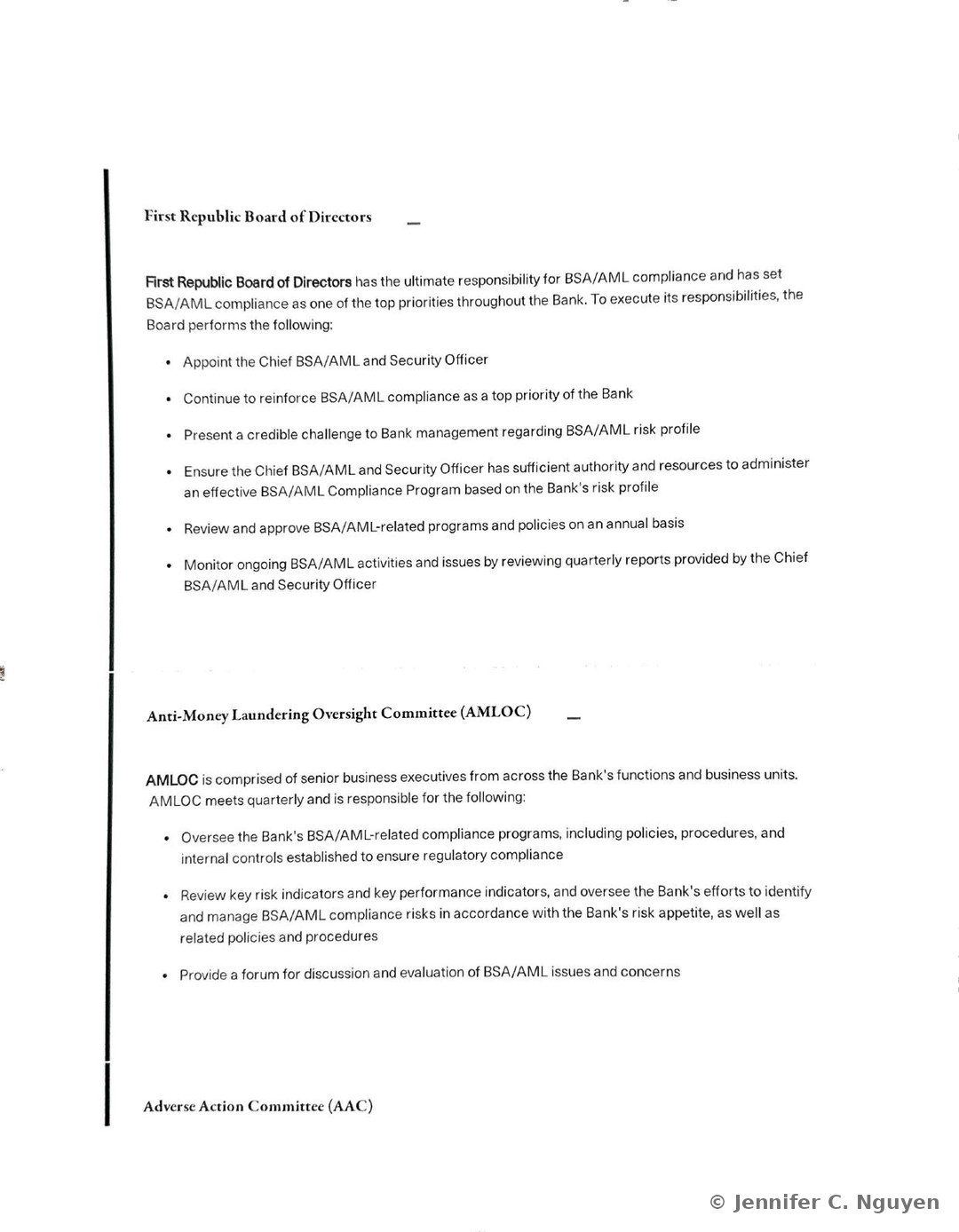
First Republic Board of Directors heading and bulleted list describing the Board's ultimate responsibility for BSA/AML compliance, including appointing the Chief BSA/AML and Security Officer and reviewing quarterly reports, followed by an Anti-Money Laundering Oversight Committee (AMLOC) heading and bulleted list describing its quarterly oversight of BSA/AML-related compliance programs, and the start of an Adverse Action Committee (AAC) heading
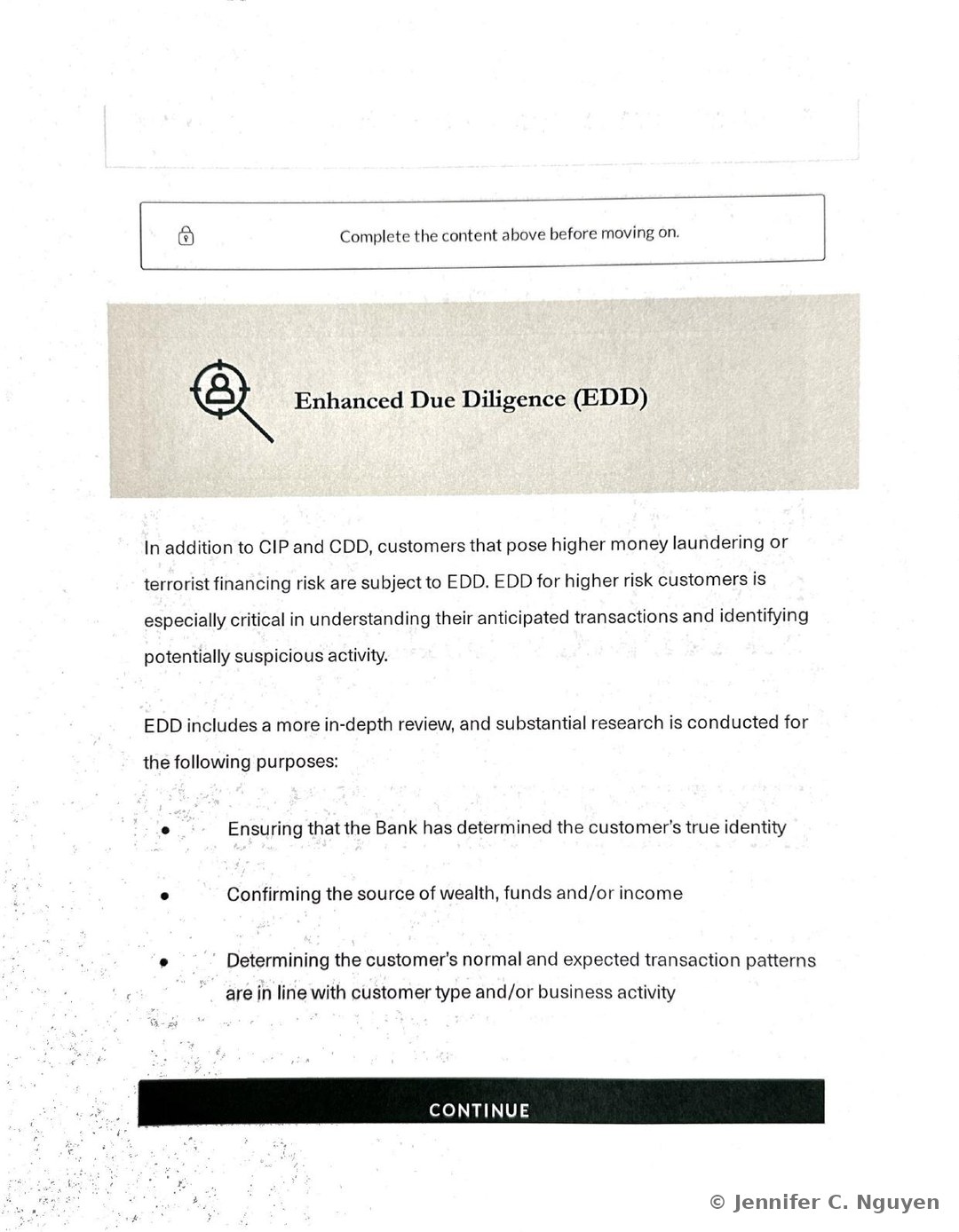
Enhanced Due Diligence (EDD) section with a magnifying-glass icon and paragraph text explaining that customers posing higher money laundering or terrorist financing risk are subject to EDD, followed by a bulleted list of EDD purposes covering ensuring the Bank has determined the customer's true identity, confirming the source of wealth, funds, and income, and determining whether the customer's normal and expected transaction patterns are in line with their customer type or business activity
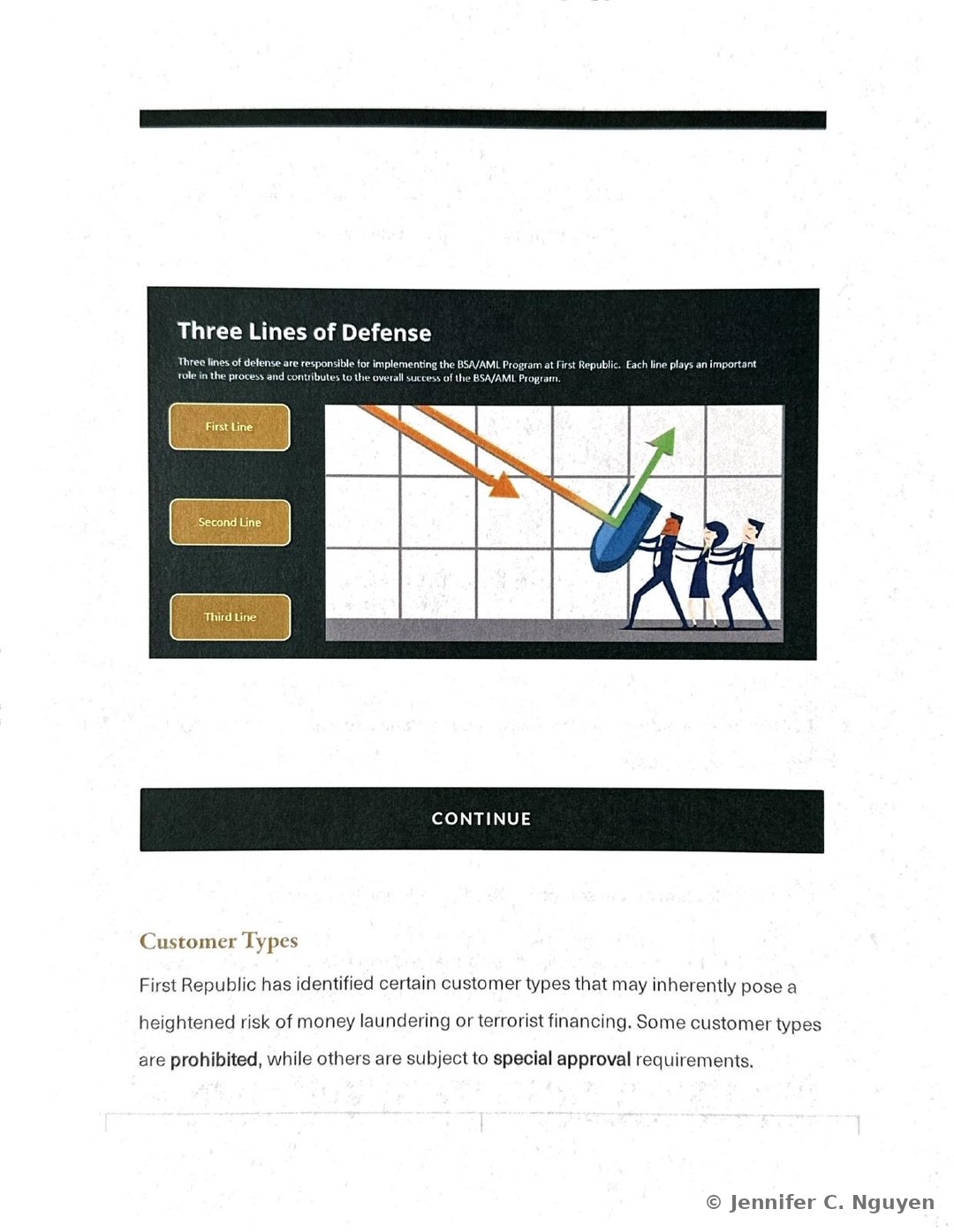
Three Lines of Defense dark banner graphic with First Line, Second Line, and Third Line tab buttons beside an illustrated icon of three figures pushing a large shovel with red and green directional arrows, a CONTINUE button below, and the start of a Customer Types heading and paragraph explaining that First Republic has identified certain customer types that may inherently pose a heightened risk of money laundering or terrorist financing
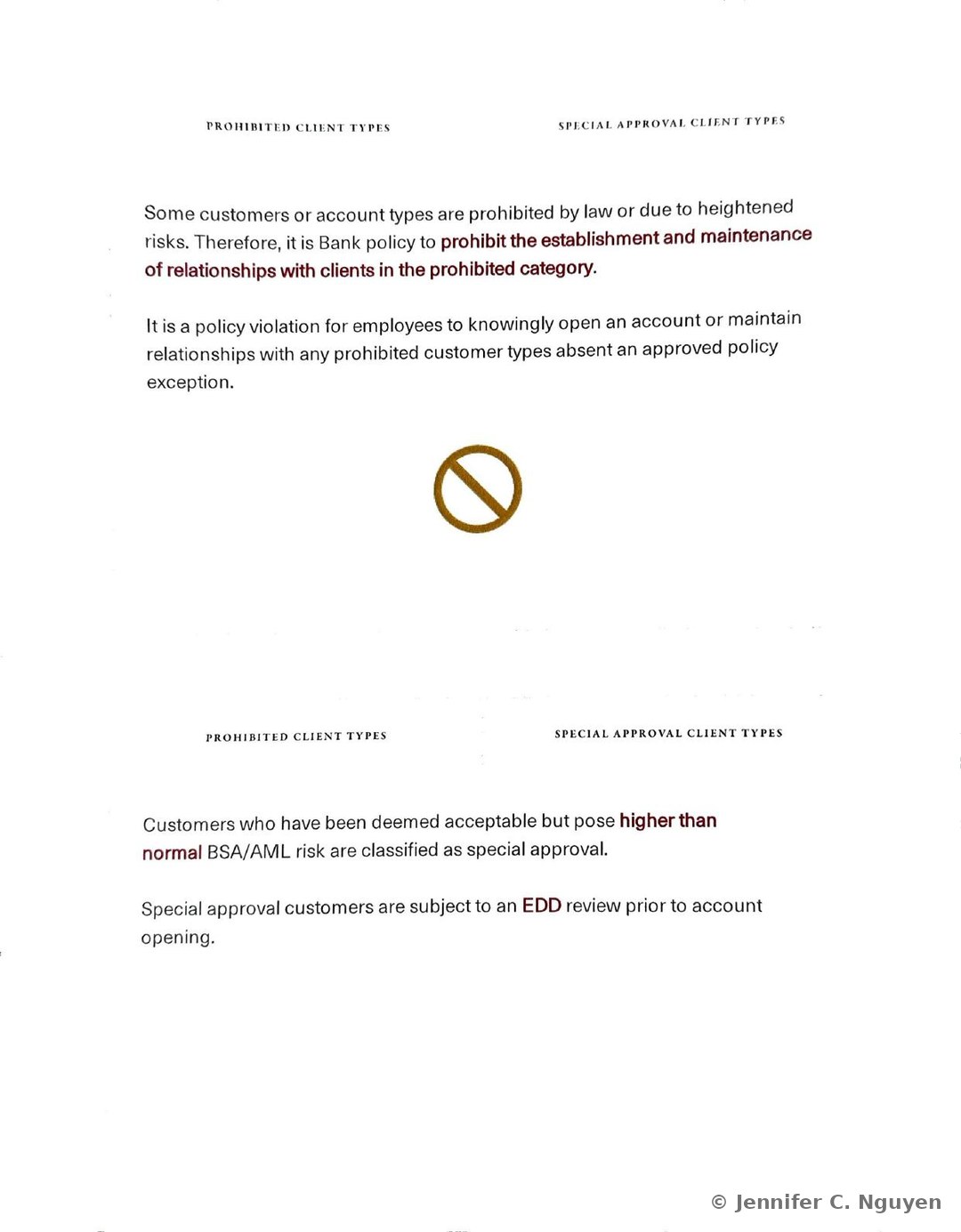
Two-tab Prohibited Client Types and Special Approval Client Types comparison with a prohibition icon, paragraph text stating it is Bank policy to prohibit relationships with clients in the prohibited category absent an approved policy exception, and paragraph text explaining that customers deemed acceptable but posing higher than normal BSA/AML risk are classified as special approval and subject to an EDD review prior to account opening
03
California Consumer Privacy Act (CCPA) Training: Piper 2.0

This four-lesson Rise course walks colleagues through Piper 2.0, First Republic's platform for intaking and processing California Consumer Privacy Act requests. It opens with a summary of related privacy regulations and a rundown of CCPA consumer rights, then walks through both the external self-service and internal request forms step by step, covering CAPTCHA verification, identity confirmation, and the internal ID Verification workflow used to mark a request as verified. An appendix defines each consumer type and closes with SailPoint access-request instructions for colleagues who need Piper 2.0 access. This course is listed in the Compliance & Regulatory Course Library above, under Privacy, Data Protection & Client Communications.

CCPA Consumer RightsPiper 2.0 Intake WorkflowExternal vs. Internal WebformsCAPTCHA & Identity VerificationSailPoint Access Requests
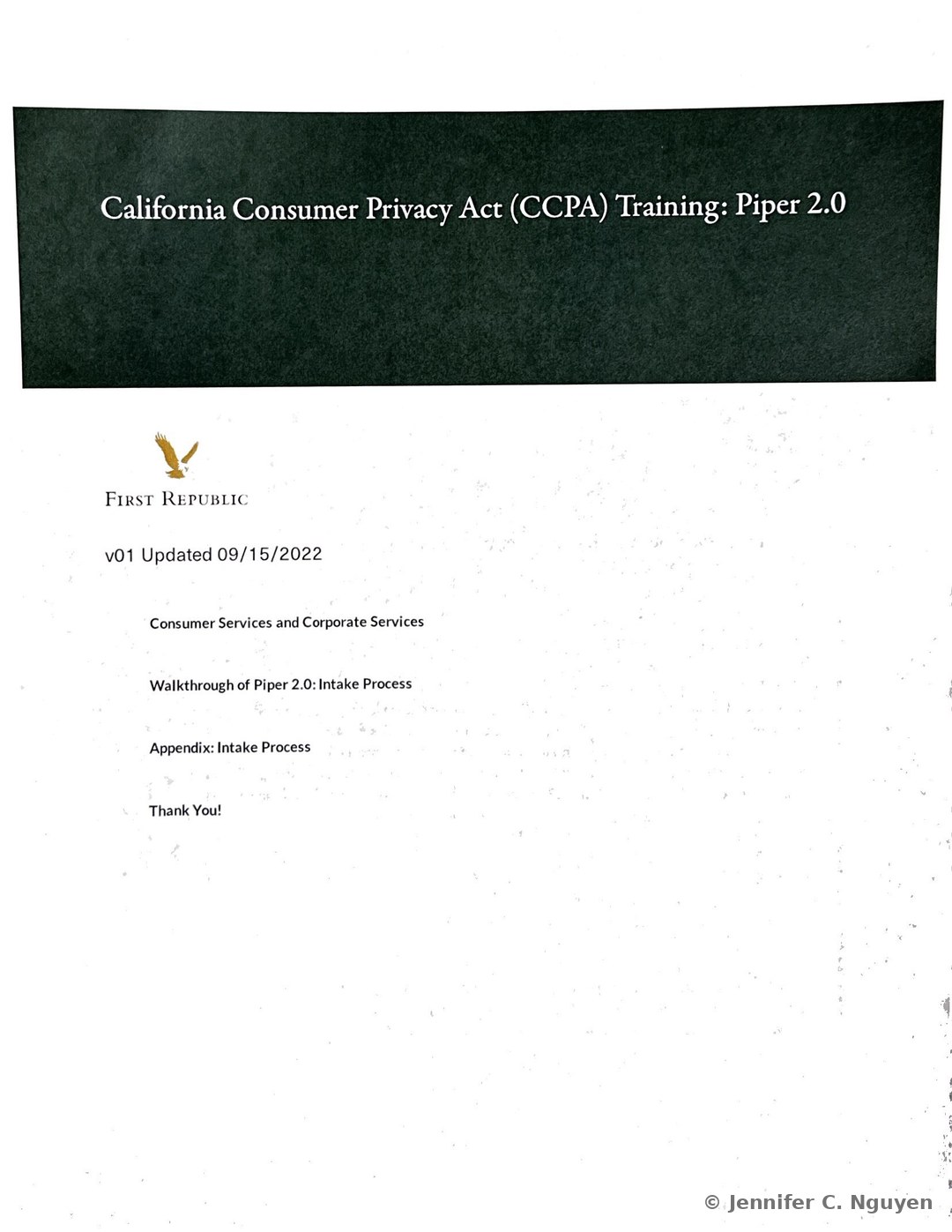
California Consumer Privacy Act (CCPA) Training: Piper 2.0 course title page with a dark charcoal header band holding a white serif title, First Republic eagle logo below on a white background, version text reading v01 Updated 09/15/2022, and a four-item lesson list reading Consumer Services and Corporate Services, Walkthrough of Piper 2.0: Intake Process, Appendix: Intake Process, and Thank You
Walkthrough of Piper 2.0: Intake Process slide numbered Lesson 2 of 4 with a target icon, a Piper 2.0: CCPA Request Forms heading, and text explaining the two types of CCPA request forms, an external facing self-service form posted to the Privacy Policy for consumers to complete and an internal form used when a consumer has restrictions and cannot complete the form themselves, followed by a gold italic Best Practice note advising to copy and paste the link into Chrome if it is not the default browser
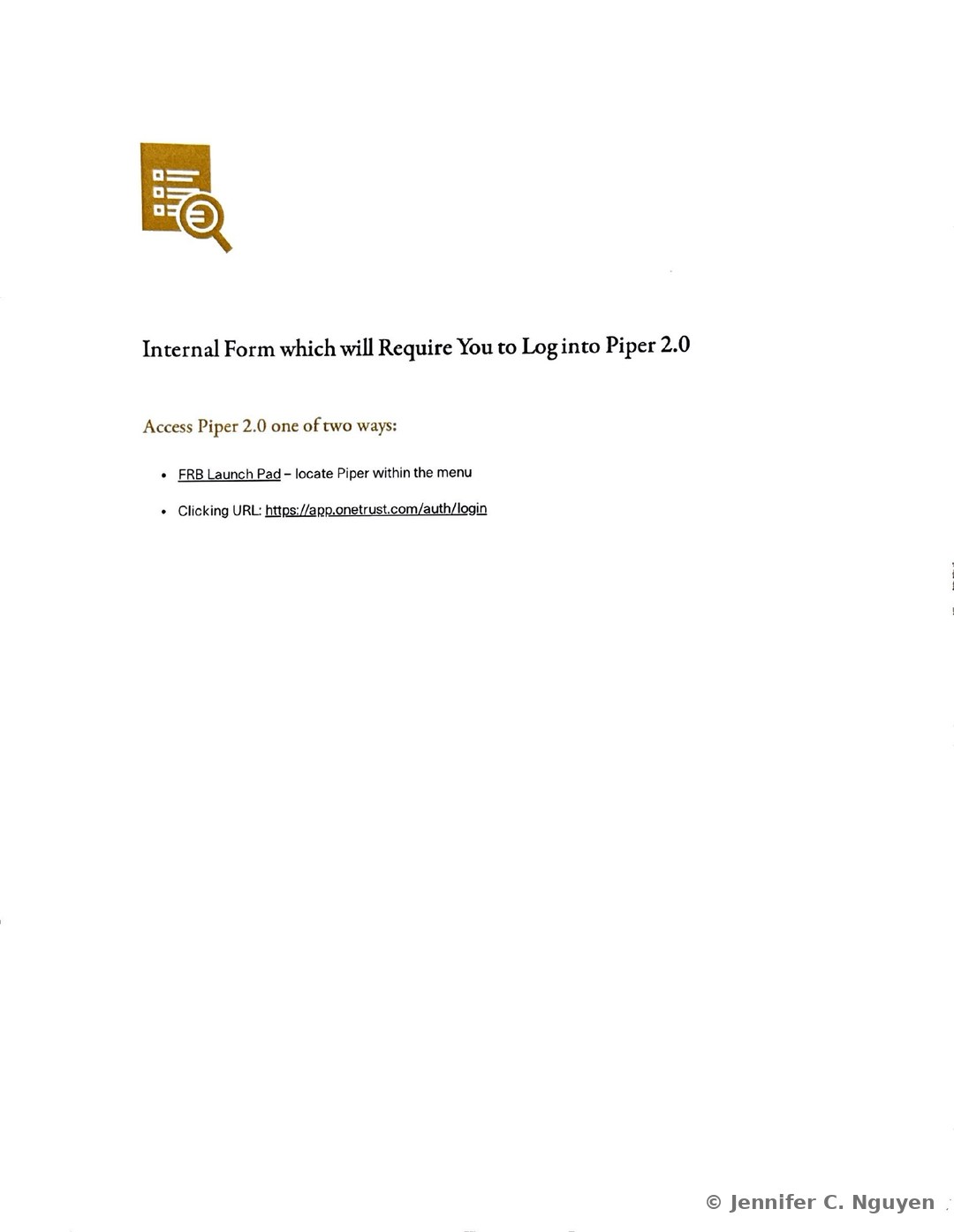
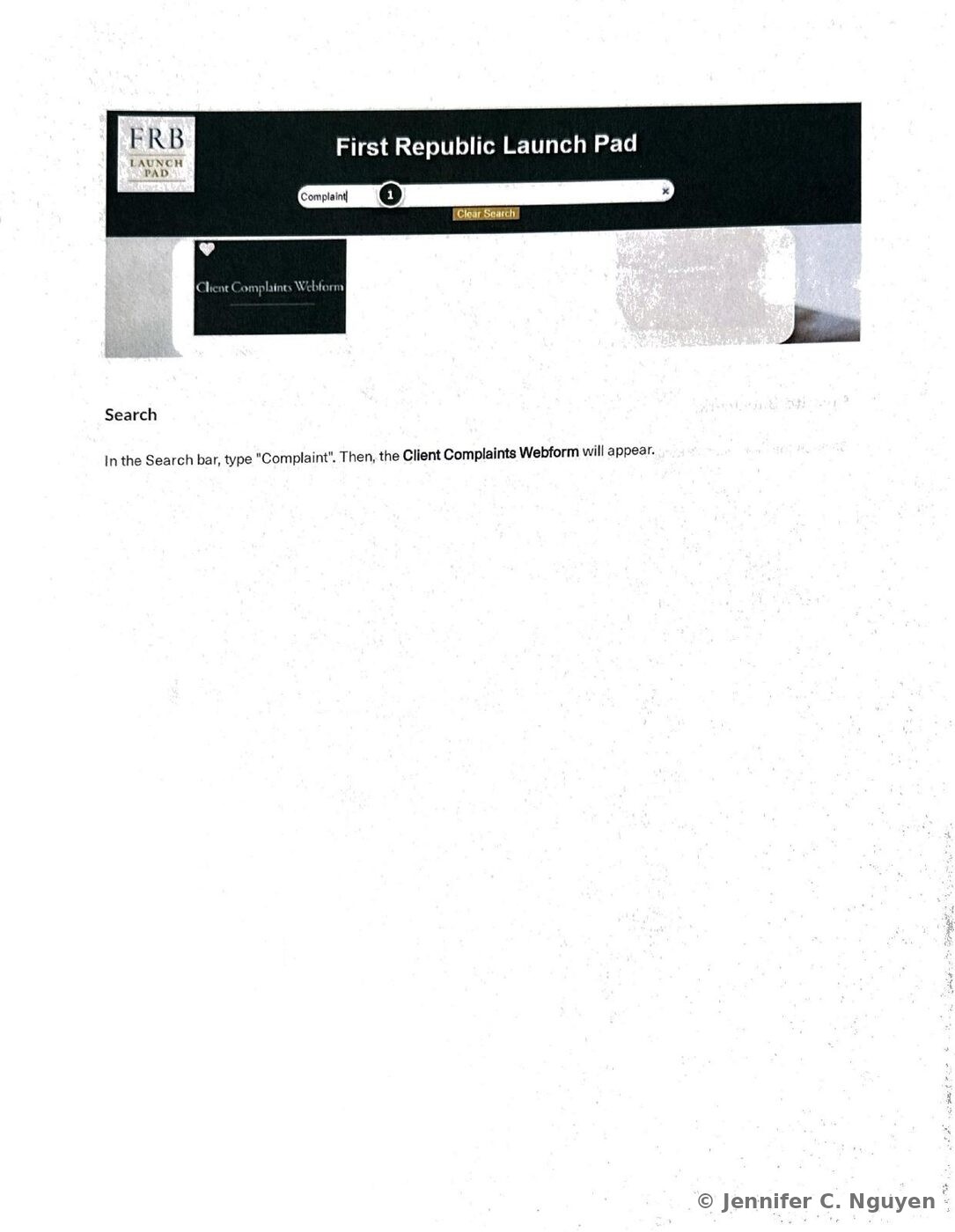
Internal Form which will Require You to Log into Piper 2.0 slide with a document and magnifying-glass icon, a heading reading Internal Form which will Require You to Log into Piper 2.0, and an Access Piper 2.0 one of two ways subheading followed by a two-item bulleted list reading FRB Launch Pad, locate Piper within the menu and Clicking URL https://app.onetrust.com/auth/login
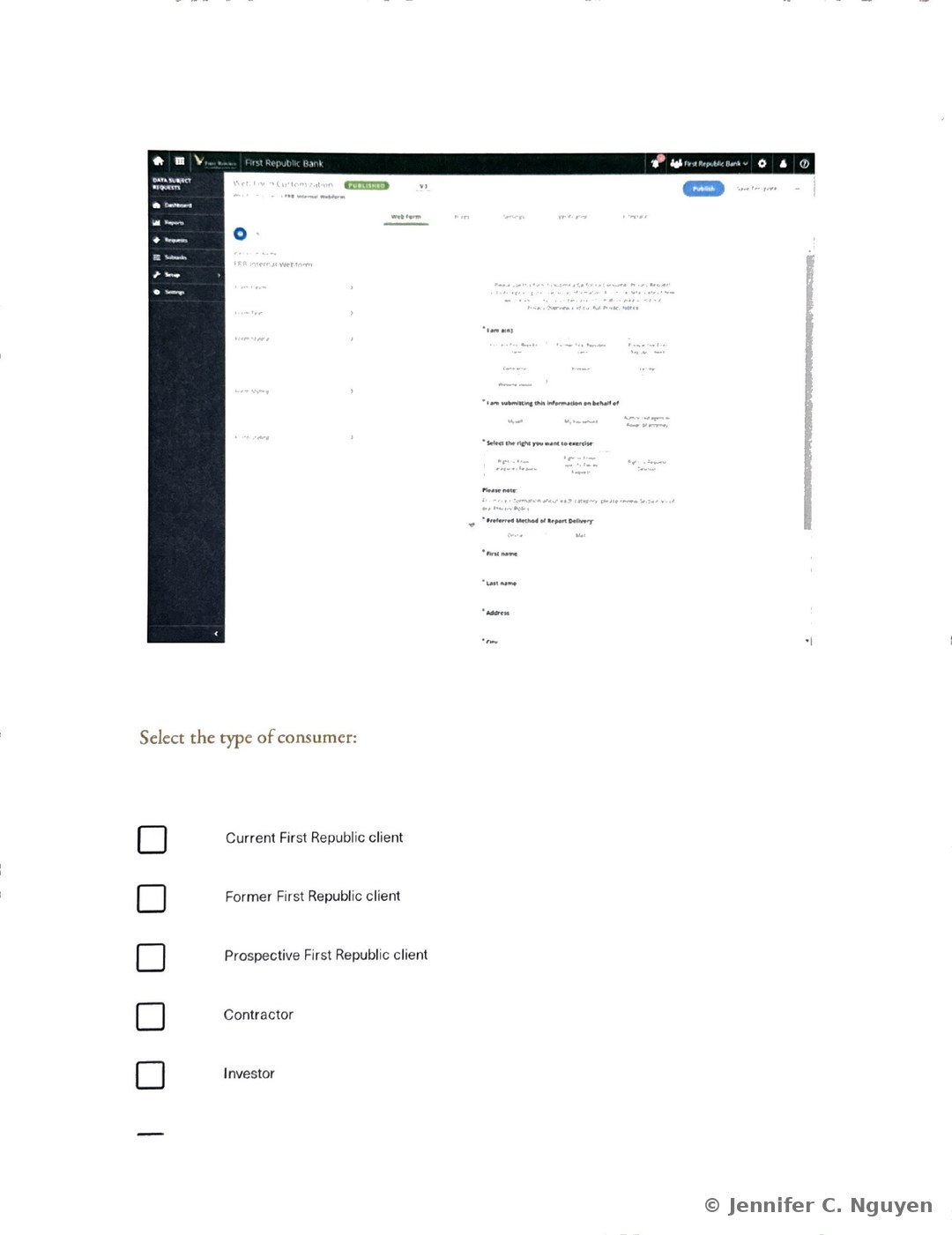
Screenshot of the Piper 2.0 Web Form Customization admin screen showing a published FRB Internal Webform with fields for I am a/an consumer type, I am submitting this information on behalf of, and Select the right you want to exercise, followed by a Select the type of consumer heading with the start of a checkbox list reading Current First Republic client, Former First Republic client, Prospective First Republic client, Contractor, and Investor
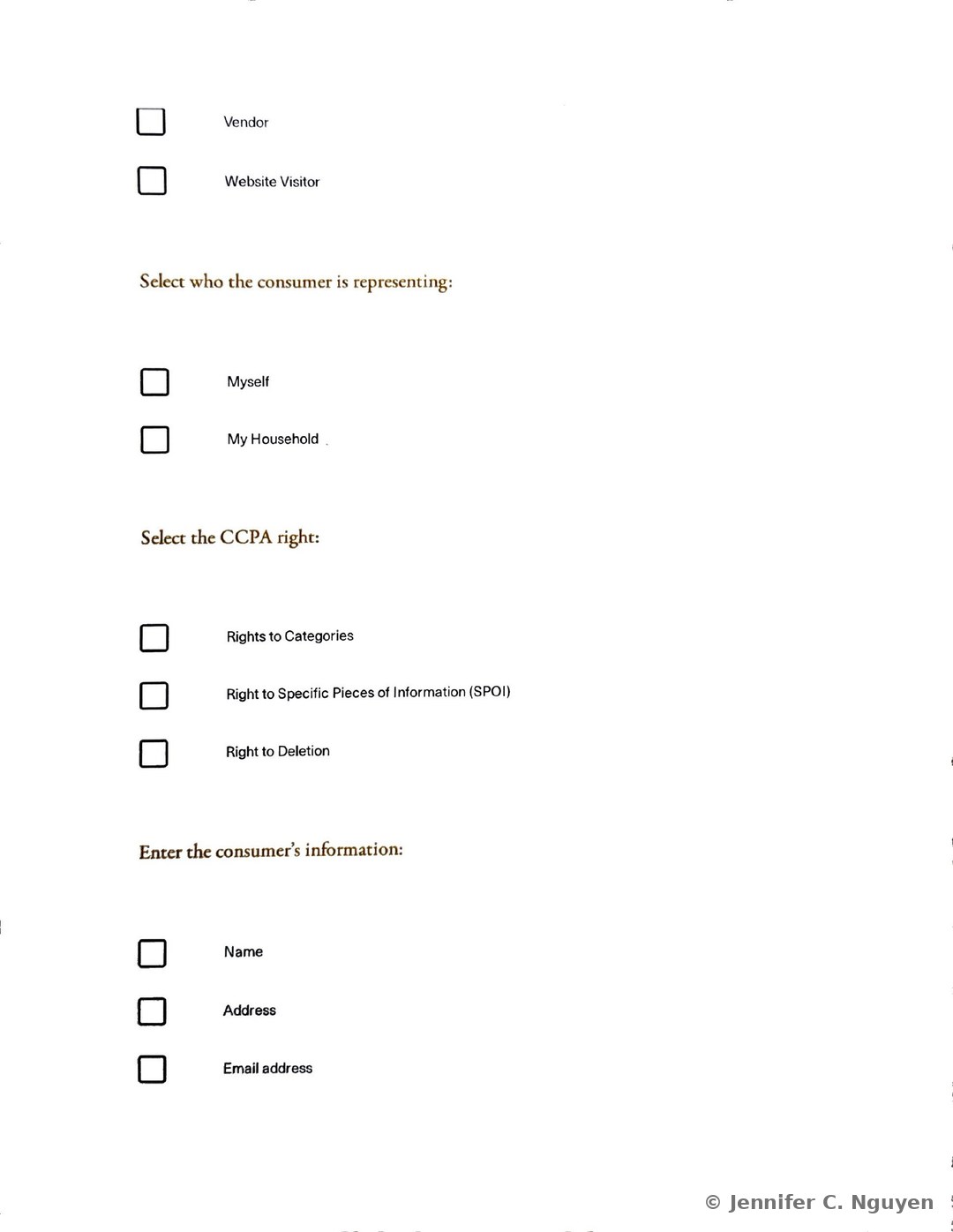
Internal Webform checkbox list continuing with Vendor and Website Visitor consumer types, followed by a Select who the consumer is representing heading with Myself and My Household checkboxes, a Select the CCPA right heading with Rights to Categories, Right to Specific Pieces of Information (SPOI), and Right to Deletion checkboxes, and an Enter the consumer's information heading with Name, Address, and Email address checkboxes
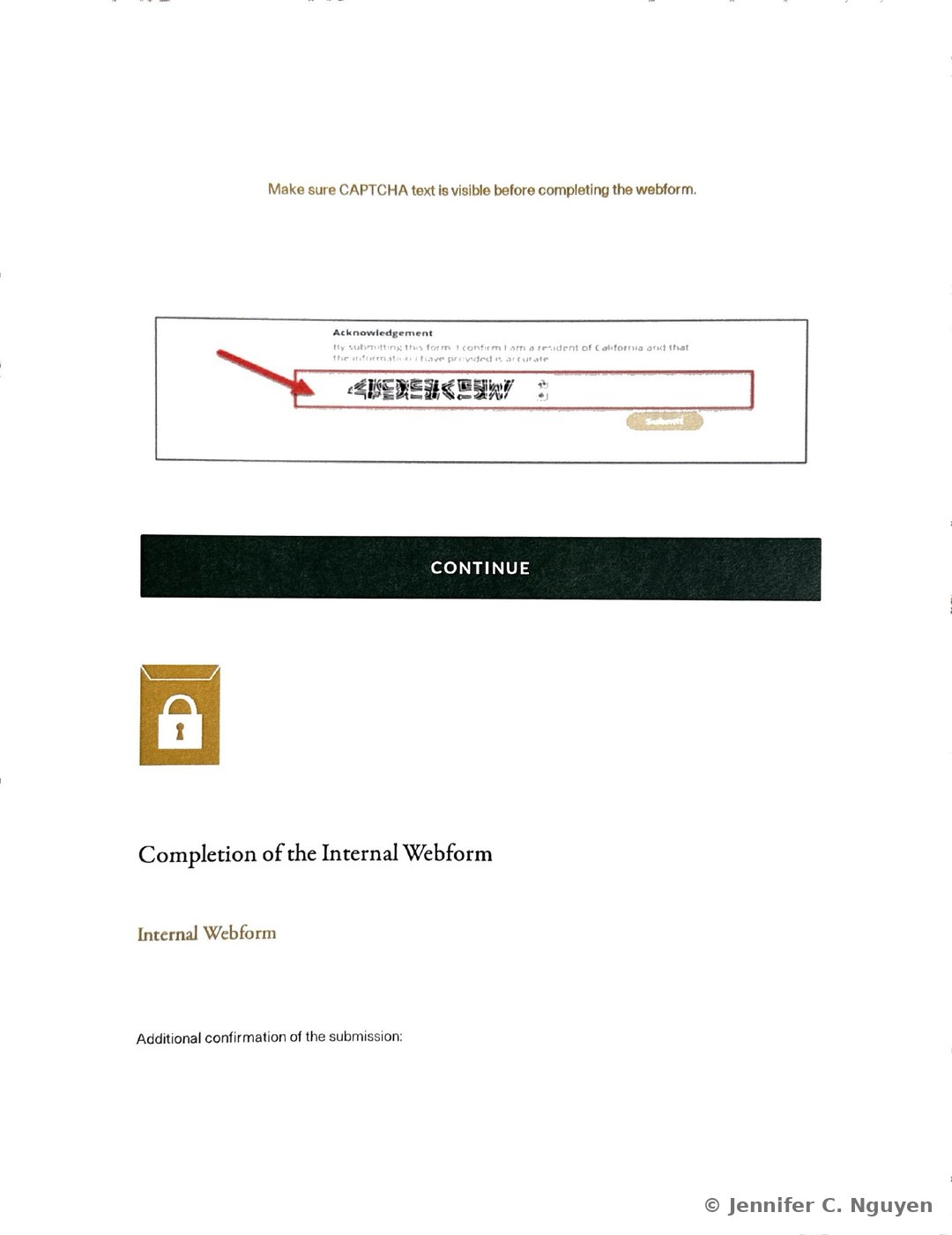
Slide reading Make sure CAPTCHA text is visible before completing the webform above a screenshot of an Acknowledgement box with a distorted CAPTCHA text field circled in red, followed by a lock icon and a Completion of the Internal Webform heading with an Internal Webform subheading and text reading Additional confirmation of the submission
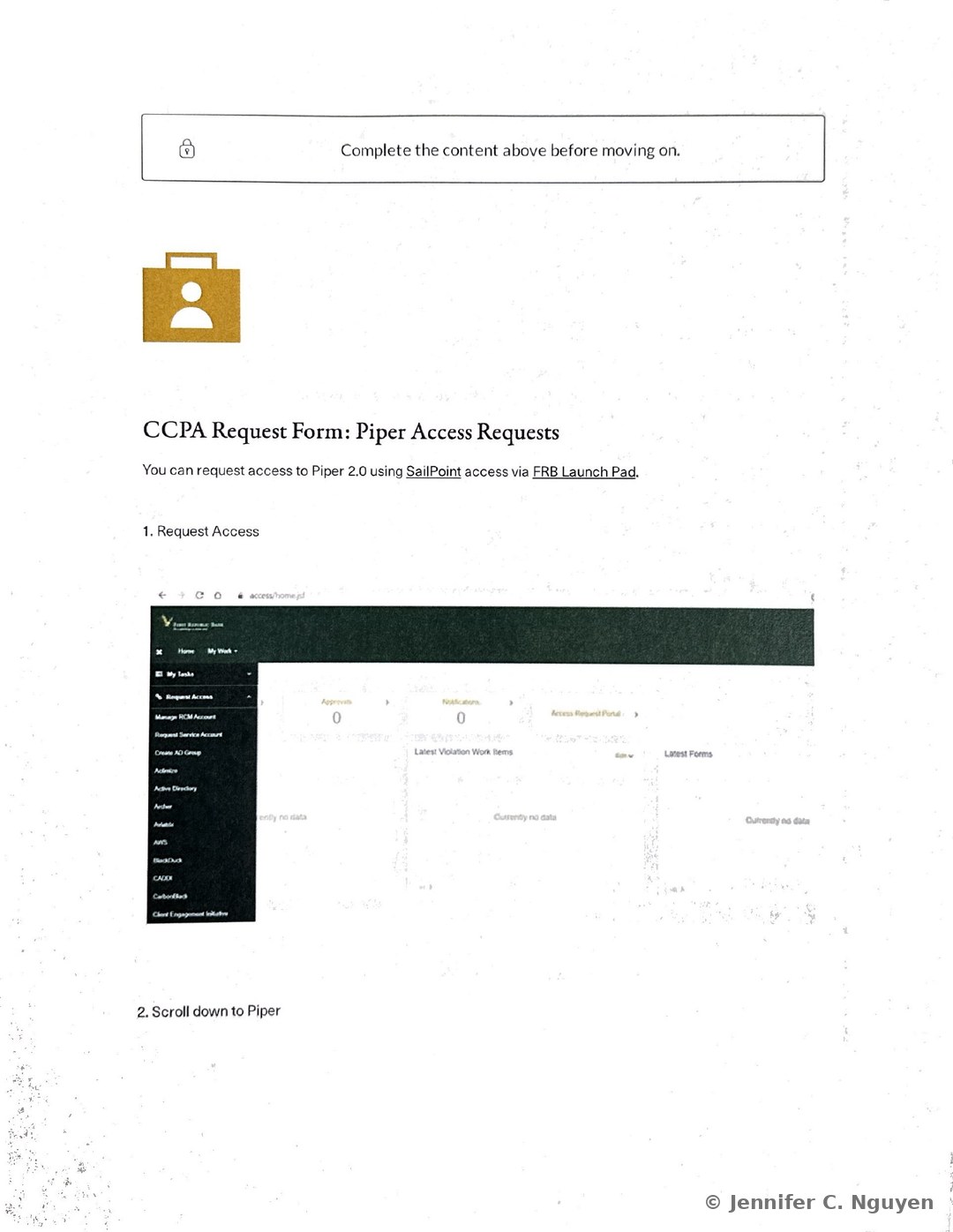
CCPA Request Form: Piper Access Requests slide with a briefcase icon, text explaining that access to Piper 2.0 can be requested using SailPoint access via FRB Launch Pad, a numbered Request Access heading, and a screenshot of the FRB access request portal showing a My Tasks and Request Access side menu with items including Manage RCM Account, Request Service Account, Create AD Group, Actimize, Active Directory, Archer, Ariba, AWS, BlackDuck, CADDI, CarbonBlack, and Client Engagement Initiative
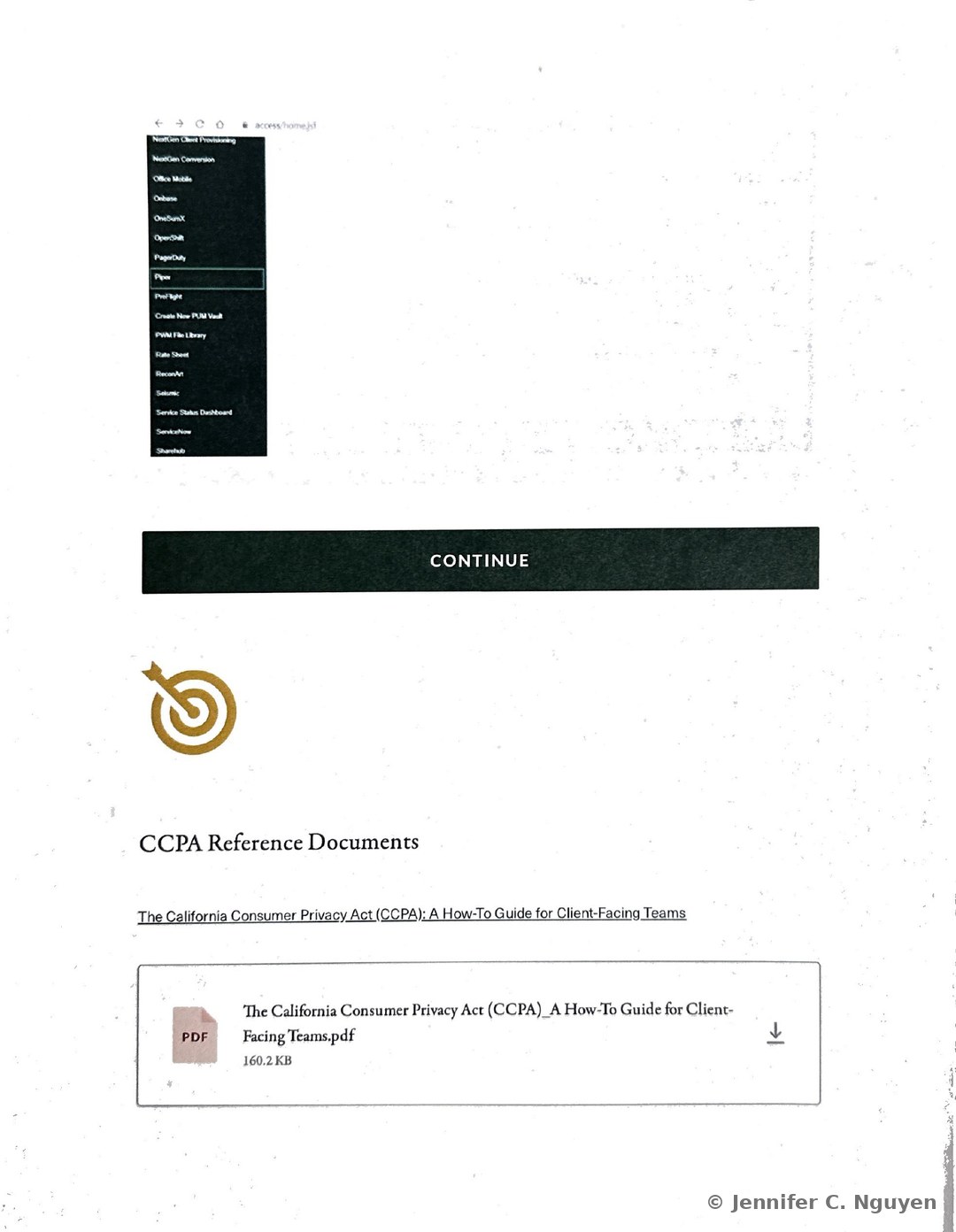
Screenshot continuing the SailPoint access request menu with a Scroll down to Piper instruction above a highlighted Piper entry in the alphabetical application list, followed by a target icon, a CCPA Reference Documents heading, and a linked PDF file card titled The California Consumer Privacy Act (CCPA): A How-To Guide for Client-Facing Teams.pdf
04
Check Deposits and Receipt and Delivery of Securities

This eight-lesson Rise course teaches FRSC and FRIM colleagues how to handle client checks and physical securities certificates, covering time-stamping, correct payee requirements, the $10 million daily scanning limit, and the 14-day secure retention period before destruction for FRSC deposits. A branch-scenario walkthrough covers receiving and overnighting a securities certificate to FRSC Operations, and a separate lesson explains why the SEC's Custody Rule prevents FRIM from accepting client checks or securities directly. The course closes with a summary allow/disallow table and a five-question scored quiz. This course is listed in the Compliance & Regulatory Course Library above, under Wealth Management, Trust & Securities Compliance.

Check Deposit Payee RequirementsSecurities Certificate Intake ScenarioSEC Custody Rule 206(4)-2Daily Scanning Dollar LimitAllow/Disallow Summary Table
Check Deposits and Receipt and Delivery of Securities 2022 course title page with a dark charcoal header band holding a white serif title, First Republic eagle logo below on a white background, an FRSC and FRIM Compliance subheading, version text reading v04 Updated 11/22/2022, and a seven-item lesson list reading Purpose of the training, Receipt of client checks for FRSC accounts, Receipt and delivery of securities for FRSC accounts, Receipt of check and security deposits for FRIM accounts, Insurance, Summary and Contacts, and Quiz
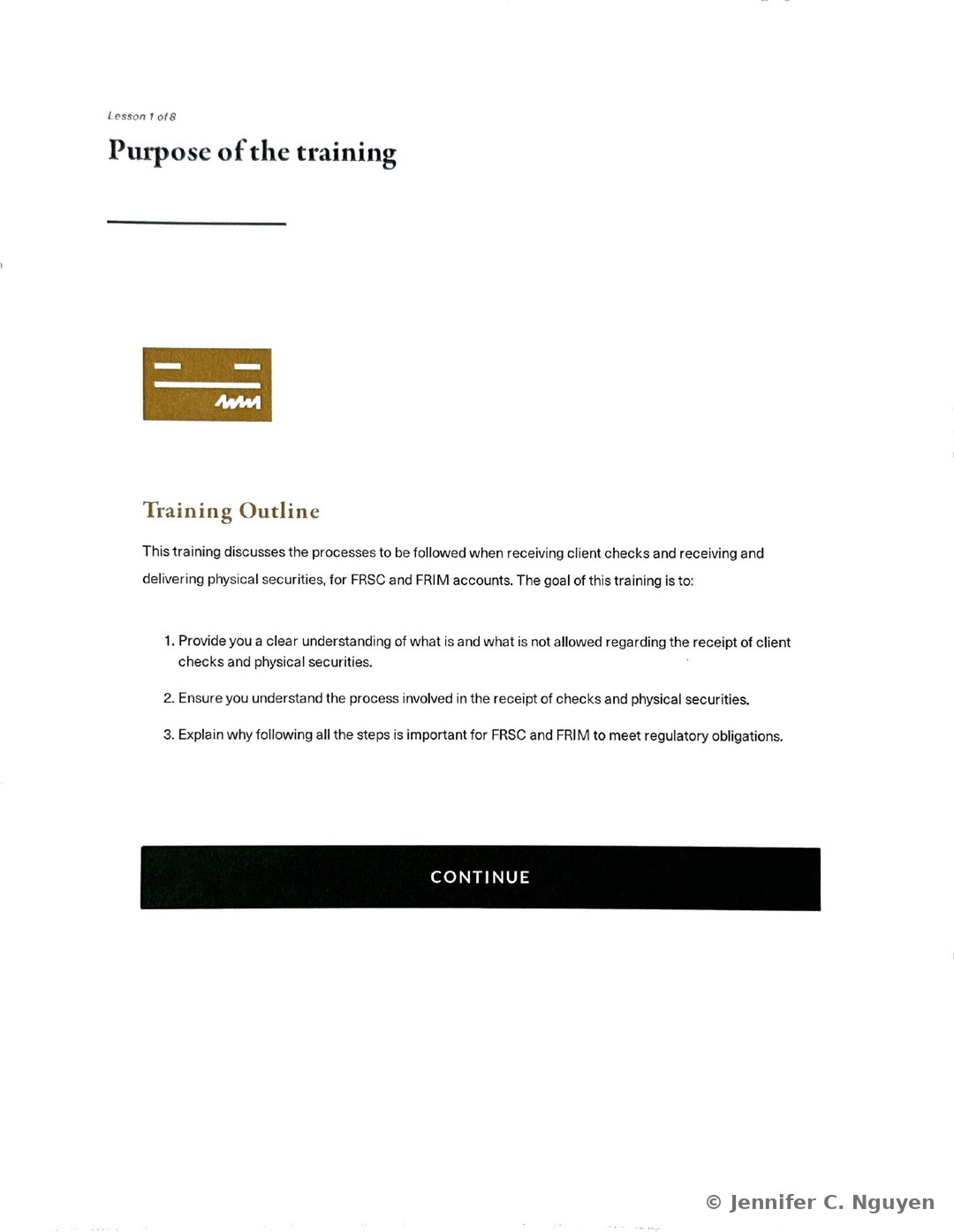
Purpose of the training slide numbered Lesson 1 of 8 with a check icon, a Training Outline heading, and a paragraph explaining that the training discusses the processes to be followed when receiving client checks and receiving and delivering physical securities for FRSC and FRIM accounts, followed by a three-item numbered list covering understanding what is and is not allowed, understanding the receipt process, and explaining why following all steps matters for regulatory obligations
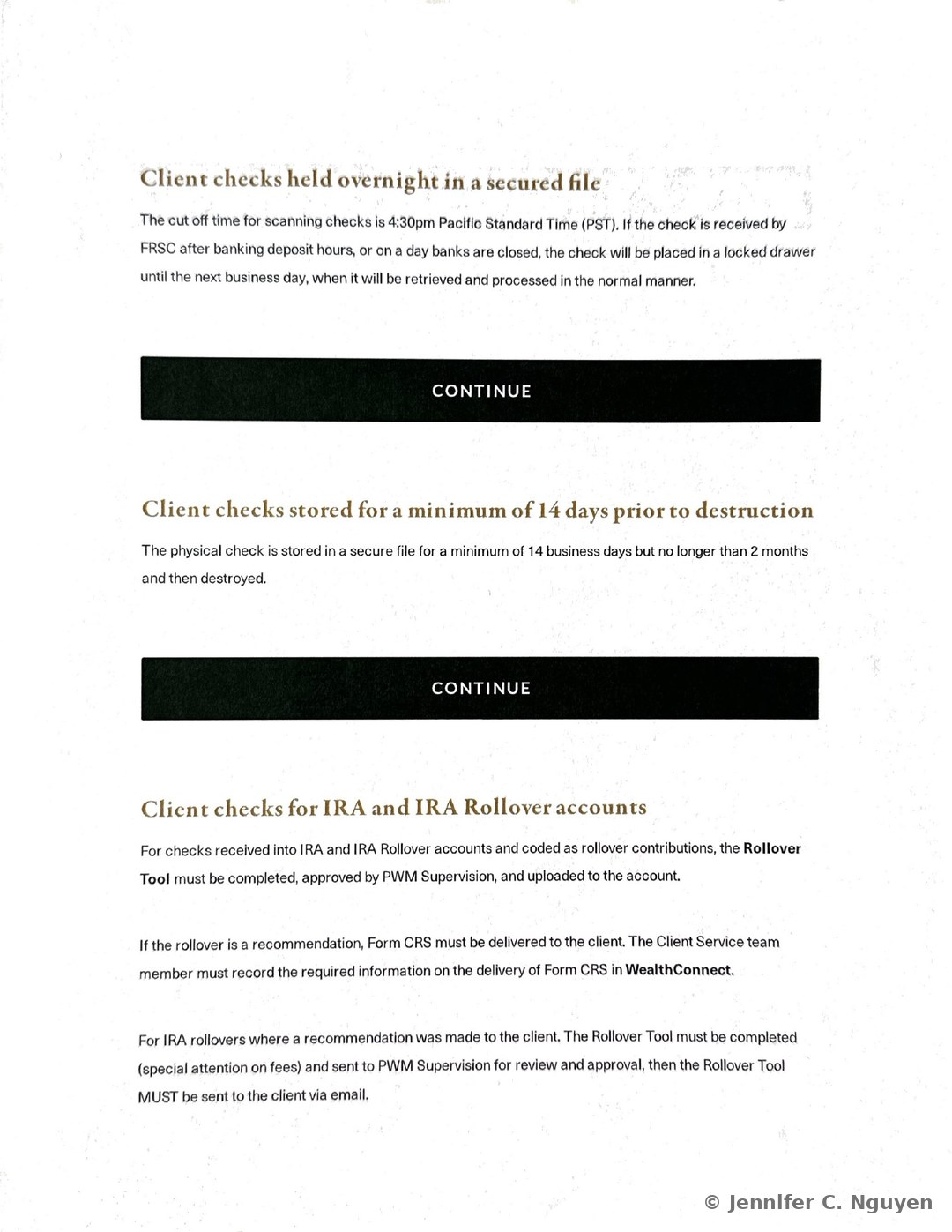
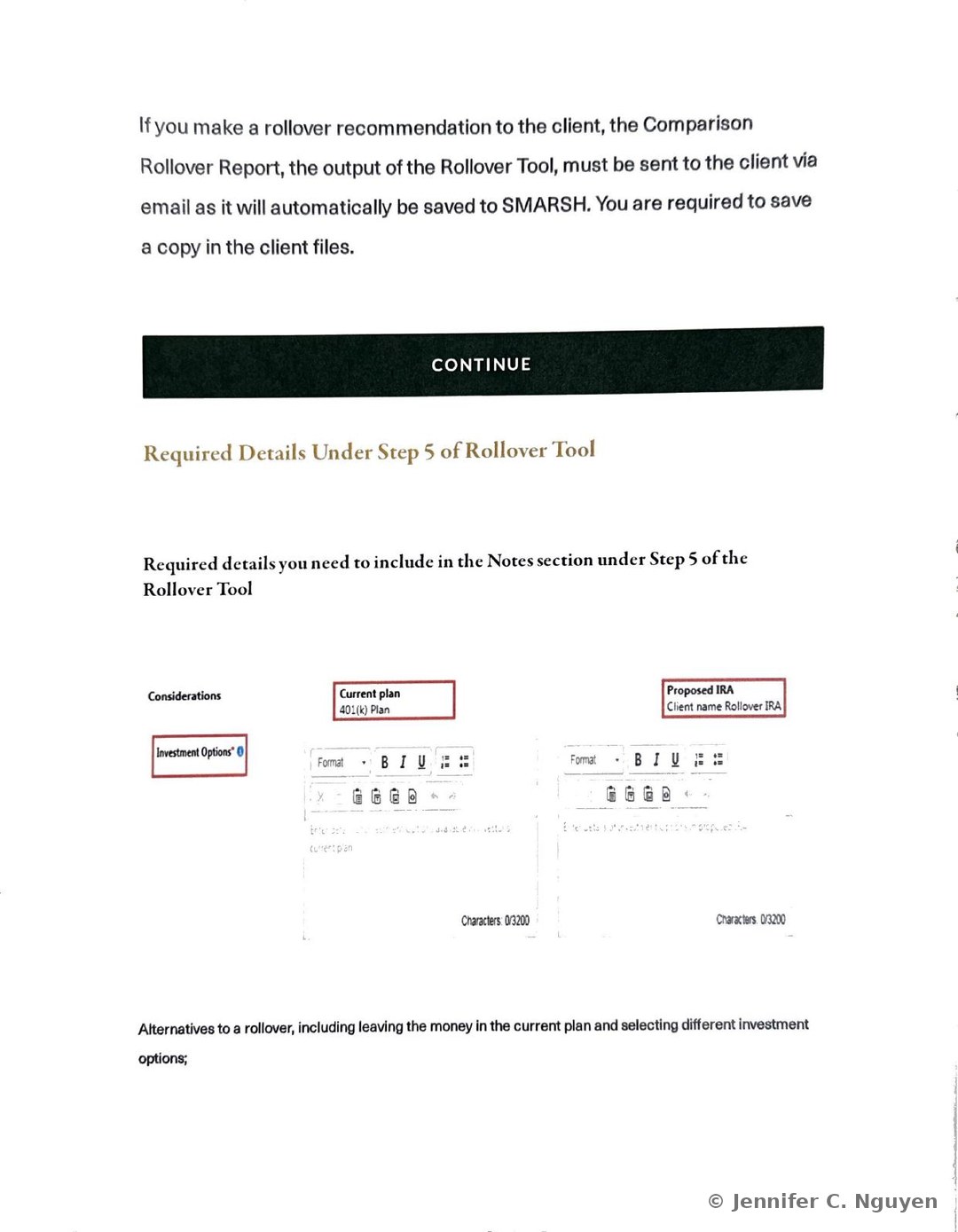
Client checks held overnight in a secured file heading with a paragraph explaining the 4:30pm PST cutoff time and locked drawer procedure, followed by a Client checks stored for a minimum of 14 days prior to destruction heading and paragraph, and a Client checks for IRA and IRA Rollover accounts heading explaining that checks coded as rollover contributions require the Rollover Tool to be completed, approved by PWM Supervision, and uploaded to the account, with Form CRS delivery requirements for recommendations
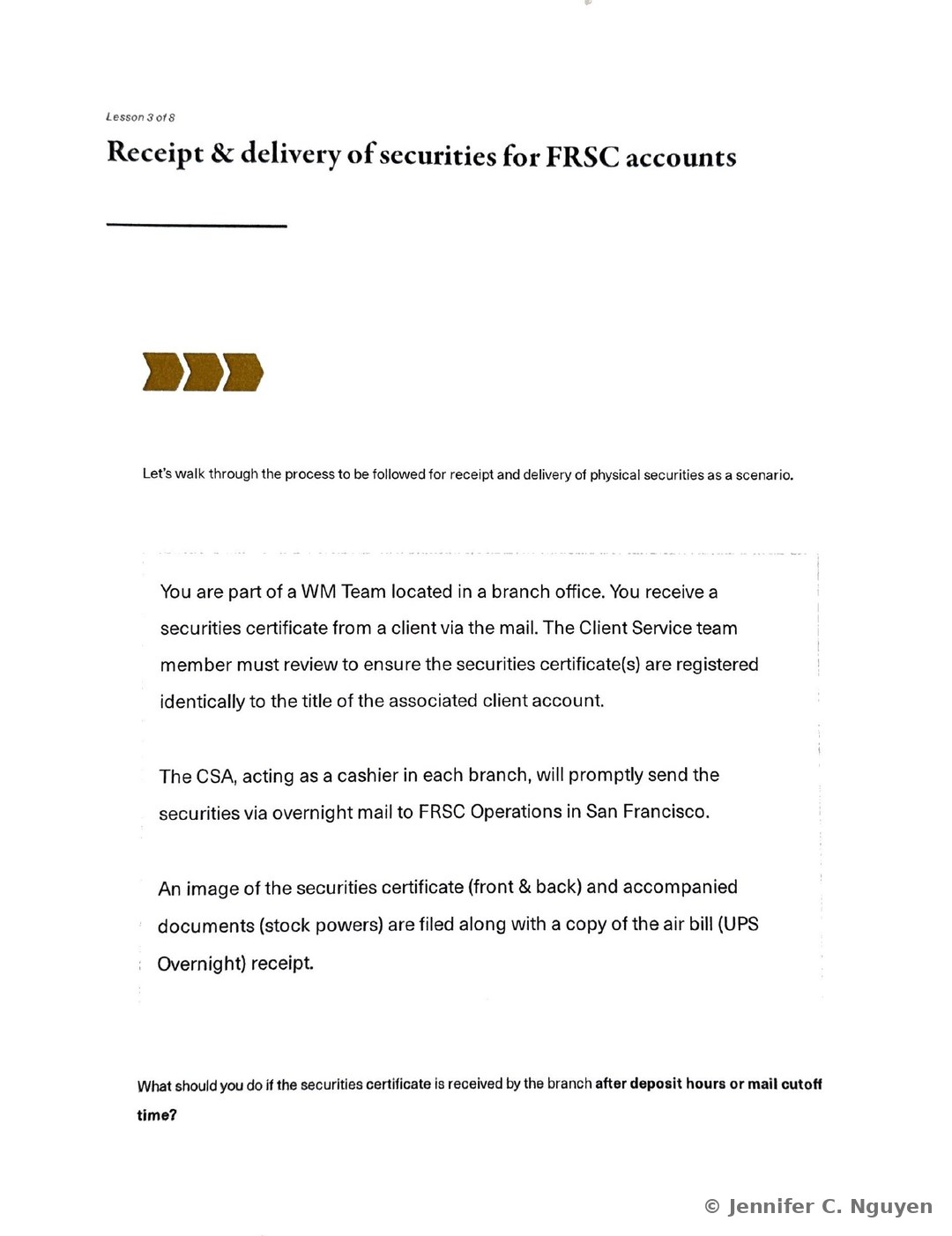
Receipt and delivery of securities for FRSC accounts slide numbered Lesson 3 of 8 with a chevron icon, an introductory paragraph reading Let's walk through the process to be followed for receipt and delivery of physical securities as a scenario, and a bordered scenario box describing a WM Team member in a branch office receiving a securities certificate by mail, reviewing that it is registered identically to the client account title, and the CSA promptly sending it via overnight mail to FRSC Operations in San Francisco, followed by a question asking what to do if the certificate is received after deposit hours or mail cutoff time
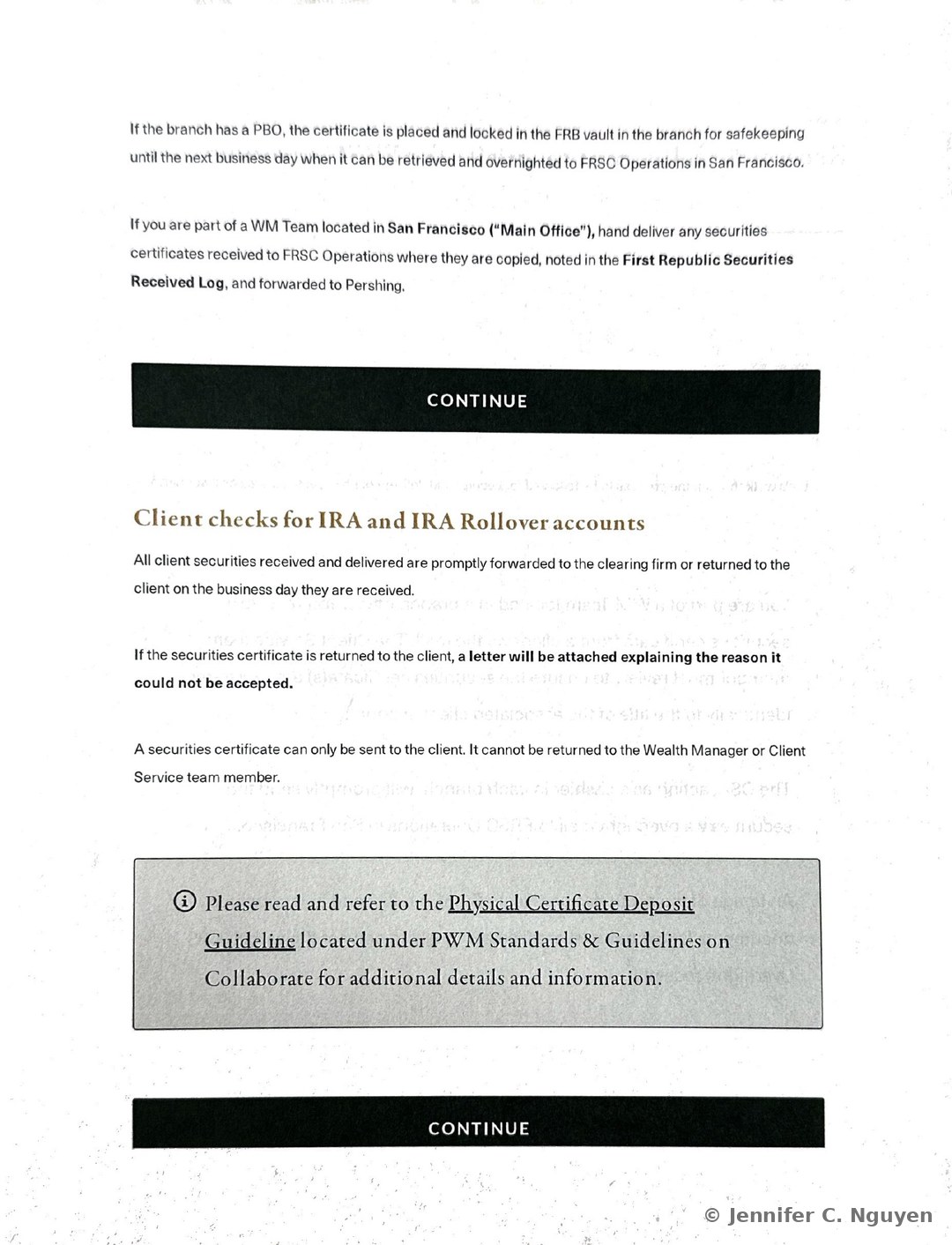
Paragraph explaining that a branch with a PBO locks the certificate in the FRB vault overnight before overnighting it to FRSC Operations, and that a San Francisco Main Office WM Team hand delivers certificates to FRSC Operations to be copied, logged in the First Republic Securities Received Log, and forwarded to Pershing, followed by a Client checks for IRA and IRA Rollover accounts heading explaining that securities are promptly forwarded to the clearing firm or returned to the client with an explanatory letter, and a gray info box referencing the Physical Certificate Deposit Guideline on Collaborate
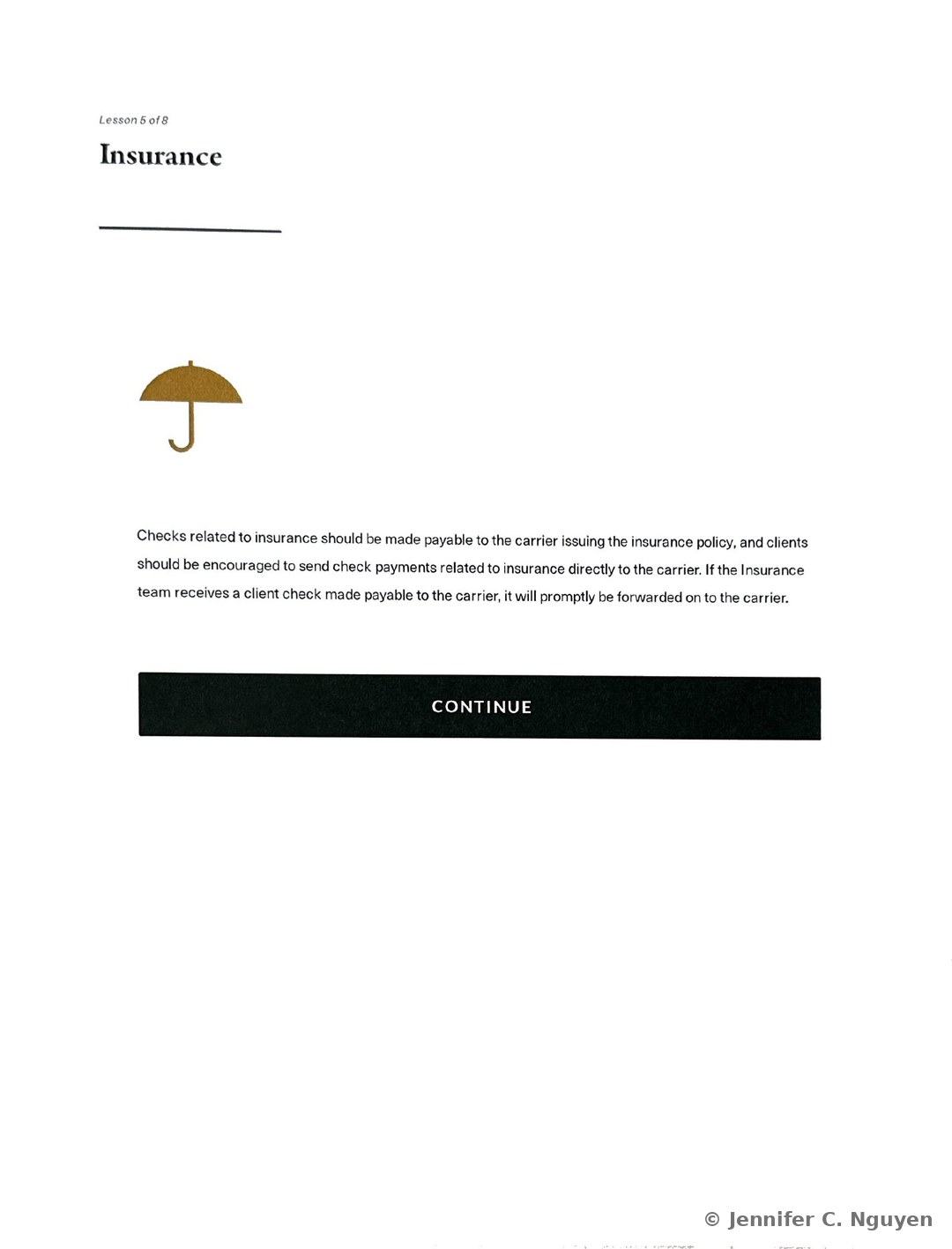
Insurance slide numbered Lesson 5 of 8 with an umbrella icon and a paragraph explaining that checks related to insurance should be made payable to the carrier issuing the policy, that clients should be encouraged to send insurance payments directly to the carrier, and that the Insurance team will promptly forward on any client check made payable to the carrier
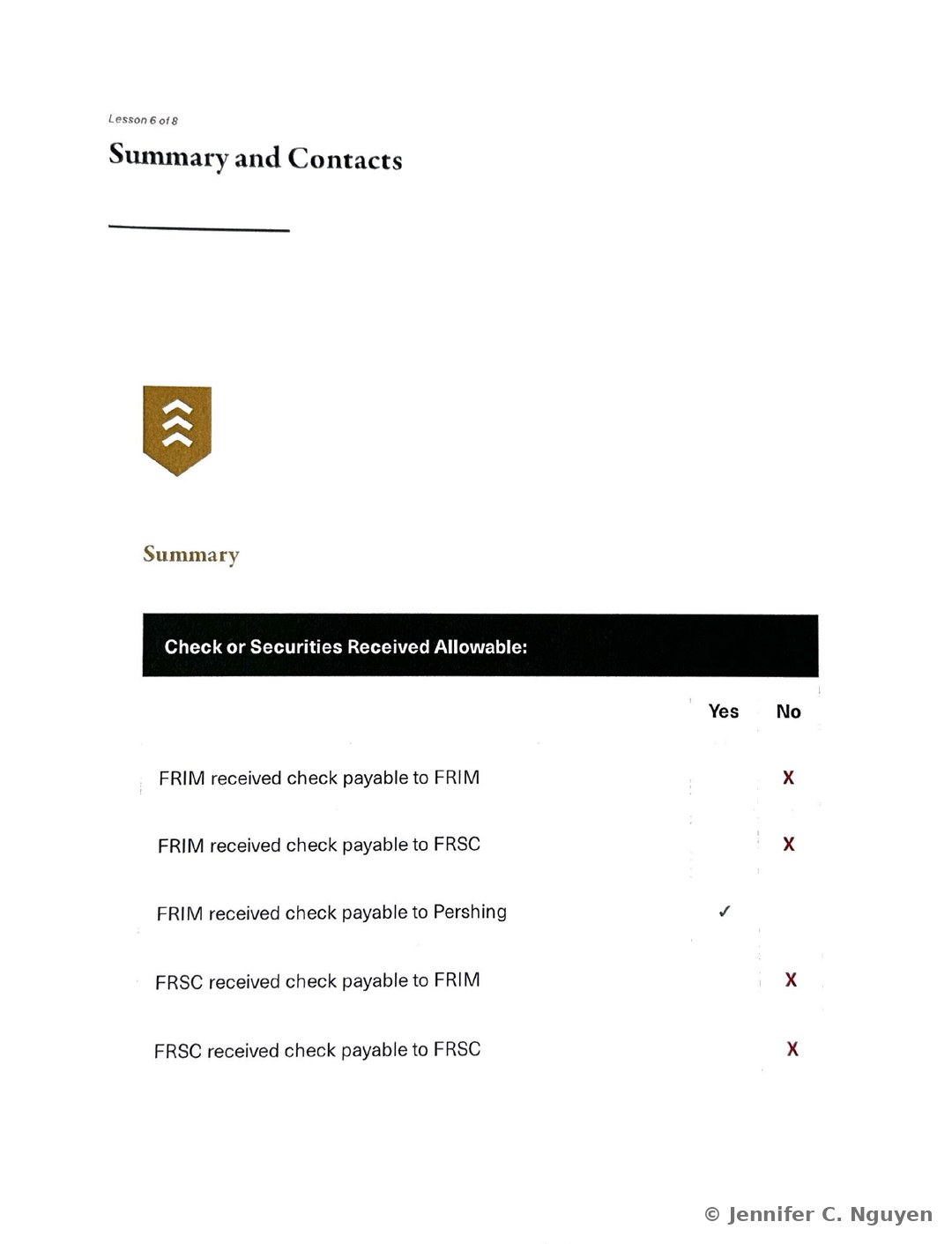
Summary and Contacts slide numbered Lesson 6 of 8 with a chevron badge icon, a Summary subheading, and the start of a Check or Securities Received Allowable table with Yes and No columns showing FRIM received check payable to FRIM marked No, FRIM received check payable to FRSC marked No, FRIM received check payable to Pershing marked Yes, FRSC received check payable to FRIM marked No, and FRSC received check payable to FRSC marked No
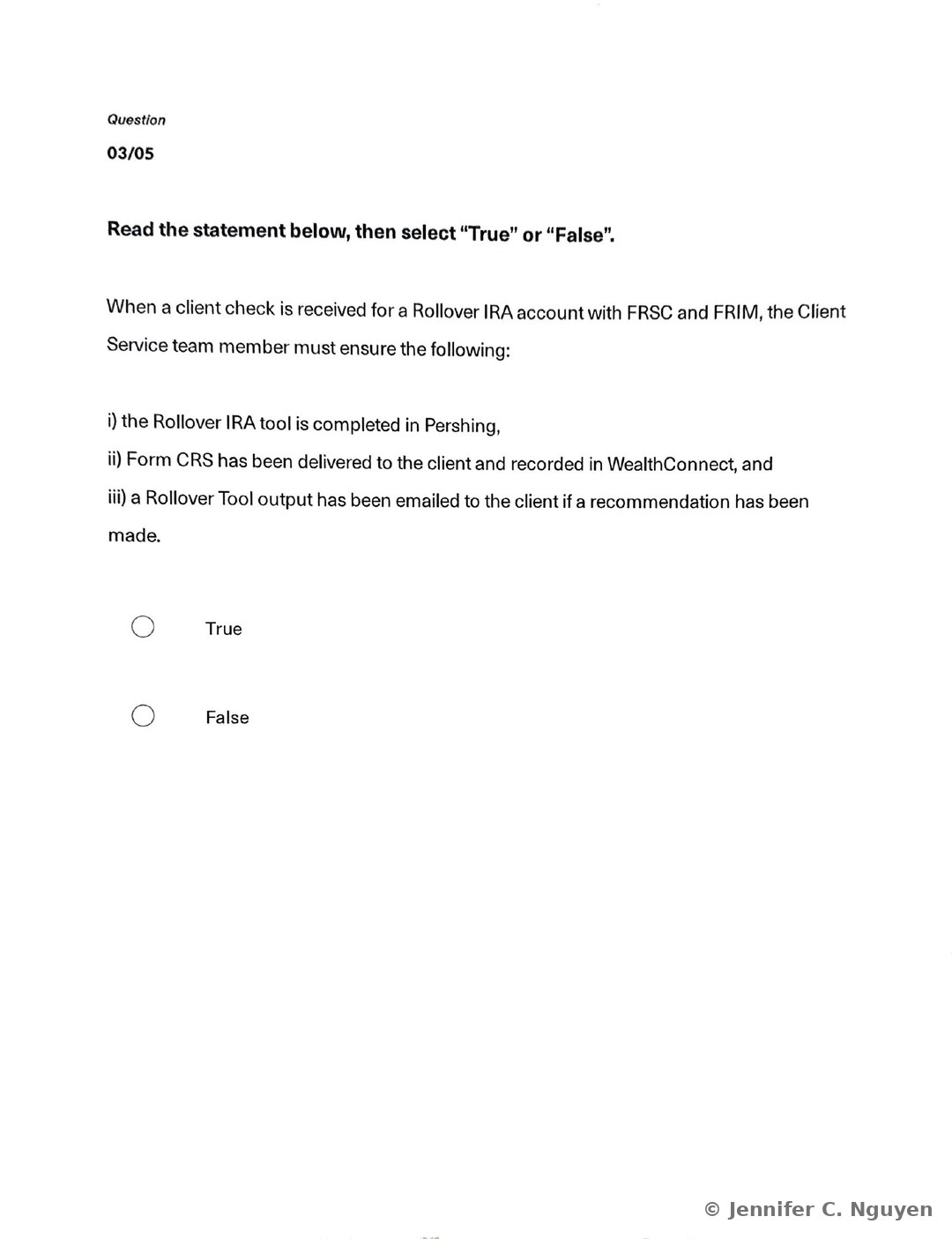
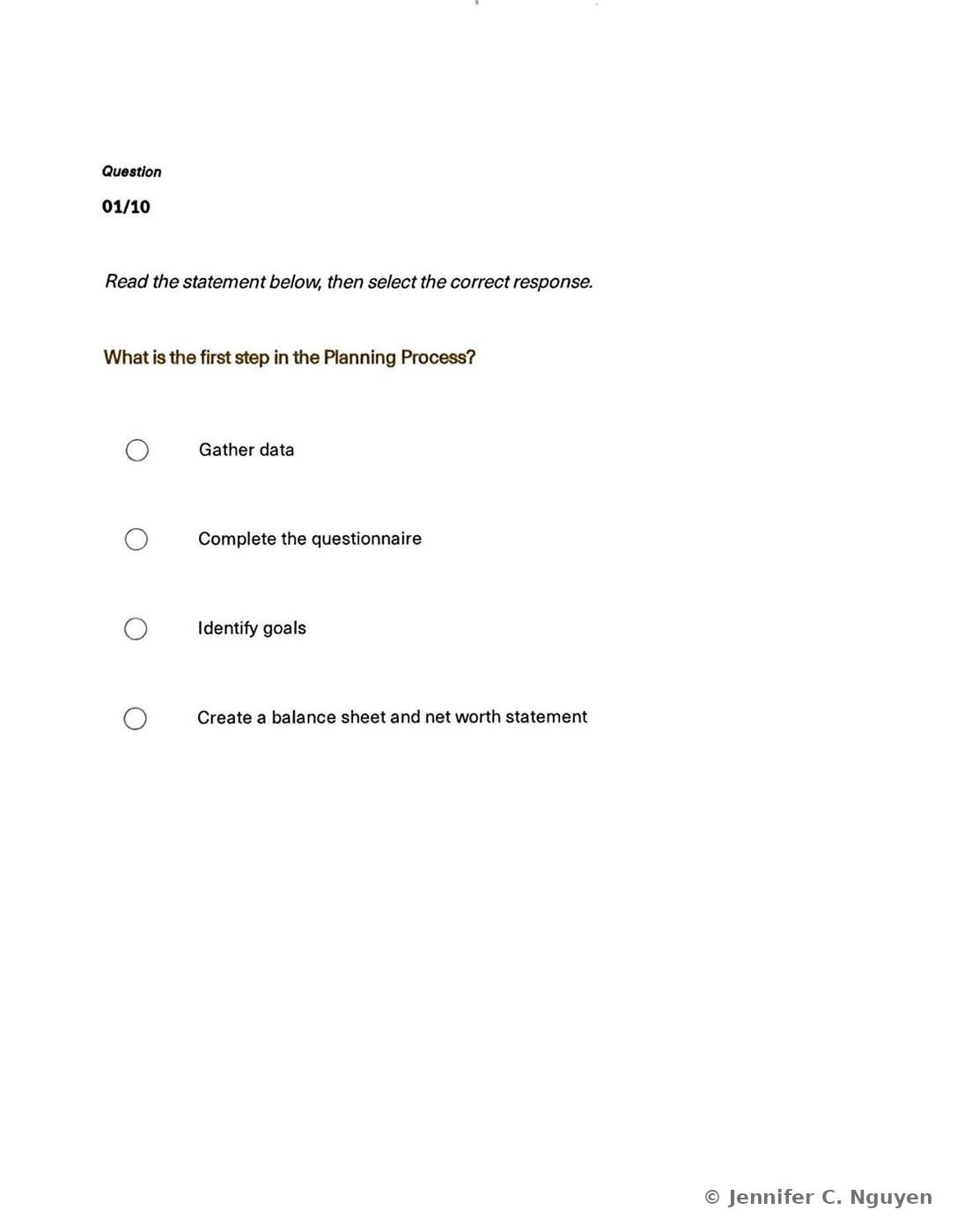
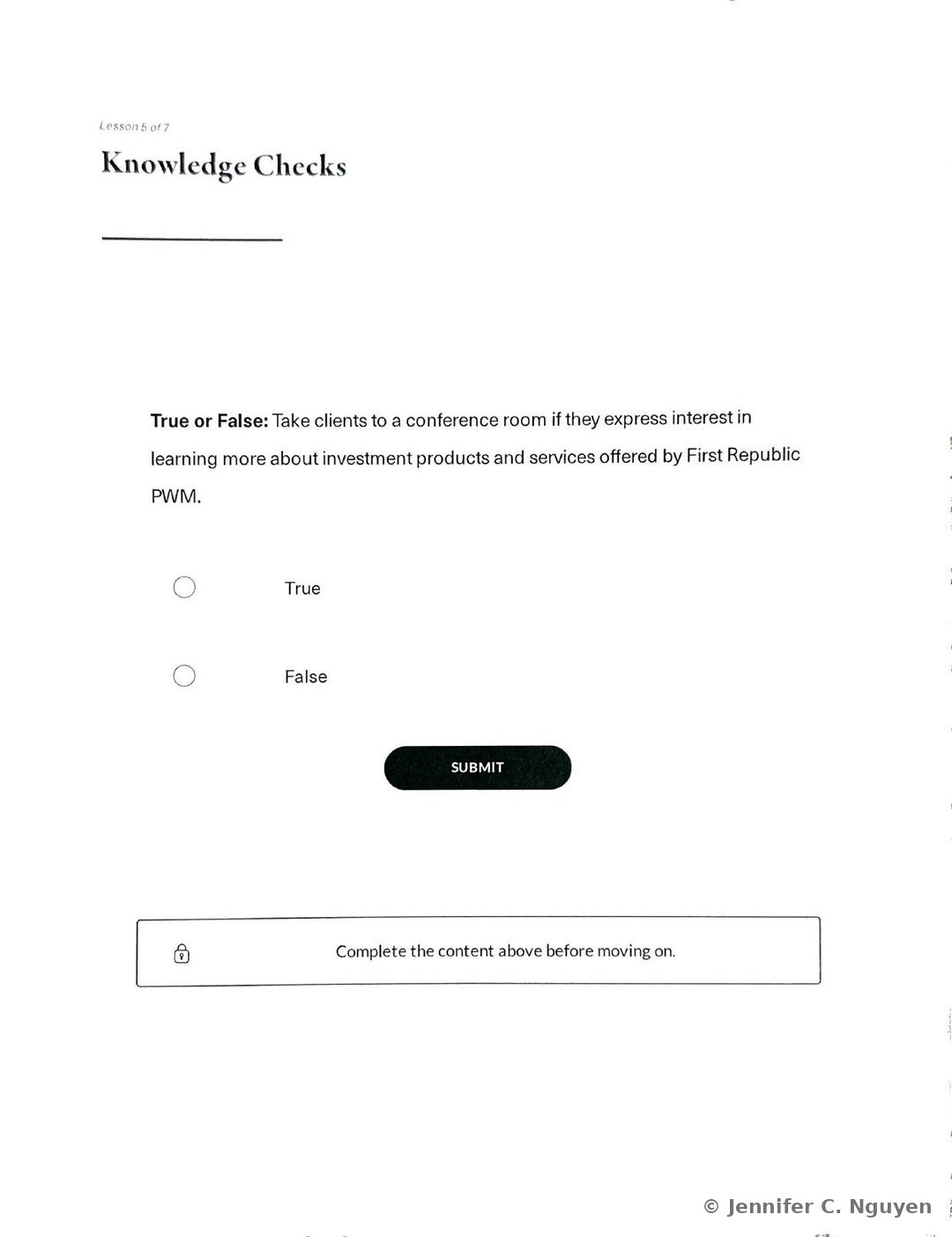
Quiz question numbered 03 of 05 reading Read the statement below, then select True or False, with a statement explaining that when a client check is received for a Rollover IRA account with FRSC and FRIM, the Client Service team member must ensure the Rollover IRA tool is completed in Pershing, Form CRS has been delivered to the client and recorded in WealthConnect, and a Rollover Tool output has been emailed to the client if a recommendation has been made, followed by True and False radio button options
05
Code of Ethics and Corporate Conduct Acknowledgment

This three-lesson Rise course is a short, required acknowledgment confirming that a colleague has read and will observe First Republic's Code of Ethics and Corporate Conduct, including the obligation to report any suspected violations. It links out to the full Code document itself, then walks through the acknowledgment click-through and an email confirmation of completion. This course is listed in the Compliance & Regulatory Course Library above, under Privacy, Data Protection & Client Communications.

Code of Ethics AcknowledgmentCorporate Conduct CertificationViolation Reporting Obligation
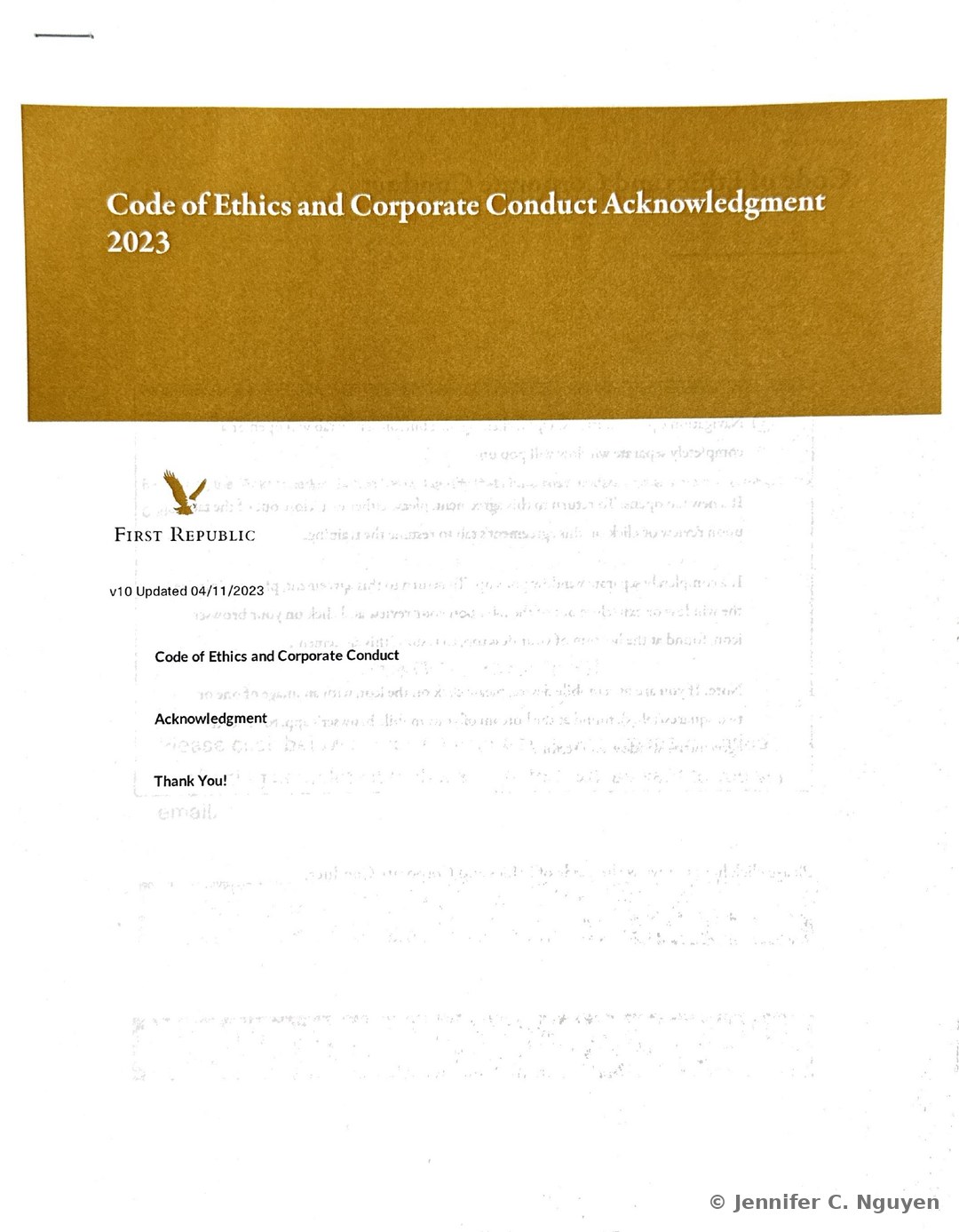
Code of Ethics and Corporate Conduct Acknowledgment 2023 course title page with a mustard gold header band holding a white serif title, First Republic eagle logo below on a white background, version text reading v10 Updated 04/11/2023, and a three-item lesson list reading Code of Ethics and Corporate Conduct, Acknowledgment, and Thank You
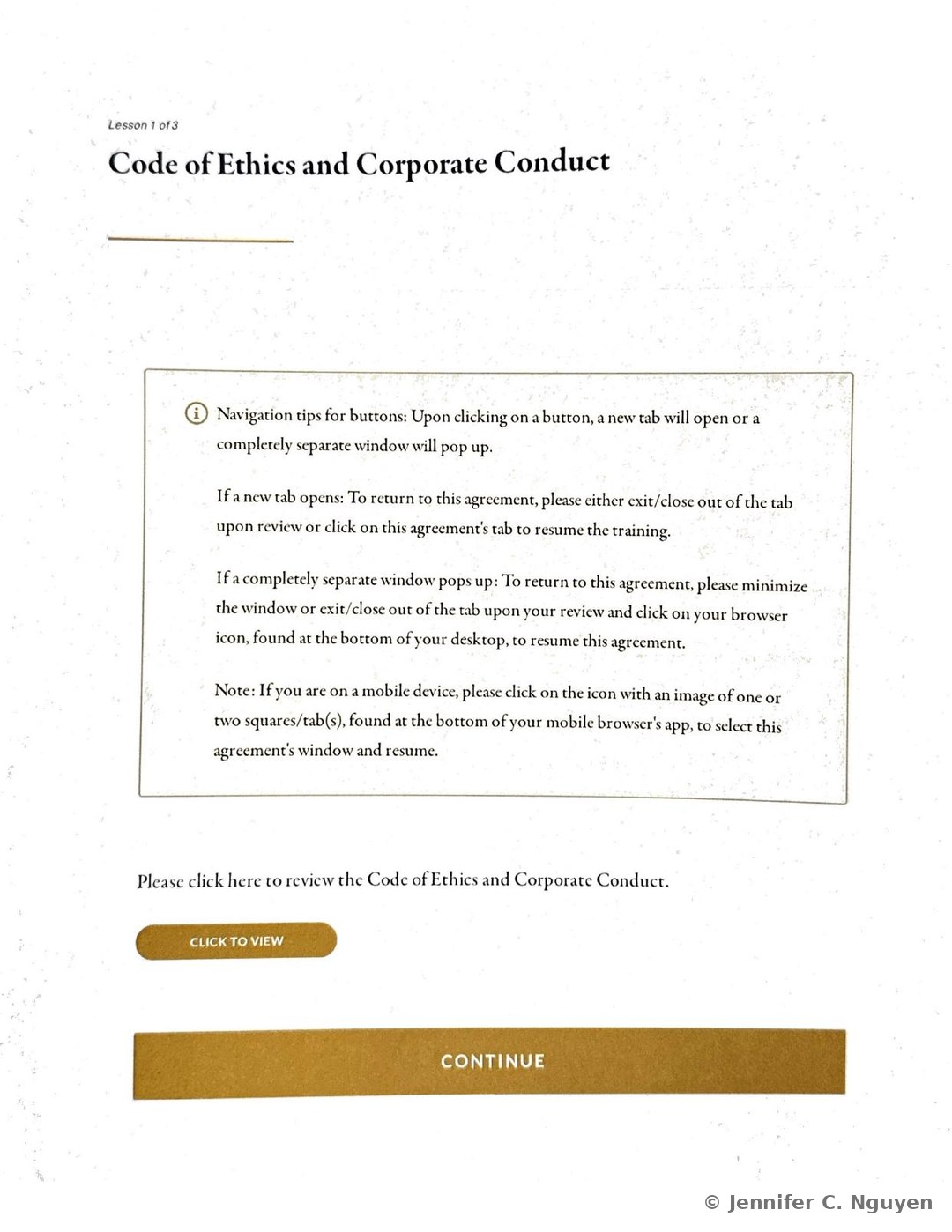
Code of Ethics and Corporate Conduct slide numbered Lesson 1 of 3 with a bordered navigation-tips box explaining that clicking a button opens a new tab or separate window and how to return to the agreement afterward, including instructions for mobile devices, followed by a prompt reading Please click here to review the Code of Ethics and Corporate Conduct with a gold Click to View button and a Continue button below
Acknowledgment slide with a paragraph explaining that all employees are required to be familiar with and observe the Code of Ethics and Corporate Conduct and report any suspected violations, and that clicking the Acknowledge button certifies the employee has read, understands, and is conforming to the Code, followed by an Acknowledgment heading, a paragraph noting a completion notice will be sent via email, and a gold Click Here to Acknowledge button
Course completion slide reading You have now completed: Code of Ethics and Corporate Conduct Acknowledgment in bold serif text on a white background
06
Crisis Management Team Training

This eight-lesson Rise course prepares Crisis Management Team members for handling a "Covered Incident," an event that exceeds normal business processes and could cause material harm to First Republic. It covers the CMT and CMT Task Force structure, the Crisis Event Timeline from emergency response through restoration, a four-level Incident Severity Level chart, the Initial Response Checklist and Event Management Quadrant used to track a live event, and the layered communication tools available during a crisis, including the Employee Emergency Hotline, the Emergency Communication System, and the federal Government Emergency Telecommunications Service. It closes with a rundown of the annual CMT tabletop exercise and a four-question scored quiz. This course is listed in the Compliance & Regulatory Course Library above, under Business Continuity & Information Security.

Covered Incident IdentificationCrisis Event TimelineIncident Severity Level ChartInitial Response ChecklistGovernment Emergency Telecommunications Service
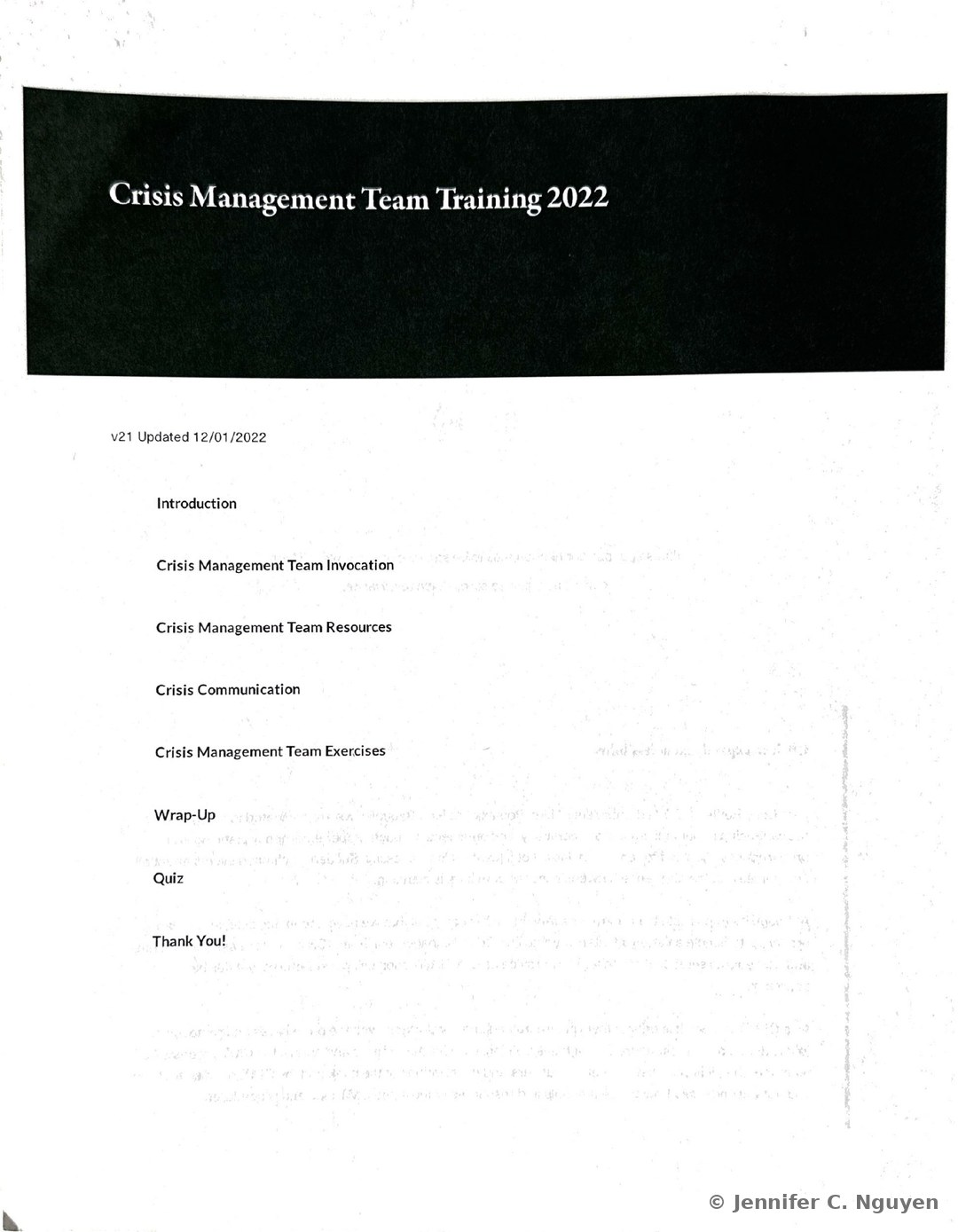
Crisis Management Team Training 2022 course title page with a dark charcoal header band holding a white serif title, version text reading v21 Updated 12/01/2022, and an eight-item lesson list reading Introduction, Crisis Management Team Invocation, Crisis Management Team Resources, Crisis Communication, Crisis Management Team Exercises, Wrap-Up, Quiz, and Thank You
Introduction slide closing with a dark Crisis Management Team Training title panel and a lock icon reading Complete the content above before advancing, followed by a paragraph asking the reader to consider what types of threats face First Republic and its colleagues, such as a data breach, category 5 hurricane, or mass electrical outage
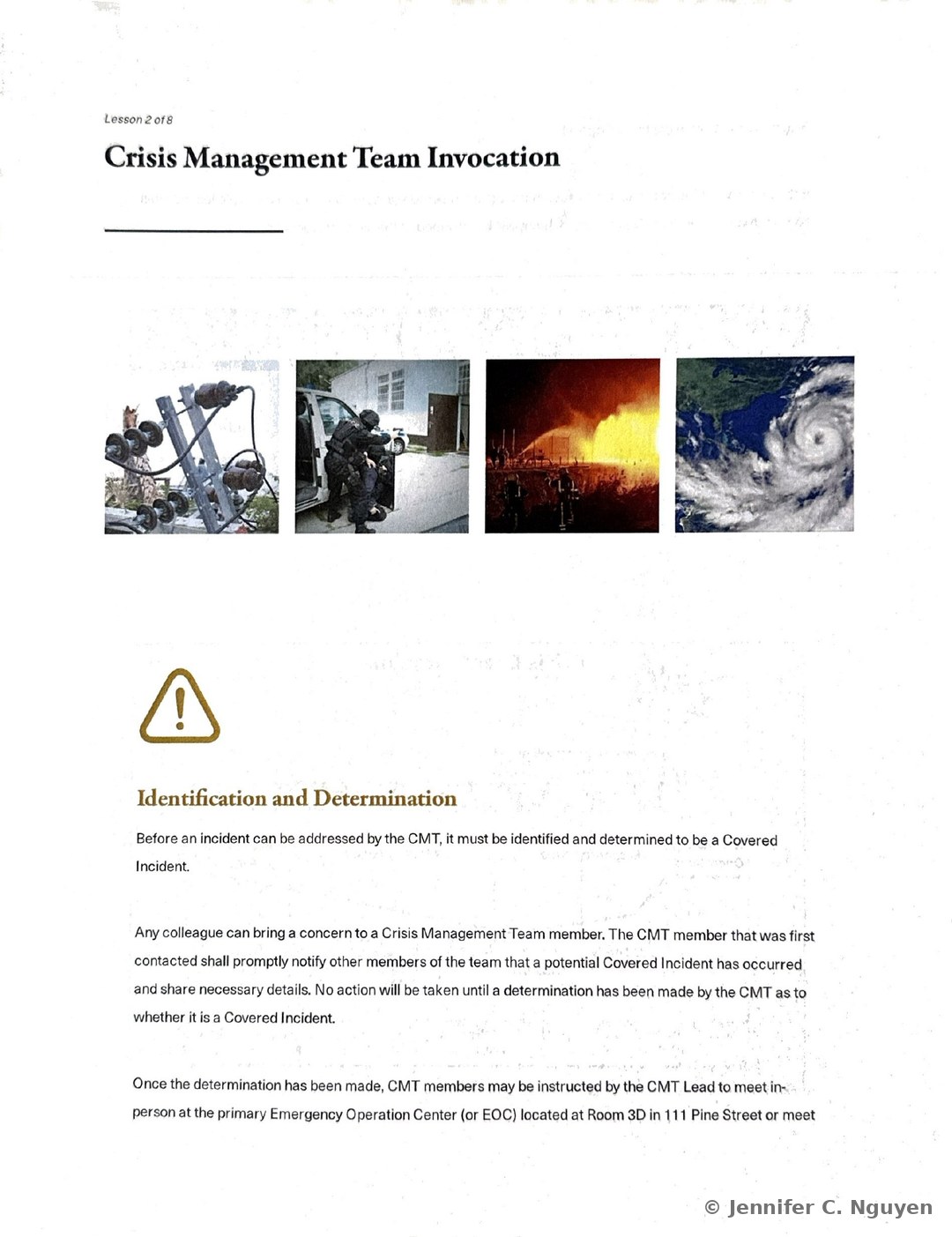
Crisis Management Team Invocation slide numbered Lesson 2 of 8 with a four-photo row depicting radio equipment, a tactical response team, a fire, and a hurricane satellite image, followed by a warning triangle icon and an Identification and Determination heading explaining that any colleague can bring a concern to a CMT member, who must notify the rest of the team that a potential Covered Incident has occurred
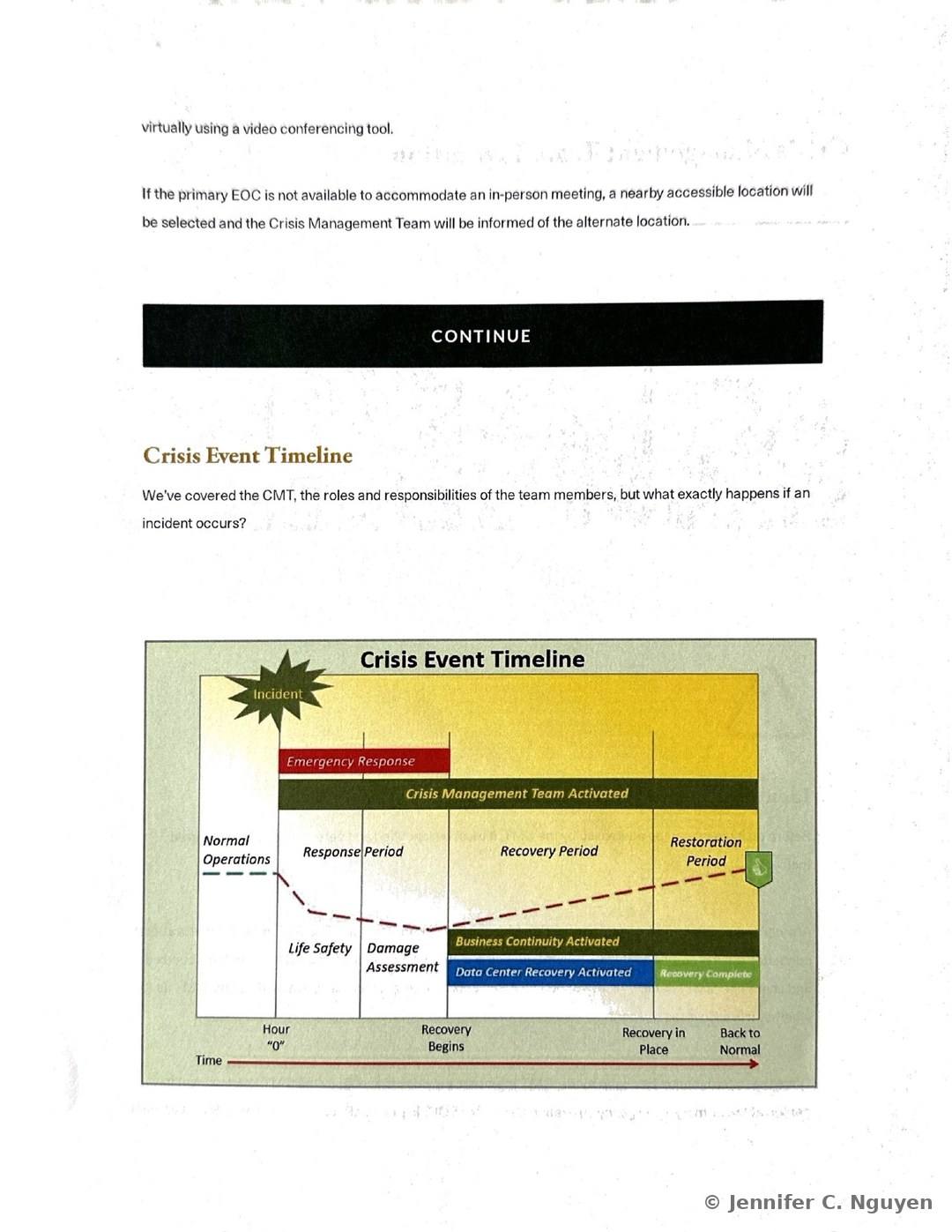
Paragraph explaining that if the primary Emergency Operation Center is unavailable, a nearby accessible location will be selected, followed by a Crisis Event Timeline heading and a colorful horizontal timeline graphic showing Normal Operations, Response Period with Life Safety and Damage Assessment, Recovery Period, and Restoration Period, with Emergency Response and Crisis Management Team Activated bands running across the top
Binoculars icon with a Crisis Management Team Event Management Quadrant heading and a paragraph explaining that the quadrant captures information during a significant crisis, tracking event status and action items, and should be maintained by a Crisis Management Team Support Staff member
Four-quadrant labels reading Event Summary and Status as of Time, Issues with Status, Timeline of Events, and Action Items with Assignments, illustrating the four sections of the Crisis Management Team Event Management Quadrant tool
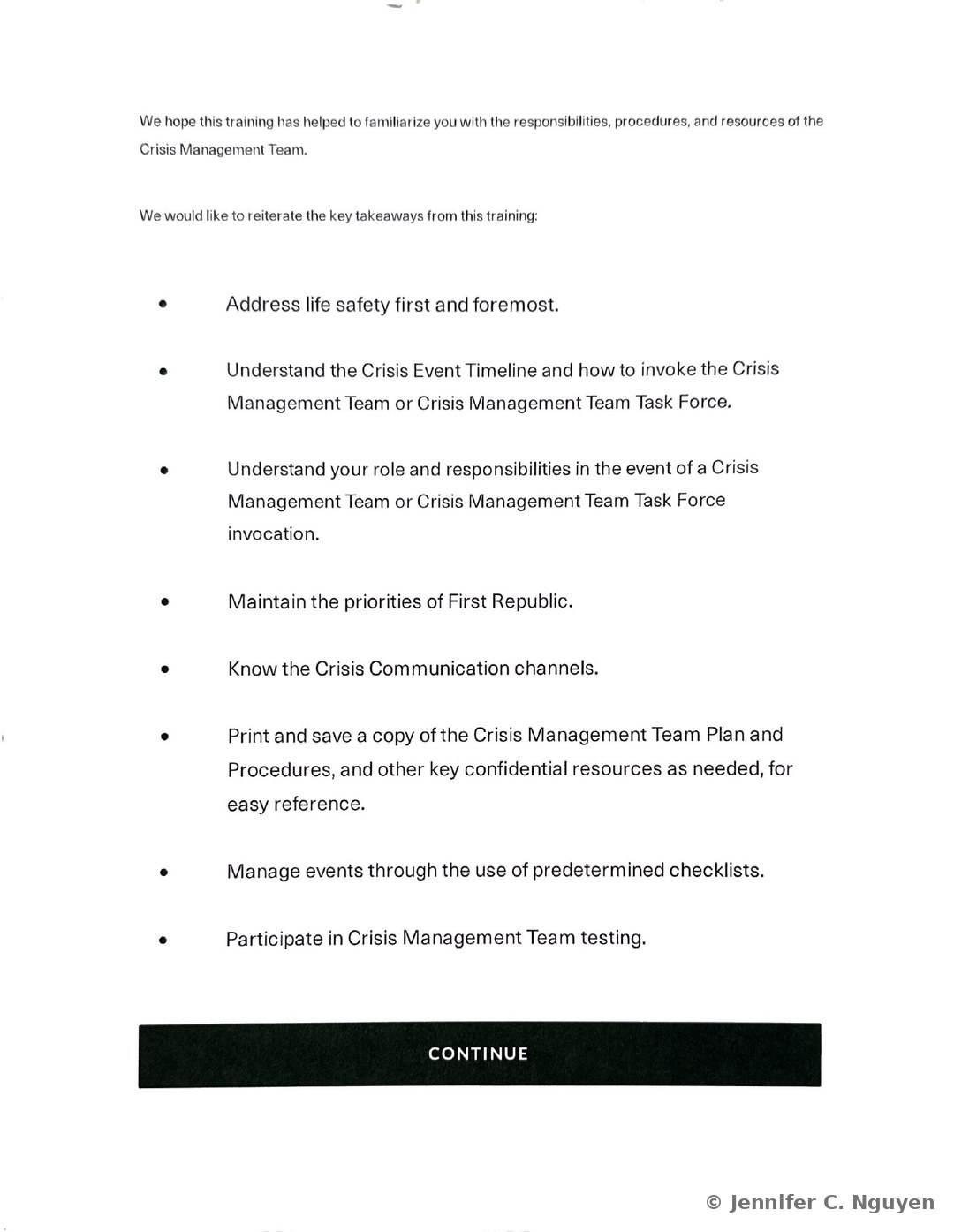
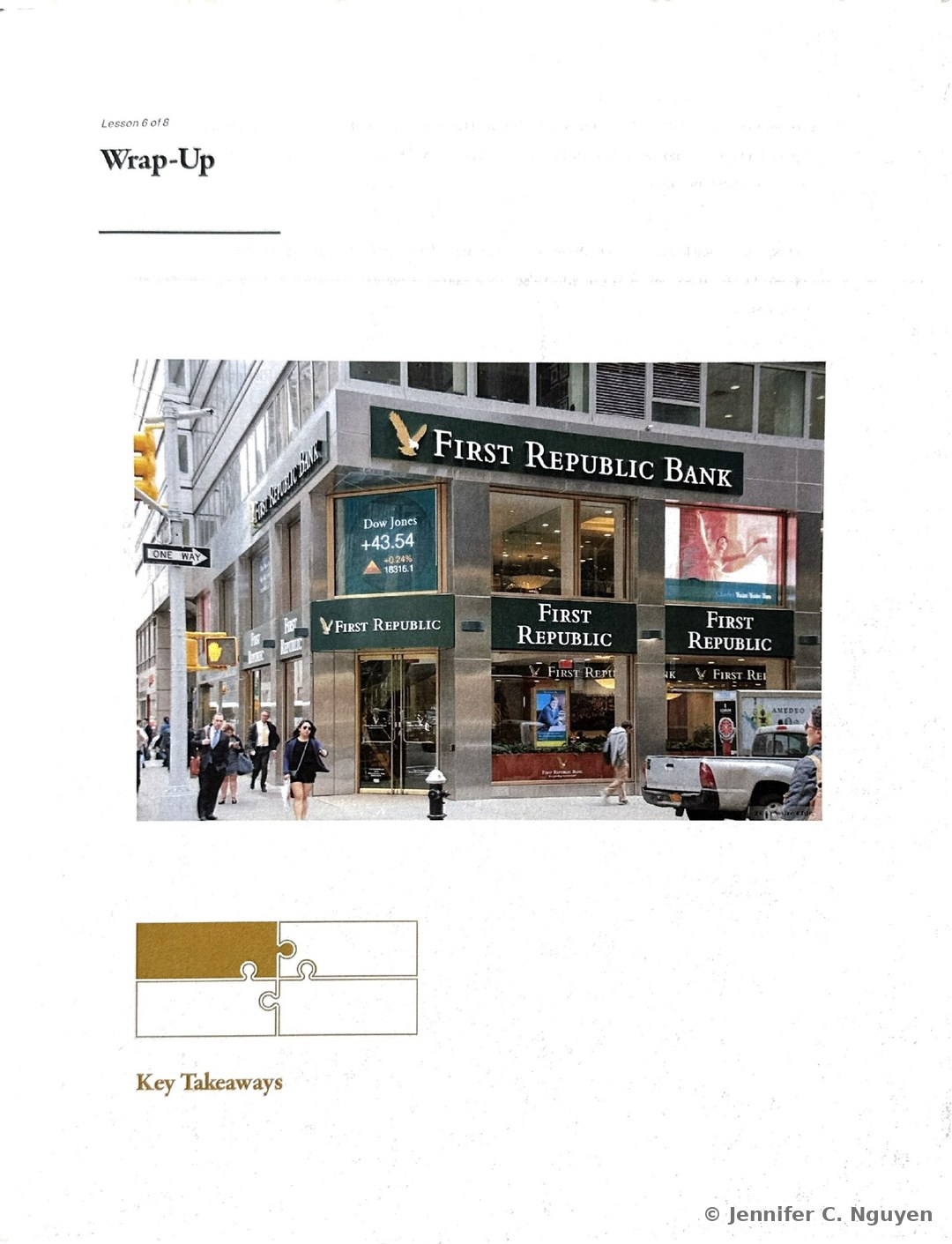
Wrap-Up slide numbered Lesson 6 of 8 with a photo of a First Republic Bank branch storefront on a city street, followed by a puzzle-piece icon and a Key Takeaways heading
Key Takeaways bulleted list reading Address life safety first and foremost, Understand the Crisis Event Timeline and how to invoke the CMT or CMT Task Force, Understand your role and responsibilities in the event of a CMT or CMT Task Force invocation, and the start of Maintain the priorities of First Republic
07
Electronic Funds Transfer and Error Resolution

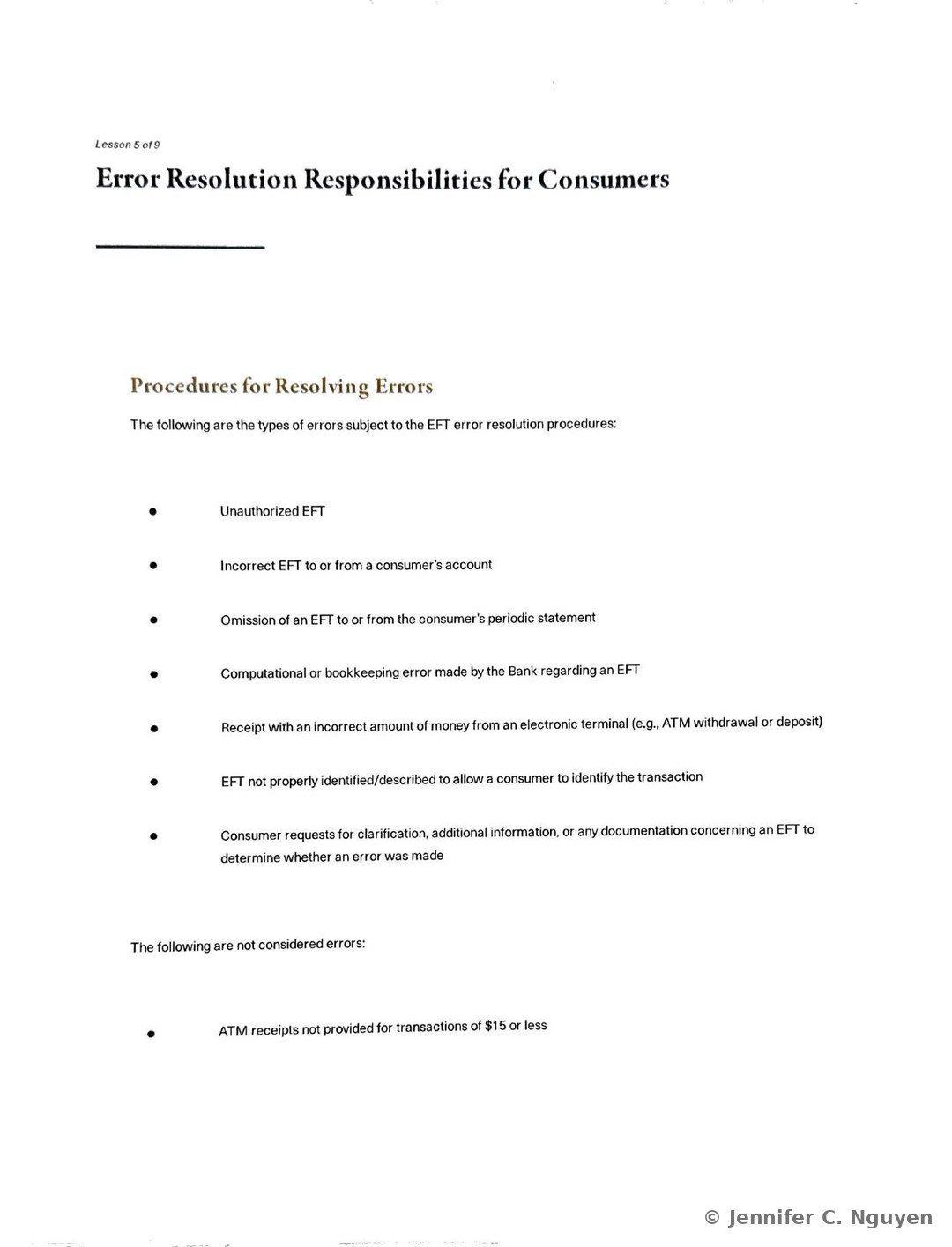
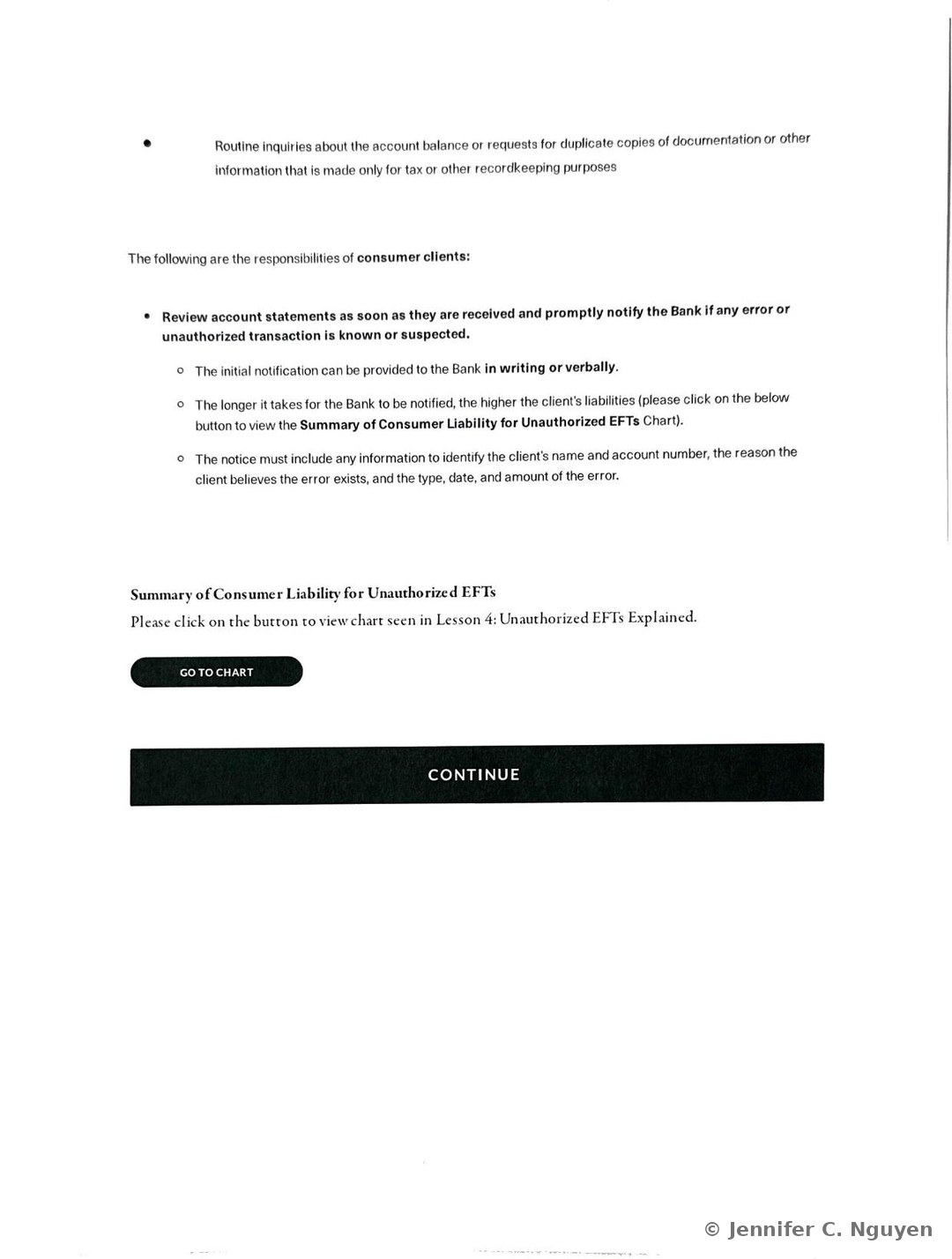
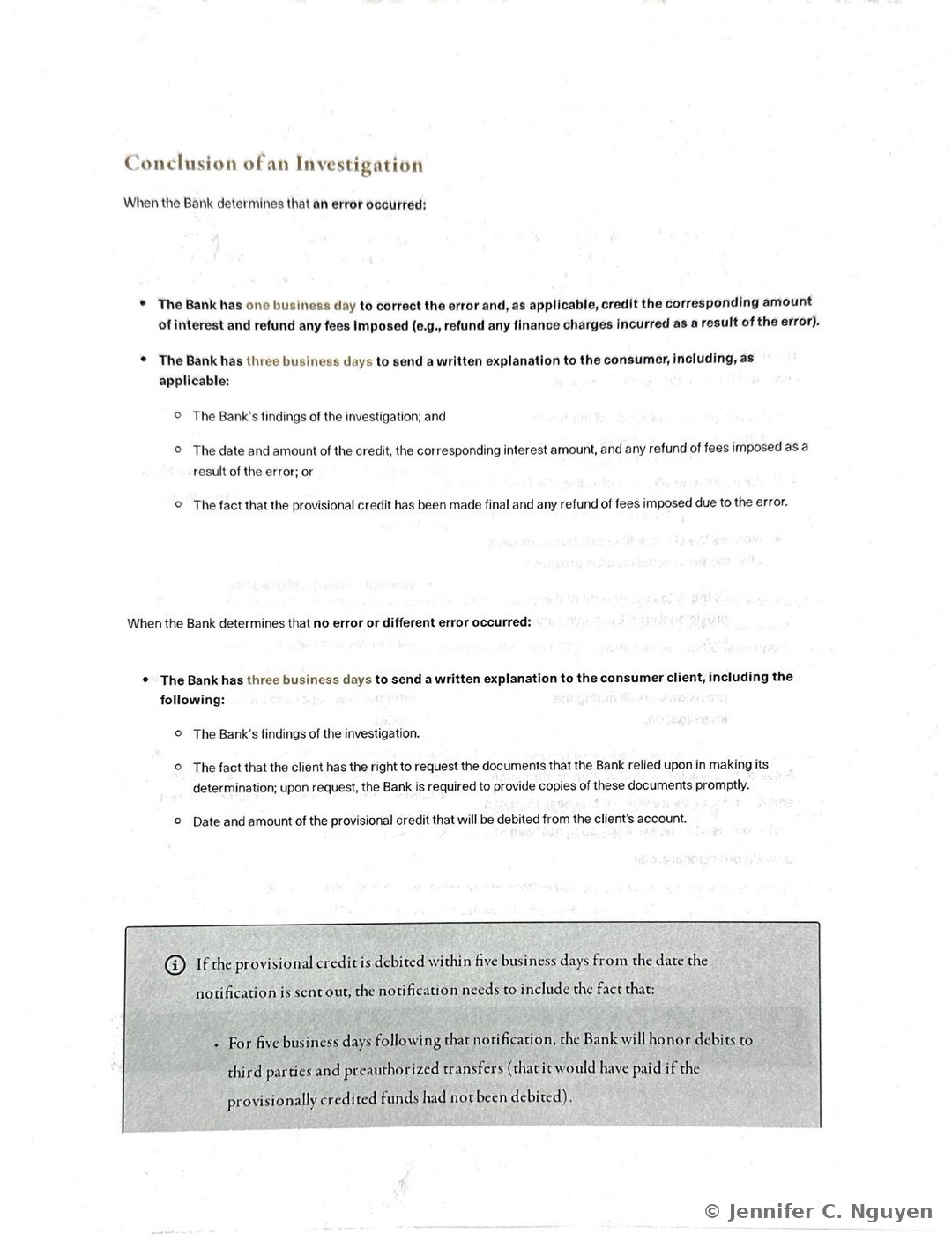
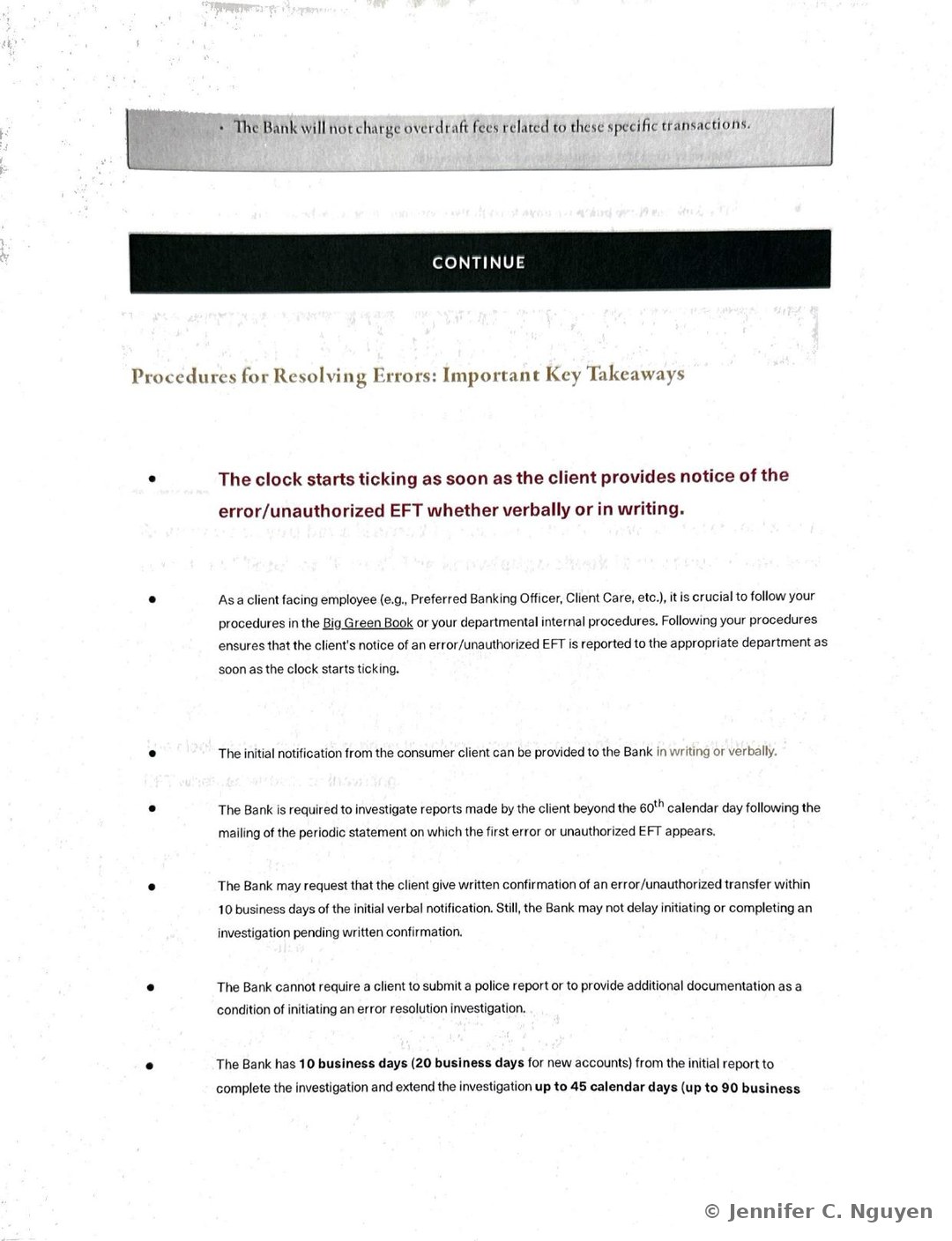
This nine-lesson Rise course trains consumer-facing colleagues on the Electronic Funds Transfer Act, covering which transactions count as EFTs (ATM, point-of-sale, ACH, telephone bill pay, and pre-authorized transfers), the account disclosures the Bank must provide before a client's first EFT, and the Bank's own investigation duties once a client reports a problem, including written explanations of findings and refunding any fees tied to a confirmed error. A knowledge check asks colleagues to spot the one true unauthorized EFT among three client scenarios, distinguishing it from a family member's spending and a merchant dispute. Later lessons cover state-specific carve-outs for California, Massachusetts, and New York residents, and point client-facing colleagues to the Big Green Book for internal error-reporting procedures. This course is listed in the Compliance & Regulatory Course Library above, under Deposit Operations & Banking Regulations.

Electronic Fund Transfer ActCovered EFT Transaction TypesBank Investigation DutiesState-Specific Liability Carve-OutsUnauthorized EFT Scenario CheckBig Green Book Reference
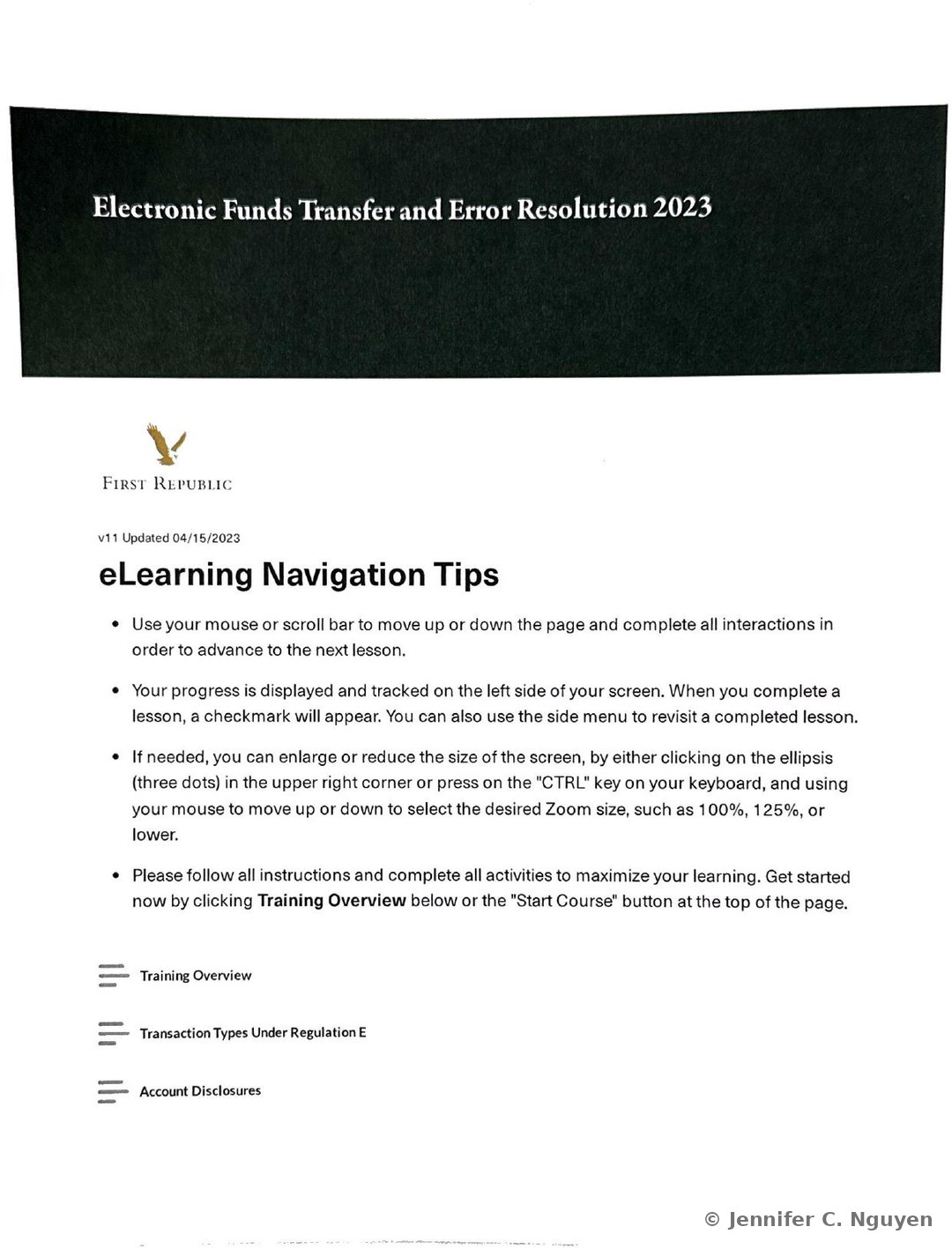
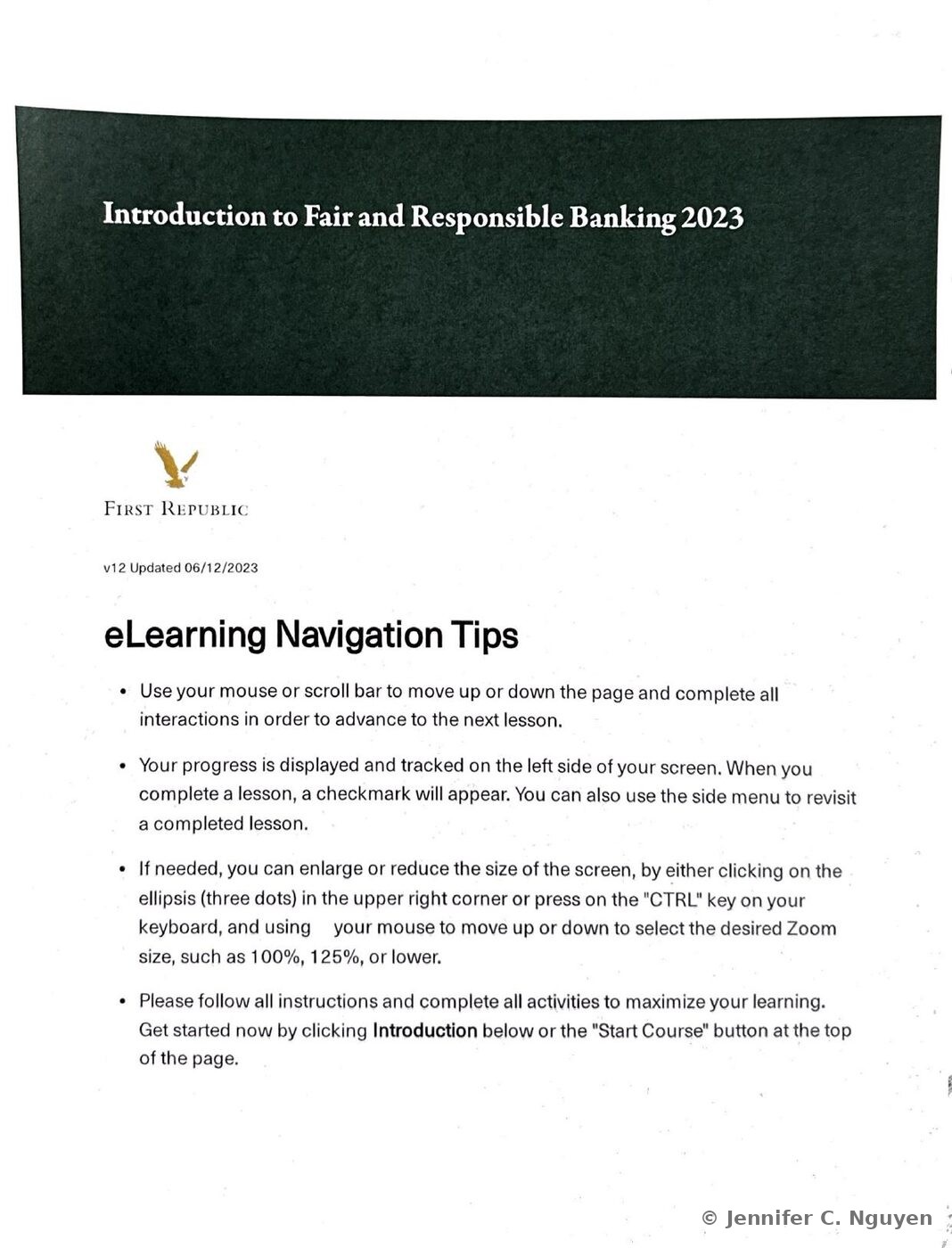
Electronic Funds Transfer and Error Resolution 2023 course title page with a dark textured header band holding a white serif title, First Republic eagle logo and wordmark below on a white background, version text reading v11 Updated 04/15/2023, an eLearning Navigation Tips heading with four bulleted instructions about scrolling, progress tracking, zoom controls, and completing activities, and the start of a lesson menu listing Training Overview, Transaction Types Under Regulation E, and Account Disclosures
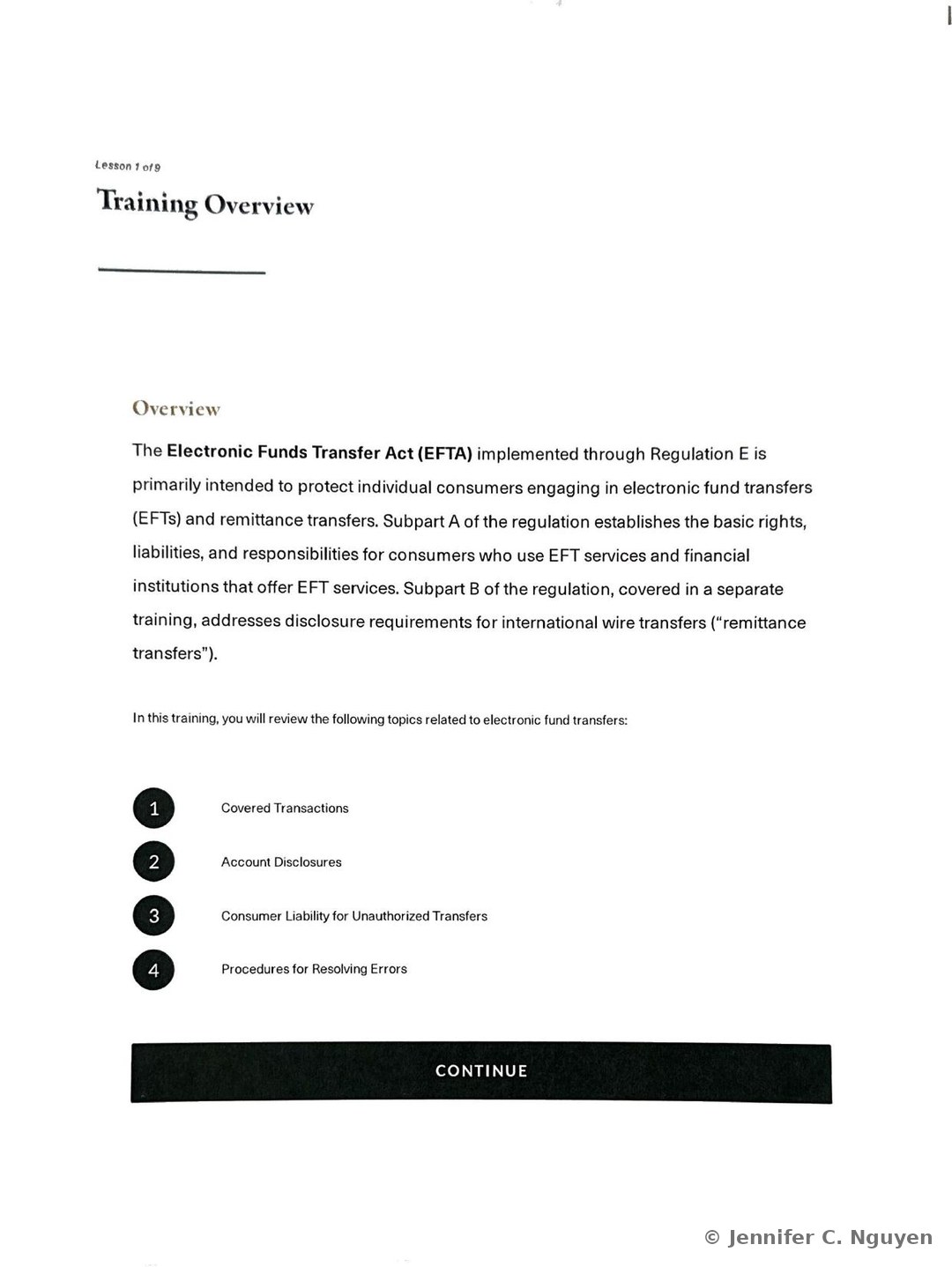
Training Overview slide numbered Lesson 1 of 9 with a gold Overview subheading, a paragraph explaining that the Electronic Funds Transfer Act implemented through Regulation E protects consumers using EFT and remittance transfer services, and a four-item numbered list reading Covered Transactions, Account Disclosures, Consumer Liability for Unauthorized Transfers, and Procedures for Resolving Errors, followed by a black Continue bar
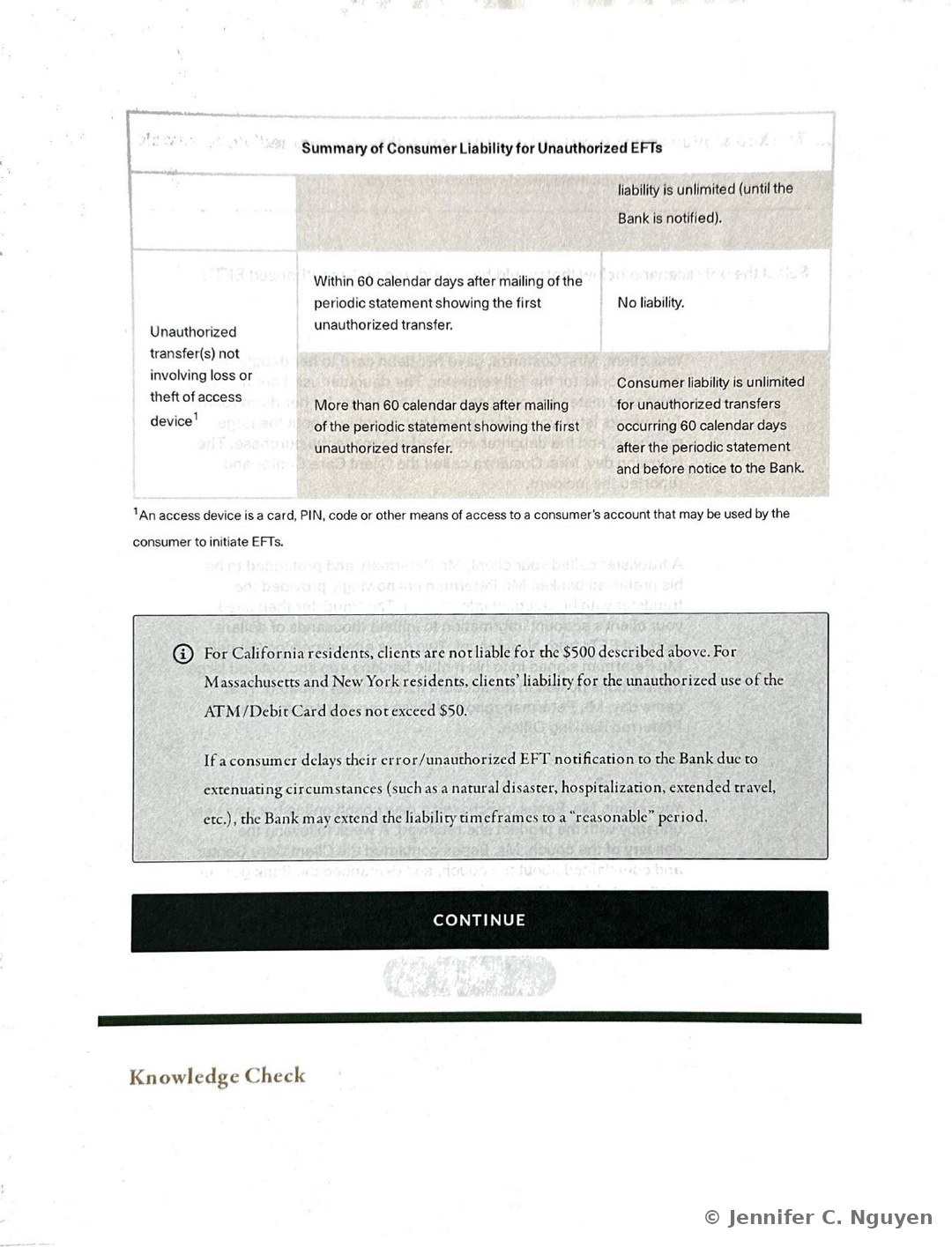
Summary of Consumer Liability for Unauthorized EFTs table continued, showing a row where liability is unlimited until the Bank is notified, a row stating no liability applies within 60 calendar days after mailing of the periodic statement showing the first unauthorized transfer, and a row for unauthorized transfers not involving loss or theft of an access device where liability is unlimited for transfers occurring more than 60 calendar days after that statement and before notice to the Bank, with a footnote defining an access device as a card, PIN, code, or other means of account access
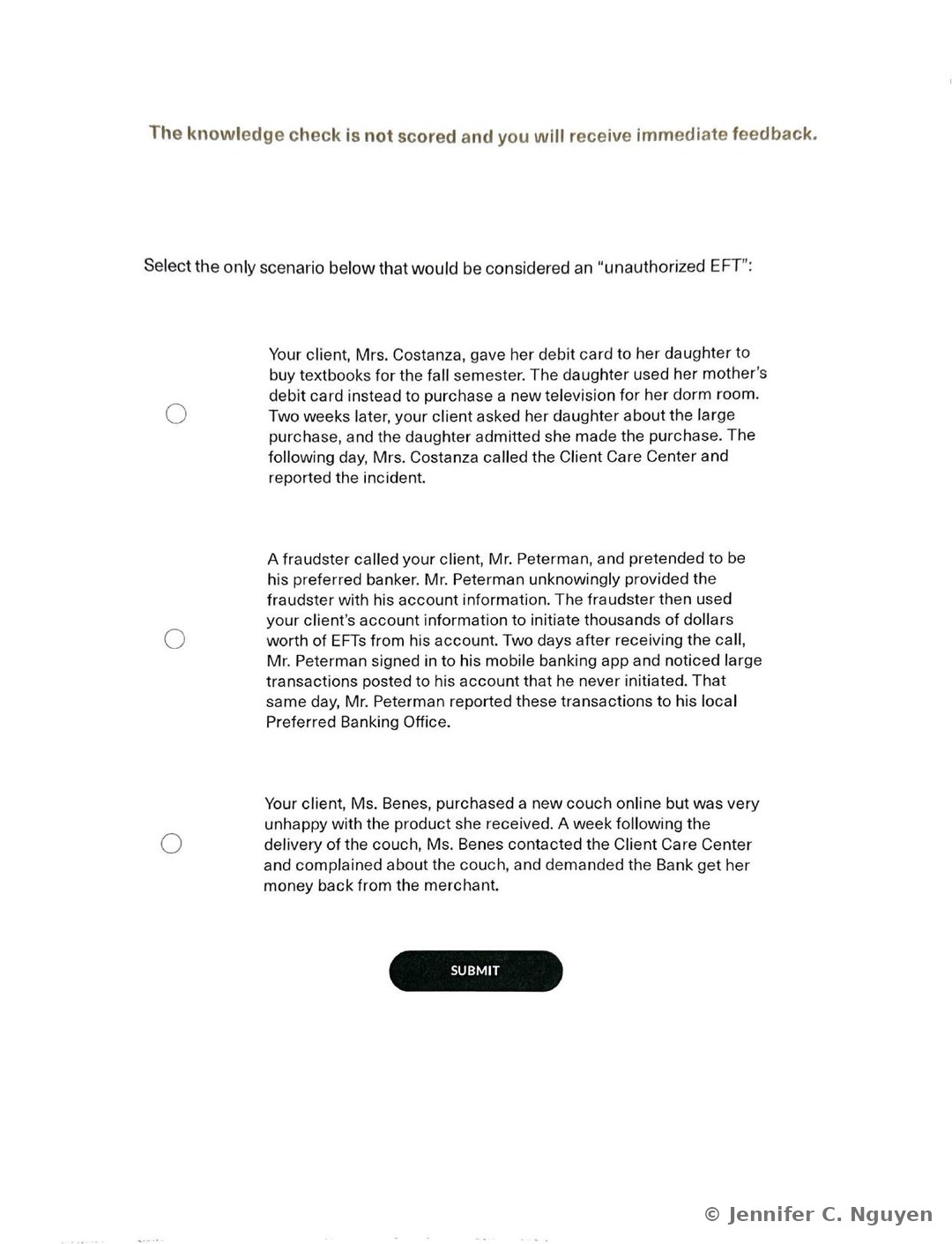
Knowledge check page stating the check is not scored and offers immediate feedback, with the prompt Select the only scenario below that would be considered an unauthorized EFT, followed by three radio-button scenarios describing Mrs. Costanza's daughter using her debit card for an unrelated purchase, Mr. Peterman falling for a fraudster's phone call, and Ms. Benes disputing a couch purchase with a merchant, and a black Submit button
Error Resolution Responsibilities for Consumers slide numbered Lesson 5 of 9 with a gold Procedures for Resolving Errors subheading and a seven-item bulleted list of errors subject to EFT error resolution procedures, including unauthorized EFTs, incorrect or omitted EFTs on a statement, computational or bookkeeping errors, incorrect ATM receipt amounts, unidentified EFTs, and consumer requests for clarification about a transaction
Continuation slide listing routine account balance inquiries and recordkeeping document requests as not considered errors, followed by a Responsibilities of consumer clients heading with a bulleted list covering reviewing statements promptly, providing initial notification to the Bank in writing or verbally, how notification timing affects liability with a Go to Chart button linking to the Summary of Consumer Liability for Unauthorized EFTs, and the information a notice of error must include, ending in a black Continue bar
Conclusion of an Investigation slide with a gold heading and two scenario sections, the first covering when the Bank determines an error occurred, listing a one business day window to correct the error and credit interest or refund fees and a three business day window to send a written explanation of findings, and the second covering when no error or a different error occurred, requiring a three business day written explanation including the client's right to request supporting documents and the date and amount of any provisional credit to be debited, with a gray info box at the bottom noting that the Bank will continue honoring third-party debits and preauthorized transfers for five business days after a provisional-credit reversal notice
Key Takeaways slide with a gold Procedures for Resolving Errors heading, an opening bolded bullet stating that the clock starts ticking as soon as the client provides notice of the error or unauthorized EFT whether verbally or in writing, and a following bullet instructing client-facing colleagues to follow the procedures in the Big Green Book or their departmental internal procedures so the notice reaches the appropriate department promptly
08
Employee, Job Candidate and Consultant Privacy Policy Acknowledgment

This three-lesson Rise course has employees, job candidates, and consultants review and acknowledge First Republic's internal Privacy Policy before it counts as complete. The embedded Policy itself defines Personal Information and Sensitive Personal Information with a detailed table of collection categories, from identifiers and geolocation data to biometric information and legally protected personal characteristics, then walks through the business purposes for collecting that data and the categories of third parties it may be shared with, including affiliates, service providers, and advertising partners. A California residents section outlines the additional privacy protections available to state residents, and the course closes with a one-click acknowledgment step that emails the reader a confirmation notice. This course is listed in the Compliance & Regulatory Course Library above, under Privacy, Data Protection & Client Communications.

Employee Privacy PolicyPI and SPI Data CategoriesBusiness Purpose DisclosuresThird-Party Sharing CategoriesOne-Click AcknowledgmentCalifornia Residents Section
Employee, Job Candidate and Consultant Privacy Policy Acknowledgment 2023 course title page with a dark mustard-gold textured header band holding a white serif title, First Republic eagle logo and wordmark below, version text reading v06 Updated 03/03/2023, and a three-item lesson menu listing Employee, Job Candidate and Consultant Privacy Policy Agreement, Acknowledgment, and Thank You, with a faint double-exposed scan ghost of the same menu text layered behind it
Lesson 1 of 3 slide with an Employee, Job Candidate and Consultant Privacy Policy Agreement heading, an instruction to click and review the Policy with a mustard Click to View button and a black Continue bar, followed by the embedded Policy document's own gold heading, an Effective Date of January 1, 2023, and the opening paragraph of its Introduction section describing First Republic's respect for the privacy of its employees, job candidates, and consultants
Privacy Policy continuation page defining Personal Information and Sensitive Personal Information, noting that externally collected online PI is governed by the public Privacy Policy while customer PI falls under a separate customer privacy policy, and introducing a Section 2 heading that defines SPI as PI revealing government identifiers, account login information, precise geolocation, racial or ethnic origin, genetic data, religious beliefs, union membership, biometric information, health, sexual orientation, or private communications content
Section 3 of the Privacy Policy explaining how First Republic collects and stores personal information, covering directly provided PI such as job applications and benefit forms, Sensitive Personal Information sourced from affiliates, social media, the press, and credit reporting agencies, and the start of a two-column data category table beginning with an Identifiers row listing example values including name, postal address, IP address, email address, Social Security number, driver's license number, and passport number
Data category table continuation listing an Internet or other similar network activity row covering browsing history and device information, a Geolocation data row describing physical location tracking through Bluetooth, satellites, cell towers, and Wi-Fi signals, a Sensory data row covering audio, electronic, and visual information, and the start of a Personal Customer Information row
Privacy Policy page closing the disclosure-category list with an Inferences drawn from other personal information item, followed by a Section 7 heading on security measures citing the First Republic Security Hotline phone number and Security and Fraud Prevention Center link, and a Section 8 heading introducing additional privacy rights for California residents under the CCPA and CPRA, including the start of a Right to Know subsection
Acknowledgment slide numbered Lesson 2 of 3 with a boxed panel instructing the reader to click below to acknowledge receiving the Privacy Policy and noting that a confirmation notice will be emailed, a mustard Click Here to Acknowledge button, a checkmark line reading You have acknowledged, please continue to submit, and a black Continue bar
Course completion slide numbered Lesson 3 of 3 reading Thank You, confirming that the reader has completed the course Employee, Job Candidate and Consultant Privacy Policy Acknowledgment with a checkmark
09
Financial Planning Training for eMoney Users

Wealth Managers use this eight-lesson Rise course to learn First Republic's five-step financial planning process, the eMoney report types tied to each plan level, and when a Financial Planning Agreement is required before presenting to a client. Interactive click-to-expand and click-to-zoom graphics walk through each planning step and reporting requirement, and the course closes with a scored knowledge check. This course is listed in the Compliance & Regulatory Course Library above, under Wealth Management, Trust & Securities Compliance.

CFP Board StandardsFive-Step Planning ProcesseMoney Plan TypesFinancial Planning AgreementCompliance Approval WorkflowInteractive Click-to-Expand GraphicsScored Knowledge Check
Financial Planning Training for eMoney Users course title page with a dark charcoal header band holding a white serif title, First Republic eagle logo below on a white background, version text reading v06 Updated 03/08/2023, and a vertical lesson menu listing Introduction, Client Experience, eMoney Reports and Presentations, User Guidelines, Best Practices, Resources, Final Exam, and Thank You
Client Experience slide numbered Lesson 2 of 8, with a gray Standards and Best Practices callout box stating that First Republic uses the CFP Board Code and Standards as a reference to ensure clients receive a consistent experience with an emphasis on competency and ethics, followed by a five-item bulleted list covering acting with honesty and integrity, acting in the client's best interests, avoiding or disclosing conflicts of interest, maintaining confidentiality, and acting in a manner that reflects positively on First Republic
The Relevant Elements of Planning graphic showing six staggered, ascending color-coded panels labeled Net Worth, Cash Flow, Income Tax, Insurance, Estate, and Charitable Giving, each with a small document-tab icon and a short description such as creating a detailed net worth statement, generating cash flow schedules, discussing tax minimization strategies, reviewing insurance needs, addressing core estate planning documents, and addressing philanthropic goals, with a caption below reading Click on image to zoom in; click again to zoom out
The Planning Process five-step chevron graphic with Step 1 Identify goals, Step 2 Gather data, Step 3 Analyze current position, Step 4 Explore alternatives, and Step 5 Deliver plan, each paired with a circular icon and expandable plus sign, with the Step 1 icon shown expanded and detail text below reading Step 1, Meet with the client or prospect to discuss goals and planning objectives
Required Reports comparison graphic with a left-hand box listing baseline required reports such as the PWM Cover Page, Table of Contents, Family Information Summary, Net Worth Statement, and Disclaimer, connected by an arrow to three columns labeled Single Topic Analysis, Personal Financial Analysis (PFA), and Comprehensive Plan, each listing the additional reports required at that plan level, with a caption below reading Click on image to zoom in; click again to zoom out
Positioning the Financial Planning Agreement graphic with three stacked gray-header boxes, the first defining the FPA as a formal agreement describing services, exclusions, data sharing, fee arrangements and legal parameters, the second listing ways to position the FPA to clients including framing the time commitment and strengthening their commitment to the data-gathering process, and the third noting that fees will not be assessed for planning services offered by Wealth Manager teams
Best Practices slide numbered Lesson 5 of 8 with a two-row Do and Don't table, the green-tinted Do row listing including all required reports, submitting the presentation for approval with a 24 to 48 hour allowance, and obtaining a Financial Planning Agreement when covering more than one topic, and the red-tinted Don't row listing not making modifications to reports, not modifying CMA data, and not presenting a plan before it has been approved
Quiz question 01 of 10 asking what the first step in the Planning Process is, with four multiple-choice radio button options reading Gather data, Complete the questionnaire, Identify goals, and Create a balance sheet and net worth statement
10
FRIM Annual Compliance Training

Portfolio management concentration limits, an internal PWM Research SharePoint walkthrough, Salesforce's Annual Client Review task, New Account Opening account types, and Code of Ethics personal trading and outside business activity rules make up this fourteen-lesson Rise course for First Republic Investment Management advisors. You'll find this title in the Compliance & Regulatory Course Library above, under Wealth Management, Trust & Securities Compliance.

Fiduciary Duty of CareIPS Concentration LimitsCustody Rule CompliancePersonal Trading Pre-ClearanceMulti-Topic Annual Training
FRIM Annual Compliance Training 2022 course title page with a dark charcoal header band holding a white serif title, First Republic eagle logo below on a white background, version text reading v05 Updated 11/22/2022, and a vertical lesson menu listing Portfolio Management, Client Complaints, Private Offerings, Marketing Compliance, Social Media, Custody, Form CRS, and Standard of Conduct
PWM Research SharePoint homepage screenshot with a black top navigation bar reading PWM Research, a page heading FRIM Research Home, introductory text noting that materials on the site are for internal use only unless otherwise specified, a grid of ten dark research-category tiles labeled Allocation Strategies, Client-Ready Research, Eagle Alternatives, Equities Research, ESG Research, Fixed Income Research, Manager Research, OCIO Research, Options Research, and Risk and Asset Allocation, a Research Team Contacts section with two colleague photo entries identified only by job title, and a General Inquiry email address field
Portfolio Management slide stating that portfolios should not be concentrated in individual equity or fixed-income positions, explaining that a position is deemed concentrated if its market value exceeds 15% of the total IPS market value with remediation required at 20% (10% and 15% thresholds for an Income Investment Objective), followed by a note that portfolios must adhere to appropriate Research department asset ranges and a bulleted list of consequences for IPS non-compliance including a Wealth Manager Letter of Education, an IPS Compliance Violation Letter, restricting new account openings, and reduction in payout percentage, with a lock icon completion prompt below
Salesforce screenshot in two parts showing a New Test Household relationship record with tabs for Relationships, Financial, and Team, an Activity panel listing an upcoming Complete Client Review - Compliance task, and below it the expanded task detail view with Assigned To, Subject, Related To, and Status fields alongside Additional Notes fields for Type of Client Review, Attendees, Client Profile Changes, and IPS Changes, all populated with placeholder test-account data
New Account Opening slide explaining that the SEC expects Wealth Managers to consider all account and service types and to evidence the rationale for the account type chosen, followed by a black Account Type reference header and a stacked list reading Discretionary Fee-Based, Non-Discretionary Fee-Based, and Full-Service Brokerage
Personal Trading Do's slide with introductory text explaining that FRIM employees are considered Access Persons subject to the Code of Ethics, followed by a green Do header table listing four disclosure and pre-clearance requirements: disclosing all personal and household investment accounts, disclosing new accounts opened during the quarter, completing quarterly and annual Protegent PTA certifications, and pre-clearing personal securities transactions including private funds through Protegent PTA before placing trades
Personal Trading Don't table continuing the Code of Ethics section, with a black Don't header listing nine prohibited actions: acquiring securities and digital tokens in initial public and coin offerings, purchasing FRC preferred shares during preliminary offerings, short selling FRC, borrowing or lending money or securities to or from clients, trading a Covered Security within the five-day window around an associated client trade, executing a trade without pre-approval, transacting in a security held less than 30 days that resulted in a profit, trading a security on a restricted list, and subscribing to a private fund without pre-approval
Outside Business Activities (OBA) and Political Contributions Do's and Don'ts table, with a green Do column covering obtaining prior manager and PWM Compliance Monitoring approval before engaging in any outside business activity, and a black Don't column covering keeping volunteer activity for a political candidate separate from one's FRIM role and obtaining Compliance pre-approval before soliciting or fundraising political contributions, plus a note that political contributions to state or local government officials, party committees, or PACs must be pre-approved and disclosed via Protegent PTA
11
Handling Client Complaints for FRTC, FRTC-DE, and FRTC-WY Colleagues

A step-by-step, six-lesson Rise course for trust colleagues, walking through what counts as a client complaint, best-practice do's and don'ts, and how to locate and submit the Client Complaints Webform in First Republic's internal systems. This course appears in the Compliance & Regulatory Course Library above, under Privacy, Data Protection & Client Communications.

Client Complaint HandlingEscalation ProceduresComplaint Best PracticesInternal Tool WalkthroughManagement & Compliance Roles
Handling Client Complaints for FRTC, FRTC-DE and FRTC-WY Colleagues 2023 course title page with a dark charcoal header band holding a white serif title, First Republic eagle logo below on a white background, version and update-date text, and an eLearning Navigation Tips section explaining how to scroll through lessons, track progress in the side menu, adjust the zoom level, and start the course
Introduction slide with a gold speech-bubble icon featuring an exclamation point, welcome text introducing the Handling Client Complaints course for First Republic Trust Company, First Republic Trust Company of Delaware, and First Republic Trust Company of Wyoming colleagues, and a gray info callout box posing the question of how to recognize and handle a client complaint
Handling Complaints slide with a gold speech-bubble icon, a What is a Complaint heading, a definition of a complaint sourced from the Bank's Client Complaint Response Policy as a written or verbal communication alleging one or more issues, and the start of a bulleted list covering policy violations, erroneous fee or interest charges, and failure to timely pay sums owed to the client
Best practices slide with a bulleted checklist of black checkmark icons covering expressing empathy without drawing conclusions, getting a manager involved early, and reporting or escalating the complaint via the Client Complaints Webform, followed by an unchecked box icon warning that ignoring the situation is the worst thing an employee can do, and a gold document icon introducing the Complaint Scenarios section
First Republic Launch Pad screenshot with three numbered callouts, the first circling the search bar containing the typed word Complaint, the second circling a heart-shaped favorite icon next to the Client Complaints Webform result, and the third circling the Client Complaints Webform tile itself
First Republic Launch Pad screenshot showing the walkthrough advanced to its first numbered step, with a Search subheading and instructional text explaining that typing Complaint into the search bar will make the Client Complaints Webform result appear
Client Complaints Webform Guide screenshot of the Archer-based Complaints Add New Record form with a numbered callout circling the Submit button at the bottom right, paired with instructional text explaining that selecting Submit sends a confirmation email with a link to the submitted form to the employee, their manager, and any resolution owners
Roles and Responsibilities of Management slide with a gold gear-and-dollar-sign icon, a heading on management's role in the complaint handling process, and a bulleted list stating that managers are responsible for ensuring complaints are reported via the Client Complaints Webform, followed by employee responsibilities covering reviewing facts, providing documentation to Compliance, and developing a resolution strategy
12
Introduction to Fair and Responsible Banking

Covering ECOA and Fair Housing Act protected bases, the Fair and Responsible Banking framework, disparate treatment versus disparate impact discrimination with a real DOJ enforcement example, risk factors like steering and redlining, and anti-discouragement and anti-steering policy rules, this five-lesson Rise course grounds fair lending principles in real regulatory language. It opens with a narrated audio introduction from the Fair and Responsible Banking Officer. This course is listed in the Compliance & Regulatory Course Library above, under Fair Lending, Enterprise & Vendor Risk.

Fair Lending ComplianceECOA & Fair Housing ActDisparate Impact & TreatmentAnti-Steering PolicyTrue/False Knowledge CheckNarrated Audio Introduction
Introduction to Fair and Responsible Banking 2023 course title page with a dark charcoal header band holding a white serif title, First Republic eagle logo below on a white background, version and update-date text, and an eLearning Navigation Tips section explaining how to scroll through lessons, track progress in the side menu, adjust the zoom level, and start the course
Introduction slide with a small circular headshot photo of a colleague identified by job title as the Fair and Responsible Banking Officer, an audio player with a play button and progress scrubber reading 01:12, a Contact Fair Lending email address, and a black Email Fair Lending button, followed by a gold scales-of-justice icon introducing the Learning Objectives section
Fair and Responsible Banking slide with a gold pyramid diagram showing Fair and Responsible Banking at the apex connected by arrows to Fair Lending and Unfair, Deceptive, or Abusive Acts or Practices (UDAAP) at the base, followed by two-column definitions explaining Fair Banking as consistent, objective, and unbiased treatment of clients and Responsible Banking as avoiding consumer harm from unfair, deceptive, or abusive acts or practices
Regulatory background slide listing the protected bases covered by the Equal Credit Opportunity Act, including race, color, religion, national origin, sex, marital status, receipt of public assistance income, and age, followed by a Fair Housing Act heading and a similar bulleted list of protected bases for residential real estate transactions
Disparate Treatment and Disparate Impact slide with bolded subheadings, explaining that disparate treatment is when a lender treats a credit applicant differently based on a prohibited basis, and disparate impact is when a facially neutral policy disproportionately excludes or burdens applicants on a prohibited basis, including a real example of a $400,000 minimum mortgage-loan policy that the Department of Justice found had a disparate impact on the basis of race and national origin in its Luther Burbank Savings settlement
Fair Lending Risk Factors slide with a gold circular arrows icon, and a left-bordered accent list of risk categories beginning with a Marketing subheading describing advertising practices that indicate a preference for or exclusion of prohibited-basis customers, continuing into Steering and Redlining subheadings with their definitions
Discouragement, Steering and Prohibited Practices slide with a gold warning-flag icon, a Rules Against Discouragement subheading explaining that employees may not discourage or selectively encourage applicants on a prohibited basis, and a Rules Against Steering subheading referencing First Republic's Anti-Steering Statement and product-selection guidance based on financial needs and creditworthiness
Knowledge Check slide with a True or False statement asking whether Fair and Responsible Banking is the consistent, objective, and unbiased treatment of all clients without regard to any basis prohibited by law, two radio button answer options reading A) True and B) False, and a black pill-shaped Submit button below
13
Legal Orders

This nine-lesson Rise course opens each lesson with its own custom illustration — a hot air balloon for the Introduction, a spyglass-wielding figure for Identifying Accounts, a beach umbrella scene for California exemptions, a NYSE trading floor for New York exemptions — paired with tabbed reference panels covering account-type prioritization, California's IF...THEN stacking rules for FTB and EDD levies, and New York's lettered list of statutorily exempt fund types under CPLR 5222. This title sits in the Compliance & Regulatory Course Library above, under Deposit Operations & Banking Regulations.

Lesson-by-Lesson IllustrationsCalifornia IF...THEN Stacking RulesNew York CPLR 5222 ExemptionLegal Order Intake ProcessTabbed Reference Navigation
Legal Orders 2023 course title page with a dark charcoal header band holding a white serif title, First Republic eagle logo below on a white background, version text reading v06 Updated 03/10/2023, a Welcome paragraph explaining that the course addresses protected funds, high-volume jurisdiction exemptions in California and New York, and when fees are permitted, and the start of an eLearning Navigation Tips bulleted list
Introduction slide numbered Lesson 1 of 9 with an illustration of a green and yellow striped hot air balloon carrying two passengers above white clouds against a blue sky, accompanying text stating that gaining knowledge and skills related to Legal Orders supports the core value to provide extraordinary service
Identifying Accounts for a Legal Order slide numbered Lesson 3 of 9 with an illustration of a suited figure using a spyglass to look down a network of branching paths on a green hillside, a small storefront building sitting on a red cart in the foreground, followed by an Identifying Accounts for a Legal Order heading and a paragraph noting that understanding details about the Legal Order and account are important to compliant processing
Identifying Accounts for a Legal Order slide with a three-tab navigation bar reading Account Order by Type, Legal Order Procedure, and Accounts Subject to an Order, showing the Account Order by Type tab open with a bulleted priority list reading Checking (DD), Savings (SV), Money Market (DD or SV), Certificate of Deposit (CD), Individual Retirement Account (IRA), and Safe Deposit Box, followed by the start of a numbered Legal Order Procedure list
High Volume States: California State Exemptions slide numbered Lesson 5 of 9 with an illustration of a person relaxing in a beach chair under a green umbrella beside a golden retriever on a sandy shoreline, followed by a California Exemption for Social Security and Public Benefits heading and a paragraph explaining that the exemption automatically applies to direct deposits of social security and California public benefit payments for specific statutory amounts
California exemptions procedure slide with a two-step numbered list explaining that exemptions apply only to accounts held by an individual, that the Bank should not freeze exempt funds when served with a pre-judgment attachment or restraining order, and should not turn over exempt funds when served with a levy, followed by a Unique Stacking of Federal & State Exemptions in California heading and the start of an IF...THEN tab list showing levy type categories including FTB Order to Withhold for Court-Ordered Debt Collections and FTB Order to Withhold for Vehicle Registration Debt
High Volume States: New York State Exemptions slide numbered Lesson 6 of 9 with an illustration of a bustling NYSE trading floor featuring blue NYSE banners, computer monitor booths, and diverse figures in motion, followed by a New York Exemptions heading and a paragraph noting that exemptions are available to individuals from any type of Legal Order including restraining orders, levies, and prejudgment attachments
New York Auto Exemptions tab open on a two-tab New York Auto Exemptions and New York Request Exemptions navigation bar, with a Presence of Exempt Payments section explaining that under N.Y. CPLR 5222 the lookback period is 45 days and the Bank may not restrain up to $3,000 of exempt funds, followed by the start of a lettered Statutorily Exempt Funds list covering Social Security, Supplemental Security Income or child support payments, Veteran's Administration benefits, Public Assistance, Workers' Compensation, Unemployment Insurance, Public or Private Pensions, and Railroad Retirement
14
Marketing Compliance

This Rise course serves as First Republic's broad marketing compliance training, spanning twenty lessons that move from Fair and Responsible Banking's ECOA protections through social media disclosure rules for wealth management content, Model Risk Management's SR 11-7 framework, and a Privacy Program section closing with real-world fine data from companies like Amazon and WhatsApp. Selected screens highlight that range: the full lesson-list title page, an Equal Credit Opportunity Act laws-and-regulations lesson, a First Republic Bank Facebook post example demonstrating NNM webinar disclosure practice, a Model Risk Management framework overview and its Development-and-Implementation breakdown, and a Confidential versus Proprietary Information privacy closer. You can find this course in the Compliance & Regulatory Course Library above, under Sales, Marketing & Productivity Tools.

ECOA & Fair Lending LawsSocial Media Disclosure PracticeModel Risk Management FrameworkPrivacy Fines Case DataConfidential vs. Proprietary Info
Marketing Compliance 2022 course title page with a dark charcoal header band holding a white serif title, First Republic eagle logo below on a white background, version text reading v11 Updated 12/01/2022, and the start of a vertical lesson list beginning with Fair and Responsible Banking: Overview and Fair and Responsible Banking: Types of Discrimination and Prohibited Practices, continuing through Deposit Compliance overview and advertising-rules lessons, and ending with Private Wealth Management Content Distribution Guidelines
Marketing Compliance course slide combining a Why Is It Important to Discuss Equal Treatment section with a gold bell icon and paragraph explaining that treating clients equally and fairly is required by law and aligned with First Republic's core values, and a Fair and Responsible Banking Laws and Regulations section with a magnifying-glass icon introducing federal and state laws, followed by the start of an Equal Credit Opportunity Act (ECOA) and its implementing Regulation B heading and a paragraph stating that ECOA prohibits discrimination in any aspect of a credit transaction across mortgage, consumer, and commercial lending
Distribution guidance slide stating that promotional webinars intended to advertise PWM related services must include the NNM disclosure in the posting or linked webinar, followed by a First Republic Bank Facebook post example published by Khoros Social Marketing featuring a lighthouse-and-mountains illustration for A Year of Two Bridges: Markets, Inflation and Policy Update, engagement metrics reading 3,085 people reached, 122 engagements, and a -1.1x average distribution score, and a blue Boost Post button
Model Risk Management title slide numbered Lesson 13 of 20 with a gold chevron badge icon, an overview stating that First Republic Bank has adapted regulatory Interagency Guidance on Model Risk Management known as SR 11-7/FDIC FIL 22-7 and that the Bank's MRM framework requires independent validation and review for all models including third-party models, followed by a Model Definition heading and a paragraph defining a Model as a quantitative method, system, or approach applying statistical, economic, financial, or mathematical theories and expert judgment
Model risk validation and review slide with a two-column layout under Model Development, listing model development data, documentation, and model theory, approach and assumptions, and under Model Implementation, listing coding and execution errors, incomplete processing of input data, and inaccurate integration into upstream or downstream systems
Privacy Program slide with a cluster bubble chart titled Issued Since the Enactment of Privacy-Specific Laws and Regulations (2019-Current) showing fine totals for WhatsApp, British Airways, H&M, Amazon, Google, TIM, and Marriott topped by a Total US$ Fines to Date figure, followed by a Countries Ranked by Total Bank Fine Amount in 2020 table listing the United States, Australia, Netherlands, Israel, Sweden, Germany, UK, Canada, China, and Iran with fine totals and number of fines per country
Slide stating that employees at First Republic routinely handle Confidential Information, defined as Company information that if lost, stolen, or breached could result in material harm through financial loss, reputational damage, or regulatory sanctions, and Proprietary Information, defined as data freely shared within the Company that is not intended for public use and would cause minimal loss if lost or stolen, followed by the start of a Call to Action heading on managing confidential and proprietary information and limiting privacy risk with Client and Bank Information and Personal Information subheadings
Two-column slide encouraging employees to start thinking about privacy as part of everyday responsibilities, with a left numbered list asking whether the reader handles Client and/or Bank Information, whether their projects involve such information, how to ensure it doesn't fall into the wrong hands, and reminders not to leave sensitive material unattended, access information only on a business need, or discuss non-public personal information without a need to know, and a right numbered list asking who, what, when, where, why, and how regarding one's own personal information, closing with a reminder box stating that protecting and safeguarding this information helps protect clients, the Company, and its reputation
15
Money Market Mutual Fund Compliance Training

Nondeposit investment product regulatory background, government versus non-government money market mutual fund structure, disclosure requirements, and account-opening and compliance procedures for money market fund accounts are the focus of this fourteen-lesson Rise course, which closes with a multiple-choice quiz. Named in the Compliance & Regulatory Course Library above, under Deposit Operations & Banking Regulations.

Nondeposit Investment ProductsRegulation RGovernment MMF StructureProspectus DisclosureAccount Opening ProceduresMultiple-Choice Quiz
Money Market Mutual Fund Compliance Training 2022 course title page with a dark charcoal header band holding a white serif title, First Republic eagle logo below on a white background, version and update-date text, and a vertical lesson menu listing Introduction, Learning Objectives, Regulatory Requirements, What Is a Mutual Fund, What Is a Money Market Mutual Fund, Government Money Market Mutual Funds, Structure of Money Market Mutual Funds, and Disclosure Requirements
Introduction slide with a soft blue and green illustration of a suited figure watering a small green sprout with a gray watering can, accompanying a centered quote defining a nondeposit investment product as any product with an investment component that is not an insured deposit, citing examples like stocks, bonds, government and municipal securities, mutual funds, annuities, and life insurance policies, attributed to IAC-10, Retail Nondeposit Investment Products Policy
Regulatory background slide with a gold gavel icon at top, followed by paragraph text explaining that the Gramm-Leach-Bliley Act amended the Securities Exchange Act of 1934, that Regulation R was jointly issued by the Federal Reserve Bank and the SEC in 2007 to grant banks limited securities-activity exemptions, and that First Republic Bank and First Republic Securities Company operate under a Networking Agreement governing the nondeposit investment product program
Government Money Market Mutual Funds slide with two stacked question-and-answer sections, the first headed What is a government MMF explaining the 99.5 percent asset requirement in government securities and the ability to seek a stable one dollar net asset value, and the second headed What are the credit ratings of the government MMFs available through FRB stating that all government MMFs offered carry AAA ratings from Moody's and Standard and Poor's
Money Market Mutual Fund Account versus Money Market Deposit Account comparison slide with a two-column layout, the left column headed A Money Market Mutual Fund is a type of with large gold text reading mutual fund and explanatory text on bond investments, no FDIC insurance, and prospectus delivery, and the right column headed A Money Market Deposit Account is a with large gold text reading bank deposit and explanatory text on FDIC insurance and deposit disclosure documents
How to Open a Money Market Mutual Fund Account for a Client slide with a numbered two-step list stating the client must have a checking account before an MMF account, a Note callout explaining that separate accounts are a Regulation R requirement, and a bulleted procedure for opening the account covering the application form, submission to FRSC Operations, account number assignment, and uploading the completed paperwork
Compliance Requirements for Money Market Mutual Fund Accounts slide with a gold document-stack icon, a bolded subheading reading The MMF prospectus, the client's most robust informational tool, and a bulleted list of prospectus contents covering the fund's investment objective, a fee table, key risks, financial highlights information, a statement of additional information, and shareholder reports
Quiz question 02 of 05 asking what stable dollar amount per share Money Market Mutual Funds try to maintain as their net asset value, with four multiple-choice radio button options reading $1.00, $5.00, $10.00, and $20.00
16
Non-Deposit Investment Products Compliance Training for Licensed Colleagues

Keeping non-deposit investment product activity separate from FDIC-insured banking is the throughline of this seven-lesson Rise course for licensed First Republic colleagues, covering the 1994 Interagency Statement's regulatory background, the brokerage, advisory, trust, and insurance entities under First Republic Private Wealth Management, the sales-setting rules that keep NDIP conversations out of deposit-taking areas, and the license distinction between Registered Representatives and colleagues who cannot recommend or sell NDIPs. The course closes with a knowledge check and the Referring Licensed Banker Acknowledgement Form. Find this course listed in the Compliance & Regulatory Course Library above, under Deposit Operations & Banking Regulations.

Interagency Statement (1994)Sales Setting SegregationLicensed vs. Unlicensed DutiesReferring Banker AttestationRegistered Representative Role
Non-Deposit Investment Products Compliance Training for Licensed Colleagues 2021 course title page with a dark charcoal banded header holding a white serif title with the year struck through and marked by a small blue arrow icon, First Republic eagle logo below on a white background, version text reading v05 Updated 08/27/2021, and a vertical lesson menu listing Introduction, Regulatory Environment, NDIP Program at First Republic, Avoiding NDIP Issues, Knowledge Checks, Referring Licensed Banker Acknowledgement Form, and Thank You
Introduction slide with an illustrated stock exchange trading floor scene showing diverse figures at computer monitor booths beneath American flags, followed by a definition of a Non-Deposit Investment Product as any product with an investment component that is not a bank deposit or bank guaranteed, not FDIC insured, not insured by any federal government agency, and may go down in value, accompanied by a bulleted list of examples including stocks, bonds, government and municipal securities, mutual funds, annuities, and life insurance policies
Who Offers NDIPs at First Republic slide explaining that First Republic Private Wealth Management provides clients access to NDIPs through affiliated companies, with bullets naming brokerage products through First Republic Securities Company (FRSC), investment advisory through First Republic Investment Management (FRIM), trust services through First Republic Trust Company and its Delaware and Wyoming affiliates, and insurance products through FRSC's Grand Eagle Insurance Services and FRIM's Eagle Private Insurance Services DBAs, followed by a gray disclosure box stating that investment, insurance, and advisory products are not FDIC insured, not a bank deposit or obligation, and subject to investment risk including possible loss of principal
NDIP Program at First Republic slide with an illustration of a two-story First Republic Bank branch building and a diverse group of employees and clients gathered on the lawn outside under a blue sky, followed by a Retail Non-Deposit Investment Products Policy Overview paragraph explaining that the IAC-10 policy is collectively owned by First Republic Securities Company and the Bank Chief Compliance Officer, approved by the Board of Directors, and permits agreements with affiliated and nonaffiliated parties and licensed employees called Registered Representatives
Sales Settings at Preferred Banking Offices slide explaining that NDIP sales or recommendations are limited to designated locations such as conference rooms, with bullets stating that NDIP activities cannot be conducted at Banker's desks or account-opening locations that require FDIC signage or at any designated area lacking proper signage, followed by a gray note box referring colleagues to the Big Green Book for further signage and disclosure details
Avoiding NDIP Issues slide defining Licensed Bank employees as those holding SIE, Series 6, or Series 7 licenses who are registered representatives of First Republic Securities Company and are permitted to discuss Sweep Accounts, and Unlicensed Bank employees as those who are not registered representatives and may not recommend or sell NDIPs, introducing the Referrals to PWM section below
Knowledge Checks slide numbered Lesson 5 of 7 with a True or False question asking whether colleagues should take clients to a conference room if they express interest in learning more about investment products and services offered by First Republic PWM, radio button options for True and False, a black Submit button, and a locked gray notice reading Complete the content above before moving on
Acknowledgement slide from the Referring Licensed Banker Acknowledgement Form with three confirmation statements reading I have read and understand the provisions of this Referring Licensed Bank Employee Acknowledgement Form, I have read and understand the Bank's policy (IAC-10) - Retail Nondeposit Investment Products, and I currently hold License Series 7 and 63 (or equivalent) with First Republic Securities Company, LLC, followed by a dark Click Here to Acknowledge button
17
Preventing Elder Financial Exploitation for FRIM and FRSC

This eighteen-lesson Rise course opens with an executive audio introduction on why elder financial exploitation prevention matters, before covering common exploitation scenarios such as misappropriation of funds, undue influence, and improper use of power of attorney, alongside behavioral red flags like secretive withdrawals and sudden new acquaintances. Two illustrated case studies, a false-threat crypto scam and a friendly-fraud account-access attempt, are reinforced by a locked scenario video walking through the reporting workflow. The course closes with FINRA-specific guidance for First Republic Investment Management and First Republic Securities Company colleagues, covering specified adult definitions, trusted contact collection under Rule 4512, and the Rule 2165 temporary hold safe harbor. This course is listed in the Compliance & Regulatory Course Library above, under Fraud Prevention & Financial Crimes.

Elder Financial ExploitationFINRA Rule 2165Trusted Contact (Rule 4512)Specified Adult DefinitionCase Study Scenarios
Preventing Elder Financial Exploitation for FRIM and FRSC 2022 course title page with a dark green banded header holding a white serif title, First Republic eagle logo below on a white background, version text reading v18 Updated 12/12/2022, and a vertical lesson menu listing Introduction, Learning Objectives, Elder Financial Exploitation Overview, Common Elder Financial Exploitation Scenarios, Potential Elder Financial Exploitation Red Flags, Case Studies and Reporting Elder Financial Exploitation, and Additional Requirements for FINRA Licensed Employees
Locked audio content screen instructing the learner to put on headphones to listen to the executive audio introduction and scroll down to advance upon completion, with a horizontal audio progress bar showing a play triangle icon and a 01:15 time stamp, and a gray notice box below reading Complete the content above before advancing
Learning Objectives slide numbered Lesson 2 of 18 with a soft illustrated scene of an elderly man using a cane and a younger woman with dark hair standing arm in arm at a beach behind a wooden picket fence, tall grass in the foreground, ocean waves and a flock of birds in a blue sky, followed by the start of a sentence reading At the conclusion of this course you will be familiar with the following
Learning Objectives slide continuing with a bulleted list reading Elder Financial Exploitation Overview, Common Elder Financial Exploitation Scenarios, Potential Elder Financial Exploitation Red Flags, Elder Financial Exploitation Reporting Procedures, and Additional Requirements for FINRA Licensed Employees, followed by a dark green Continue button
Common Elder Financial Exploitation Scenarios slide numbered Lesson 4 of 18 with a gold icon of a person walking with a cane, a two-column layout pairing the heading Misappropriation of funds or assets on the left with a description on the right explaining that misappropriation occurs when a suspect uses a victim's funds for a purpose unrelated to their intended use, such as paying themselves rather than the victim's bills, and a 1 of 5 page counter beneath a horizontal divider line
Common Elder Financial Exploitation Scenarios slide continuing the two-column layout with the heading Obtaining money or property by undue influence, misrepresentation or fraud paired with a description explaining that elders are often targeted due to their trusting nature and financial assets, marked 2 of 5, followed by the start of a third pairing headed Improper or fraudulent use of the power of attorney or fiduciary authority describing why elders often choose to appoint a power of attorney, marked 3 of 5
Case Study: Friendly fraud slide with a gold serif heading beneath a dark green section bar, and three text blocks marked by black vertical rule bars labeled The case, The action, and The result, describing an elder client who disclosed her account number, date of birth, and social security number to a trusted individual who pressed for her login credentials, the Banker's offer to open a new account or add a verbal password, and the Banker's decision to add account remarks and alert the First Republic Fraud team
Locked scenario video introduction screen with a dark green Continue button, a gold headphone icon, instructional text reading Please put on your headphones to listen to the audio content, and a gold serif heading reading Elder Financial Exploitation followed by a Scenario Video subheading
18
Regulation DD: Truth in Savings Act Training

Account-opening disclosure timing, an email-based workflow for clients who aren't present, and the oral rate-quoting language required under Truth in Savings (Regulation DD) set the framework for this six-lesson Rise course, built for First Republic colleagues who provide deposit account information or disclosures to consumers. Lesson photography leans on First Republic-branded merchandise, including an eagle-logo umbrella framed against a bridge and waterfront view, and the course closes with a Check Your Understanding knowledge check. The complete course is named in the Compliance & Regulatory Course Library above, under Deposit Operations & Banking Regulations.

Regulation DD ComplianceAccount-Opening TimingEmail Disclosure WorkflowDeposit Promotion Flyer RulesOral Rate-Quote ScenarioFill-in-the-Blank Knowledge Check
Regulation DD: Truth in Savings Act Training 2022 course title page with a dark charcoal header band holding a white serif title, First Republic eagle logo below on a white background, version text reading v07 Updated 12/12/2022, a Welcome paragraph explaining that the course is designed for colleagues who provide consumers with information or account disclosures about deposit accounts, and the start of an eLearning Navigation Tips bulleted list
Introduction slide numbered Lesson 1 of 6 with a photograph of a First Republic branch building's curved glass corner facade among city high-rises, a gold pull-quote reading When you gain knowledge and skills to help clients make informed decisions about their accounts, you support our core value of Doing the Right Thing, and the start of an Overview section explaining that Truth in Savings (Regulation DD) lets consumers shop for financial services by comparing offerings across institutions
Truth in Savings (Regulation DD) Requirements slide numbered Lesson 2 of 6 with a photograph of a First Republic golf umbrella held up against a view of a suspension bridge over the bay, an Overview section explaining that Truth in Savings (Regulation DD) enables consumers to make informed account decisions through uniform, accurate disclosures, and the start of a Deposit Accounts Include bulleted list naming savings accounts, checking (demand deposit) accounts, and money market accounts
Applying Truth in Savings (Regulation DD) Requirements at First Republic Bank slide numbered Lesson 3 of 6, with a photograph of a colleague's hands typing at a laptop keyboard, an Account Opening heading explaining that initial and deposit promotion disclosures must be provided before account opening or enrollment, and a three-tab reference table labeled If the Client Is Present, If the Client Is Not Present, and Digital Account Application with in-person disclosure procedures shown under the active first tab
Applying Truth in Savings (Regulation DD) Requirements at First Republic Bank slide continuing the Account Opening tabbed table, showing the If the Client Is Not Present tab with a six-step numbered procedure for emailing account disclosures before account opening, including obtaining consent, opening the Consumer or Business Account Disclosures Email Template, confirming the client's email address, inserting the client name and banker signature, and attaching the Deposit Promotion Flyer if applicable, followed by the start of the Digital Account Application tab instructing that client consent be obtained by email alongside the application link
Applying Truth in Savings (Regulation DD) Requirements at First Republic Bank slide closing the Digital Account Application tab with a note that the Deposit Promotion Flyer must be saved as a PDF from the Deposit Toolkit via Seismic, a locked Complete the Content Above Before Advancing notice, and the opening of a new Consumer Disclosures section titled Accessing Consumer and Business Account Disclosures above a photograph of a laptop, a First Republic eagle plush toy, a tablet, and a smartphone arranged on a table
Review the Rate Scenario slide presenting an Oral Inquiry example, with body text describing a client calling to request current CD rates and being given the annual percentage yield per Truth in Savings (Regulation DD) oral-quote requirements, a Note clarifying that the interest rate may be quoted in addition to the annual percentage yield, and a photograph of a hand holding a smartphone to an ear during a phone call
Check Your Understanding slide with a fill-in-the-blank question stating When Enrolling a Client Into a Promotion, You Are Required to Provide the Deposit Promotion Flyer/Disclosure blank, Deposit Promotion Fliers Can Be Found blank, with a Select One instruction and four radio button options, the correct option marked as before enrolling the client into the promotion; in Big Green Book, followed by three incorrect options referencing enrolling after the fact or finding the flyer in Collaborate or Seismic
19
Volcker Rule Training

Tracing the Dodd-Frank origins of the Volcker Rule through proprietary trading and covered fund prohibitions, permissible trading activities, and First Republic's own compliance program, this fifteen-lesson Rise course turns a dense regulatory framework into a guided walkthrough. This course is listed in the Compliance & Regulatory Course Library above, under Regulatory & Compliance Foundations.

Dodd-Frank ActProprietary TradingCovered FundsCheckbox Compliance ChecklistScored Quiz
Volcker Rule Training course title page with a dark charcoal header band holding a white serif title, First Republic eagle logo below on a white background, version and update-date text, and a vertical lesson menu listing Course Objectives, Introduction, Overview of Volcker Rule, Proprietary Trading Prohibitions, Ban Applies Only to Financial Instruments, Permissible Trading Activities, Overarching Limitations, First Republic's Current Volcker Excluded and Permitted Trading Activities, and What is a Covered Fund
Introduction slide referencing the Dodd-Frank Wall Street Reform and Consumer Protection Act passed after the 2007-2008 financial crisis, with a black-and-white line-drawn portrait illustration of former Federal Reserve Chairman Paul Volcker in glasses and a suit, accompanying bold text on banks engaging in high-risk speculation, and paragraphs noting the rule's April 2014 effective date and July 21, 2015 conformance date
Ban Applies Only to Financial Instruments slide with a two-column layout, the left column headed by an empty gold rectangle outline labeled Financial Instruments listing securities, swaps, derivatives, and commodity futures, and the right column headed by a gold checkmark labeled Non Financial Instruments listing loans, deposits, spot foreign exchange, and spot commodities
Permissible Trading Activities slide with a gold double-arrow exchange icon at top and a two-column bulleted list covering trading in domestic government securities, acting as agent or fiduciary for customer benefit plans, riskless principal trading, liquidity management, repurchase agreements, risk-mitigating hedging, market making, and debt collection activities
Overarching Limitations slide stating that all transactions and activities out of scope may not result in a material conflict of interest, result in a material exposure to a high-risk asset or trading entity, or pose a threat to safety and soundness, each paired with a bold black numbered circle icon reading 1, 2, or 3
Current Fund Activity by Each Line of Business table with a black header bar and four columns labeled Treasury, FRIM, FX, and FRSC, listing agency pools, RMBS, CMBS, and BOLI under Treasury, Eagle-Altair and Bolthouse funds under FRIM, No fund activity under FX, and placement agent for Altair Funds under FRSC
Compliance Program Standards slide with a bulleted checklist of six empty square checkboxes covering written policies and procedures, a system of internal controls, a management framework, periodic independent testing, training, and five-year records retention, with a locked gray Complete the content above before moving on notice below
Quiz question 04 of 05 asking what restriction Super23A places on lending activities, with four multiple-choice radio button options covering lending directly to a FRIM-Advised or Controlled Fund, lending to a borrower who invests in such a fund, using such a fund as loan collateral, and All of the above
20
Wage and Hour Training for Employees

FLSA and California wage rules drive this eight-lesson Rise course, which covers exempt/non-exempt classification, overtime calculations, meal period and rest break requirements, and training and travel time policies. This course rounds out the Compliance & Regulatory Course Library above, under People, Culture & Workplace Compliance.

FLSA ComplianceExempt vs. Non-ExemptOvertime CalculationMeal & Rest Break PolicyScenario-Based Q&A
Wage and Hour Training for Employees 2022 course title page with a dark charcoal header band holding a white serif title, First Republic eagle logo below on a white background, version and update-date text, and a vertical lesson menu listing Introduction, Module 1 Legal Overview, Module 2 Timekeeping and Overtime, Module 3 Meals and Rest Breaks, Module 4 Training and Other Issues, Quiz, Conclusion, and Thank You
Compensable Hours bullet list continuing with overtime, break time, training time, travel time, and reporting time, followed by a dark green Continue button, then a gold Time Is Our Business heading with paragraph text on wage and hour considerations being part of the Bank's day-to-day business, and a gray info callout box warning that running afoul of the rules, such as by not recording time accurately, can result in disciplinary action up to and including termination of employment
FLSA Exempt versus Non-Exempt slide with a black FLSA document icon at top, introductory text explaining the two key terms, and a two-column comparison table with a dark green header row reading Exempt and Non-Exempt, the left cell stating Not subject to the FLSA's overtime rules and the right cell stating Subject to the FLSA's overtime rules
Q&A Instructing Employees slide asking what an employee named Tim did wrong under the law, with four multiple-choice radio button options covering an eight-hour workday statement, a manager accusation, a plan to reclassify an employee as exempt to avoid overtime, and interrupting a manager's lunch, followed by a black submit button
Scenario: Timekeeping dark charcoal title card with white bordered serif text, followed by a locked completion notice reading Complete the content above before moving on, then the start of a Q&A: Instructing Employees knowledge check asking what an employee named Marc did correctly, with the first multiple-choice option describing letting Jim skip recording all of his time so it wouldn't affect the department's overtime budget
Meal Periods policy reference page with a black POLICY document icon paired with the Track, Control, Compensate badge, a note that states such as California may have specific meal period requirements, and a bold Meal Periods heading followed by paragraph text detailing the Bank's five-hour meal period trigger, an 8:30 a.m. clock-in example, and the voluntary waiver option for shifts of six hours or less
Lactation Breaks slide with a gold heading, paragraph text on providing reasonable break time to lactating mothers who want to express milk, a bulleted list covering use of paid rest break time, additional unpaid break time as necessary, and the Bank's commitment to meeting or exceeding FLSA and California standards, and a gray info callout box directing accommodation questions to the Benefits team email address
Thank You closing slide reading Lesson 8 of 8 in small black text above a bold black serif Thank You heading and a thin black horizontal rule, with centered text confirming completion of the course Wage and Hour Training for Employees alongside a black checkmark

More Rise courses coming soon.

A note on confidentiality: Per signed NDAs, exact course content including text, client branding, and proprietary information cannot be shared publicly. Screenshots shown here focus on design, layout, interactions, and visual structure. Select shareable work is available for review upon request. ILT programs including facilitator guides, lesson plans, module structures, and participant resources are available for discussion and review during interviews only. The same applies to the complete Rise course PDFs referenced in the Compliance & Regulatory Course Library above — full versions are walked through together during an interview rather than provided as a download.